Press release: New report on 2018 fair chance and expungement reforms (updated)

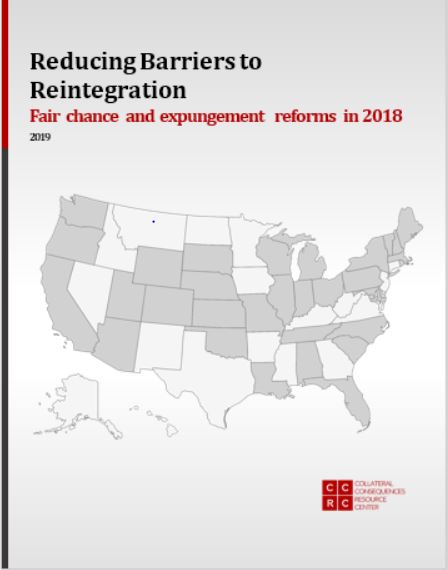
Washington, D.C. — The Collateral Consequences Resource Center (CCRC) has released a new report documenting the extraordinary number of laws passed in 2018 aimed at reducing barriers to successful reintegration for individuals with a criminal record.  In the past twelve months, 32 states, the District of Columbia, and the U.S. Virgin Islands have enacted 61 new laws aimed at avoiding or mitigating the collateral consequences of arrest and conviction, consequences that may otherwise last a lifetime.  The CCRC report analyzes the past year’s lawmaking and summarizes all 61 new authorities, which include 57 statutes, 3 executive orders, and one ballot initiative.  The report, titled “Reducing Barriers to Reintegration: Fair chance and expungement reforms in 2018,” is available to download here

Last year saw the most productive legislative year since a wave of “fair chance” reforms began in 2013.  CCRC documented these earlier developments in reports on the 2013-2016 reforms and 2017 reforms.  In the period 2012–2018, every state legislature has in some way addressed the problem of reintegration.  Congress has not enacted any laws dealing with the problems presented by collateral consequences for more than a decade.

The state laws enacted in 2018 aim to break down legal and other barriers to success in the courts, the workplace, the pardon process, and at the ballot box:

Read more

New edition of collateral consequences treatise now available

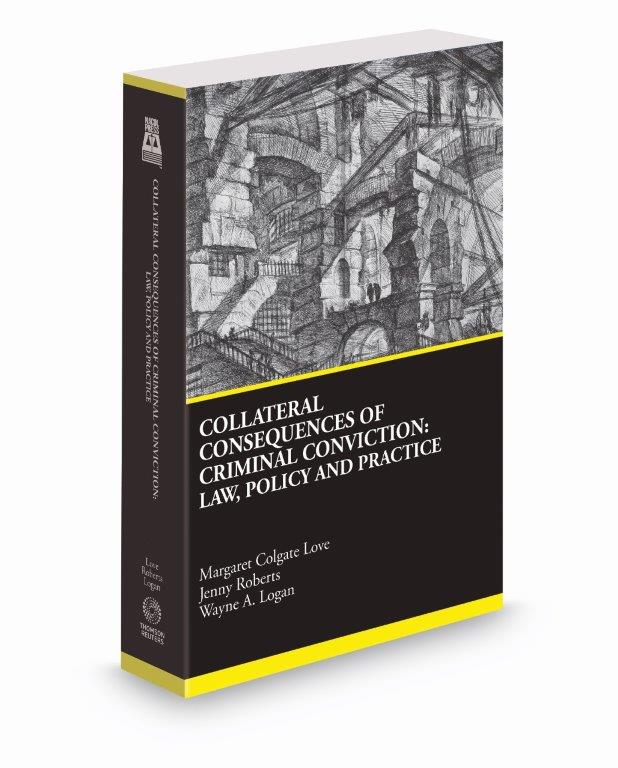
The 2018-2019 edition of the West/NACDL treatise on collateral consequences is now available for purchase, at a publisher’s promotional discount. Wayne A. Logan has joined Margaret Love and Jenny Roberts as a co-author of this comprehensive resource: Collateral Consequences of Criminal Conviction: Law, Policy & Practice.

This third edition of the treatise has been entirely updated, and includes new material on regulation of criminal background checking; consideration of collateral consequences in the criminal case; laws providing for restoration of rights and status, including in employment and occupational licensing; and, recent court decisions on sex offender registration and related penalties.  Appendices include detailed state-by-state analysis of restoration laws, and other primary source materials.  The full table of contents for this 1048-page book is available here. 

The publisher describes the book as follows: 

Today, many millions of Americans have a criminal record of some kind, potentially triggering a vast array of highly burdensome and stigmatizing consequences that can have life-long debilitating effects. This volume provides comprehensive discussion and analysis of these after-effects of the nation’s ongoing “tough on crime” policies, ranging from loss of civil rights and employment opportunities, to registration and residency restrictions.  It serves as a single go-to resource for practicing lawyers, judges, and policymakers as they negotiate the often-complex and sometimes-obscure statutes and regulations that come into play as a result of arrest and conviction.

Highlighted features:

  • Describes specific types of consequences, including firearms dispossession, licensing and contracting bars, travel restrictions, immigration consequences, and sex offender registration
  • Addresses legal and ethical duties of counsel and courts
  • Analyzes constitutional law aspects of collateral consequences
  • Explains varied methods of rights restoration and preservation in different U.S. jurisdictions
  • Covers criminal practice-related issues (charging, negotiating pleas, sentencing, appeals and collateral relief)
  • Addresses access to criminal records and regulation of criminal background checking
  • Discusses current and possible future law reform efforts (ALI/MPC, state initiatives, etc.)

Appendices contain summaries of state and federal laws on restoration of and status, and key documents on law reform proposals.

The book is available for purchase, currently at a discounted price of $186.30 for paperback or e-book (though the discounted rate may not be shown on the West catalogue page).  For the discounted rate, please call the publisher at 800-328-9352, and press “2” to place an order.

The book is also available on-line on Westlaw.  Endorsements from Bryan Stevenson, Jeremy Travis, Judge John Gleeson, and Jo-Ann Wallace can be seen here.


Pardons for immigrants: legal, legitimate, and long overdue

In the past year, California Governor Jerry Brown and New York Governor Andrew Cuomo made generous use of their power to pardon state crimes committed by noncitizens, reinvigorating a much-neglected means by which long-term residents may stave off conviction-based deportation.  The personal stories of the individuals who benefited from the Brown and Cuomo pardons no doubt illustrate how individuals and families can be spared from unjustified hardship through the power to pardon.  But were the governors justified in asserting a role for state interests in tempering federal immigration enforcement policies they evidently regarded as too harsh?  In this post, I will briefly explain the legal and theoretical framework that supports a role for state pardons in the immigration context, and then argue for a more generous use of the pardon power in principled and transparent ways.

Read more

CCRC’s top 10 posts and most popular tweets of 2018

Happy New Year!  Thank you so much for spending time with us this year on our tools, news, and commentary.  In 2018, visitors most frequently utilized the resources in our Restoration of Rights Project: a state-by-state and federal guide to pardons, sealing & expungement, loss & restoration of civil rights and firearms rights, and consideration of criminal records in employment and licensing.  In addition, links to our top 10 posts and most popular tweets from 2018 are below.

We have several projects in store for 2019 to expand our work of promoting public discussion of collateral consequences and restoration of rights and status.  To begin with, we will issue in January 2019 a report on the unprecedented number of new “fair chance” laws enacted in the past year: 29 states and the District of Columbia enacted more than 50 separate new laws, many addressing more than one type of restoration mechanism.  18 states expanded their laws authorizing sealing or expungement, Florida voters acted to restore the vote to more than 1.5 million individuals with felony convictions, and a bipartisan effort to reform how licensing agencies treat people with a criminal record bore fruit in a dozen states.  In addition, in early 2019 we also expect to begin a major research project to determine which kinds of restoration laws are most effective in furthering reintegration.

More to come soon! Read more

Lawsuit challenges PA good-character requirement for cosmetologists

The Institute for Justice has filed a lawsuit on behalf of two women who were denied a license by the Pennsylvania Board of Cosmetology based on their criminal record, because they could not establish the necessary “good moral character.”  The IJ lawsuit illustrates the continuing difficulties faced by people with a past conviction in the workplace even when they are qualified and fully rehabilitated.  At the same time, in recent years Pennsylvania courts have not looked kindly on conviction-based employment bars, and last summer a board appointed by Governor Tom Wolf to review occupational licensing in the state issued a report critical of the good-character requirement in many licensing laws.  So perhaps the tide is turning.   

piece in Forbes by IJ’s Andrew Wimer describes the case of Amanda Spillane, one of the two plaintiffs in the lawsuit:  As a teenager, Amanda started using drugs to self-medicate for mental health issues. Eventually, she turned to burglary to support her habit. She was caught, convicted and spent two years in a state correctional facility.  In prison, she overcame her addiction to drugs and found a new faith. After release, with help from family, she remained clean and worked a fast food job, before deciding to improve her prospects by taking a course to become an esthetician (a cosmetologist who focuses on the face), which required 300 hours of instruction and cost about $6,000.  In applying for a license, Amanda did not expect her past to be an issue; she knew cosmetology was a skill taught to women in prison.  But the Board of Cosmetology informed her that she lacked the requisite “good moral character” for licensure because of her criminal record. When she appealed, a board official “questioned whether her faith was real, demanded proof that Amanda gave regularly to charity, and asked why the people who had provided letters of recommendation had not traveled the two hours to the hearing to testify in person.”  Her appeal was denied.

On December 12, 2018, IJ filed suit on behalf of Amanda and Courtney Haveman—another Pennsylvania woman similarly rejected for a license—challenging the Pennsylvania law that requires applicants for esthetician, nail technician, and natural-hair barber licenses to “be of good moral character.”  Click here to read the complaint.  

Read more