Most states restrict firearm rights too broadly and make restoration difficult, in potential violation of the Second Amendment, according to new report

FOR IMMEDIATE RELEASE
June 5, 2025
Media Contact: Margaret Love
Margaretlove@pardonlaw.com
Loss of firearm rights after a felony conviction extends well beyond what is necessary to advance public safety objectives, according to a study released today by the Collateral Consequences Resource Center. The loss of rights is permanent in most states, and under federal law.
The study shows that each state operates under its own complex legal framework with overlapping federal requirements that create the possibility of further criminal jeopardy for inadvertent violations. Only 13 states limit dispossession to violent crimes, and more than two-thirds of the states offer no route to firearm relief to residents convicted in another state or in federal court. Only 16 states provide a way to regain lost rights that is easily accessible to all state residents.
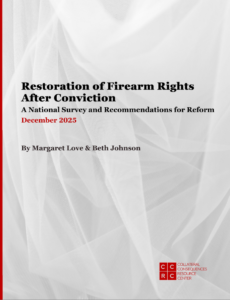
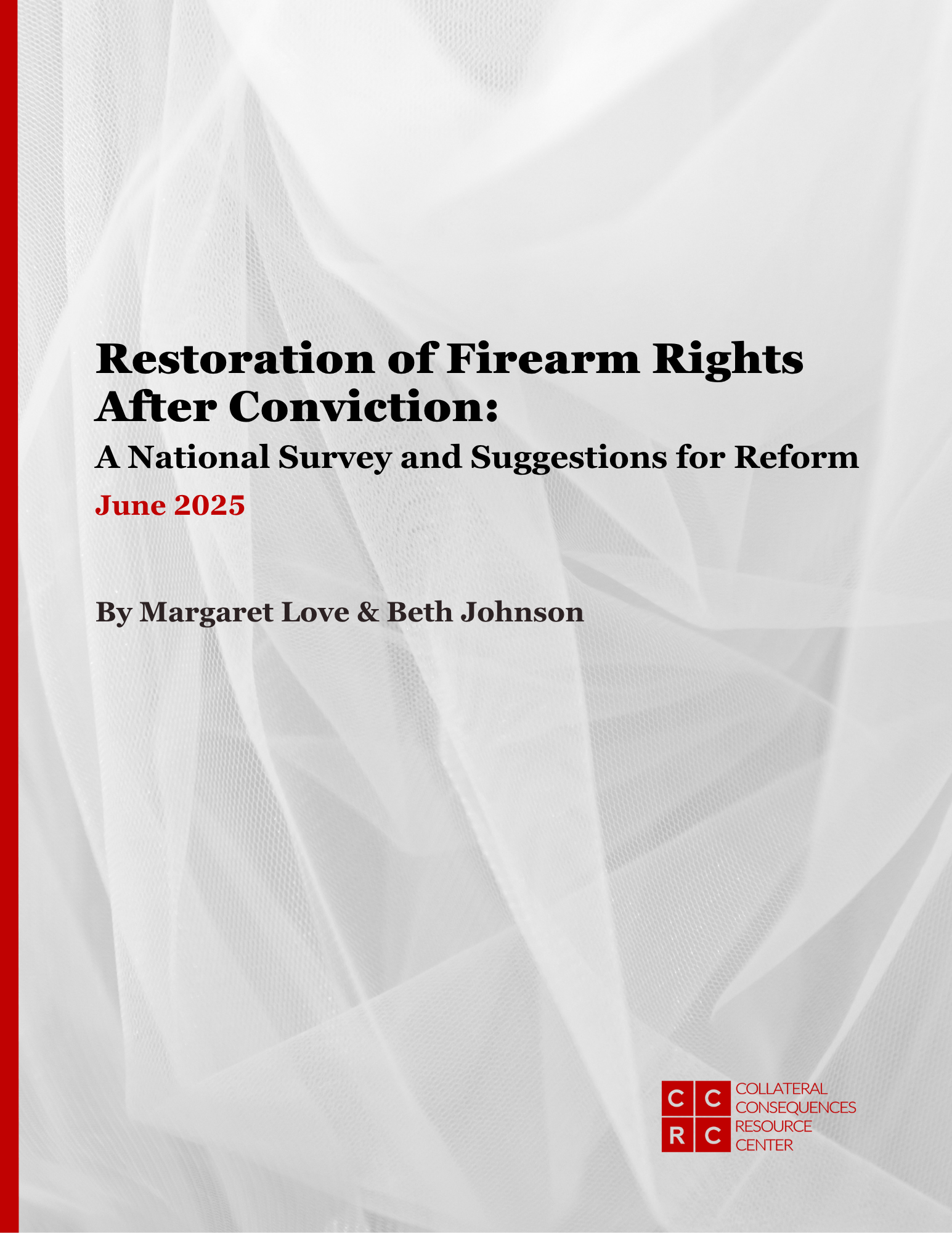
CCRC’s report, Restoration of Firearm Rights After Conviction: A National Survey and Suggestions for Reform, offers a comprehensive and up-to-date picture of the differing ways states restrict and restore the right to possess a firearm, including relevant sections of statutory text to facilitate analysis and comparison. This detailed information on state laws has not been made previously available, and is timely in light of impending changes to federal firearm restoration.
 In almost every state, the process for regaining firearm rights is complex and difficult to navigate. Restoration of federal rights currently depends on restoration under state law, which means that restoration is effectively unavailable to many people, notably including those convicted in federal court whose only remedy is a presidential pardon. It also means that federal firearms restrictions are unevenly applied across the country.
Broad categorical dispossession laws like those in most states are more vulnerable to constitutional challenge under the Second Amendment when there is no individualized assessment of public safety risk, according to Margaret Love, one of the co-authors of the report. “There is no empirical research that would support restricting firearm rights for those convicted of non-violent offenses.”
Love said that “A close look at how firearm rights are restored in states across the country is important because of prospective changes to federal restoration procedures announced in March by the Department of Justice.” She pointed out that “The revival of an alternate way of avoiding federal restrictions means that federal rights will no longer depend on how states restore rights. At the same time, it will leave applicable state restrictions in place, and challenge states to consider whether any analogous state restrictions should remain after federal rights have been restored.”
The change in federal firearm restoration procedures under consideration by the Department of Justice should encourage states to look carefully at restoration provisions in their own laws to determine whether more restrictive state provisions should outlive federal ones. States will also have to consider whether to offer opportunities for restoration of rights to all state residents rather than restricting them to people convicted in their own state courts.
Beth Johnson, the other co-author of the report, said that facilitating relief from felony dispossession has not been a focus of organizations seeking to remove criminal record restrictions on basic needs such as housing, employment, and access to social supports. It has also not been a familiar part of the advocacy program of organizations dedicated to challenging other types of restrictions on firearm possession.
“Gun violence has been too volatile an issue on the national scene to make support for restoring firearm rights to ‘convicted felons’ anything but a political third rail,” Johnson said. “Lost in the debate is what should be common ground: treating people fairly and supporting their reintegration includes restoring, with appropriate safeguards, their full access to housing, jobs, credit, and yes, also firearm rights.”
The report recommends that the federal government should make relief from federal felony dispossession under the proposed new restoration program broadly available to those who present no public safety risk. It also recommends that states should narrow the scope of their felony dispossession laws, and provide a procedure for regaining firearm rights that incorporates a public safety determination and is easily accessible to all residents.
Both of the report’s authors have each spent decades representing people seeking to regain their firearm rights, Love in the Federal system through the presidential pardon process, and Johnson in the State of Illinois through the various relief mechanisms that state provides. “We are convinced that the time is right for a serious and open-minded effort to reform the law applicable to a collateral consequence of conviction that is in many ways unreasonable and unfair,” they said. “We are optimistic that the proposed changes to federal restoration will encourage states to reform their unduly restrictive laws.”
###
ABOUT CCRC
The Collateral Consequences Resource Center is a non-profit organization that researches laws and policies relating to restoration of rights and criminal record relief throughout the country, whose work makes it possible to see national patterns and emerging trends in efforts to mitigate the adverse impact of a criminal record. For more information visit https://ccresourcecenter.org/.