Last week we announced the forthcoming publication of a national report surveying various legal mechanisms for restoring rights and opportunities following arrest or conviction, a revision and updating of our 2020 report “The Many Roads to Reintegration.” The first post in the series (“Expungement, Sealing & Set-Aside of Convictions“), published on February 25, gives some additional background about the report. The second post in this “preview” series (“Fair Chance Employment & Occupational Licensure“) was published on February 26.
Today’s post concerns the role that executive pardon plays in supplementing and in some cases providing the only record relief following conviction. We expect to publish the whole national report, plus our Reintegration Report Card for 2022, later this week.
*******
Executive Pardon: A National Survey
Pardon has been described as the patriarch of restoration mechanisms, whose roots in America are directly traceable to the power of the English crown. Just as a power to pardon was assigned to the president in Article II of the U.S. Constitution, the constitution of every state save two provides for an executive pardoning power.[1] Both in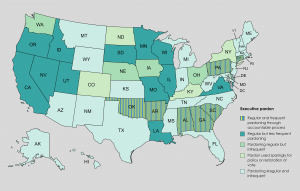 theory and practice, pardon is the ultimate expression of forgiveness and reconciliation from the sovereign that secured the conviction.
For almost two centuries, executive pardon played a routine operational role in criminal justice systems throughout the United States, dispensing with or mitigating court-imposed punishments and, after a sentence had been served, restoring rights and status after conviction.
Nowadays, in many U.S. jurisdictions pardon is a shadow of its once-robust self, particularly in those where it is exercised without institutional restraint or encouragement. Since the 1980s, governors and presidents alike have been wary of exposing themselves to public criticism from an ill-advised grant. In many jurisdictions pardoning has stopped being thought of as part of the chief executive’s job — though being labeled “soft on crime” seems thankfully no longer a political kiss of death. Still, it is not surprising that reformers tend to regard pardon with suspicion, dubious about its legitimate operational role in the modern justice system.
Yet pardon fills significant gaps in record relief schemes across the country, supplementing judicial record relief mechanisms like sealing and expungement. For example, in 20 states pardon offers the only way to regain firearms rights lost because of conviction, including California, Colorado, Florida, Georgia, Nebraska, Oklahoma, and Wyoming. In 11 states ineligibility for jury service is permanent without a pardon, including Arkansas, Delaware, Oklahoma, Pennsylvania, South Carolina, and Texas. (By comparison, expungement restores firearms rights in only five states, and jury rights in only two.[2]) A pardon may be necessary to enable a person to stand for elected office, or to demonstrate the requisite good character to secure a professional or business license.
Read more