We are pleased to publish an update of our 50-state report on how unpaid court debt blocks restoration of voting rights lost as a result of a felony conviction: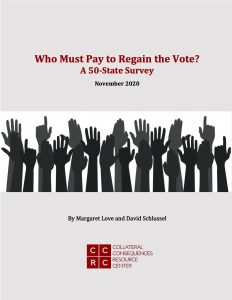
Who Must Pay to Regain the Vote? A 50-State Survey
This report examines the extent to which state reenfranchisement laws consider payment of legal financial obligations (LFOs), including fines, fees, and restitution, in determining whether and when to restore voting rights to people disenfranchised due to a felony conviction. (Our national survey discusses and ranks each state’s general approach to loss and restoration of voting rights based on conviction.)
We first published this research in July 2020 during litigation over Florida’s 2018 voting rights ballot initiative, which many expected would restore voting rights to more than a million people disenfranchised because of a felony conviction. However, the initiative was interpreted by Florida’s legislature and supreme court to condition reenfranchisement on payment of all outstanding fines, fees, costs, and restitution, which drastically limited its anticipated reach. A federal district court found this system unconstitutional, but the U.S. Court of Appeals for the Eleventh Circuit reversed that conclusion in a 6-4 decision.
During the appeal, an amicus brief by the State of Texas, joined by seven other states, asserted that “States across the country have similar rules [to Florida] for felon voting” and that the district court’s holding “called into question the widespread practice” of permanently disenfranchising people who are not able to “pay their debts to society.” As we demonstrated in our original report and amicus brief, the assertions in the Texas brief were not well-founded: few states have laws like Florida’s that indefinitely deny reenfranchisement based on any unpaid debt related to a disqualifying conviction.
This updated report documents whether and to what extent unpaid LFOs restrict voting rights in each state, and reflects developments in California, where voters early this month passed a constitutional amendment to restore voting rights to those on parole; and in Iowa, where the governor in August issued an executive order to restore voting rights after completion of incarceration and supervision, regardless of payment of LFOs.
(more…)
Read more