


Positive Credentials That Limit Risk: A Report on Certificates of Relief (June 2024)
Advancing Second Chances: Clean Slate and Other Record Reforms in 2023 (Jan. 2024)
Accessing SNAP and TANF Benefits after a Drug Conviction: A Survey of State Laws (Dec. 2023)
The Frontiers of Dignity:
Clean Slate and Other Criminal Record Reforms in 2022 (Jan. 2023)
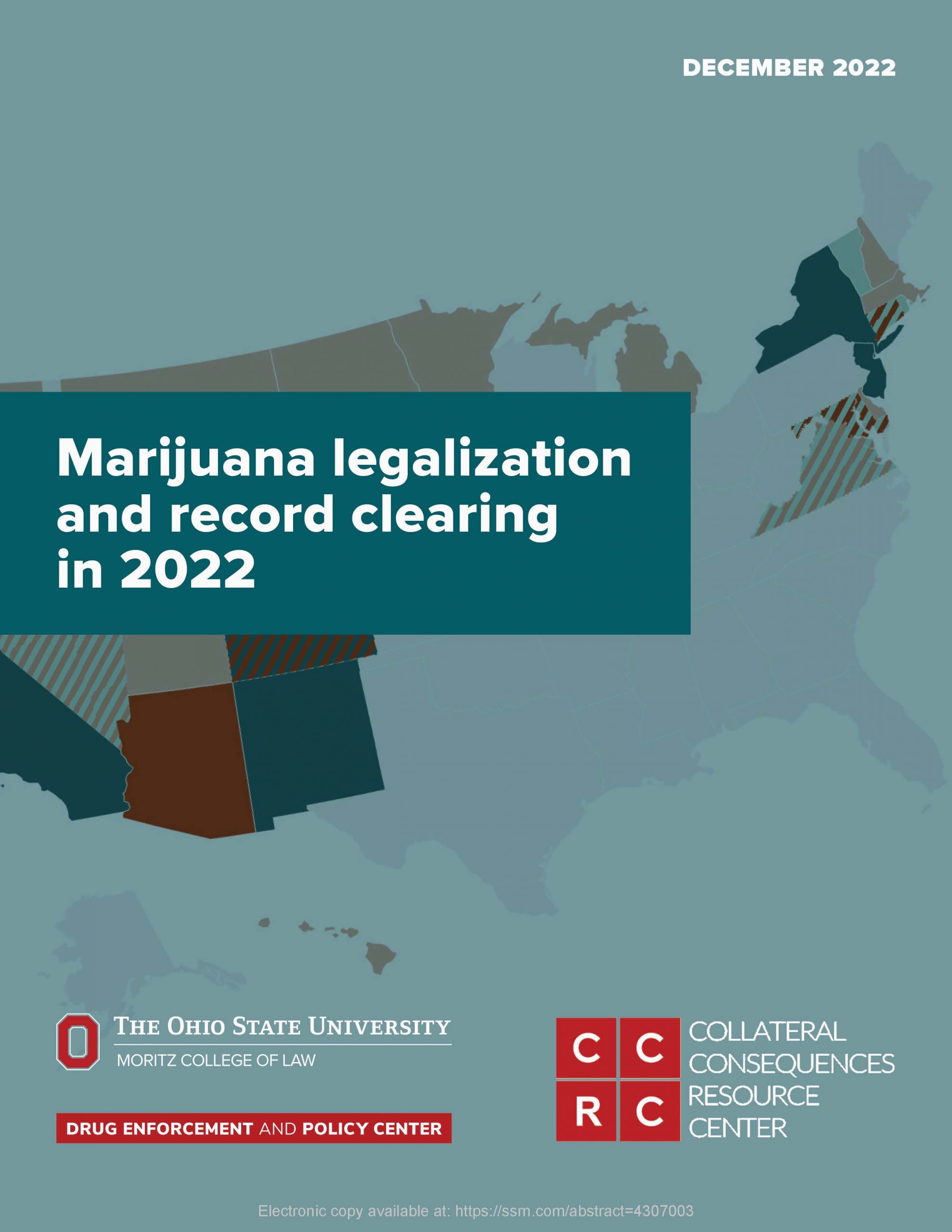
Marijuana legalization and record clearing in 2022 (Dec. 2022)
The Reintegration Report Card (March 2022)
Waiting for Relief:
A National Survey of Waiting Periods for Record Clearing (Feb. 2022)
From Reentry to Reintegration:
Criminal Record Reforms in 2021 (Jan. 2022)
Access Barriers to Felony Expungement in Utah
(July 2021)

Access Barriers to Felony Expungement: The Case of Illinois (Feb. 2021)
The Reintegration Agenda During Pandemic:
Criminal Record Reforms in 2020 (Jan. 2021)
Who Must Pay to Regain the Vote?
A 50-State Survey (Nov. 2020)
The Reintegration Report Card
Grading the States on Laws Restoring Rights and Opportunities After Arrest or Conviction (Oct. 2020)
Pathways to Reintegration
Criminal Record Reforms in 2019 (Feb. 2020)
Model Law on Non-Conviction Records
(Dec. 2019)
Reducing Barriers to Reintegration
(Dec. 2019)
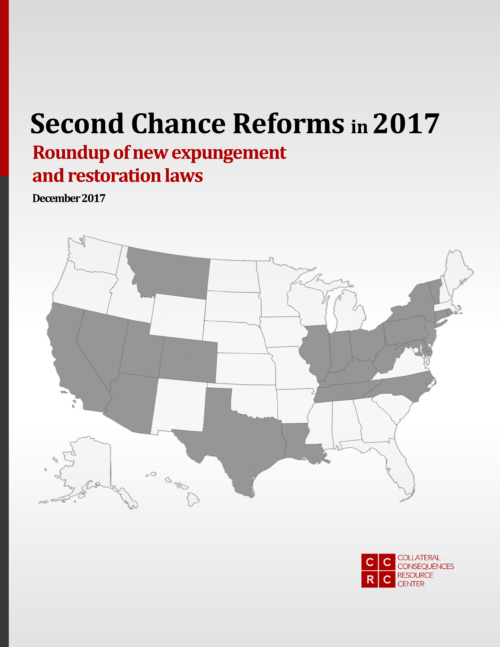
Second Chance Reforms in 2017
Roundup of new expungement and restoration laws
Other reports
Ban the Box: U.S. Cities, Counties, and States Adopt Fair Hiring Policies
Continuously updated report by the National Employment Law Project
Out of Prison & Out of Work: Unemployment among formerly incarcerated people
2018 report by Lucius Couloute & Daniel Kopf, Prison Policy Initiative
Nowhere to Go: Homelessness among formerly incarcerated people
2018 report by Lucius Couloute, Prison Policy Initiative
Getting Back on Course: Educational attainment and exclusion among formerly incarcerated people
2018 report by Lucius Couloute, Prison Policy Initiative
Repairing the Road to Redemption in California
2018 report by Californians for Safety and Justice
Does a Criminal Past Predict Worker Performance? Evidence from One of America’s Largest Employers
2017 report by the U.S. Government Accountability Office
Criminal Background Checks and Access to Jobs: A Case Study of Washington, DC
2017 report by the Urban Institute
Criminal Background Checks: Impact on Employment and Recidivism
2017 report by the Urban Institute
Back to Business: How Hiring Formerly Incarcerated Job Seekers Benefits Your Company
2017 report by the American Civil Liberties Union
Ban the Box and Racial Discrimination: A Review of the Evidence and Policy Recommendations
2017 report by the Urban Institute
Fair Chance Licensing Reform: Opening Pathways for People with Records to Join Licensed Professions
2017 report by the National Employment Law Project
Collateral Consequences: Protecting Public Safety or Encouraging Recidivism?
2017 report by the Heritage Foundation
2016 report by Stephen Slivinski, Center for the Study of Economic Liberty at Arizona State University
2016 report by the Joshua Aiken, Prison Policy Initiative
2016 report by National H.I.R.E. Network
2016 report by the Center for Economic and Policy Research
Putting Time Limits on the Punitiveness of the Criminal Justice System
2016 policy memo by Anne Morrison Piehl of The Hamilton Project
Disenfranchised by Debt: Millions Impoverished by Prison, Blocked from Voting
2016 report by Alliance for a Just Society
6 Million Lost Voters: State-Level Estimates of Felony Disenfranchisement, 2016
2016 report by the Sentencing Project
Racial Profiling in Hiring: A Critique of New “Ban the Box” Studies
2016 policy brief by the National Employment Law Project
Ensuring Fairness in Background Checks for On-Demand Work
2016 policy brief by the National Employment Law Project
Justice in Review: New Trends in State Sentencing and Corrections 2014 – 2015
2016 report by the Vera Institute of Justice discussing collateral consequence relief mechanisms.
Beyond the Box: Increasing Access to Higher Education for Justice-Involved Individuals
2016 report by the U.S. Department of Education
2016 report by the National Employment Law Project
Future Interrupted: The Collateral Damage Caused by Proliferation of Juvenile Records
2016 report by the Juvenile Law Center
Jobs After Jail: Ending the prison to poverty pipeline
2016 report by the Alliance for a Just Society
2015 report by the Center for American Progress
Boxed Out: Criminal History Screening and College Application Attrition
2015 report by the Center for Community Alternatives in cooperation with the Education from the Inside Out Coalition
The State of Sentencing 2014: Developments in Policy and Practice
2015 report by The Sentencing Project
2015 report by the National Employment Law Project (NELP)
National Summit on Collateral Consequences – Conference Report
2015 report by the ABA Criminal Justice Section
Report of House Judiciary Committee hearing on collateral consequences
U.S. House of Representatives Committee on the Judiciary, Over-Criminalization Task Force (2014)
2014 report of the National Association of Criminal Defense Lawyers
2014 report by Rebecca Vallas and Sharon Dietrich published by the Center for American Progress
Relief in Sight? States Rethink the Collateral Consequences of Criminal Conviction, 2009 – 2014
2014 report by The Vera Institute of Justice
Failed Policies, Forfeited Futures: A Nationwide Scorecard on Juvenile Records
2014 report on expungement and confidentiality from the Juvenile Law Center
Juvenile Records: A National Review of State Laws on Confidentiality, Sealing, and Expungement
2014 report from the Juvenile Law Center
2013 report by Human Rights Watch
65 Million “Need Not Apply”: The Case for Reforming Criminal Background Checks for Employment
2011 report by Michelle Natividad Rodriguez & Maurice Emsellem, National Employment Law Project
The Use of Criminal Records in College Admissions Reconsidered
2010 report of the Center for Community Alternatives
Second Chances in the Criminal Justice System: Alternatives to Incarceration and Reentry Strategies
2008 report by the ABA Commission on Effective Criminal Sanctions
NO SECOND CHANCE: People with Criminal Records Denied Access to Public Housing
2004 report by Corinne Carey for Human Rights Watch
>> See also Compilations & inventories of collateral consequences <<
Related blog posts:
- Update on federal firearms restoration program (11/4/2025) - Last spring, the Department of Justice (DOJ) announced its intention to revive a long-dormant program to remove federal restrictions on firearm possession, including for those with a criminal record. In July DOJ published for comment a proposed rule that would, when finalized, accomplish this for people who are determined to pose no public safety risk. See 18 U.S.C. § 925(c). See Trump's Justice Department aims to restore gun rights for nonviolent offenders. The comment period closed on October 20, and it is therefore possible that a final rule will be published at any time to launch the revived program. This will open the door, for the first time in more than 30 years, to many individuals who have been unable to regain their firearm rights because of their criminal record. It is anticipated that thousands of people will want to apply for this relief, which will be administered by the Justice Department's Office of the Pardon Attorney. We have some concerns about whether the demanding § 925(c) application process described in the proposed rule will deliver on its promise. For example, the document production requirements may be challenging for many people, especially those with dated minor convictions. See proposed 28 CFR § 107.1(d). Hopefully, the final rule will facilitate application rather than discourage it for those unable to hire counsel. At a minimum, the revived § 925(c) process will provide an alternative to presidential pardon for people dispossessed because of a federal conviction. But relief under § 925(c) affects only restrictions on firearm possession arising under federal law, and will not affect analogous restrictions in the laws of most states. As a result, individuals who benefit from the federal restoration program will need to determine what their rights are under state law. In all likelihood, states will also want to determine whether restrictions in their own laws should conform to or outlive federal ones. While the new federal restoration program may be good news for people who can successfully navigate it, the not-so-good news is that many of these same people (including those with federal convictions) will remain frustrated by restrictive state laws that permanently prohibit their possession of any firearm without regard to public safety risk. In June of 2025, CCRC published a report on state law firearm restrictions that will inform these determinations. CCRC’s report, Restoration of Firearm Rights After Conviction: A National Survey and Suggestions for Reform, offers a comprehensive picture of the differing ways states restrict and restore the right to possess a firearm for those dispossessed because of a criminal record, including relevant sections of statutory text to facilitate analysis and comparison. CCRC's report concluded that most states restrict firearm rights too broadly and make restoration difficult, in potential violation of the Second Amendment. Our report found that only 13 states limit dispossession to violent crimes, and 34 states offer no route to firearm relief to residents convicted in another state or in federal court. Sixteen (16) states make pardon the exclusive way to regain state firearm rights, and not all of those states offer pardon as a reliable remedy. Even in those states where pardoning is frequent and regular, those with out of state or federal convictions may be out of luck (unless the state gives effect to pardons issued by other jurisdictions). Our research revealed that only 16 states provide a way to regain lost rights that is easily accessible to all state residents wherever they were convicted, usually from an administrative agency or a court in the county of their residence. That is the kind of relief system we recommend. We are in the process of updating our report on state firearms dispossession laws to reflect new enactments in a dozen states since June, and we expect to republish it before Thanksgiving. NOTE: One interesting additional development since June is that the Supreme Court has agreed to hear a case that could add to our understanding of how the Second Amendment applies to federal firearm restrictions. The case, United States v. Hemani, involves the federal prosecution of a Texas man for violating the prohibition on gun possession by anyone who is "an unlawful user of" any controlled substance. 18 U.S.C. § 922(g)(3). The district court found § 922(g)(3) unconstitutional as applied to Mr. Hemani, and the court of appeals agreed. The Justice Department has urged the Supreme Court to find § 922(g)(3) constitutional as analogous to Founding Era gun laws applicable to "habitual drunkards," despite the absence of any record facts to support such a finding in Mr. Hemani's case. It has also argued that the impending revival of the § 925(c) relief program obviates any constitutional problem with this provision, which the proposed regulation explains applies only to those currently using drugs in violation of the law. The Court's willingness to hear the case suggests an openness to curbing aggressive federal firearm prosecution policies in cases implicating the Second Amendment.
- New report: Most states restrict firearm rights too broadly and make restoration difficult (6/6/2025) - Most states restrict firearm rights too broadly and make restoration difficult, in potential violation of the Second Amendment, according to new report FOR IMMEDIATE RELEASE June 5, 2025 Media Contact: Margaret Love Margaretlove@pardonlaw.com Loss of firearm rights after a felony conviction extends well beyond what is necessary to advance public safety objectives, according to a study released today by the Collateral Consequences Resource Center. The loss of rights is permanent in most states, and under federal law. The study shows that each state operates under its own complex legal framework with overlapping federal requirements that create the possibility of further criminal jeopardy for inadvertent violations. Only 13 states limit dispossession to violent crimes, and more than two-thirds of the states offer no route to firearm relief to residents convicted in another state or in federal court. Only 16 states provide a way to regain lost rights that is easily accessible to all state residents. CCRC’s report, Restoration of Firearm Rights After Conviction: A National Survey and Suggestions for Reform, offers a comprehensive and up-to-date picture of the differing ways states restrict and restore the right to possess a firearm, including relevant sections of statutory text to facilitate analysis and comparison. This detailed information on state laws has not been made previously available, and is timely in light of impending changes to federal firearm restoration. In almost every state, the process for regaining firearm rights is complex and difficult to navigate. Restoration of federal rights currently depends on restoration under state law, which means that restoration is effectively unavailable to many people, notably including those convicted in federal court whose only remedy is a presidential pardon. It also means that federal firearms restrictions are unevenly applied across the country. Broad categorical dispossession laws like those in most states are more vulnerable to constitutional challenge under the Second Amendment when there is no individualized assessment of public safety risk, according to Margaret Love, one of the co-authors of the report. "There is no empirical research that would support restricting firearm rights for those convicted of non-violent offenses." Love said that “A close look at how firearm rights are restored in states across the country is important because of prospective changes to federal restoration procedures announced in March by the Department of Justice.” She pointed out that “The revival of an alternate way of avoiding federal restrictions means that federal rights will no longer depend on how states restore rights. At the same time, it will leave applicable state restrictions in place, and challenge states to consider whether any analogous state restrictions should remain after federal rights have been restored.” The change in federal firearm restoration procedures under consideration by the Department of Justice should encourage states to look carefully at restoration provisions in their own laws to determine whether more restrictive state provisions should outlive federal ones. States will also have to consider whether to offer opportunities for restoration of rights to all state residents rather than restricting them to people convicted in their own state courts. Beth Johnson, the other co-author of the report, said that facilitating relief from felony dispossession has not been a focus of organizations seeking to remove criminal record restrictions on basic needs such as housing, employment, and access to social supports. It has also not been a familiar part of the advocacy program of organizations dedicated to challenging other types of restrictions on firearm possession. “Gun violence has been too volatile an issue on the national scene to make support for restoring firearm rights to ‘convicted felons’ anything but a political third rail,” Johnson said. "Lost in the debate is what should be common ground: treating people fairly and supporting their reintegration includes restoring, with appropriate safeguards, their full access to housing, jobs, credit, and yes, also firearm rights." The report recommends that the federal government should make relief from federal felony dispossession under the proposed new restoration program broadly available to those who present no public safety risk. It also recommends that states should narrow the scope of their felony dispossession laws, and provide a procedure for regaining firearm rights that incorporates a public safety determination and is easily accessible to all residents. Both of the report’s authors have each spent decades representing people seeking to regain their firearm rights, Love in the Federal system through the presidential pardon process, and Johnson in the State of Illinois through the various relief mechanisms that state provides. “We are convinced that the time is right for a serious and open-minded effort to reform the law applicable to a collateral consequence of conviction that is in many ways unreasonable and unfair,” they said. “We are optimistic that the proposed changes to federal restoration will encourage states to reform their unduly restrictive laws.” ### ABOUT CCRC The Collateral Consequences Resource Center is a non-profit organization that researches laws and policies relating to restoration of rights and criminal record relief throughout the country, whose work makes it possible to see national patterns and emerging trends in efforts to mitigate the adverse impact of a criminal record. For more information visit https://ccresourcecenter.org/.
- “Positive Credentials That Limit Risk: A Report on Certificates of Relief” (6/27/2024) - We are pleased to present a new report dealing with "certificates of relief," a form of relief from the collateral consequences of conviction that is less far-reaching than record clearing but potentially available to more people at an earlier point in time. These certificates, offered by a court or correctional agency, do not limit public access to a person’s record but are effective in reducing many record-related disadvantages in the workplace, including by providing employers and others with protection against the risk of being sued for negligence. Positive Credentials That Limit Risk: A Report on Certificates of Relief makes the case that, at least as long as expungement and sealing remain unavailable to many people with a felony conviction record, or are available only after lengthy waiting periods, certificates of relief can provide an important addition to a state’s reentry scheme, and serve as a bridge to more thorough forms of record relief like expungement or pardon. At the same time, in a promising development, certificates are beginning to be widely used by prison and parole agencies to encourage employment opportunities and otherwise facilitate reentry for those exiting prison or completing supervision. Given the perceived limits of record clearing as a comprehensive reentry strategy, social science researchers have become interested in studying the effect of laws that aim to increase the positive information about individuals with a criminal record to counter the negative effect of the record itself. This report is intended to support these research efforts by describing the state of the law relating to certificates of relief in the 21 states that now offer them, and by suggesting directions of further research. A follow-up study will look at pardons. We hope that this report will stimulate public interest in a type of relief that has been neglected in recent years as background screening has become widespread, and suggest ways to make it more widely appreciated and available. Our goal is to encourage a view of certificates and expungement as complementary parts of a single structured system of serially available criminal record relief. As state certificate programs are referenced in the body of this report, readers may want to refer to the comparison charts and state-by-state summaries of the law included in the Appendices. Certificates can be put into the broader context of a state’s other record relief mechanisms in the state profiles from CCRC’s Restoration of Rights Project.
- Oklahoma and California win Reintegration Champion awards for 2022 laws (1/17/2023) - On January 10 we posted our annual report on new laws enacted in 2022 to restore rights and opportunities to people with a record of arrest or conviction. Like our earlier reports, it documents the steady progress of what we characterized two years ago as “a full-fledged law reform movement” aimed at restoring rights and dignity to individuals who have successfully navigated the criminal law system. This year’s criminal record reforms bring the total number of separate laws enacted in the past five years to more than 500. Posted below is our fourth annual legislative Report Card recognizing the most productive states in 2022. Reintegration Awards for 2022 While more than a handful of states enacted noteworthy laws in 2022, two states stand out for the quantity and quality of their legislation: California and Oklahoma share our 2022 Reintegration Champion award for their passage of at least two major pieces of record reform legislation. California – Enacted a whopping 11 new laws, including the broadest general record clearing law in the nation, a direction to courts to effectuate clearing of marijuana records, removal of restitution as a bar to clearing criminal records, easing access to judicial certificates of rehabilitation, and simplification of the process for certifying people with criminal records to work in community care. California’s governor also vetoed a bill that would have facilitated background screening by eliminating court-imposed restrictions on online access to personal identifying information. Oklahoma – Enacted a major automatic record clearing law and the most sweeping update to an occupational licensing scheme of any state in the country this year. Oklahoma also passed a significant law allowing young people who successfully complete the state’s youthful offender program to have their charges dismissed and expunged. Another eight states earned an Honorable Mention for their enactment of at least one significant new record reform law: Colorado – Expanded automatic sealing to include all offenses eligible for petition-based sealing, reduced the waiting period for low-level drug possession from three years to two, and enhanced procedural rights of those applying for occupational licenses. Connecticut – Made it easier for people with felony convictions to work in dozens of occupations under the state department of public health and authorized a binding preliminary determination. Delaware – Enacted the “Fair Chance Licensing Act,” establishing a binding preliminary application process, providing that many records may not be grounds for denial (convictions over 10 years old with no intervening convictions; pardoned, sealed, or expunged convictions; non-conviction records; and juvenile adjudications). Even “substantially related” crimes must be given an opportunity for a waiver via a board vote. Delaware also authorized automatic expungement of records of charges lacking a final disposition and prohibited higher education institutions from inquiring into an applicant's criminal history. Indiana – Eliminated the one-year waiting period for sealing non-conviction records, including uncharged arrests, and made this relief automatic. Louisiana – Strengthened and extended its occupational licensing law, by establishing a binding preliminary determination, providing for appeal, bringing many new boards under its general licensing limits, and adopting new factors to be considered in determining “direct relationship.” The state also provided unusually broad record relief for victims of human trafficking. Maryland – Legalized the personal use of up to 1.5 ounces of cannabis for adults 21 and older, authorized resentencing and expungement of marijuana conviction records and established a business assistance fund that prioritizes individuals with cannabis convictions. Maryland also enacted a law removing state authority over the delinquency of children aged 13 and under. Missouri – Missouri voters amended the state constitution to legalize personal use of marijuana, and at the same time authorized release from prison for those serving prison sentences for marijuana trafficking, provided for automatic expungement for numerous marijuana convictions upon completion of sentence, and extended preference in commercial licensure to sell legalized marijuana to those with convictions. In addition, Governor Mike Parson has become the most prolific pardoner in the state in more than 40 years, working efficiently to reduce a case backlog built up over many years. Rhode Island – Legalized adult possession of small amounts of marijuana, provided for automatic expungement of convictions for decriminalized marijuana offenses, and waived costs as a bar to expungement for anyone who has been incarcerated for a marijuana offense. Low marks go to two states that enacted no record reform laws at all in 2022. While there are many other states in this category this year, the legislatures of Alaska and Wisconsin earn their place at the bottom of the heap for having been equally unproductive in 2021, 2020 and 2019, years in which almost every other state passed at least some law limiting access to and use of criminal records. Wisconsin’s one saving grace is the extensive record of pardoning by Governor Tony Evers in the past 30 months, during which he has pardoned more than 600 individuals, 325 in 2022 alone. Looking ahead to 2023, we expect to see a continuing expansion of eligibility for record clearing, and reduction of access barriers like lengthy waiting periods, outstanding court debt and application-related costs. We also predict efforts to improve records management to accommodate automation of record clearance. We look for extension of state fair employment laws, and further facilitation of occupational licensing, both areas where bipartisan reforms have benefitted from helpful model laws. We are slightly less optimistic about additional progress toward dismantling the structure of felony disenfranchisement, which has become mired in faction looking toward the presidential race in 2024. Hopefully, 2023 will see some record reform action in Congress and federal agencies, including measures to extend access to government-guaranteed loans and contracting opportunities to small businesses owned or managed by people with a criminal history. We have come a long way just in the past five years, but there is still a long way to go.
- The Frontiers of Dignity: Clean Slate and Other Criminal Record Reforms in 2022 (1/10/2023) - At the beginning of each year since 2017, CCRC has issued a report on legislative enactments in the year just ended, new laws aimed at reducing the barriers faced by people with a criminal record in the workplace, at the ballot box, and in many other areas of daily life. These annual reports document the steady progress of what our report two years ago characterized as “a full-fledged law reform movement” aimed at restoring rights and dignity to individuals who have successfully navigated the criminal law system. In the three years between 2019 and 2021, more than 400 new criminal record reforms were enacted. Many states enacted new laws every year, and all but two states enacted at least one significant new law during this period. The modern record reform movement reflected in our annual reports is bipartisan, grounded in and inspired by the circumstance that almost a third of adults in the United States now have a criminal record, entangling them in a web of legal restrictions and discrimination that permanently excludes then from full participation in the community. It reflects a public recognition that the “internal exile” of such a significant portion of society is not only unsafe and unfair, but it is also profoundly inefficient. We are pleased to present our report on new laws enacted in 2022, titled The Frontiers of Dignity: Clean Slate and Other Criminal Record Reforms in 2022. While this report shows that the legislative momentum gathering since 2018 slowed somewhat in the past year, there has still been progress, with more new laws enacted this year than in 2018 when the current reform movement took off in earnest. The title of this report is borrowed from the Basic Law adopted by the Federal Republic of Germany after World War II, which declared that “Human dignity shall be inviolable. To respect and protect it shall be the duty of state authority.” Most European countries incorporate this foundational premise, as well as a concern for individual privacy, into their treatment of criminal records, by making them largely unavailable to the public and by limiting how they are used to deny rights and opportunities. In part because American legal systems are not similarly grounded in respect for dignity and privacy, our progress toward a fair and efficient criminal records policy has been slow and uneven. Yet it has been steady, animated in recent years both by a concern for racial justice and by economic self-interest. This report, like our past annual reports, attempts to capture this steady progress toward recognizing the worth and dignity of the millions of Americans whose past includes a record of arrest or conviction. Report Overview This overview highlights key developments in reintegration reforms from the past year. Following it, our fourth annual legislative Report Card recognizes the most productive legislatures in 2022, and notes that there are now only two states have enacted no record reforms since our reporting began in 2016. The body of the report provides topical discussions of last year’s reform measures, followed by an appendix documenting and summarizing the new laws by jurisdiction. More detailed analysis of each state’s laws is available in the state profiles from CCRC’s Restoration of Rights Project, and a national overview is presented in our 50-state comparison charts on various types of record relief. In 2022, 33 states, the District of Columbia, and the federal government enacted 71 separate pieces of legislation, passed two ballot initiatives, and took unprecedented executive actions to restore rights and opportunities to people with an arrest or conviction history. As in past years, more than half of the new authorities involved individual record clearing: 22 states and the federal government enacted 37 measures and took six executive actions that revise, supplement or limit public access to individual criminal records to reduce or eliminate barriers to opportunity. Because of the significant progress on this front in recent years, most of the laws enacted in 2022 represent measured changes to existing record relief schemes rather than radical new reforms. At the same time, three states significantly expanded automatic “clean slate” record relief, a handful of states continued to remove marijuana convictions from public view, and other states trimmed barriers to relief by reducing waiting periods or eliminating obstacles to relief represented by outstanding court debt (fines and fees). Executive actions also continued the momentum, particularly with actions to relieve the consequences of past marijuana convictions. In addition, many of the new laws limited consideration of criminal record in economic settings: 20 states and the federal government enacted 24 new measures regulating employment and occupational licensing, while two more states removed barriers to restoring a driver’s license. A few states made significant improvements in their occupational licensing laws by enacting binding preliminary applications for licensure, and by limiting the types of records that licensing agencies may consider. Arizona is the only state whose legislature took steps this past year to restore civil rights to those with felony convictions, although governors in Missouri, Virginia and Wisconsin used their pardon power to restore civil rights in unprecedented ways. As in the past, the state legislatures that have enacted the most significant reforms span the political spectrum, from California and Maryland to Oklahoma and Utah. The report highlights the renewed interest in executive pardons by both Republican and Democratic governors, notably in Missouri (where large case backlogs invited energetic executive attention), in Wisconsin (where the pardon power had been shelved for almost a decade), and in Oregon (where 45,000 individuals benefitted from pardons in response to marijuana legalization). Overall, while there were fewer record reforms in 2022 than in the three preceding years, it would be a mistake to see this as a flagging of the reform wave we’ve identified in previous reports. In fact, the productivity of state legislatures in 2022 mirrors their performance in 2018, itself a year that broke every record. If 2022 marked a return to pre-2019 productivity levels, several states making significant strides toward restoring rights and clearing records, and many others built on and extended reforms enacted in earlier years. This year’s criminal record reforms bring the total number of separate laws enacted in the past five years to more than 500. Looking ahead to 2023, we expect to see a continuing expansion of eligibility for record clearing, and reduction of access barriers like lengthy waiting periods, outstanding court debt and application-related costs. We also predict efforts to improve records management to accommodate automation of record clearance. We look for extension of state fair employment laws, and further facilitation of occupational licensing, both areas where bipartisan reforms have benefitted from helpful model laws. We are slightly less optimistic about additional progress toward dismantling the structure of felony disenfranchisement, which has become mired in faction looking toward the presidential race in 2024. Hopefully, 2023 will see some record reform action in Congress and federal agencies, including measures to extend access to government-guaranteed loans and contracting opportunities to small businesses owned or managed by people with a criminal history. We have come a long way just in the past five years, but there is still a long way to go.
- Marijuana legalization and record clearing in 2022 (12/20/2022) - CCRC is pleased to announce a new report on recent cannabis-specific record sealing and expungement reforms in the past 18 months. The report, extending CCRC's fruitful collaboration with the Drug Enforcement and Policy Center at The Ohio State University, is available here. An accompanying infographic (reproduced at the end of this postr) summarizes the report’s findings, and includes a color-coded US map showing which states have enacted cannabis-specific record-clearing provisions. To supplement the map, the report includes an appendix classifying and describing marijuana-specific record clearing statutes in all 50 states, based on CCRC's 50-state comparison chart on "Marijuana Legalization, Decriminalization, Expungement and Clemency." To put our new report in context, CCRC and DEPC reported 18 months ago on an “unprecedented period for policymaking at the intersection of marijuana legalization and criminal record reform in the first months of 2021,” with four states (New Jersey, New Mexico, New York, and Virginia) legalizing marijuana possession and at the same time providing criminal record relief for past convictions along with a variety of social equity provisions. Our report shows this trend continuing into 2022. Since our 2021 report, four additional states (Connecticut, Maryland, Missouri, and Rhode Island) have adopted similar record-clearing provisions in connection with adult-use cannabis legalization, authorizing sealing and expungement provisions that in most cases extend well beyond convictions for legalized conduct. All four states made at least some relief automatic, removing the burden of a criminal record from many individuals while raising the bar on standards for marijuana record relief nationwide. Like the four states discussed in our earlier report, these four also address racial disparities in marijuana criminalization by directing tax revenue and business opportunities for legal marijuana to individuals and communities disproportionately affected by criminal law enforcement. During this same timeframe, three additional states (California, Colorado, and Massachusetts) enhanced their existing marijuana-specific record sealing statutes. The report summarizes the cannabis-specific record clearing provisions enacted since publication of our earlier report in the spring of 2021 in California, Colorado, Connecticut, Maryland, Massachusetts, Missouri and Rhode Island. Missouri's record-clearing provisions, adopted through a ballot initiative and effective immediately, are particularly impressive: individuals currently incarcerated for possession of up to three pounds of marijuana may petition for release and expungement (with certain offenses excepted), most individuals currently under supervision are automatically released from their sentence and their record expunged, and individuals convicted of all marijuana-related misdemeanors and most felonies have their records automatically expunged upon completion of sentence. See Section III(C) of the Missouri profile from the Restoration of Rights Project for additional information about this extraordinary ballot initiative. As in the 2021 report, we include laws authorizing marijuana-specific automatic record clearing provisions that are not scheduled to be implemented until some future date, with an appropriate notation. We focus exclusively on authorities that specifically expunge or seal marijuana convictions, and do not take into consideration more general record clearing laws that may also apply to marijuana convictions (frequently more broadly). Additional information about state record relief laws, including those that apply specifically to marijuana records, can be found in the state profiles in the Restoration of Rights Project. In addition to the 50-state overview of marijuana-specific record clearing provisions, the appendix also includes a summary of the marijuana-specific pardon initiatives undertaken by several states in recent years. Read the report Explore the infographic (click to enlarge)
- “The Many Roads From Reentry to Reintegration” (3/3/2022) - We are pleased to publish the March 2022 revision of our national survey of laws restoring rights and opportunities after arrest or conviction, "The Many Roads from Reentry to Reintegration." Like the earlier report, this report contains a series of essays on various relief mechanisms operating in the states, including legislative restoration of voting and firearms rights, various types of criminal record relief (expungement and sealing, pardon, judicial certificates), and laws limiting consideration of criminal record in fair employment and occupational licensing. Drawing on material from CCRC’s flagship resource the Restoration of Rights Project, the report grades each state for the scope and efficacy of its laws in nine different relief categories. Based on these grades, it compiles an overall ranking of the states. As described below, most of the states identified as reform leaders in our 2020 report still rank highly, but several new states have joined them. Half a dozen other states made substantial improvements in their ranking by virtue of progressive legislation enacted in 2020 and 2021, in two cases (D.C. and Virginia) rising from the bottom ten to the top 20. The legal landscape has been changing rapidly in the 18 months since the first edition of this report was published in September 2020. Substantial progress has been made in a number of states, and in the Nation as a whole, toward devising and implementing an effective and functional system for relieving collateral consequences. The bipartisan public commitment to a reintegration agenda seems more than ever grounded in economic imperatives, as pandemic dislocations have brought home the need to support, train, and recruit workers, who are essential to rebuilding the small businesses that are the lifeblood of healthy communities. The greatest headway has been made in restoring the vote and broadening workplace opportunities controlled by the state, both areas where there are national models and best practices. The area where there is least consensus, and that remains most challenging to reform advocates, is managing dissemination of criminal record information. Time will tell how the goal of a workable and effective criminal record relief system is achieved in our laboratories of democracy. One area of record relief on which there does appear to be an emerging bipartisan consensus is that non-conviction records should be automatically sealed or expunged on case disposition. We are particularly pleased to see how many states have enacted laws limiting access to the record of cases disposed in favor of the defendant just since publication of our Model Law on Non-Conviction Records in 2019. But despite so much encouraging progress, there is still a long way to go before people with a record are treated fairly in getting a job and supporting a family, securing a place to live, and participating fully in civic affairs. A recent federal agency report noted how the criminal justice system conspires at every step to exacerbate the financially precarious situation in which many entering that system already find themselves.[1] Another recent report, which CCRC co-authored, shows how the "high cost of a fresh start" extends to many if not most of the record relief mechanisms now available.[2] The two sections below describe the contents of the report in greater detail, and explain how we graded and ranked the states. Contents of the Report Gabriel Chin's introduction to the report outlines the features of a functional relief system, and urges "objective time limits on dissemination of criminal justice information, just as there are in other countries with which we compare ourselves." He notes that "lawmakers and policymakers seem to have come to recognize that collateral consequences are, and must be treated as, part of the criminal justice system," as opposed to some separate system of civil regulation. Like criminal sentences themselves, [collateral consequences] should be imposed only when and to the extent necessary, there should be opportunities for case-by-case consideration, and there should be an end to them. Otherwise, collateral consequences, designed to promote public safety, risk undermining it. The executive summary of the report introduces the characteristics of the new "age of reform" that seemingly looks to redress some of the lasting injustices of the 30-year War on Crime, and explains the report's grading and ranking system. The first chapter finds a continuation of the trend toward restricting felony disenfranchisement to those actually incarcerated, a long-time goal of national reform organizations and advocates. Some of these reforms may have been influenced by the high-profile litigation over Florida’s “pay-to-vote” system, which shined a national spotlight on the unfairness of financial barriers to the franchise and their disproportionate exclusion of Black and Brown individuals. This chapter also finds that systems for restoring firearms rights are considerably more varied, with many states providing relief through the courts but others requiring a full pardon. The second chapter deals with laws intended to revise, supplement, or limit public access to criminal records, relief mechanisms that have attracted the most attention in legislatures thanks to vigorous advocacy efforts, but that have benefited the least from national models and generally accepted best practices. This chapter is divided into several parts, based on the type of relief offered (e.g., pardon, expungement, set-aside, certificates, diversion, etc.), and the type of record affected (conviction or non-conviction). It includes a discussion of recent efforts to make record relief automatic, in light of the barriers in petition-based systems that tend to discourage individuals from taking advantage of remedies intended by legislatures to benefit them. The wide variety in eligibility, process, and effect of these record relief laws speaks volumes about how far the Nation is from common ground on which records should be available and at what point, and who they should be available to -- although, as noted above, there appears to be a growing acceptance of the need to limit access to non-conviction records. The third chapter of the report describes the area in which perhaps the most dramatic progress has been made just since 2018: the regulation of how criminal record is considered in the workplace, particularly where the state controls access to employment opportunities. In enacting these “fair chance” laws, legislatures have been guided and encouraged by helpful model laws and policies proposed by two national organizations with differing regulatory philosophies: The Institute for Justice, a libertarian public interest law firm, and the National Employment Law Project, a workers’ rights advocacy organization. Regulation of private employment has also been influenced by national models, although to a lesser extent. Grading and ranking the states In each section of the report, after our discussion of the type of relief, we assign a grade to each state, D.C., and the federal system, and explain the basis for our grading system. In an appendix, we collate these grades to produce a consolidated ranking of states and D.C. in the nine categories that we graded. That ranking is reproduced below. State rankings have changed somewhat since the first edition of this report was published in September 2020. New Jersey and New Mexico moved into the top 10 by virtue of impressive lawmaking in 2021, while the District of Columbia, Michigan, Ohio, and Virginia moved into the top 20 based on laws enacted in the last 18 months. Most encouraging, two of the latter group of movers had been well down toward the bottom of the pack in our earlier report card, with Virginia making a particularly strong showing, moving from #44 place to #16, and D.C. moving from #40 place to #19. Oregon also improved its rank significantly based on an overhaul of its record-clearing law. That Arizona's ranking changed only slightly is deceptive: it got less credit than it deserved for its first-ever record-sealing law, essentially because its parallel set-aside law was credited in our 2020 report. Finally, Indiana would have joined the states ranked in the top 20 had it given final approval to a bill making expungement of non-conviction records automatic, on the governor's desk for signature at the time this report was published. [Indiana's governor signed the bill on March 7, making that state the 19th to make clearance of non-convictions automatic, and the 13th in the past four years.] Illinois retained its top rank, with Connecticut and California close behind. Most of the other states ranked in the top 10 in the 2020 Report Card are still there (or close by), while most of the states ranked in the bottom 10 in the earlier report remained where they were. (Rankings from the 2020 report can be accessed for comparative purposes here.) The record reforms enacted by the District of Columbia in the past few years are worth a separate comment, for they present a remarkable study in contrasts: On the one hand, D.C. has enacted a series of extraordinarily progressive laws to open opportunities for people with a record in civil areas like voting, employment, housing, and occupational licensing. At the same time, D.C.’s laws in every category of criminal record relief have not changed in years and are among the lowest of any U.S. jurisdiction, likely reflecting the heavy hand of federal prosecutors. The grades in each category and overall rankings of the states are collected in a companion report, The Reintegration Report Card, which explains how each state rated in the nine graded categories and proposes specific ways in which each state may strengthen or extend its laws and thus improve its ranking. In some cases, a state’s law is compared to analogous laws in surrounding states with which the state may compare itself. Hopefully, our grades and rankings will challenge, encourage, and inspire additional reforms in the months and years ahead. Our grading and ranking judgments deserve one further comment. Gabriel Chin’s introduction describes the operational features of a desirable relief system: accessible, effective, coordinated, fair, and administrable. Because we have not studied how the relief systems described in this report actually operate, we cannot say for certain whether or to what extent any of them deliver on these five features. Our grades are based solely on the text of each state’s law, and we welcome more nuanced judgments by practitioners, researchers, and the law’s intended beneficiaries. [1] See Consumer Financial Protection Bureau, Justice-Involved Individuals and the Consumer Financial Marketplace (January 2022). [2] See, e.g., Collateral Consequences Resource Center & National Consumer Law Center, The High Cost of a Fresh Start: A State-by-State Analysis of Court Debt as a Bar to Record Clearing (February 2022).
- Judicial Diversion and Deferred Adjudication: A National Survey (3/1/2022) - *Update (3/3/22): the full national report, “The Many Roads from Reentry to Reintegration,” is now available. Last week we announced the forthcoming publication of a national report surveying various legal mechanisms for restoring rights and opportunities following arrest or conviction, a revision and updating of our 2020 report “The Many Roads to Reintegration." The first post in the series ("Expungement, Sealing & Set-Aside of Convictions"), published on February 25, gives some additional background about the report. The second post in this "preview" series ("Fair Chance Employment & Occupational Licensure") was published on February 26. The third part ("Executive Pardon") was published on February 28. Today's post concerns the role that court-managed diversionary dispositions play in reducing convictions and avoiding collateral consequences. Since our first national report was published in 2018, many states have expanded the availability of these non-conviction dispositions, including for any defendant potentially eligible for a probationary sentence, and made record clearing more generally available. We expect to publish the whole national report, plus our Reintegration Report Card for 2022, later this week. Judicial Diversion and Deferred Adjudication: A National Survey An increasingly desirable strategy for facilitating reintegration through avoiding collateral consequences is to divert individuals away from a conviction at the front end of a criminal case. Diversion in its various forms offers a less adversarial means of resolving an investigation or prosecution through compliance with agreed-upon community-based conditions leading to dismissal of charges and termination of the matter without conviction. Diversionary dispositions are described in the Model Penal Code: Sentencing as a way to “hold the individual accountable for criminal conduct when justice and public safety do not require that the individual be subjected to the stigma and collateral consequences associated with conviction.”[1] In this understanding, diversion functions as a mechanism for ensuring accountability and facilitating rehabilitation, rather than as retribution for its own sake.[2] The effectiveness of diversionary dispositions in furthering these goals has not been studied in depth, and they are not without their controversial aspects, but existing research suggests their promise.[3] Diversion may allow for a mutually-acceptable outcome for the prosecutor and defendant in cases where the extent of culpability is not clear, where a treatment intervention seems appropriate, or where the defendant otherwise fits within some category considered deserving of leniency (e.g., human trafficking victims, veterans, “youthful offenders”). While terminology and program characteristics vary, there are two primary types of diversion: deferred prosecution or diversion is typically managed by the prosecutor and may or may not be regulated by law, while deferred adjudication is managed by the court after charges have been filed and is typically regulated by statute or court rule. Diversion may also be judicially managed, notably in treatment and other specialized “intervention” courts for those suffering from substance abuse or mental illness, and for special populations like veterans. One or both of these dispositions is authorized in every jurisdiction, and eligibility may range from narrowly-defined categories of offenses or individuals to any probation-eligible crime.[4] Deferred prosecution is controlled by the prosecutor and may commence before or after the filing of criminal charges. Typically, it involves an agreement between the prosecutor and an arrested or charged individual that successful completion of a community-based program will terminate the criminal investigation or prosecution. While a court may be involved in approving the terms of a deferred prosecution agreement, particularly if it involves use of court supervisory or treatment resources, the prosecutor decides whether a person may participate in diversion and has complied with conditions of the agreement, so as to avoid further prosecution. Pure diversion may result in a formal decision not to prosecute (“nolle prosequi”), and the record of the defendant’s arrest and any charges may be subject to court-ordered dismissal and sealing. If the person was never charged, there may be no court record to seal, and state laws may or may not provide for limiting public access to uncharged arrest records in a state repository and law enforcement agency.[5] Deferred adjudication is most saliently distinguished from pure diversion by the more formal authority of the court to manage the criminal case, usually after charges have been filed. It is designated variously in state codes,[6] and varies also in how it is administered from state to state. It often requires a plea, admission, or finding of guilt, and almost invariably includes a period of probation and/or other conditions administered by the court, with the court deferring entry of a judgment of conviction. The prosecutor may have a say in which defendants are given the option of a deferred disposition, and in a few states even a dispositive one, but the key legal difference between the two dispositions is that the court determines whether the defendant has complied with conditions when adjudication or sentencing has been deferred, so to warrant vacating any plea and dismissing the charges. Nowadays, dismissal of the charges generally includes sealing of the record, frequently but not always at disposition. The discussion that follows focuses on deferred adjudication rather than prosecutor-controlled diversion, as the latter frequently operates informally in accordance with the policies of a specific prosecutor’s office and typically does not involve a formal court proceeding beyond placing a post-charge diversion agreement on the record. This section also does not discuss record relief mechanisms by which courts are authorized to reduce felony convictions to misdemeanors after completion of conditions, dispositions that resemble deferred adjudication in offering an alternative way of encouraging compliance and making the record eligible for expungement, but that do not have the advantage of avoiding a record of conviction.[7] Deferred adjudication first became popular in the 1970s as an efficient case management tool for prosecutors reluctant to divert entirely, and a way of maximizing the possibility that defendants could be steered out of the justice system entirely so as to avoid the collateral consequences of a conviction.[8] (Avoidance of collateral consequences was of course considerably easier in the days before digitization of criminal records and the near-universal practice of background checking.) There are pluses and minuses both for criminal defendants and for the prosecution in these types of dispositions: for defendants there is the prospect of a “clean slate” if they can manage to comply with sometimes-onerous conditions, which may include substantial financial costs for supervision or required programs, and for prosecutors there is the prospect of swift and potentially harsh consequences if a defendant fails.[9] At the same time, the long-term benefits for the community of this sort of conviction-avoidance setup for at least some defendants have been established in the research literature.[10] While every state offers some form of prosecutor-directed diversion, and many also have specialized treatment courts to which individuals may be referred on a county-by-county basis, in the past three or four years states have taken advantage of expanded court-managed diversionary dispositions to lower incarceration rates across the board, and they have made sealing more generally available after successful completion. Eligibility criteria and standards for participation in a deferred adjudication program have been broadened, and several states have enhanced their courts’ ability to offer deferred dispositions by authorizing admission of a defendant notwithstanding a prosecutor’s objection.[11] Some states have also eliminated the requirement of a guilty plea to avoid having this disposition trigger federal collateral consequences, as some federal laws and policies—including immigration law—treat diversionary pleas as convictions, even if no judgment of conviction is ever entered by the court.[12] The map accompanying this section shows that 17 states now make deferred adjudication broadly available, in many cases for any offense eligible for a probationary sentence and without regard to prior record, leaving it up to the court to determine the appropriateness of the disposition on a case-by-case basis (frequently in consultation with the prosecutor).[13] States whose diversion authority is connected to specialized treatment courts are not included in this category. All but one of these 17 states authorize sealing upon successful completion of supervision, though Texas requires a 2-to-5-year waiting period in some cases before the court will issue an “Order of Nondisclosure.”[14] The next category of 18 states is distinguishable from the first by varying restrictions on eligibility based on offense charged or prior record and, for many, limits on record relief.[15] Florida and Louisiana alone in this group allow someone with a prior felony conviction to participate, but both restrict sealing in these cases (Florida for almost any prior record and Louisiana by a 10-year waiting period for felonies and 5 for misdemeanors). Illinois has a 5-year wait to expunge for its “Second Chance Probation” and other diversionary programs, and Idaho, Iowa, and Wyoming do not allow sealing at all. Delaware, Pennsylvania, and Oregon still restrict eligibility for their “probation before judgment” programs to misdemeanor-level cases, and Connecticut’s “Accelerated Pretrial Rehabilitation” program is reserved for individuals whose crimes were “not of a serious nature.” Some of these states also have specialized programs that defer accused individuals out of the criminal system. A third group of 7 states offer deferred dispositions leading to expungement exclusively for participation in specialized court programs, including but not limited to substance abuse treatment, or in other defined circumstances. In many of these states a court-managed drug treatment program has existed for years, although statewide statutory programs have been established in Georgia, Mississippi, and Wisconsin to target additional populations like veterans and individuals with mental health needs.[16] Many of these programs have been expanded in recent years to reach people charged with felonies who have a prior felony record.[17] A fourth group of 8 states restrict the court’s statutory deferral authority to narrow categories (e.g., first drug offenses or first misdemeanors).[18] In these states, treatment courts operate in some counties, with informal state-wide coordination. The statute authorizing deferred adjudication in federal cases was enacted in 1984 and adheres to the narrowest eligibility model, with relief narrowly targeted to youthful offenses.[19] In recent years federal courts have implemented informally various programs to divert and defer criminal defendants,[20] but there is little authority for these programs in federal statutes and no evidence of Congressional interest even in expanding the limited statutory authority that does exist. There have been only a few research studies of these programs, but those that do exist have generally found them effective in promoting desistance, employment, and earning outcomes at least for some populations.[21] Criticism of these programs generally involves their potential for coercion at the front end and intrusive supervisory regimes that many individuals will predictably fail. As the adverse consequences of a conviction record show no signs of abating, studying conviction-avoidance mechanisms like diversion and deferred adjudication should be a research priority for the academy.[22] In the end, as the public appetite for punitive prosecution and incarceration policies fades in the states, and a public commitment to rehabilitation and clean slate outcomes grows stronger, it is likely that governments will focus more resources on community-based accountability and treatment programs as opposed to custodial punishments. In this environment we can expect jurisdictions to expand reliance on court-managed diversionary programs, with additional states joining the 17 whose programs we determined to be “broadly inclusionary.” Further information about deferred adjudication procedures and eligibility can be found in in the state-by-state profiles in the Restoration of Rights Project (http://restoration.ccresourcecenter.org). Report Card: Judicial Diversion and Deferred Adjudication The grading categories for diversion and deferred adjudication are as follows: A. broad eligibility for deferred adjudication by type of offense and record of defendant, with sealing upon disposition. B. Less broad eligibility, including no prior felonies, and less favorable relief. C. Broad eligibility through treatment and other specialized intervention courts. D. Narrow eligibility through treatment and other specialized intervention courts. State Grades AL B AK C AZ C AR B CA D CO A CT C DE C DC D FL C GA C HI B ID B IL C IN C IA C KS D KY B LA C ME A MD A MA A MI D MN D MS A MO A MT B NE A NV C NH D NJ C NM A NY C NC D ND A OH D OK B OR C PA C RI A SC C SD C TN A TX A UT A VT A VA A WA A WV A WI D WY C Fed D End Notes [1] See American Law Institute, Model Penal Code: Sentencing (2017) §§ 6.06(2) (“Deferred Adjudication”), 6.04(2) (“Deferred Prosecution”) (same quoted phrase except “charge and” are inserted before conviction). Because one goal of this model law is to introduce more transparency and structure into a prosecutor’s administration of pure diversion, the section on deferred prosecution is considerably more detailed than the one dealing with court-managed diversion. These schemes may have been modeled on Section 301.5 of the 1962 Model Penal Code, which provides that upon successful completion of a period of probation, the court may order that the judgment “shall not constitute a conviction for the purpose of any disqualification or disability imposed by law upon conviction.” Diversionary schemes have antecedents even in the early 20th century. See, e.g., Marks v. Wentworth, 85 N.E. 81, 82 (Mass. 1908) (if “the object of the probation seems to the court to have been accomplished, in such a way as not to require any punishment of the defendant, either for his own reformation or in the interests of the public, the court may finally dispose of the case by a dismissal of it”); C. S. Potts, The Suspended Sentence and Adult Probation, 1 TEX. L. REV. 188, 190 (1923) (discussing 1913 law; “[i]f defendant is not convicted of another felony during the time assessed as punishment by the jury, he may make application for a new trial and have the case dismissed.”); Report of Committee C of the American Institute of Criminal Law and Criminology: Adult Probation Parole and Suspended Sentence, 1 J, Am. Inst. Crim. L. & Criminology 438, 443 (1910) (“we strongly recommend that after successful probation the indictment or complaint should be dismissed of record.”). [2] See Love, et al., Collateral Consequences of Criminal Conviction, supra note 6 at § 7:22 (“Deferred adjudication and other diversionary dispositions”); Margaret Love, Alternatives to Conviction: Deferred Adjudication as a Way of Avoiding Collateral Consequences, 22 Fed. Sent’g Rep. 6 (2009). [3] See, e.g., Michael Mueller-Smith and Kevin Schnepel, Diversion in the Criminal Justice System (January 17, 2019) (studying short- and long-term outcomes of deferred adjudication in Harris County, Texas, and finding notable benefits for young Black men with no previous involvement in the justice system), https://sites.lsa.umich.edu/mgms/wp-content/uploads/sites/283/2019/01/Diversion.pdf; Ted Chiricos et al., The labeling of convicted felons and its consequences for recidivism (17 Sept., 2007) (studying recidivism outcomes of withheld adjudications in Florida), https://onlinelibrary.wiley.com/doi/abs/10.1111/j.1745-9125.2007.00089.x. [4] See Pretrial Diversion, National Conference of State Legislatures (September 28, 2017), available at http://www.ncsl.org/research/civil-and-criminal-justice/pretrial-diversion.aspx (providing statutes for 49 states and the District of Columbia); S.D. Codified Laws §§ 23A-3-35, 23A-3-36, 23A-27-12.2, 23A-27-13. The one state that apparently lacks any statutory diversion authority, North Dakota, provides for diversion by court rule. See N.D. R. Crim. P. 32.2. Many of these states also have specialized treatment courts to which prosecutors may refer individuals pursuant to a deferred prosecution agreement. Courts whose diversion authority is limited to treatment courts are listed at note 172, infra. [5] See Collateral Consequences Res. Ctr., Model Law on Non-Conviction Records § 2(a)(Dec. 2019), https://ccresourcecenter.org/model-law-on-non-conviction-records/. [6] See, e.g., Ark. Code § 16-93-1206 (“suspended imposition of sentence”); Cal. Penal Code §§ 1000 & 1000.8 (“deferred entry of judgment”); Colo. Rev. Code § 18-1.3-102 (“deferred sentencing”); 11 Del. Cod. § 4218 (“probation before judgment”); Conn. Gen. Stat. § 54-56e (“accelerated pretrial rehabilitation”); Hawaii Rev. Stat. § 853-1 (“deferred acceptance of guilty plea”); Maryland Code, Criminal Procedure § 6-220 (“probation before judgment”); Mass. Gen. Laws ch. 278, § 18 (“continuance without a finding”); N.Y. Crim. Proc. Law § 170.55 (“adjournment in contemplation of dismissal”); N.D. Cent. Code § 12.1-32-02(4) (“deferred imposition of sentence”); Ohio Rev. Code § 2951.041 (“intervention in lieu of conviction); Tex. Code Crim. Proc. art. 42A.102 (“deferred adjudication community supervision”); Utah Code Ann. 77-40-104 (“plea in abeyance”); 18 U.S.C.A. § 3607 (“pre-judgment probation”). [7] See, e.g., Cal. Penal Code § 17(b) (“wobbler” charged as a felony may be reduced to a misdemeanor); Idaho Code. Ann § 19-2601(3) (reduction of felony to misdemeanor); Minn. Stat. § 609.13, subd. 1 (same); N.D. Cent. Code § 12.1-32-02(9) (same). [8] See, e.g., Yale v. City of Independence, 846 S.W.2d 193 (Mo. 1993) (“The obvious legislative purpose of the sentencing alternative of suspended imposition of sentence is to allow a defendant to avoid the stigma of a lifetime conviction and the punitive collateral consequences that follow.”); State v. Schempp, 498 N.W.2d 618, 620 (S.D. 1993) (noting that the purpose of suspended imposition of sentence is “to allow first-time offender to rehabilitate himself without the trauma of imprisonment or the stigma of conviction record”). See generally Love, Alternatives to Conviction, supra note 157, at 6. [9] See, e.g., Amy Yurkanin, Leniency for sale? Alabama offers first offenders a second chance -- at a price, AL.com (Oct. 9, 2017, updated Mar. 7, 2019), https://www.al.com/news/2017/10/dismissal_for_sale_programs_of.html; see generally Nat'l Ass'n of Criminal Def. Lawyers, America's Problem-Solving Courts: The Criminal Costs of Treatment and the Case for Reform 11 (2009), available at http://www.nacdl.org/criminaldefense.aspx?id=20191 (“Although procedures vary, the hoops through which participants must jump result in dismissals for relatively few defendants. Profound consequences flow from every failure.”). Commenting on the perils of exposing ill-equipped defendants to the high cost of failure under the Texas deferred adjudication law, a practitioner in that state recalled to one of the authors of this report that prosecutors value it as an option because it is available to a broader group of offenses than regular probation (and they have lobbied to keep it that way), and particularly because the defendant retains their full exposure to the underlying penalty. So a deferred for burglary (a first degree felony) can be violated with limited due process and get the 50 years the prosecutor wanted in the first place. They tell the baby DAs that deferred is the easy way to send someone to prison “because you know they’re going to screw up.” [10] See research reports cited in note 158, supra. [11] See, e.g., Ariz. Rev. Stat. § 11-361, amended in 2021 by HB 2186 to strike a series of restrictions on the availability of this disposition based on an individual’s prior record, and to authorize sealing; Cal. Penal Code §§ 1001.21 through 1001.29, amended in 2020 by AB3234 to permit a court to defer judgment over the objections of the prosecutor. [12] See, e.g., Or. Rev. Stat. § 475.245 (eliminating the requirement of a plea or admission to avoid triggering deportation under 8 U.S.C. § 1101(a)(48)); Colo. Rev. Stat. § 18-1-410.5 (authorizing vacating guilty pleas in diversion cases on grounds that they were entered without adequate advice of counsel). Among the other federal laws and policies that treat diversionary dispositions as a conviction if the person was required to plead guilty or admit facts sufficient to establish guilt, even if the plea has been withdraw and the case dismissed, are federal sentencing guidelines, U.S.S.G. § 4A1.2(f) and the federal Fair Credit Reporting Act, 15 U.S.C. § 1681c(a), as construed by Aldaco v. RentGrow, Inc., 921 F. 3d 685 (7th Cir. 2019). The federal banking laws independently consider diversionary dispositions to be convictions without regard to a guilty plea, see 15 U.S.C. § 1892(a)(1)(A), but the FDIC has recently amended its interpretive policy document to give effect to expungement and sealing, which should provide states with incentive to amend some of the deferred adjudication provisions that require waiting periods before sealing or do not provide for sealing at all. See Federal profile, Restoration of Rights Project, Section III(B)(3)(b), and note 128, supra. [13] The 1 states whose courts have broad deferred adjudication authority leading to expungement or sealing of the record are Alabama, Arkansas, Colorado, Massachusetts, Missouri, Nebraska, New Jersey, New Mexico, North Dakota, Rhode Island, Tennessee, Texas, Utah, Vermont, Virginia, Washington, and West Virginia. Details of these laws and statutory citations are available in the relevant state profiles from the Restoration of Rights Project. [14] In Texas, people charged with non-violent misdemeanors who are discharged following “deferred adjudication community supervision” are eligible for an automatic OND, although the court may deny relief in specific cases. Those denied automatic relief, along with those charged with felonies and serious and repeat misdemeanors, may seek relief after a waiting period, two years for misdemeanants and five years for felonies. See Tex. Code Crim. Proc. art. 42A.102; Tex. Gov’t Code § 411.0725. [15] The 18 states in this category are Alaska, Connecticut, Delaware, Florida, Hawaii, Illinois, Idaho, Iowa, Kentucky, Louisiana, Maine, Maryland, Montana, Oklahoma, Pennsylvania, South Carolina, South Dakota, and Wyoming. [16] The seven states in this category are Arizona, Georgia, Indiana, Mississippi, New Hampshire, New York, and Wisconsin. States in other categories may also have systems of problem-solving courts offering deferred dispositions. [17] Compare, e.g., Ind. Code §§ 12-23-5-1 et seq. (deferral with prosecutor’s permission of individual charged with non-violent misdemeanor with no prior felony)(1992) with Ind. Code §§ 12-23-7.1-1, 12-23-6.1 (deferral of individual charged with non-violent felony who self-identifies as drug abuser or alcoholic who has no more than one prior felony)(2015). [18] The eight states in this category are California, Kansas, Michigan, Minnesota, Nevada, North Carolina, Ohio, and Oregon. They are joined by the District of Columbia, whose courts have authority to defer sentencing independent of the prosecutor only in first drug possession cases. [19] See 18 U.S.C.§ 3607 (deferred adjudication if a person charged with drug possession has no prior drug conviction; expungement only if offense committed under the age of 21). [20] A 2017 report from the United States Sentencing Commission (USSC) catalogues various programs managed by federal courts that are geared to avoiding a prison sentence, though perhaps not always a criminal record. See Federal Alternative-to-Incarceration Court Programs (September 2017), https://www.ussc.gov/sites/default/files/pdf/research-and-publications/research-publications/2017/20170928_alternatives.pdf. That report describes generally analogous state problem-solving court programs but does not focus on statutory deferred adjudication options aimed at avoiding conviction and generally leading to expungement of the record. Perhaps because federal law contains only one narrow authority for deferred adjudication (18 U.S.C. § 3607, sometimes referred to as the Federal First Offender Act), the USSC report does not address non-incarceration outcomes that avoid a conviction record. Curiously, it does not suggest the potential usefulness of such outcomes in reducing recidivism or proposed further study of these issues. Such a study has been suggested on several occasions by the Practitioner’s Advisory Group to the USSC. [21] See supra note 158. [22] A collection of social science research into “strategies to improve reentry outcomes” judged diversion from incarceration and cognitive therapy a productive strategy, though intensive supervision was judged among the least effective. See Jennifer Doleac, Strategies to productively reincorporate the formerly-incarcerated into communities: A review of the literature. IZA Discussion Paper No. 11646 (2018).
- Executive Pardon: A National Survey (2/28/2022) - Last week we announced the forthcoming publication of a national report surveying various legal mechanisms for restoring rights and opportunities following arrest or conviction, a revision and updating of our 2020 report “The Many Roads to Reintegration." The first post in the series ("Expungement, Sealing & Set-Aside of Convictions"), published on February 25, gives some additional background about the report. The second post in this "preview" series ("Fair Chance Employment & Occupational Licensure") was published on February 26. Today's post concerns the role that executive pardon plays in supplementing and in some cases providing the only record relief following conviction. We expect to publish the whole national report, plus our Reintegration Report Card for 2022, later this week. ******* Executive Pardon: A National Survey Pardon has been described as the patriarch of restoration mechanisms, whose roots in America are directly traceable to the power of the English crown. Just as a power to pardon was assigned to the president in Article II of the U.S. Constitution, the constitution of every state save two provides for an executive pardoning power.[1] Both in theory and practice, pardon is the ultimate expression of forgiveness and reconciliation from the sovereign that secured the conviction. For almost two centuries, executive pardon played a routine operational role in criminal justice systems throughout the United States, dispensing with or mitigating court-imposed punishments and, after a sentence had been served, restoring rights and status after conviction. Nowadays, in many U.S. jurisdictions pardon is a shadow of its once-robust self, particularly in those where it is exercised without institutional restraint or encouragement. Since the 1980s, governors and presidents alike have been wary of exposing themselves to public criticism from an ill-advised grant. In many jurisdictions pardoning has stopped being thought of as part of the chief executive’s job -- though being labeled “soft on crime” seems thankfully no longer a political kiss of death. Still, it is not surprising that reformers tend to regard pardon with suspicion, dubious about its legitimate operational role in the modern justice system. Yet pardon fills significant gaps in record relief schemes across the country, supplementing judicial record relief mechanisms like sealing and expungement. For example, in 20 states pardon offers the only way to regain firearms rights lost because of conviction, including California, Colorado, Florida, Georgia, Nebraska, Oklahoma, and Wyoming. In 11 states ineligibility for jury service is permanent without a pardon, including Arkansas, Delaware, Oklahoma, Pennsylvania, South Carolina, and Texas. (By comparison, expungement restores firearms rights in only five states, and jury rights in only two.[2]) A pardon may be necessary to enable a person to stand for elected office, or to demonstrate the requisite good character to secure a professional or business license. Perhaps most important for a substantial number of non-citizens, a pardon is the only state relief mechanism recognized by federal immigration law, providing the only way for a non-citizen convicted of an aggravated felony to avoid mandatory deportation and remove the conviction-related bar to citizenship.[3] Sometimes pardon is sought simply as a sign of official forgiveness, not a small matter to some people. Of greater moment, pardon represents the only potential source of record relief in the 16 U.S. jurisdictions whose courts have no authority to expunge or seal any felony convictions, and in six of those 16 states a pardon is the essential predicate for record clearing.[4] Of the states that do extend record clearing relief to felonies, 14 limit it to a single felony, and almost all categorically exclude violent or sexual offenses. Given pardon’s role in almost every state as an important auxiliary record relief mechanism, its vitality is or ought to be of considerable public concern. The good news is that the pardon power is neither dead nor fatally compromised in most U.S. jurisdictions. In fact, in a significant number of states (18) the practice of pardoning has continued to thrive over the years as an integral part of the justice system even when it has been severely curtailed in others.[5] In most of these 18 states, pardoning is either shielded from politics by institutional design or sanctioned by custom. Ordinary people who can demonstrate their rehabilitation have a good chance of official forgiveness, obtaining relief from legal disabilities and certification of their rehabilitation and good character. In more than half of these 18 states, pardon now leads to expungement of the record. In three or four additional states, the pardon power appears to be in the early stages of a revival.[6] Not surprisingly, in most of these 18 states, the governor either has little or no involvement in pardoning or is required to seek (and in some cases required to follow) the advice of other executive officials.[7] In six of the 18 states (Alabama, Connecticut, Georgia, Idaho, South Carolina, Utah) the pardon power is exercised in most or all cases by an independent board of appointed officials. In five of those six states, the power derives from the state constitution. (In Connecticut, the power to pardon has since colonial times remained within the legislature’s control, so that pardoning is both authorized and limited by statute.) In all six of these independent board states, standards are clear, pardoning is frequent and regular, administered through a transparent public process. Procedures are regular and relatively accessible, and a high percentage of applications are granted. In Alabama, Connecticut, Georgia, and South Carolina, hundreds of pardons are granted each year to people convicted of garden variety crimes who are seeking to mitigate the harsh lingering consequences of conviction. For example, in 2019 the Alabama board granted 889 pardons, or 80% of eligible applications, and the Connecticut board granted 593, also 80% of applications considered. Idaho gets fewer applications but grants a high percentage of them. Utah for many years preferred to rely on a broad expungement remedy, but a recent tightening of the expungement process has produced a demand for reinforcements from the state pardon board. In another eight of the 18 states where pardons are frequent, the governor sits on a board with other high-level officials (Minnesota, Nebraska,[8] Nevada), or shares power with an appointed “gatekeeper” board whose affirmative recommendation is necessary before the governor may act (Delaware, Louisiana, Oklahoma, Pennsylvania, South Dakota). In these states pardon remains a viable form of record relief, and pardoning occurs at regular intervals through a public process: Delaware and Pennsylvania are the stars of this category, but the governors of Oklahoma and South Dakota have traditionally also pardoned generously, and Louisiana’s current governor has revived pardoning in that state. The three boards that include the governor as a member hold regular public hearings and grant a substantial percentage of the applications they hear.[9] In the final four of the 18 states, the governors are less constrained by regulation, but they have authorized advice available to them. The governors of Illinois and Arkansas have customarily relied on the recommendations of an administrative board produced by a formal process, though they are not required to do so. The governors of California and Virginia have also pardoned generously in recent years, though without the same degree of structure and transparency in their advisory system. But since the constitutions of both states require the governors to make a formal annual report to the legislature on their pardons, there is at least at least a post-hoc system of accountability in place.[10] A regular process facilitates regular pardoning, but it does not guarantee it. For example, interest in pardoning in California, Florida, Illinois, Louisiana, Maryland, Ohio, and Wisconsin has waxed and waned depending upon the predilections of the incumbent governor. The current governors of California, Illinois and Louisiana have been enthusiastic pardoners, but the power is still in a waning phase in Florida, Maryland, and Ohio. Texas and Arizona, both of which have a well-regulated process and “gatekeeper boards” that control who the governors may pardon, have in recent years seen, respectively, very few pardons and no pardons at all. Beyond the 18 states that pardon on a frequent and regular basis, there are another three states where recent efforts to revive the process are promising. Wisconsin’s governor Tony Evers has re-established that state’s pardon advisory board and began issuing grants in the fall of 2019 after a 9-year hiatus during which his processor expressed disdain for pardons and granted none at all.[11] Missouri’s governor Mike Parson granted more than 200 pardons in 2021 in an effort to reduce a backlog of petitions that had accumulated under his immediate predecessors.[12] Oregon’s governor Kate Brown has also pardoned more generously than her predecessors.[13] All three of these states received relatively high marks for their recent pardoning. Ohio’s Governor Mike DeWine has taken steps to reinvigorate that state’s pardon process, but to date it has produced few grants.[14] In the other 28 states, the District of Columbia, and the federal system pardoning takes place, if at all, in an ad hoc and unreliable fashion.[15] Effect of a pardon Until relatively recently, the relief offered by a pardon in most states added an executive certification of rehabilitation and good conduct to a person’s record, but it did not seal or expunge it. In this way, pardon functioned to supplement a person’s record, not to revise it like sealing or set-aside. But in a growing number of states, a full pardon now entitles the recipient to judicial expungement (either upon application or automatically, depending on the state). Indeed, in 11 of the 18 “frequent and regular” states (Alabama, Arkansas, Connecticut, Delaware, Georgia, Louisiana, Nebraska, Oklahoma, Pennsylvania, South Dakota, and Utah) a pardoned conviction is either automatically sealed or is presumptively eligible for sealing. In two additional states, Illinois and Ohio, the governor may specifically authorize this additional judicial relief. Pardon is uniquely valuable to people with felony records in five of these 13 states (Alabama, Georgia, Nebraska, Pennsylvania, and South Dakota), because they otherwise offer no judicial record clearing for felony-level convictions.[16] Sealing or expunging the record of a pardoned conviction is authorized in another nine states: Indiana, Kentucky, Maryland (non-violent first offenses), Massachusetts, New Jersey, Oregon, Tennessee, Texas, and West Virginia (one year after pardon and at least five years after discharge, with certain exceptions for violent crimes). In Washington, pardons result in automatic vacatur and nondisclosure of administrative records, but petitions to seal court records are subject to a balancing test. Maine treats pardoned convictions like non-conviction records subject to non-disclosure rules. In most of these nine states record clearing relief for felony convictions is otherwise limited or nonexistent.[17] In addition to providing record relief to individuals, the pardon power has in recent years been enlisted to advance criminal justice reforms on a broader basis in a number of states. The governors in Iowa, Kentucky, New York, and Virginia have used their power to limit felony disenfranchisement on a class-wide basis (and in the two last-mentioned states statutory or constitutional reforms have followed.) In addition, the governors of several states, including Colorado, North Dakota, and Washington, have used their pardon power to deliver record relief to people convicted of marijuana possession before its decriminalization, and the Colorado legislature even passed a law authorizing class-wide pardon relief.[18] The Nevada Board of Pardons Commissioners passed a resolution at the request of that state’s governor automatically pardoning approximately 15,000 people convicted of possessing one ounce or less of marijuana between 1986 and 2017.[19] The legislature in Illinois also gave the governor’s pardon power a part to play in Illinois’ marijuana sealing effort,[20] and also authorized the governor to restore civil rights to people convicted of federal offenses.[21] It seems unfortunate that in more than half the states and in the federal system pardoning has been sporadic or rare since the 1980’s. Many of these states have no formal statutory advisory process in place, so the governor has no institutional encouragement to engage in what may still seem a politically risky activity. In two of the states in this category (Mississippi and Kentucky) the pardon power was notoriously abused when out-going governors made hundreds of controversial grants, confirming popular suspicions about the corruptibility of the pardon power.[22] In a few others, notably Rhode Island and New Hampshire, the constitutional limits on the governor’s power almost guarantee few pardon grants. But successive governors of Alaska, Kansas, Massachusetts, and North Carolina, who have issued almost no pardons since the mid-1990s, do not have the same excuse. They are not among the handful of states whose governors have no authority from the legislature to seek official assistance in their pardoning (Maine, Oregon, and Wisconsin). The governor of Maine is joined only by the president of the United States in having no statutory support for his pardoning and no obligation to account for it. Pardoning in the federal system has become less frequent and regular since the 1970's, occasionally punctuated by episodes of excessive and controversial grants (Clinton in 2000-01, Trump in 2020-21). Yet, for all its professed support for second chances and reintegration, Congress has resisted adopting any sort of statutory relief mechanism for those with federal convictions. The federal pardon process housed in the Department of Justice has steadily declined in productivity and reputation over the past thirty years.[23] It was ignored almost entirely by President Trump. Overall, the number of presidential pardons granted in the past twenty years is small considering the volume of applications filed each year, and there has been only one presidential pardon granted for a D.C. Code conviction during this period.[24] In summary, in 18 states a person may file a pardon application with a reasonable expectation of success, and there are signs that pardoning may revive in another three states. Hope springs eternal that governors in other states will want to employ this uniquely personal power to help their constituents and advance the cause of criminal justice reform, but for present purposes it seems functional and reliable pardon program. So, there are 32 states in which pardon cannot be counted on to provide record relief for ordinary people. To be sure, in 24 of these 32 states there is some alternative individualized judicial record relief for felony-level offenses: ten of the 32 offer sealing or expungement for many felonies,[25] another 12 offer relief for a single felony (usually a first felony offense),[26] and New York and New Jersey also restore rights though judicial and administrative certificates. But still and all, that means that there are 10 U.S. jurisdictions – eight states, the District of Columbia, and the federal system – in which neither executive nor judicial record relief is reliably available to people convicted of a felony.[27] Report Card: Pardon The following report card grades each state, D.C., and the federal government on their pardon policy and practice during the past several years. The highest mark of “A” goes to jurisdictions whose pardon process is regular and accessible, that has a degree of independence from politics, and produces favorable decisions in a high percentage of applications. In addition to four states with independent boards (Alabama, Connecticut, Georgia, and South Carolina), three states with “gatekeeper” boards (Delaware, Oklahoma, and Pennsylvania) and one state with a tradition of productive and accountable pardoning (Arkansas) earned that grade. Generally, states that received a “B” have a regular process that produces a substantial number (or percentage) of grants, though three states with regular processes (Nebraska, Ohio, and Washington) earned lower marks for the slow recent pace of grants. The governors in three other states (Wisconsin, Missouri, Oregon) earned a “B” grade for their enthusiastic recent revival of pardoning in their states, though in two of those states there is no statutory advisory process to encourage regular pardoning. States where pardoning is irregular or is used primarily to restore voting rights received a “D”, while states where the pardon power is rarely used received an “F.” State grades AL A AK F AZ F AR A CA B CO D CT A DE A DC F FL F GA A HI F ID B IL B IN F IA D KS F KY D LA B ME F MD F MA F MI F MN B MS F MO B MT F NE C NV B NH F NJ F NM F NY D NC F ND D OH C OK A OR B PA A RI F SC A SD B TN F TX F UT B VT F VA B WA C WV F WI B WY F Fed F End Notes [1] In both Alabama and Connecticut, the power to pardon is regulated by the legislature. Ala. Const. amend. 38 (amending art. V § 124) (since 1939, power to pardon in all but capital cases in administrative board appointed by governor); Conn. Gen. Stat. § 54-124a(f) (since colonial times, pardoning regulated by the legislature). For an overview of pardoning in the United States, and additional citations, see generally Love et al., Collateral Consequences of Criminal Conviction, supra note 6 at § 7:6 (“Executive Pardon: Generally”); Margaret Colgate Love, Reinvigorating the Federal Pardon Process: What the President Can Learn from the States, 9 St. Thomas L. Rev. 730 (2013). [2] See 50-state chart, “Authority for Expunging or Sealing Convictions,” Restoration of Rights Project, https://ccresourcecenter.org/state-restoration-profiles/50-state-comparisonjudicial-expungement-sealing-and-set-aside/ [3] See 8 U.S.C. § 1227(a)(2)(A)(vi).; see also Thompson v. Barr, 959 F.3d 476, 484 (1st Cir. 2020)(“A pardon waiver has the effect of automatically canceling removal”). Cases and executive opinions are collected in Love et al., Collateral Consequences of Criminal Conviction, supra note 6 at § 2:61(“Immigration Consequences – Pardon Waiver”). [4] See 50-state chart, “Authority for Expunging or Sealing Convictions,” supra note 65. The six states that authorize sealing of a felony only if it has been pardoned are Alabama, Georgia, Nebraska, Pennsylvania, South Dakota, and Texas. The other 10 jurisdictions where pardon is the only form of record relief for a felony conviction are Alaska, Florida, Hawaii, Iowa, Maine, Montana, South Carolina, Wisconsin, the District of Columbia, and the Federal system. As will as be noted later in this section, pardons are frequently and regularly granted in all but Texas in the first group of six, but in only two of the last-mentioned group of 10 (South Carolina and Wisconsin). [5] The 18 states are Alabama, Arkansas, California, Connecticut, Delaware, Georgia, Idaho, Illinois, Louisiana, Minnesota, Nebraska, Nevada, Oklahoma, Pennsylvania, South Carolina, South Dakota, Utah, and Virginia. [6] Missouri, Oregon, Wisconsin, and perhaps Ohio. See commentary on Oregon and Wisconsin pardoning on the Collateral Consequences Resource Center. [7] For more detail about the organization and authority of the pardoning authorities in these 18 states, consult the individual state profiles and 50-state material on “Pardon Policy & Practice” from the Restoration of Rights Project, https://ccresourcecenter.org/state-restoration-profiles/50-state-comparisoncharacteristics-of-pardon-authorities-2/. [8] Nebraska’s pardon board has in past years been among the most prolific in the country but staffing changes in 2019 led to a reduced hearing schedule and a sharp reduction in the number of grants that year. In early 2020 the legislature considered passing a statute that would require the board to meet more regularly and was told that the board would shortly return to a more regular schedule. See Paul Hammel, Nebraska Pardons Board met only twice last year, denying people ‘a fresh start,’ senators told, Omaha World Herald (Jan. 27, 2020), https://www.omaha.com/news/state_and_regional/nebraska-pardons-board-met-only-twice-last-year-denying-people/article_1c1e0fbe-fc5a-579a-81d0-af4a65f7bb02.html. At the time of this report, only a handful of pardons had been issued by the Nebraska board in 2020 and 2021. [9] For additional detail, see the authorities cited in note 70, supra. [10] See id. A full thirty states (including most of the states where pardon is regular and frequent) require the pardoning authority to report annually to the legislature on its grants, frequently with reasons. [11] See Jack Keating, Tony Evers revives pardoning in Wisconsin, Collateral Consequences Res. Ctr., Oct. 19, 2021, https://ccresourcecenter.org/2021/10/19/evers-revives-pardoning-in-wisconsin/. [12] In December 2020, shortly after his reelection, Governor Mike Parson began a regular practice of pardoning, responding to an increase in applications and calls in the press for greater use of the power. Between December 2020 and the end of 2021, he issued 219 pardons and 16 commutations, making grants of clemency a regular monthly occurrence. On September 30 the governor’s office issued a summary of his pardoning to that date, noting that he intended to keep pardoning to reduce the backlog of 3500 applications that existed when he took office. Until these grants, pardoning in Missouri had been irregular and sparing in recent years, despite a dramatic increase in applications as a result of heightened employment restrictions since 9/11 and extension of firearms restrictions to long guns in 2008. [13] See Jack Keating, Oregon ramps up its clemency, record relief, and resentencing programs, https://ccresourcecenter.org/2022/01/11/oregon-ramps-up-its-clemency-record-relief-and-resentencing-programs/. [14] In December 2019, Ohio Governor Mike DeWine announced the Expedited Pardon Project, a collaboration between the Governor’s Office and the Drug Enforcement Policy Center at Ohio State University and the Reentry Clinic at The University of Akron School of Law, to supplement the existing process through the state parole board required by law. In 2021 additional law schools were added to this effort. This project aspires to expedite the process by which people apply for a pardon under Ohio’s laws but judging from the few grants issued to date it (only 16 in two years) it seems to have only complicated it and delayed decision-making. See Governor DeWine’s news release dated November 9, 2021, https://governor.ohio.gov/wps/portal/gov/governor/media/news-and-media/governor-dewine-expands-expedited-pardon-project-to-include-law-partners-in-cleveland-dayton-and-cincinnati-11092021. [15] See, e.g., Margaret Colgate Love, After Trump: Restoring Legitimacy to the Pardon Power, 33 Fed. Sent’g Rep. 285 (2021). [16] See 50-state chart, “Authority for Expunging or Sealing Convictions,” supra note 65. Texas also authorizes sealing for pardoned convictions, but they have been rare in recent years. [17] Id. [18] See Colo. Rev. Stat. § 16-17-102(2). [19] The form issued by the Board for grantees to apply for documentation evidencing the pardon is at http://pardons.nv.gov/uploadedFiles/pardonsnvgov/draft%20marijuana.pdf. [20] Illinois established a tiered procedure to deal with marijuana arrests and convictions, with non-conviction records sealed automatically by the State Police, “minor cannabis offenses” made eligible for expungement through a streamlined pardon process, and more serious marijuana offenses required to petition for relief from the court. See Ill. Comp. Stat. Ann. 2630/5.2(i)(2). For further detail see the Illinois profile from the Restoration of Rights Project. [21] See SB 825, amending 10 Ill Cons. Stat. 5/1-1. [22] Between his defeat at the polls and his final days in office in December 2019, Kentucky Governor Matt Bevin issued more than 400 pardons and commutations, many of which were controversial. See AP, Bevin Pardons Include Man Whose Brother Held Fundraiser, https://www.nytimes.com/aponline/2019/12/12/us/ap-us-kentucky-governor-pardons.html. Mississippi Governor Haley Barbour granted no more than a handful of pardons until the very end of his tenure in 2012, when he issued 215 clemency grants, many of which were challenged as having failed to comply with constitutionally-mandated procedures. In See In re Hooker, 87 So. 3d 401 (Miss. 2012). [23] See generally Margaret Colgate Love, Obama’s Clemency Legacy: An Assessment, 29 Fed. Sent’g Rep. 271 (2017). The Justice Department’s pardon process was bypassed by President Trump, and to date the Biden Administration has shown little interest in reviving its role in advising the president in clemency matters. See Love, After Trump, supra note 78. [24] In 2018 the D.C. City Council authorized an independent pardon advisory process for those convicted of D.C. Code offenses, in an apparent effort to avoid an advisory process at the Justice Department that historically has been unfriendly to D.C. Code petitioners, but nothing appears to have come of it. See D.C. Code § 24-481.01 et seq. [25] Colorado, Indiana, Kansas, Maryland, Massachusetts, New Mexico, North Dakota, Oregon, and New Hampshire. See the first column of ch. 1 in the 50-state chart, “Authority for Expunging or Sealing Convictions,” supra note 65. [26] See id., second column (all listed states except Delaware and Utah). [27] The eight states are Alaska, Florida, Hawaii, Iowa, Maine, Montana, Texas, and Wisconsin. The state profiles from the Restoration of Rights Project indicates that a few of these states provide for specialized record relief for, e.g., youthful first drug offenses, prostitution convictions by victims of human trafficking, and juvenile adjudications.
- Fair Chance Employment and Occupational Licensure: A National Survey (2/25/2022) - Yesterday we announced the forthcoming publication of a national report surveying various legal mechanisms for restoring rights and opportunities following arrest or conviction, a revision and updating of our 2020 report “The Many Roads to Reintegration." The first post in the series ("Expungement, Sealing & Set-Aside of Convictions") gives some additional background about the report. This second post in this "preview" series deals with how the law regulates consideration of criminal history in employment and occupational licensing. We expect to publish the whole report, plus our Reintegration Report Card for 2022, early next week. Fair Chance Employment & Occupational Licensing Introduction There is perhaps no more critical aspect of a reintegration agenda than removing the many unjustified and unjustifiable barriers faced by people with a criminal record in the workplace.[1] In an era of near-universal background checking and search engines, the “Mark of Cain” these individuals bear will sooner or later be known to potential employers and licensing boards even if criminal record information is not requested on an initial application. Some barriers take the form of laws formally disqualifying people with certain types of convictions from certain types of jobs or licenses. More frequently, barriers result from informal discrimination grounded in an aversion to risk and, too frequently, racial stereotypes. Whether it is securing an entry level job, moving up to management responsibilities, or being certified in a skilled occupation, people with a criminal record are at a competitive disadvantage, if they are even allowed to compete. As between two individuals with hypothetically equal qualifications, it is easy for a risk-averse prospective employer or licensing agency to justify breaking the tie in favor of the person who has never been arrested. Individualized record relief mechanisms like expungement or pardon are intended to improve employment opportunities, and they can be helpful on a case-by-case basis to those who are eligible and able to access them.[2] But equally important are fair employment and licensing laws that impose general standards limiting consideration of criminal record and provide for their enforcement, offering class-wide relief to all similarly situated individuals. States have enacted an impressive number of this sort of systemic “clean slate” law[3] just since 2015, some building on laws enacted in an earlier period of reform half a century ago in the 1960s and 1970s,[4] and others breaking new ground in regulating how employers and licensing agencies consider an applicant’s criminal record. In employment, one of the most striking legislative trends in the past decade is the embrace of limits on inquiry into criminal history in the early stages of the hiring process, particularly for public employment. The so-called “ban-the-box” campaign that began modestly more than 20 years ago in Hawaii and took off nationwide after it was adopted in California, has now produced new laws or executive orders in more than two-thirds of the states and in over one hundred cities and counties. More efficient and broadly effective than after-the-fact lawsuits, ban-the-box laws now represent the primary tool for eliminating unwarranted record-based employment discrimination on a system-wide basis. They are premised on an expectation that getting to know applicants before learning about adverse information in their background is likely to lead to a fairer and more defensible hiring decision. This should be particularly true when a records check is permitted only after a conditional offer of employment has been made, so there is little doubt about the reason in the event of a later withdrawal.[5] A few states (though still too few) have coupled ban-the-box strategies with standards for considering a person’s record after inquiry is permitted. Occupational licensing has also seen an acceleration of legislative efforts to limit the arbitrary rejection of qualified workers. Significant procedural and substantive reforms have been enacted in more than two thirds of the states in the last five years, in some cases building on reforms originally adopted in the 1970s, and in others following models recently proposed by policy advocacy organizations from across the political spectrum whose model laws aim to make licensing authorities newly accountable for their actions and individuals newly able to obtain and practice a skill with enhanced career prospects. Following these models, states have substituted objective standards related to the specific occupation for vague “good moral character” criteria; afforded individuals a preliminary decision about whether their record will be disqualifying before they invest in education or training; prohibited consideration of certain records considered unrelated to job performance, including based on their minor or dated nature; required licensing agencies to justify negative decisions, frequently in terms of public safety, and to afford disappointed applicants an opportunity to appeal; imposed legislative oversight requirements to hold licensing agencies accountable for their performance. As shown in the following discussion and in the “Report Card” maps that follow the section, almost every state now has at least some law aimed at limiting record-based discrimination in employment or licensure, and most have both. Enforcement of these new laws may in many cases depend on education and persuasion rather than on lawsuits and executive orders, but this may make systemic change come sooner and have a more lasting effect. The very exercise of repeatedly having to decide the relevance of an individual’s past conduct through a transparent and accountable process is likely to result in more reliable decision-making, and a better understanding of those relatively few instances when denial of opportunity is justifiable. We discuss the state of the law in greater detail in the following sections. Note: Color-coded maps and a side-by-side Report Card for both employment and occupational licensing are at the end of the section. Employment Only a handful of states have adopted general rules prohibiting employment discrimination based on criminal record, and the only relevant federal law depends upon being able to establish disparate impact based on race or some other classification protected under the civil rights laws.[6] In fact, until this century, only three states had incorporated provisions relating to a record of arrest or conviction into their general FEP law: New York (1976), Wisconsin (1981), and Hawaii (1998).[7] Article 23-A of New York’s Corrections Law prohibits “unfair discrimination” against a convicted person by public and private employers and licensing entities. The law imposes a “direct relationship” standard defined by a multifactor test limited only by public safety considerations, which may be enforced through the courts or through the State Human Rights Law. Certificates issued by a court or parole board may lift mandatory employment or licensing bars and are evidence of rehabilitation in discretionary decisions. Rejected applicants must be given reasons in writing.[8] Wisconsin’s fair employment law also covers arrest or conviction record and has been broadly interpreted by the administrative agency responsible for its enforcement and the courts to require a conclusion that “a specific job provides an unacceptably high risk of recidivism for a particular employee.”[9] Many other states adopted laws in the last years of the 20th century providing that a conviction could not be the “sole” reason for refusing to employ someone in a government position and directing public employers and licensing agencies to consider whether a criminal record was related in some fashion to the job. Some even set out detailed criteria for determining when a “direct relationship” (or, variously, “substantial” or “reasonable” relationship) exists between a person’s criminal record and the position. These standards were sometimes sufficiently precise as to encourage rejected applicants to go to court, but the employer usually won.[10] Individuals rejected for employment because of a criminal record had somewhat better luck under federal civil rights law if they could establish a correlation between criminal record and another independently prohibited basis for adverse treatment such as race.[11] But for all intents and purposes until 1998 Wisconsin and New York were the only states that provided administrative remedies for criminal record-based employment discrimination without also requiring a nexus with race or some other characteristic protected under the civil rights laws. When Hawaii extended its Fair Employment Practices law to criminal records in 1998, it was the first state to identify and address a concern about threshold disqualification based on criminal background checks. Its prohibition on inquiries into an applicant’s criminal record until after a conditional offer of employment has been made served as an inspiration for the “ban-the-box” campaign that began several years later in California. In Hawaii, a conditional offer may be withdrawn only if a felony conviction within the most recent 7 years or a misdemeanor within 5 bears a “rational relationship to the duties and responsibilities of the position.”[12] Its four-part enforcement mechanism is still a model for other states: To prohibit application-stage inquiries about criminal history After inquiry is made, to prohibit consideration of non-convictions and certain other records that are categorically deemed “unrelated” to qualifications To apply detailed standards to consideration of potentially relevant records, and To enforce these standards and procedures through the general fair employment law. While the ban-the-box approach pioneered by Hawaii has taken hold across the country, only three additional jurisdictions have built a comprehensive approach to “fair chance employment” around the same four-part mechanism, and of these three only two have applied it to private as well as public employment. The District of Columbia was the first in this century to enact what has come to be called a “fair chance” approach to hiring people with a criminal record, regulating public employment in 2010 and a few years later extending similar rules to private organizations employing more than 10 people.[13] D.C. employs essentially the same four-part approach as Hawaii, including enforcement through its general fair employment law. It prohibits inquiry until after a conditional offer has been made, which may be withdrawn only for a “legitimate business reason” that is “reasonable” under a multi-factor test and accompanied by written reasons. More recently California and Illinois have joined the small group of states that make discrimination based on criminal record a civil rights violation. California’s 2017 extension of its Fair Employment and Housing Act (FEHA) to both public and private employers is the more extensive, combining ban-the-box with later prohibitions on consideration of non-conviction records, as well as convictions that have been dismissed or set aside, pardoned, or been the subject of a judicial Certificate of Rehabilitation. In all cases, employers must conduct individualized assessments to determine whether a conviction has a “direct and adverse relationship with the specific duties of the job,” notify an applicant in the event of denial and of the record relied upon (though no further reasons need be given) and allow the applicant to respond. Violations constitute an “unlawful employment practice” that may lead to administrative enforcement by the Department of Fair Employment and Housing and ultimately to court.[14] In 2021, Illinois expanded its Human Rights Act to add a new section prohibiting discrimination in employment based on “conviction record,” making it a civil rights violation for any employer, employment agency or labor organization to use a prior conviction record as a basis to refuse to hire or to take any other adverse action unless: 1) there is a substantial relationship between one or more of the previous criminal offenses and the employment sought or held, or 2) the granting or continuation of the employment would involve a public safety risk. The employer must consider various factors, including the time since conviction and evidence of rehabilitation, and afford due process rights in connection with an adverse action.[15] It does not take much to complete the meagre catalogue of state laws limiting discrimination based on criminal record in private employment, Massachusetts makes it an unlawful employment practice to take adverse action based on non-convictions and some misdemeanors after five years,[16] and Louisiana enacted a law in 2021 that has broad substantive standards but few procedural protections and no enforcement mechanism.[17] Nevada’s 2017 law also deserves mention although it applies only to public employers, because it categorically prohibits consideration not only of non-conviction and sealed records, but also of misdemeanors that did not carry a prison sentence.[18] A public employer must consider a variety of factors before denying employment on the basis of criminal record and must give a written explanation of the reasons for rejection. Failure to comply with applicable procedures is an unlawful employment practice and complaints may be filed with the Nevada Equal Rights Commission. A large number of states have now adopted the first step of Hawaii’s comprehensive approach to hiring by enacting “ban-the-box” laws, relying primarily on limiting the amount of information employers have about an applicant’s criminal record until the later stages of the hiring process. These laws are premised on a hopeful expectation that if applicants are given a chance to demonstrate their job-related qualifications before their past record is revealed, employers will be willing to take a more considered look at them. By the beginning of 2022, laws or ordinances prohibiting application-stage inquiries applied to public employment in 37 states, the District of Columbia, and over 150 cities and counties, and in many cases limited record checks until after a conditional offer of employment.[19] In 15 states and D.C., and 22 cities and counties, private sector employment is also affected.[20] procedural protections for applicants or mechanism for enforcement .[24] The limited information available to date on the practical effect of ban-the-box schemes suggests that they do improve job opportunities for people with a criminal record.[25] However, their effectiveness depends to some extent upon a willingness on the part of decision-makers to forego, at least temporarily, information about a candidate for employment that might be highly relevant to a hiring decision. In this regard, some research has indicated that limiting inquiry into criminal history may lead to employer reliance on racial or other stereotypes about who may have a criminal record.[26] Some state laws protect employers from negligent hiring liability, the primary reason cited by employers for not hiring someone with a criminal record.[27] Frequently such protections are triggered when an employee or applicant for employment receives some form of individualized restoration of rights, such as a pardon or judicial sealing. But some states, like Colorado, Minnesota, and New York, absolutely prohibit the use of conviction evidence in a negligent hiring civil suit. Texas prohibits negligent hiring suits except when the employer knew or should have known that an employee committed certain high-risk offenses.[28] Massachusetts protects employers so long as they relied on information from the state’s Criminal Offender Record Information System (CORI) and reached a decision within 90 days of receiving that information. While ban-the-box laws generally exclude specific types of employment, including employment where a background check is required by law, and are essentially toothless without standards and an enforcement mechanism, collectively they represent the single most significant advance for people with a record in the workplace in thirty years. In requiring potential employers to evaluate each applicant’s circumstances as opposed to reflexively rejecting anyone who reports a record, and in some cases potentially making it expensive to withdraw an offer conditionally extended, these laws are to a considerable extent self-enforcing. In this sense, they depend for their effectiveness not so much on the threat of lawsuits to compel compliance as on marketplace efficiency. As we will see in the following discussion, comprehensive occupational licensing reforms enacted by more than a dozen states since 2018, and partial reforms enacted by another dozen, are an equally encouraging development. Occupational Licensing Recent studies have shown that close to 25% of all jobs in the United States are available only to people who have been approved to compete for them by a government licensing agency.[29] It is therefore of obvious importance to the reintegration agenda to remove record-based barriers that unfairly and inefficiently restrict access to the licenses and certificates that people need to work in regulated occupations and professions. In addition to the burdens imposed in time and money by engaging in the licensing process, applicants face regulatory agencies that may be inhospitable to people with a criminal record even if they are fully qualified by skill and training. Sometimes this is because the law mandates a heightened standard for those who have been convicted of a crime (if they are not excluded entirely). More frequently it is because of vague “good moral character” standards arbitrarily enforced by those with a guild mentality or moral sensibilities untethered to established occupational standards or actual public safety risk.[30] In an earlier era of reform in the 1960s and 1970s, many states enacted laws intended to soften the rough edge of what had been complete exclusion of people with a criminal record from trades and professions[31] Several states regulated public employers and licensing agencies together, requiring them to consider whether a conviction was “directly related” to a job or license, and whether the person was “rehabilitated.”[32] Some states that enacted detailed regulation of public employment and licensing prior to the 1980s have not made major changes to their licensing rules since that time.[33] Beginning in 2013, a new era of occupational licensing reform took shape, transforming the policy landscape.[34] By mid-2020, more than 30 states had enacted legislation to make it easier for qualified individuals with a criminal record to obtain occupational and professional licensure and the foothold in the middle class that this promises.[35] The modern reforms were heavily influenced by model occupational licensing laws proposed by two national organizations with differing regulatory philosophies: The Institute for Justice (IJ), a libertarian public interest law firm,[36] and the National Employment Law Project (NELP), a workers’ rights research and advocacy group.[37] Both of these model law proposals address the following five key issues: What records should be considered? Both proposals limit the kinds of records that may be considered, recommending that only recent serious convictions should be the basis of denial or other adverse action, and that non-convictions and sealed or pardoned convictions should not be considered at all. What are proper criteria for denial of licensure based on conviction? Both of these proposals require a “direct relationship” between a conviction and the occupation. IJ’s proposal also permits denial based on public safety risk, and the NELP proposal permits denial based on lack of rehabilitation. Both proposals would eliminate mandatory bars to licensure and vague standards like “good moral character.” At what point in the process should criminal record be considered? The timing for considering whether a criminal record should be disqualifying differs significantly in the two proposals. Under IJ’s proposal, a person may at any time petition for a “preliminary determination” whether a criminal record will be disqualifying, before investing in any training or special education, the agency must promptly respond and charge a minimal fee, and its determination is binding upon later application. Under NELP’s proposal the order of decision is reversed: consideration of the record should occur only after determining the person is otherwise qualified, a variation on its “ban-the-box” approach. What procedural protections should apply in licensing decisions? Under both proposals, procedures for decision-making are well-defined, and both require agencies to bear the burden of showing unfitness, to issue written decisions defending denials, and to allow for appeals. How should licensing agencies be held accountable? Both proposals require agencies to make periodic reports that will allow monitoring of compliance by the legislature or responsible executive agency. The most ambitious and extensive licensing schemes enacted during the current reform period address each of these questions, while other states have been more selective in deciding which approaches to adopt. Between 2016 and 2021, 39 states and the District of Columbia enacted a total of 66 laws imposing new generally applicable obligations and limitations on licensing agencies, several states enacting multiple laws in successive years.[38] Some of these states regulated licensing decisions state-wide for the first time,[39] while others expanded on recent enactments, and a few states updated and improved licensing regulations enacted during the earlier reform era in the 1960s and 70s.[40] Many required agencies to publish lists of disqualifying convictions and limit disqualification to convictions “directly related” to the occupation, abolished vague “moral character” criteria and emphasized public safety instead, barred consideration of non-convictions, sealed or expunged records and certain other records, and required agencies to justify denials in writing and defend them on appeal. Many states also required agencies to report periodically to the legislature.[41] The Institute for Justice keeps a running tab of the reforms broken down by feature.[42] The most ambitious of the new laws were the comprehensive schemes enacted by Indiana in 2018, Iowa in 2020, and the District of Columbia in 2021. All three are strong both substantively and procedurally, incorporating many features of the Institute for Justice’s model law. Indiana’s requirements apply not only to state agencies but also to county and municipal governments that issue occupational and professional licenses and permits.[43] The broad laws adopted in recent years by New Hampshire, Ohio, and Rhode Island are also commendable.[44] The most surprising new laws were the extensive schemes put in place in two Southern states, North Carolina and Mississippi, the first an expansion of a scheme from an earlier reform era, and the second a brand new effort by a state that previously had no law at all.[45] Several states, including New Jersey. New Mexico, and Washington have recently undertaken to modernize licensing schemes originally enacted in the 1960s and 1970s and virtually unchanged since that time,[46] but Minnesota has evidently seen no need to modify a progressive scheme first enacted in 1974 that still gets high marks.[47] Pennsylvania completely reworked the substantive standards intended to guide 29 licensing agencies controlling 255 licenses,[48] and along with Maryland and Nebraska also imposed new reporting requirements on licensing boards, perhaps a prelude to more extensive procedural regulation. Alabama and Washington authorized their courts to grant exemptions from many mandatory barriers to licensure.[49] Arizona enacted no fewer than six separate laws over a four-year period, each building upon the last to expand licensing opportunities. The extraordinary number and variety of laws in this category adopted between 2018 and 2021 can be surveyed in the annual reports of new legislation published by CCRC and posted on the CCRC website. There are now only three states (Alaska, Massachusetts, and South Dakota) that have no general law or regulations setting limits on how licensing boards may consider an applicant’s criminal record. In addition to these general reforms, states also enacted laws regulating specific occupations or addressing narrower aspects of licensure. Five states (Connecticut, Delaware, Florida, Idaho, and Iowa) loosened restrictions on barbers and cosmetologists, and Florida and Iowa facilitated licensing in construction trades taught in their prisons. Wisconsin added discrimination by occupational licensing boards to its venerable fair employment law, and Alabama passed a law allowing individuals to petition a court to remove mandatory bars to specific occupational licenses so that applicants may be considered on the merits. Texas and Washington opened health care occupations to people who may have been barred from them earlier in life.[50] In summary, given the number of work opportunities they control, licensing agencies play a key part in any reintegration strategy aimed at giving people with a criminal record a fresh start. While the philosophies behind the bipartisan advocacy for licensing reform may vary, the practical value of this advocacy to the many individuals who stand to benefit cannot be overestimated. If a “clean slate” means “an absence of existing restraints,”[51] lifting legal and societal barriers to licensure seems an essential part of a clean slate agenda. Report Card: Employment & Occupational Licensing Employment: The map above assigns each state to one of five color-coded categories reflecting the textual strength of the law regulating how criminal record is taken account of in the employment application process. (We cannot comment on how these laws operate or how they are enforced.) Grades below are based on these categories. The five categories are: 1) Orange: robust regulation of both public and private employment with provision for enforcement; 2) Green: robust regulation of public employment only; 3) Light orange: some regulation of both public and private employment, no systematic enforcement; 4) Light green: some regulation of public employment only; and 5) White: no meaningful regulation of either public or private employment. In determining which laws were robust and which were minimal, consideration was given to whether a state’s fair employment law extends to discrimination based on criminal record; whether a “ban-the-box” law prohibits inquiry until after a conditional offer has been made or allows it earlier in the process; whether the law provides clear standards for how employers should consider a criminal record in the employment application process; and, whether the law provides for administrative enforcement. Occupational licensing: A similar color-coded map describes the strength of each state’s regulation of how criminal record is considered in the occupational licensing context, with grades assigned correspondingly. The five categories are 1) Orange: Strong substantive and procedural protections; 2) Green: Moderate protections in both categories with room for improvement; 3) Light orange: Modest protections needing improvement; 4) Light green: Minimal substantive standards leaving room for disqualification based on vague standards and few procedural protections; and 5) Few or no protections for those with criminal records in the licensing process. Categories assigned considering the following criteria: whether clear and specific standards apply to test the relevance of an applicant’s criminal record to the occupation, by reference to public safety rather than character; whether certain categories of records (notably non-conviction records, sealed records, and misdemeanors) are deemed irrelevant to licensure and therefore may not be considered; whether the law provides an opportunity for aspiring applicants to get an early read on their likelihood of success, and whether that early read is binding on the agency at a later point; whether procedural protections are available through written reasons for denial and opportunities to appeal, including provision for external review of an adverse decision; whether there is an external accountability mechanism to monitor agency performance, such as periodic legislative reporting requirements. Comparison of State Grades Between Employment and Licensing Looking at how states performed on the two report cards, we found it interesting that there is not a particularly strong correlation between their rankings for employment and for occupational licensing. That is, a state that has a robust system for regulating consideration of criminal record in employment may not and frequently does not have a similarly strong system for regulating occupational licensing agencies. In fact, only two jurisdictions (Minnesota and the District of Columbia) scored at the top of both categories. Four other states that scored well on employment also scored well on occupational licensing (California, Illinois, New York, and Wisconsin), but the last jurisdiction in the top employment category (Hawaii) scored poorly on occupational licensing. Four of the six states that have robust regulation of public employment scored in the middle tier of occupational licensing (Delaware, Kentucky, Missouri, and Tennessee), but the other two with good scores on public employment scored poorly on occupational licensing (Louisiana and Nevada). Conversely, three states that ranked in the top tier for occupational licensing had no law at all regulating employment (Iowa, Mississippi, and New Hampshire) and five that scored well on licensing fared poorly in regulating public employment and had no law at all governing private employment (Arizona, Indiana, North Carolina, Ohio, and Utah). Three states had no regulation at all governing either employment or occupational licensing (Alaska, South Carolina, and South Dakota). The Restoration of Rights Project contains 50-state comparison charts of each of the relief mechanisms analyzed in this report: consideration of criminal records in employment & licensing; loss and restoration of civil & firearms rights; pardon policy & practice; and expungement, sealing, & other record relief. Each of these summaries has links to state profiles that may be consulted for additional detail. State grades Employm't Licensing AL F F AK F F AZ D A AR F B CA A B CO C C CT B C DE C C DC A A FL D D GA D C HI A C ID F C IL A B IN D A IA F A KS D D KY B B LA B D ME C C MD C C MA B F MI D B MN A A MS F A MO C B MT F D NE D C NV B D NH F A NJ C C NM C C NY A B NC D A ND D B OH D A OK D B OR C D PA C C RI C A SC F D SD F F TN C B TX D C UT D B VT C D VA D C WA C A WV F B WI A B WY F C Fed B F End Notes ***** [1] Studies have shown that having a well-paying job has a demonstrable impact on recidivism rates for those released from prison. See, e.g., Crystal Yang, Local labor markets and criminal recidivism, 147 J. Pub. Economics 16 (2017). Recent years have produced an extraordinary literature on the public policy importance of removing barriers to employment and licensure for those with criminal records, as a matter of economic efficiency, public safety, and fairness. See, e.g., J.J. Prescott & Sonja B. Starr, Expungement of Criminal Convictions, supra note 91. The chapter on "Consequences for Employment and Earnings" from the report of the National Research Council of the National Academy of Sciences, The Growth of Incarceration in the United States: Exploring Causes and Consequences 211-259 (Jeremy Travis and Bruce Western, eds.), remains the most thorough treatment of the impact of incarceration in the social science literature on the life prospects of those who experience it. [2] Recent reforms in a few states call for automatic sealing of records on a categorical basis, legislative relief that is described in Part II of this report on Record Relief. [3] The term “clean slate” is frequently used to describe the desired effect of record-sealing laws, but its definition as “an absence of existing restraints or commitments” makes it equally apt in connection with regulation imposition of unwarranted record-related restrictions in employment and occupational licensing. See Oxford Dictionary of Idioms 65 (John Ayto, ed., 2020), https://www.lexico.com/definition/clean_slate. [4] See Love, Clean Slate, supra note 60 at 1707-1717. [5] One caveat that has been raised by researchers about ban-the-box strategies is that barring early inquiry into criminal record may lead employers to rely on stereotypes about which applicants are likely to have one. See infra note 225. [6] The only national standards for employment of people with a criminal record, the 2012 EEOC Enforcement Guidance on the Consideration of Arrest and Conviction Records in Employment Decisions Under Title VII of the Civil Rights Act of 1964 tests the validity of employment policies affecting people with a criminal record in terms of their adverse effect on groups that are otherwise protected from discrimination. The EEOC has taken the position that employers may not reject applicants based on an arrest record alone and may not impose an across-the-board exclusion of people with a conviction record. The Guidance requires individualized consideration using a multifaceted screening test that considers the nature of the person’s offense, the time elapsed since it occurred, and the nature of the position. See Love, et al., Collateral Consequences of Criminal Conviction, supra note 6 at § 6:5. In 2019 the Fifth Circuit invalidated the Guidance, so its legal status is no longer clear. See Texas v. Equal Employment Opportunity Commission, 933 F.3d 433, 451 (5th Cir. 2019) (finding that the EEOC overstepped its statutory authority in promulgating guidance on employers' use of criminal records in hiring). [7] A fourth state, Connecticut, included as early as 1980 provisions addressing discrimination based on criminal record in public employment in its human rights code. See Conn. Gen. Stat. § 46a-80 (citing the former Sec. 4-61o which was transferred to Sec. 46a-80 in 1981). However, the state Commission on Human Rights and Opportunities evidently never regarded enforcement of these provisions as within its mandate. See 1994 memorandum from the Office of Legislative Research on Employment Discrimination Based on Prior Conviction of a Crime to the Connecticut General Assembly (Jan. 19, 1999), https://www.cga.ct.gov/PS94/rpt/olr/htm/94-R-0201.htm. [8] Compare Boone v. New York City Department of Education, 38 N.Y.S.3d 711, 721 (N.Y. Sup. Ct. 2016) (holding that denial of security clearance for a position as a School Bus Attendant to petitioner convicted of shoplifting from her employer, without due regard to the factors set forth in Article 23-A, or petitioner’s CRD, was arbitrary and capricious) with Arrocha v. Bd. of Educ. Of City of N.Y., 93 N.Y.2d 361, 366 (1999) (holding that the Board of Education’s determination that teaching license applicant’s prior conviction for sale of cocaine came within statutory “unreasonable risk” exception to general rule that prior conviction should not place person under disability, was neither arbitrary nor capricious, where Board properly considered all statutory factors and determined that those weighing against granting license outweighed those in favor; age of conviction, applicant’s positive references and educational achievements, and presumption of rehabilitation were outweighed by teacher’s responsibility as role model and nature and seriousness of applicant’s offense.). [9] See e.g. Palmer v. Cree, Inc., ERD Case No. CR201502651 (LIRC, Dec. 3, 2018) (finding that lighting products company could not show that a job applicant's convictions—for felony strangulation and suffocation, and misdemeanor battery, fourth degree sexual assault, and damage to property—were substantially related to employment as a lighting applications specialist who would have contact with the public; "Whether the crime is an upsetting one may have nothing to do with whether it is substantially related to a particular job."); Staten v. Holton Manor, supra, ERD Case No. CR201303113 (LIRC, Jan. 30, 2018) (holding that skilled nursing facility could not refuse to hire based on misdemeanor theft conviction that had been expunged; permitting the employer to do so would conflict with the purpose of the statute permitting expungement, which is to permit certain persons to “wipe the slate clean of their offenses and to present themselves to the world—including future employers—unmarked by past wrongdoing.”). [10] For example, Minnesota’s Criminal Rehabilitation Act of 1974 prohibits discrimination in public employment and licensing and sets out a detailed set of standards for determining whether a criminal record is “directly related” to a specific job so that it justifies adverse employment action. See Minn. Stat. § 364.03, subd. 2. Even where a crime is found to be directly related, a person may not be disqualified if the person can show “competent evidence of sufficient rehabilitation and present fitness to perform the duties of the public employment sought or the occupation for which the license is sought.” § 364.03, subd. 3. Rehabilitation may be established by a record of law-abiding conduct for one year after release from confinement, and compliance with all terms of probation or parole. The problem is that, unlike the laws enacted in Wisconsin and New York, the Minnesota law contains no enforcement mechanism, leaving aggrieved individuals to seek relief in the courts, which have tended to interpret the standard in favor of the employer. See, e.g., Peterson v. Minneapolis City Council, 274 N.W.2d 918 (Minn. 1979) (finding that conviction for attempted theft by trick directly related to the operation of a massage parlor); In re Shelton, 408 N.W.2d 594 (Minn. Ct. App. 1987) (holding that embezzlement directly related to fitness to teach; teacher with 20 years of service terminated in spite of efforts to make restitution); In re Shelton, 408 N.W.2d 594 (Minn. Ct. App. 1987). [11] See, e.g., Green v. Missouri Pacific Railroad Co., 523 Fed. 2d 1158 (8th Cir. 1975), and discussion of early EEOC practice and policies in Love et al., Collateral Consequences of Criminal Conviction, supra note 6 at § 6:4 (“Title VII – Applied to criminal records – Judicial interpretations”). [12] See Haw. Rev. Stat. §§ 378-2.5(b), (c) (an employer may withdraw a conditional offer of employment only if a felony conviction within the most recent 7 years or a misdemeanor within 5 years “bears a rational relationship to the duties and responsibilities of the position.”). The look-back periods for both felonies and misdemeanors were reduced from 10 years in 2021 by SB2193. See also Sheri-Ann S.L. Lau, Recent Development: Employment Discrimination Because of One’s Arrest and Court Record in Hawaii, 22 U. Haw. L. Rev. 709, 714-15 (2000). [13] See D.C. Code §§ 1-620.42, 1-620.43. Public employers and private employers with 10 or more employees may not inquire into an applicant’s criminal record until after the employer has extended a conditional offer of employment, may not consider arrests or charges that are not pending and that did not result in a conviction, and may withdraw a conditional offer of employment based on an applicant’s conviction history only for a “legitimate business reason” that is “reasonable” in light of a multi-factor test. The applicant may also file a complaint with the D.C. Office of Human Rights, which can bring administrative proceedings against an employer that it believes has violated the law and levy fines. [14] See Cal. Gov’t Code § 12952. It is unclear what effect the enactment of § 12952 will have on DFEH regulations, also promulgated in 2017, providing that consideration of criminal history may violate FEHA if it has “an adverse impact on individuals on a basis protected by the Act, including, but not limited to, gender, race, and national origin.” Cal. Code Regs. tit. 2 § 11017.1(d)–(g). Because the regulations are not coextensive with § 12952 and because they are rooted in a theory of liability not based directly on criminal history discrimination, it is possible that they may provide an alternate path to relief for some applicants disqualified due to criminal history. [15] 775 Ill. Comp. Stat. Ann. 5/1-103, 5/2-103.1. By virtue of amendments made the year before, the Act already prohibited inquiries about or consideration of non-conviction records, juvenile records, or expunged or sealed records. Id. at 5/3-103. A claim of racial discrimination has also been sustained under this law where a criminal conviction was the articulated basis for a refusal to hire. See Bd. of Trs. v. Knight, 516 N.E.2d 991, 996-97 (Ill. App. Ct. 1987) (stating that no business necessity justified denial of employment as university police position to person convicted of single misdemeanor weapons charge; mitigating circumstances existed including time passed since conviction and record of responsible employment). [16] See Mass. Gen. Laws ch. 151B, § 4(9) (It shall be an unlawful practice for an employer “to request any information . . . regarding: (i) an arrest, detention, or disposition regarding any violation of law in which no conviction resulted, or (ii) a first conviction for any of the following misdemeanors: drunkenness, simple assault, speeding, minor traffic violations, affray, or disturbance of the peace, or (iii) any conviction of a misdemeanor where the date of such conviction or the completion of any period of incarceration resulting therefrom, whichever date is later, occurred five or more years prior to the date of such application for employment or such request for information, unless such person has been convicted of any offense within five years immediately preceding the date of such application for employment or such request for information”). The law is enforced by the Massachusetts Commission against Discrimination, and procedures are set forth in Mass. Gen. Laws ch. 151B, § 5. [17] La. Rev. Stat. Ann. § 23:291.2 prohibits discrimination in hiring by public and private employers based on criminal history records and provides criteria for considering criminal records. Specifically, unless otherwise provided by law, an employer may not request or consider an arrest record or charge that did not result in a conviction if such information is received in the course of a background check. The statute further provides that when considering other types of criminal history records, an employer can make an individual assessment of whether an applicant’s criminal history record has a "direct and adverse relationship" with the specific duties of the job that may justify denying the applicant the position. To make that assessment, the employer must consider various factors. The statute requires the employer to make available to the applicant any background check information used during the hiring process, but there are no other procedural protections written into the bill, and no provisions for enforcement. [18] See Nev. Rev. Stat. §§ 245.046, 268.402. [19] Beth Avery & Han Lu, Ban-the-Box, U.S. Cities, Counties, and States Adopt Fair Hiring Policies, National Employment Law Project (October, 2021), https://www.nelp.org/publication/ban-the-box-fair-chance-hiring-state-and-local-guide/. [20] Id. According to this report, the states that have mandated the removal of conviction history questions from job applications for private employers are California, Colorado, Connecticut, Hawaii, Illinois, Maine, Maryland, Massachusetts, Minnesota, New Jersey, New Mexico, Oregon, Rhode Island, Vermont, and Washington. [21] On December 17, 2019, The National Employment Law Project published a summary of the law’s provisions and a set of FAQs. https://www.nelp.org/publication/faq-fair-chance-to-compete-for-jobs-act-of-2019/. See also CCRC Staff, Fair Chance Act advances in Congress, (Dec. 16, 2019), https://ccresourcecenter.org/2019/12/16/fair-chance-act-advances-in-congress/. As of the date of this report’s publication, the Office of Personnel Management had not issued the required regulations implementing the law’s provisions. [22] Id. As of February 2022, the Office of Personnel Management had not issued regulations implementing this statute on the schedule required. [23] See Restoration of Rights Project, 50-State Comparison: Criminal Record in Employment & Licensing, https://ccresourcecenter.org/state-restoration-profiles/50-state-comparisoncomparison-of-criminal-records-in-licensing-and-employment/. [24] See Colo. Rev. Stat. § 24-5-101(3)(c), retaining exclusions for non-conviction records, and convictions that have been sealed, expunged or pardoned, and including for the first time convictions where “a court has issued an order of collateral relief specific to the employment sought by the applicant.” If none of the exclusions in (3)(c) apply, the agency “shall consider” the following factors in deciding whether to disqualify an applicant based on criminal record: (1) the nature of the conviction; (2) whether the conviction is “directly related” to the job; (3) the applicant’s rehabilitation and good conduct; and (4) time elapsed since conviction. Id. § 24-5-101(4). [25] See Anastasia Christman & Michelle Rodriguez, Research Supports Fair-Chance Laws, National Employment Law Project (Aug. 2016), https://www.nelp.org/publication/research-supports-fair-chance-policies/; Washington Lawyers Committee for Civil Rights and Urban Affairs, The Collateral Consequences of Arrests and Convictions under D.C., Maryland, and Virginia Law (2014), http://www.washlaw.org/pdf/wlc_collateral_consequences_report.pdf; D.C. Council Comm. on the Judiciary and Public Safety, Report on Bill 20-642, the ‘Fair Criminal Records Screening Amendment Act of 2014’ at 3 (May 28, 2014); Council for Court Excellence, Unlocking Employment Opportunities for Previously Incarcerated Persons in the District of Columbia (2011), http://www.courtexcellence.org/uploads/publications/CCE_Reentry.pdf. [26] Researchers have determined that ban-the-box policies may increase racial discrimination due to employers’ exaggerated impressions of racial differences in conviction outcomes, thereby artificially decreasing the number of qualified minority applicants who are given a second look. See, e.g., Amanda Agan & Sonja Starr, Ban the Box, Criminal Records, and Racial Discrimination: A Field Experiment, 133 Quart. J. Econ. 1, 195-235 (2018); Jennifer Doleac & Benjamin Hansen, The Unintended Consequences of “Ban the Box”: Statistical Discrimination and Employment Outcomes When Criminal Histories Are Hidden, 38 J. Lab. Econ. 2, 321-74 (2020), https://www.journals.uchicago.edu/doi/abs/10.1086/705880?af=R&mobileUi=0&; see also Alana Semuels, When Banning One Kind of Discrimination Results in Another, The Atlantic (Aug. 4, 2016), https://www.theatlantic.com/business/archive/2016/08/consequences-of-ban-the-box/494435/. [27] See Love et al., Collateral Consequences of Criminal Conviction, supra note 6 at §§ 6:18 through 6:29. [28] See Texas profile Part IV, Restoration of Rights Project. Texas also relies on strict regulation of background screeners. Screeners are required to obtain records only from a criminal justice agency and must give individuals the right to challenge their accuracy. Screeners may not publish records whose disclosure is prohibited under another state law (e.g., records that have been expunged, or which are subject to an “order of nondisclosure”), and there is a civil remedy for violations. [29] See Morris M. Kleiner & Evgeny F. Vorotnikov, At What Cost, State and National Estimates of the Economic Costs of Occupational Licensing, Institute for Justice (Nov. 2018), https://ij.org/wp-content/uploads/2018/11/Licensure_Report_WEB.pdf; Stephen Slivinski, Center for the Study of Economic Liberty at Arizona State University, Turning Shackles into Bootstraps: Why Occupational Licensing Reform Is the Missing Piece of Criminal Justice Reform (Nov. 7, 2016), https://research.wpcarey.asu.edu/economic-liberty/wp-content/uploads/2016/11/CSEL-Policy-Report-2016-01-Turning-Shackles-into-Bootstraps.pdf. [30] The White House issued a report in July 2015 on occupational licensing, which noted that 25 states have standards requiring some kind of relationship between a license and an applicant’s criminal history, 25 states and the District of Columbia “have no standards in place.” See White House, Occupational Licensing: A Framework for Policymakers, 35–36 (July 2015), https://obamawhitehouse.archives.gov/sites/default/files/docs/licensing_report_final_nonembargo.pdf. In April 2016, President Obama directed federal departments and agencies to ensure that federally-issued occupational licenses are not presumptively denied on the basis of a criminal record, and the Department of Justice announced support for technical assistance to states pursuing similar initiatives, as part of $5 million grant solicitation focused on reentry. See White House Press Secretary, Fact Sheet: New Steps to Reduce Unnecessary Occupation Licenses that are Limiting Worker Mobility and Reducing Wages (June 17, 2016), https://obamawhitehouse.archives.gov/the-press-office/2016/06/17/fact-sheet-new-steps-reduce-unnecessary-occupation-licenses-are-limiting. The extent to which reforms have been successful in the intervening five years is reflected by the fact that by the end of 2021 only five states had no general standards in place: Alaska, Alabama, Massachusetts, South Carolina, and South Dakota. In 2020 and 2021, Vermont enacted two measures regulating occupational licenses in dozens of professions for the first time, providing general standards for consideration of criminal records, and providing for a preliminary decision on whether a record would be disqualifying. See Vt. Stat. Ann. § 129a (10), as amended by H289 (2021); see also Vermont profile, Restoration of Rights Project. [31] Notable enactments included those in New Jersey (1968), Colorado (1973), Washington (1973), Hawaii (1974), New Mexico (1974), Minnesota (1974), New York (1976), North Dakota (1977), Pennsylvania (1979), and Wisconsin (1981). See Love et al., Collateral Consequences of Criminal Conviction, supra note 6 at § 6:16. Many of these laws did little more than prohibit outright exclusion. Colorado’s law, for example, provides that a conviction for a felony or moral turpitude offense does not “in and of itself” prevent public employment or licensure (stating that with exceptions for certain sensitive positions), but may be considered in determining a person’s “good moral character.” Colo. Rev. Stat. § 24-5-101(2). Others are stronger. For example, North Dakota’s provisions prohibit denial of licensure unless there is a determination, considering a number of factors that a person is not sufficiently rehabilitated (with presumption of rehabilitation five years after completion of sentence) or the offense has a “direct bearing” on ability to serve. N.D. Cent. Code § 12.1-33-02.1. Minnesota has not substantially amended its law since it was enacted in 1974, and it was among the five top scorers in the ratings published in 2020 by the Institute for Justice. See infra note 234. [32] See, e.g., New Jersey’s Rehabilitated Convicted Offenders Act of 1968 (as amended in 2021), N.J. Stat. Ann. § 2A:168A-1; Minnesota’s Criminal Rehabilitation Act (1974), Minn. Stat § 364.01 et seq.; New Mexico’s Criminal Offender Employment Act of 1974 (as amended in 2021), N.M. Stat. Ann. §§ 28-2-1 et seq. [33] Connecticut, Kentucky, Minnesota, New Hampshire, New Jersey, New Mexico, New York, and Washington still retain the structure of regulating public employment and licensing together that prevailed during the 1960s and 1970s. While most of these states have since amended their laws, the licensing law adopted almost half a century ago in Minnesota has changed little since 1974, and it still gets high marks in the Institute for Justice’s 2020 report. See infra note 234. North Dakota and Virginia also still operate under detailed licensing regulations dating from the 1980s or earlier. Pennsylvania recently abandoned that structure in enacting a new chapter 31 of Title 68 to impose detailed substantive standards on its licensing agencies, though its new law still offers little by way of procedural protection for applicants with a record. See CCRC Staff, Pennsylvania expands access to 255 licensed occupations for people with a record, (July 14, 2020), https://ccresourcecenter.org/2020/07/14/pennsylvania-expands-access-to-255-licensed-occupations-for-people-with-a-record/. [34] While occupational licensing was not the most well-publicized type of reform during the period of 2013-2016, reforms during these years set the stage for the burst of legislative activity around licensing that began in 2018. New laws during this period addressed licensing in four different ways: (1) seven states excluded certain records from consideration in licensing; (2) four states expanded the benefits of certificates of relief in licensing; (3) five states imposed new standards for license denials based on criminal record; and (4) one state provided greater oversight of licensing boards. See Collateral Consequences Resource Center, Four Years of Second Chance Reforms, 2013-2016 (2017), https://ccresourcecenter.org/2017/02/08/round-up-of-recent-second-chance-legislation-2013-2016/. [35] See Nick Sibilla, Barred from Working: A Nationwide Study of Occupational Licensing Barriers for Ex-Offenders,” Institute for Justice (May 2020), https://ij.org/report/barred-from-working/. This report has been updated as new laws are enacted. [36] The Institute for Justice initially released its model law as part of its Occupational Licensing Review Act (OLRA). See Institute for Justice, Model Occupational Licensing Review Law: Reforming Occupational Licensing Boards following NC Dental Board v. FTC, (2018), https://ij.org/activism/legislation/model-legislation/model-economic-liberty-law-1/. Later, the provisions of OLRA relating to criminal records were revised and extended as its Collateral Consequences in Occupational Licensing Act (CCOLA) (2019), https://ij.org/wp-content/uploads/2019/11/10-31-2019-Model-Collateral-Consequences-in-Occupational-Licensing-Act-2.pdf. [37] NELP released its Model State Law as part of a report on barriers to licensing for people with a record. See Michelle Rodriguez and Beth Avery, Unlicensed and Untapped: Removing Barriers to State Occupational Licenses for People with Criminal Records, National Employment Law Project (2016), http://www.nelp.org/publication/unlicensed-untapped-removing-barriers-state-occupational-licenses. NELP issued a report on its progress in 2018: Maurice Emsellem, Beth Avery, & Phil Hernandez, Fair Chance Licensing Reform Takes Hold in the States, National Employment Law Project (May 15, 2018), https://www.nelp.org/publication/fair-chance-licensing-reform-takes-hold-states/. [38] Arizona (2017, 2018, 2019, 2021), Arkansas (2019, 2021), California (2018), Colorado (2018), Connecticut (2017), Delaware (2018), District of Columbia (2021), Florida (2019), Georgia (2016, 2021), Idaho (2020), Illinois (2016, 2017, 2021), Indiana (2018, 2019), Iowa (2019, 2020), Kansas (2018), Kentucky (2017), Louisiana (2017), Maryland (2018, 2019), Massachusetts (2018), Michigan (2021), Mississippi (2019), Missouri (2020, 2021), Nebraska (2018), Nevada (2019), New Hampshire (2018), New Jersey (2021), New Mexico (2019, 2021), New York (2019), North Carolina (2019), Ohio (2019, 2021), Oklahoma (2019), Pennsylvania (2020), Rhode Island (2020, 2021) Tennessee (2016, 2018, 2021), Texas (2019), Utah (2019, 2020), Vermont (2020, 2021), Washington (2021), West Virginia (2019, 2020), Wisconsin (2018), and Wyoming (2018). Citations and descriptions of these laws can be found in the relevant state profiles from the Restoration of Rights Project. They are summarized in the RRP’s 50-state comparison chart on employment of licensing, https://ccresourcecenter.org/state-restoration-profiles/50-state-comparisoncomparison-of-criminal-records-in-licensing-and-employment/, which links to a longer description of each state’s law. [39] The regulatory schemes enacted by Kansas and Nebraska in 2018, Mississippi, Nevada, and West Virginia in 2019, Iowa and Idaho in 2020, and Vermont in 2021, fall into this first-time category. Alabama’s 2019 law, modeled on the Uniform Collateral Consequences of Conviction Act, was also that state’s first regulation of licensing decisions. [40] For example, the laws enacted by New Jersey, New Mexico, and Washington in 2021, and by Missouri and Pennsylvania in 2020, represented those states’ first significant regulation of occupational licensing in more than 40 years. In 2019, Arkansas, Kentucky, Maryland, North Carolina, Oklahoma, and Texas did the same. [41] The provisions of each state’s law are in the Restoration of Rights Project. https://ccresourcecenter.org/state-restoration-profiles/50-state-comparisoncomparison-of-criminal-records-in-licensing-and-employment/. [42] As of December 2021, 19 states allowed individuals to petition a licensing board at any time to determine if their criminal record would be disqualifying; 22 states had done away with vague criteria like “good moral character” for some or all licenses; 19 states had prohibited consideration of non-conviction records and 18 states prohibited consideration of sealed or expunged convictions; 18 states had blocked licensing boards from denying people a license unless their record is “directly related” to the license; and 10 states instituted new reporting requirements. See Institute for Justice, State Occupational Licensing Reforms for Workers with Criminal Records (last visited Dec. 27, 2021), https://ij.org/activism/legislation/state-occupational-licensing-reforms-for-people-with-criminal-records/ (also collecting information on which states prohibit consideration of certain convictions after a stated period of time). The District of Columbia falls into all of these categories. [43] The District of Columbia’s comprehensive 2021 law is described in the D.C. profile from the Restoration of Rights Project, and in a summary of new 2021 occupational licensing laws published on the CCRC website on June 10, 2021, https://ccresourcecenter.org/2021/06/10/new-occupational-licensing-laws-in-2021/#more-38007. Iowa enacted a general licensing law for the first time in 2020, with a direct relationship standard, a broad definition of rehabilitation (presumed after 5 years for most crimes), a preliminary determination, and strong due process protections. See the new Chapter 272C of the Iowa Code, added by HF2627. The law applies to all licenses save for a few in health care. Previously, the only licenses that were related were in trades taught in the state’s prisons (e.g., electrician, plumber, mechanical, contractor, and barbering licenses). Indiana’s licensing law is described at CCRC Staff, Indiana enacts progressive new licensing law, (April 3, 2018), https://ccresourcecenter.org/2018/04/03/indiana-enacts-progressive-new-licensing-law/. Indiana was the only state to achieve an “A” rating in the Institute for Justice’s May 2020 “Barred from Working” grading of state laws (though it has since been downgraded slightly to an A-, joining Iowa, D.C., New Hampshire, and Ohio). See supra note 234. The significance of extending regulation to licenses and permits issued by counties and municipalities is underscored in Amy P. Meek, Street Vendors, Taxicabs, and Exclusion Zones: The Impact of Collateral Consequences of Criminal Convictions at the Local Level, 75 Ohio St. L.J. 1 (2014). [44] N.H. Rev. Stat. Ann. § 332-G; Ohio Rev. Code Ann. § 9.78(C); R.I. Gen. Laws § 28-5.1-14. The first two states apply a “direct relationship” standard to licensing boards, while Rhode Island’s standard is “substantial relationship,” and all three define it in detail. New Hampshire and Ohio provide for a preliminary determination for an aspiring applicant, while Rhode Island excludes certain records from consideration (including non-convictions, misdemeanors, and felonies that are not “substantially related”). All three states allow applicants to establish rehabilitation by detailed standards; provide detailed procedures in the event of denial, suspension, or revocation; and include accountability standards. [45] CCRC Staff, Two southern states enact impressive licensing reforms, (Sept. 18, 2019), https://ccresourcecenter.org/2019/09/18/two-southern-states-enact-impressive-occupational-licensing-reforms/. The laws enacted by these two states were rated among the five strongest by the Institute for Justice in its May 2020 Barred from Working study. See supra note 234. [46] See note 230, supra. [47] The Minnesota Criminal Rehabilitation Act (1974), Minn. Stat § 364.01 et seq., prohibits discrimination in public employment and licensing. It has only been amended once since its enactment, in 2013 to add text recognizing the special circumstances of veterans. The virtues of this half-century-old law were affirmed when Minnesota was judged among the top five states in the Institute for Justice’s May 2020 “Barred from Working” grading of state laws. See supra note 234. [48] See CCRC Staff, Pennsylvania expands access to 255 licensed occupations for people with a criminal record July 14, 2020), https://ccresourcecenter.org/2020/07/14/pennsylvania-expands-access-to-255-licensed-occupations-for-people-with-a-record/. Pennsylvania’s licensing law, like its employment law, has strong substantive standards but almost no procedures to ensure these standards are complied with, remitting disappointed applicants to the courts. The law does require agencies to report their progress to the legislature in two years, so perhaps this will encourage compliance. [49] See Ala. Code § 12-26-5 (Occupational Licensing Order of Limited Relief); Wash. Rev. Code § 9.97.010 (Certificates of Restoration of Opportunity). Both these judicial certificates may result in removing a mandatory bar to licensure, but without a standard to guide discretionary decision-making thereafter, Alabama’s certificate appears toothless. Washington’s law otherwise imposes a “direct relationship” standard and allows only convictions within 10 years to be considered. [50] See Collateral Consequences Resource Center, Pathways to Reintegration: Criminal Record Reforms in 2019, at 24, 60-61 (2020), https://ccresourcecenter.org/wp-content/uploads/2020/02/Pathways-to-Reintegration_Criminal-Record-Reforms-in-2019.pdf. [51] See supra note 202 for a discussion of the term “clean slate.”
- Waiting for Relief: A National Survey of Waiting Periods for Record Clearing (2/23/2022) - Our new report is the first-ever comprehensive national survey of the period of time a person, who is otherwise eligible to expunge or seal a misdemeanor or felony conviction record, must wait before obtaining this relief. Waiting periods are usually established by statute and can range from 0 to 20 years. Typically, during a waiting period the person must be free from certain forms of involvement with the justice system: from a felony conviction, from any conviction, or from any arrest, again depending on state law. These and other conditions and circumstances may extend (or occasionally shorten) the length of a waiting period in specific cases. Waiting for Relief: A National Survey of Waiting Periods for Record Clearing The waiting periods for misdemeanor convictions range from a high of 10 or 15 years in Maryland (depending on the nature of the offense) to 0 years in Mississippi (although only first-time offenses are eligible), with most states falling at the lower end of that range. Of the 44 states that authorize clearing of misdemeanor convictions, a near-majority have waiting periods of 3 years or less (19 states) and the vast majority have waiting periods of 5 years or less (35 states). The waiting periods for felony convictions range from as high as 10 or 20 years in North Carolina to as low as 0-2 years in California, with most states falling at the lower end of that range. Of the 35 states that authorize clearing of felony convictions, a near-majority have waiting periods of 7 years or less (17 states). Many waiting periods, notably longer ones, reflect a concept of record clearing via expungement or sealing as “recognition of successful rehabilitation and reason to terminate legal disqualifications and disabilities.”[1] In recent years, however, many states have shortened waiting periods in recognition of the constructive role that record clearance plays in facilitating reentry and rehabilitation, reasoning that individuals “need the most assistance immediately after release from prison or termination of sentence.”[2] The seven (7) states that have enacted a general conviction sealing authority for the first time since 2018 have generally (though not invariably) provided shorter waiting periods than states with more venerable systems.[3] Data on recidivism dating from the 1990s reinforced policy arguments that waiting periods should be long enough to reduce the risk of reoffending after record clearance. But new research on recidivism suggests that shorter waiting periods need not raise public safety concerns. Researchers at the RAND Corporation have raised questions about decades of received truth about the prevalence of reoffending after people leave prison, proposing that the majority of individuals with a conviction do not have a subsequent conviction, and that a person’s likelihood of being convicted again declines rapidly as more time passes.[4] This new research would seem to cast doubt on the legitimacy of concerns that shortening waiting periods necessarily raises public safety concerns. Indeed, to the contrary, it suggests that it may be possible to reconcile the seemingly inconsistent policy goals of facilitating and recognizing rehabilitation through shorter waiting periods. The full report is available here. --- [1] James Jacobs, The Eternal Criminal Record 131 (Harvard Univ. Press 2015). [2] Id. See also Brian M. Murray, Retributive Expungement, 169 U. Pa. L. Rev. 665, 695 (2021); J.J. Prescott & Sonja B. Starr, Expungement of Criminal Convictions: An Empirical Study, 133 Harvard L. Rev. 2460, 2479 (2020); Jeffrey Selbin et al., Unmarked? Criminal Record Clearing and Employment Outcomes, 108 J. Crim. L. Criminology 1, 52 (2018). [3] States that have reduced their eligibility waiting periods since 2016 are Arkansas, Massachusetts, Michigan, Missouri (twice), Nevada, New Jersey (twice), North Carolina, Ohio, Oklahoma (twice), Oregon, South Dakota, Vermont (twice), Washington. States that have enacted a general conviction sealing authority for the first time since 2018 are Alabama, Arizona, Connecticut, New Mexico, North Dakota, Virginia, West Virginia. Additional information about waiting periods in these states can be found in the Restoration of Rights Project. [4] Shawn Bushway et al., Providing Another Chance: Resetting Recidivism Risk in Criminal Background Checks, RAND Corp. (2022), https://doi.org/10.7249/RRA1360-1.
- “The High Cost of a Fresh Start” (2/14/2022) - The High Cost of a Fresh Start: New Report Examines Court Debt as a Barrier to Clearing a Conviction Record BOSTON – A new report from the National Consumer Law Center and the Collateral Consequences Resource Center explores the extent to which court debt—such as criminal fines, fees, costs, and restitution—is a barrier to record clearing that prevents poor and low-income people from getting a second chance. For the nearly one-third of adults in the U.S. with a record of arrest or conviction, their record is not simply part of their past but a continuing condition that impacts nearly every aspect of their life. Their record makes it hard to get a job and support a family, secure a place to live, contribute to the community, and participate fully in civic affairs. “Criminal record clearing must not be reserved only for those who can easily pay for it,” said Margaret Love, executive director of CCRC. “States should ensure people are not being priced out of a chance at a fresh start.” The High Cost of a Fresh Start: A State-by-State Analysis of Court Debt as a Bar to Record Clearing analyzes whether outstanding court debt bars record clearing under the laws of each of the 50 states, the District of Columbia, and the federal system. The report finds that in almost every jurisdiction, outstanding court debt is a barrier to record clearing, either rendering a person entirely ineligible or making it more difficult for them to qualify. In recent years, most states have passed laws aimed at restoring economic opportunity, personal freedoms, and human dignity to millions of people by providing a path to clear their record. But for too many, this relief remains out of reach because of monetary barriers, including not only the cost of applying for record clearing but also requirements in many jurisdictions that applicants pay off debt incurred as part of the underlying criminal case before they can have their record cleared. This debt can include fees imposed for every month someone spends on probation or on GPS monitoring, and for their representation by a public defender—a fee that is levied only on people whom the court has deemed too poor to pay for their own defense. Interest and payment penalties can add to this court debt over time. “The total amount of court debt can run to thousands of dollars for even minor infractions, which presents a high bar to clear,” said Ariel Nelson, staff attorney at NCLC. “Perversely, because a record makes it much harder to get a job, having an open record makes it harder to pay off court debt and therefore harder to qualify for record clearing.” This burden falls especially heavily on Black and Brown communities, which are more likely to have high concentrations of both criminal records and poverty because of long-standing structural racism in criminal law enforcement and in the economy. Based on their research, the authors offer the following recommendations: Court debt should never be a barrier to record clearing.Qualification for record clearing should not be conditioned on payment of court debt, and outstanding court debt should not be a basis for denying relief, regardless of whether record clearing is petition-based or automatic. Costs to apply for record clearing, including filing fees, should never be a barrier to record clearing. States should adopt automatic record-clearing processes that do not require individuals to incur costs to have their records cleared. Jurisdictions should collect and report data on monetary barriers to record clearing.Jurisdictions where record clearing may be denied on the basis of outstanding court debt should collect and report data reflecting the impact of these barriers on record clearing. Download the full report for report findings, recommendations, maps, graphics, and state-by-state analysis: https://bit.ly/lp-high-cost-of-a-fresh-start-22 The report's appendix cointains a state-by-state analysis of the role played by outstanding court debt in qualifying for record clearing. It may be separately downloaded at this link: https://www.nclc.org/images/pdf/criminal-justice/High-Cost-of-Fresh-Start-Appendix.pdf ### The nonprofit National Consumer Law Center® (NCLC®) works for economic justice for low-income and other disadvantaged people in the U.S. through policy analysis and advocacy, publications, litigation, and training. The Collateral Consequences Resource Center (CCRC) works to restore rights and opportunities to people with a history of arrest or conviction through research and policy advocacy. --
- CFPB documents the financial burdens imposed on justice-involved individuals (2/2/2022) - The Consumer Financial Protection Bureau has just issued an extraordinary new report on the financial challenges faced by justice-involved individuals in navigating each stage of the criminal justice system. The report, which describes itself as "the first of its kind done by the CFPB," paints a devastating picture of how the criminal law enforcement system conspires at every step to exacerbate the financially precarious situation in which many entering the justice system already find themselves. "Justice-Involved Individuals and the Consumer Financial Marketplace" documents in clear and compelling prose how the financial products and services marketed to individuals and families entangled in the criminal justice system "too often contain exploitative terms and features, offer little or no consumer choice, and can have long-term negative consequences for the individuals and families affected." What the CFPB researchers found "raises serious questions about the transparency, fairness, and availability of consumer choice in markets associated with the justice system, as well as demonstrating the pervasive reach of predatory practices targeted at justice-involved individuals." The report explores the financial burdens imposed by the criminal law enforcement system in four contexts: pretrial, incarceration, reentry, and criminal justice debt. We found both insightful and energizing, in light of several projects we are currently working on, the report's thoroughly-sourced analyses of the high cost of diversion and bonding at the pretrial stage, the failure to regulate background screening, the lack of access to business capital at the post-conviction stage, and the consequences of outstanding criminal justice debt at every stage. We were especially pleased that our work on Small Business Act lending policies is cited in the section on access to business capital. Our forthcoming 50-state report (with the National Consumer Law Center) on court debt as a barrier to record clearing, whose publication is imminent, will add a new dimension to the CFPB's analysis of the consequences of unpaid fines, fees, and restitution. Finally, we'll now be able to incorporate the CFPB's critique of unreliable background screens and expensive diversionary dispositions into our updated national survey of restoration and record relief mechanisms, the Many Roads to Reintegration, and the 50-state ranking of the Reintegration Report Card, both of which we expect to issue later this month. The CFPB report is well worth a close look on other issues, including the exorbitant cost of prison-sponsored contract services (e.g., for telephone and other communications, and for access to education and training). It documents in detail how "governments are shifting the cost of incarceration to people who are incarcerated and their families," and how communication restrictions make it difficult for people "to manage finances while incarcerated, which can result in increased debt, deteriorated credit ratings, and diminished access to credit." The CFPB report concludes with a promise from the agency that it will stay on top of the consumer protection issues raised by this commendable report: The CFPB intends to engage stakeholders to learn more about the challenges facing those involved in the criminal justice system and how the CFPB can use its tools to safeguard families from harm. The CFPB is particularly interested in the market circumstances in which people may be forced to use a prescribed product or service, and in how an individual’s criminal history might be used by some actors to restrict economic opportunities—undermining the goal of successful reentry. Entities covered by federal consumer financial laws that target or market to individuals and families involved in the criminal justice system should ensure that their activities are in compliance with law. We welcome the CFPB's presence in looking critically at the issues that concern all advocates for justice-involved individuals, whose implications extend well beyond the consumer level. We hope it augurs well for the attention of the Biden Administration to these issues, because a number of other federal agencies bear responsibility for addressing the "predatory practices targeted at justice-involved individuals" so effectively illuminated by the CFPB, including the FCC, the SBA, and the Department of Justice. Hopefully Congress is also listening.
- Reintegration Champion Awards for 2021 (1/27/2022) - Based on our annual report on 2021 criminal record reforms, the bipartisan commitment to a reintegration agenda keeps getting stronger. A majority of the 151 new laws enacted last year authorize courts to clear criminal records, in some states for the very first time, and several states enacted “clean slate” automatic record clearing. Other new laws restore voting and other civil rights lost as a result of conviction, and still others limit how criminal record is considered by employers, occupational licensing agencies, and landlords. (The report includes specific citations to each of the new laws, and they are analyzed in the larger context of each state's reintegration scheme in our Restoration of Rights Project.) Again this year we have published a Report Card recognizing the most (and least) productive legislatures in the past year. While more than a dozen states enacted noteworthy laws in 2021, two states stand out for the quantity and quality of their lawmaking: Arizona and Connecticut share our 2021 Reintegration Champion award for their passage of three or more major pieces of record reform legislation. Arizona – The state enacted eight new laws, including a broad new record clearing law, two laws improving its occupational licensing scheme, and a judicial “second chance” certificate. Arizona also repealed a law authorizing suspension of driver’s licenses for failure to pay and authorized its courts to redesignate some felonies as misdemeanors. Connecticut – Enacted a major automatic record clearing scheme, restored the right to vote and hold office upon release from prison, provided for record clearing in connection with marijuana legalization, and broadened expungement for victims of human trafficking. Another eight states and the District of Columbia earned Honorable Mention for their enactment of at least one major new law: Alabama – Enacted first state record-clearing authority applicable to misdemeanor convictions and pardoned felonies, and extended non-conviction sealing. California – Gave retroactive effect to automatic conviction sealing law enacted in 2019. (This new law may be the most consequential of any enacted last year in terms of its impact on criminal records in the state, and it was done without fanfare or publicity.) District of Columbia – Enacted a comprehensive scheme to limit consideration of criminal record in occupational licensing. Illinois – Added employment discrimination based on conviction to the state Human Rights Act, authorized voter education for prisoners. New Jersey – Enacted a landmark fair housing bill; made some improvements to its 1970’s-era occupational licensing law; and, provided for automatic record clearing in connection with marijuana legalization. (New Jersey was our Reintegration Champion for 2019, but evidently is not resting on its laurels.) New Mexico – Improved 1970’s-era public employment and licensing law; authorized expungement of marijuana convictions; and, enacted a substantial part of the Uniform Collateral Consequences of Conviction Act, limiting and providing relief from collateral consequences. Ohio – Expanded eligibility for record-clearing; significantly improved occupational licensing law. Virginia – Authorized petition-based and automated record-clearing of non-convictions and convictions, including convictions for marijuana possession; restored vote upon release by executive order and took steps to amend constitution to this end. Washington – restored vote upon release from prison; amended occupational licensing standards for health professions; repealed driver’s license suspension based on outstanding financial obligations Low marks go to three states that enacted no record reform laws at all in 2021. While there are six other states in this category this year, the legislatures of Alaska, Massachusetts, and Wisconsin earn their place at the bottom of the heap for having been equally unproductive in 2020 and 2019, years in which almost every other state passed at least some law limiting access to and use of criminal records. The profile of each state's restoration of rights scheme from CCRC’s Restoration of Rights Project is linked above (except for the states that made no progress). The profiles contain citations and links to the relevant new laws so that interested individuals can check their specific terms.
- “From Reentry to Reintegration: Criminal Record Reforms in 2021” (1/24/2022) - At the beginning of each year since 2017, CCRC has issued a report on legislation enacted in the past year that is aimed at reducing the barriers faced by people with a criminal record in the workplace, at the ballot box, and in many other areas of daily life. These reports have documented the steady progress of what last year’s report characterized as “a full-fledged law reform movement” aimed at restoring rights and status to individuals who have successfully navigated the criminal law system. The legislative momentum, which slowed a bit during the first year of the pandemic, picked up again in 2021. The title of this post introduces our annual report on new laws enacted during the past year, and emphasizes the continuum from reentry (for those who go to jail or prison) to the full restoration of rights and status represented by reintegration. Recent research indicates that most people with a conviction never have a second one, and that the likelihood of another conviction declines rapidly as more time passes. The goal of full reintegration is thus both an economic and moral imperative. In the past year the bipartisan commitment to a reintegration agenda has seemed more than ever grounded in economic imperatives, as pandemic dislocations have brought home the need to support, train, and recruit workers who are essential to rebuilding the businesses that are the lifeblood of the economy. If there is any one thing that will end unwarranted discrimination against people with a criminal history, it is a recognition that it does not pay. Our 2021 report highlights key developments in reintegration reforms from the past year. It documents that 40 states, the District of Columbia, and the federal government enacted 151 legislative bills and took a number of additional executive actions to restore rights and opportunities to people with an arrest or conviction history. As in past years, a majority of these new laws involved individual record clearing: All told, an astonishing 36 states enacted 92 separate laws that revise, supplement or limit public access to individual criminal records to reduce or eliminate barriers to opportunity. Most of these laws established or expanded laws authorizing expungement, sealing, or set-aside of convictions or arrest records. Several states enacted judicial record clearing laws for the very first time, and a number of states authorized “clean slate” automatic clearing. Executive pardoning was revived in several states where it had been dormant for years. In addition, many of the new laws enacted general provisions limiting considering of criminal record in economic settings: 17 states enacted 26 new laws regulating employment and occupational licensing, and more than a dozen other states enacted laws facilitating access to housing, education, driver’s licenses, and public benefits. Finally, civil rights restoration continued to make progress: Four states took steps to restore voting rights upon release from prison, bringing the total in that category to 21 (with another two states and D.C. not disenfranchising at all). Three other states and the federal government took steps to expand awareness of voting eligibility by those in jail or prison or after release, and four states acted to restore eligibility for jury service and public office. Overall, the productivity of state legislatures in 2021 in pursuing a commitment to reintegration mirrors their performance in 2019, itself a year that broke every record. This year’s rich harvest brings the total number of criminal record reforms enacted in the past three years to over 400 separate laws. Looking ahead to 2022, we predict a continuing expansion of eligibility for record clearing and removal of access barriers like outstanding court debt and application-related costs; efforts to improve records management to accommodate automation of record clearance; extension of state fair employment laws and facilitation of occupational licensing; and continued progress toward dismantling the structure of felony disenfranchisement. Hopefully 2022 will see some reform action in Congress, including to address restrictions on access to government-guaranteed loans to small businesses owned or managed by people with a criminal history. We have come a long way in the past five years, but there is still a long way to go. From Reentry to Reintegration, Criminal Record Reforms in 2021 is available here. It includes our third annual legislative Report Card recognizing the most (and least) productive legislatures in 2021. The body of the report provides topical discussions of last year’s reform measures, followed by an appendix documenting and summarizing the new laws by jurisdiction. More detailed analysis of each state’s law is available in the CCRC Restoration of Rights Project.
- A radical new approach to measuring recidivism risk (1/12/2022) - NOTE: This post has been updated as of 4/2 to incorporate additional research. Researchers at the RAND Corporation have proposed a radical new approach to measuring recidivism risk that raises questions about decades of received truth about the prevalence of reoffending after people leave prison. At least since the 1990s, the Bureau of Justice Statistics has measured risk of recidivism at the time of a person's last interaction with the justice system, when the statistical cohort includes many who are frequent participants in the criminal system as well as those for whom it is a one-time affair. As a result, employers and others tend to interpret background checks as overstating the risk posed by someone who in fact may have been living in the community for years without criminal incident, and is unlikely to become criminally involved again. In Providing Another Chance: Resetting Recidivism Risk in Criminal Background Checks, Shawn Bushway and his RAND colleagues argue that risk should instead be measured at the time a background check is conducted, after an individual has had an opportunity to demonstrate their ability to reintegrate lawfully as well as their propensity to reoffend. They label this the "reset principle," and argue that this more individualized approach to risk assessment promises to improve the predictive value of criminal background checks. In fact, they propose that it will "strengthen the case that people with convictions can, and usually do, change their ways." Coupled with other studies showing that the risk of recidivism depends on a variety of factors (e.g., age at time of offense), this new RAND study suggests that general "time to redemption" research should not be relied upon to predict future behavior of specific individuals. The premise of the "reset principle" seems reasonable and even self-evident once explained. And, if models based on the reset principle are developed into viable tools that employers and others can use to assess recidivism risk, these models may offer many with criminal histories a way to demonstrate that they should be offered another chance. But there is a good reason why this has not already been done: it has been hard to identify data that would account for a sufficiently long period of time that an individual spends free in the community after their last interaction with the criminal justice system to accurately measure risk of reoffending. As Bushway and his colleagues point out, this sort of data collection requires long-term surveillance that implicates issues of privacy. The large data set from the North Carolina Department of Public Safety allowed the researchers to measure the frequency with which people who have a conviction are reconvicted over a ten-year period, how quickly their likelihood of reoffending declines, and how their risk profiles change. They reached three highly significant conclusions based on the North Carolina data: The majority of individuals with a conviction do not have a subsequent conviction. A person's likelihood of being convicted again declines rapidly as more time passes After a sufficient period without a new conviction, even people initially deemed to be at highest risk for recidivism (such as those with a more extensive criminal background) transition to risk levels that appear similar to those initially at the lowest risk. The RAND researchers caution that "prediction models that work in a specific context are not guaranteed to work in other contexts," and that "there is no one-size-fits-all solution." With that caveat, based on their conclusions respecting the North Carolina data, they make a series of recommendations: Policymakers should recognize that, over an extended sampling period, most people who get convicted are not reconvicted. This provides a fact base for policymaking that differs from findings by the Bureau of Justice Statistics that articulate that, in a given cohort of people released from prison (e.g., in a given year), most people experience another conviction. Updates to the Uniform Guidelines on Employee Selection Procedures can validate a new class of models, such as those that satisfy the reset principle, providing employers a more certain defense to challenges to their employment decisions. Policymakers and other decisionmakers should make determinations about risk thresholds that are applied in a particular setting (e.g., an employer deciding how much recidivism risk is appropriate for a given job description) because those thresholds implicate issues of equity and fairness. Data quality can limit the development of successful recidivism risk models, and policymakers should consider creating data infrastructure that supports models that adhere to the reset principle. Policymakers should understand that exploring and stressing models that adhere to the reset principle for bias will be crucial. Model predictions may reflect the unfair systemic biases in the current criminal justice system. Tools that use models that adhere to the reset principle should be developed judiciously and after carefully considering many systemic factors regarding fairness. An adequate assessment of bias should include a comparison to the current state. Even an imperfect tool could provide more opportunities to candidates against whom the current system is biased than the current methods. This research was sponsored by Arnold Ventures and conducted by the RAND Justice Policy Program.
- CCRC’s First Newsletter (9/28/2021) - Dear Subscribers, We write with an update on our continued work to promote public discussion of restoration of rights and opportunities for people with a record. Highlights from this year's work are summarized below, including roundups of new legislation, case studies on barriers to expungement, policy recommendations, and a new “fair chance lending” project to reduce criminal history barriers to government-supported loans to small businesses. We thank you for your interest and invite your comments as our work progresses. Fair Chance Lending Starting a small business is increasingly recognized as a pathway to opportunity for individuals with an arrest or conviction history—particularly given the disadvantages they face in the labor market. Yet many structural barriers remain to these individuals, including from a series of little-known federal regulations and policies that impose broad criminal history restrictions on access to government-sponsored business loans, notably by the U.S. Small Business Administration (SBA). To illuminate and help reduce these barriers, our organization recently launched a new “Fair Chance Lending” project. We hope to show that—rather than broadly exclude individuals with a criminal history—officials should draw record-based restrictions as narrowly as feasible, facilitate access to resources, and celebrate entrepreneurial efforts, consistent with growing national support for reintegration and fair chances in civil society. The SBA’s record-related lending policies came into focus in the spring of 2020 when the agency imposed remarkably broad criminal history restrictions on hundreds of billions in financial relief for small businesses and nonprofits authorized through the CARES Act in response to COVID-19. We researched the issues in detail and joined a large bipartisan group of organizations calling on the SBA to revise its restrictions. This project is a continuation of that work, with an expanded look at small business loan programs more generally. Reintegration Reform Returns to Pre-Pandemic Levels in First Half of 2021 CCRC staff in July completed a roundup of record relief legislation in the first half of 2021. Thirty states enacted 101 pieces of legislation to mitigate collateral consequences. The legislation includes work in restoring access to voting rights, record relief, limiting the influence of criminal records in issues of employment and licensure, housing, and many other areas. Much of this new legislation was quite significant. For example, Alabama, Arizona, and Virginia joined the 38 other states that now allow sealing or expungement of at least some misdemeanor and felony convictions. Arizona also became the thirteenth state to authorize its courts to issue judicial certificates of relief. Connecticut enacted an automatic record clearing law and limited ineligibility for voting and jury service to the period of actual incarceration for a felony. New Jersey enacted the most comprehensive fair chance housing legislation to date. Arnold Ventures highlighted our roundup of new state legislation in this article. While much of the action came from state governments, the Biden Administration took some steps to mitigate collateral consequences. However, Congress has continued a decade long trend of little activity in this area. Given the health and economic harms of the pandemic, there is a particular need for state and federal lawmakers to adopt the policies recommended by CCRC to support opportunities for people with a record (see Reintegration Agenda below). Marijuana Expungement and Legalization in Early 2021 CCRC in the Spring partnered with the Drug Enforcement and Policy Center at The Ohio State University Moritz College of Law to document and produce maps and graphics about recent state marijuana legalization and criminal record expungement policies. The report covers four states (New Jersey, New Mexico, New York, and Virginia) who legalized recreational marijuana in 2021 and included automatic expungement provisions into their legislation. Further, all four states also included legislation to promote social equity, primarily through directing tax revenue and legal marijuana business opportunities into communities most affected by criminal law enforcement. Access Barriers to Felony Expungement by Petition CCRC has started to take a closer look at state-by-state barriers to expungement, partnering with Beth Johnson and the Rights and Restoration Law Group (RRLG) to create a survey of barriers to expungement. The survey covers barriers in four primary areas: resources and knowledge, eligibility, process, and effectiveness. We expect that detailed case studies across multiple states will expand understanding of these barriers and help drive policy change. When these case studies reveal the daunting barriers to petition-based felony expungement that, as a practical matter, limit relief to a small percentage of those eligible -- barriers that may be difficult and costly to overcome -- it may encourage adoption of automated relief systems. 1. The Case of Illinois In February RRLG produced a case study of Illinois, using this survey. While Illinois legal aid resources are well-funded and standardized application forms are used statewide, most courts do not inform defendants about the availability of sealing as required by law. In addition, complete and accurate criminal history records are hard for individuals to obtain because the Illinois courts are decentralized. While eligibility for felony sealing is very broad, and waiting periods are brief and uniform for all eligible offenses. However, the waiting period begins anew with any new conviction, including even misdemeanor driving offenses. As to process barriers, the study found that many specific aspects vary from jurisdiction to jurisdiction, and frequently impose unnecessary burdens on petitioners. Finally, on effectiveness, the study found that while most public and private employers and licensing agencies are prohibited from considering sealed records by the state human rights law, regulated employers that are required to do background checks are broadly exempted and there is no single source of information to identify those exempted employers. In addition, courts that sell their records in bulk to background screeners do not monitor purchasers to ensure that sealed records are removed. There is no private right of action for unlawful disclosure of sealed records. 2. The Case of Utah CCRC partnered with Noella Sudbury in July to continue our series of case studies. Noella also used the survey tool to analyze Utah’s expungement law and policy in terms of four categories: resource and knowledge, eligibility, process, and effectiveness. As Utah moves to implement automatic expungement for non-conviction and misdemeanor conviction records, the time seems ripe for tackling barriers to the petition-based process for felony expungement in Utah. Access to legal aid for expungement services is extremely limited, particularly in rural areas, and eligibility criteria are extremely complex and confusing. Before filing a petition for expungement in court, individuals must first apply for and obtain a certificate of eligibility from Utah’s Department of Public Safety for each offense sought to be expunged, a process that is costly, burdensome, and time-consuming. Certain state agencies continue to have access to expunged records, and Utah’s courts, like many others, sell their records in bulk to third parties, including background check companies, and there is no private right of action for unlawful disclosure of expunged records. CCRC currently has a team of practitioners studying the expungement process in Tennessee, and we hope to have a report on that state before the end of the year. A Reintegration Agenda for the 117th Congress: Criminal Record Relief, Federal Benefits, and Employment As national and political support grows for more beneficial policies in reintegration, and states continue to implement a diverse array of policies, Congress must follow their lead. Federal records continue to hinder people with previous convictions who do not have access to relief mechanisms present in most states. CCRC recommends in this report that the Biden administration and Congress pursue an ambitious agenda in four primary categories; record relief, access to federal public benefits, employment and licensing, and voting rights. The Reintegration Agenda During the Pandemic; Criminal Record Reforms in 2020 and 2021 CCRC's annual legislative reports have documented enactments authorizing record relief and mitigating collateral consequences. In 2020, 32 states, the District of Columbia, and the federal government enacted 106 legislative bills, approved 5 ballot initiatives, and issued 4 executive orders to restore rights and opportunities to people with a criminal record. While these measures represent a slight reduction in legislation as compared to the last two years, given the challenges of the pandemic, they still demonstrate a growing public commitment towards restoration of rights after arrest or conviction. This report offers a comprehensive overview of each state’s legislative efforts, which in conjunction with report cards also published by CCRC, demonstrates which states are making significant progress and which states are lagging in supporting reintegration for people with a record. An interim report for the first half of 2021 showed a return to pre-pandemic legislating, with 30 states and the District of Columbia enacting an extraordinary 101 new laws to mitigate collateral consequences. Six more bills awaited a governor’s signature. It appears that legislative momentum in support of facilitating reintegration has returned to the pre-pandemic pace of 2019. Overall, at mid-year 2021 we could report that the 30 months between January 1, 2019, and July 1, 2021, produced an astonishing total of 361 laws aimed at neutralizing the adverse effect of a criminal record, plus more than a dozen additional executive actions and ballot initiatives. Restoration of Rights Project As always, CCRC continuously updates its Restoration of Rights Project project with the most recent law and policy changes for each state around the country. The materials cover loss and restoration of civil and firearms rights; pardon, expungement and other record relief; and consideration of criminal records in employment, licensing, and housing. Our state-by-state guides and 50-state comparisons help individuals, practitioners, policymakers, scholars, and journalists understand the current landscape and advocate for change. The rest of 2021 offers a fantastic opportunity to continue efforts towards reform, and we hope that you will continue to engage with CCRC moving forward. This work has been made possible by the generosity of Arnold Ventures and we thank them for their support. Best wishes, Collateral Consequences Resource Center Margaret Love, Executive Director David Schlussel, Deputy Director Jack Keating, Intern
- Reintegration reform returns to pre-pandemic levels in first half of 2021 (7/23/2021) - This year is proving to be a landmark one for legislation restoring rights and opportunities to people with a criminal record, extending the remarkable era of "reintegration reform" that began around 2013. Just in the past six months, 30 states and the District of Columbia have enacted an extraordinary 101 new laws to mitigate collateral consequences. Six more bills await a governor’s signature. It appears that legislative momentum in support of facilitating reintegration has returned to the pre-pandemic pace of 2019. Overall, the past 30 months have produced an astonishing total of 361 laws aimed at neutralizing the adverse effect of a criminal record, plus more than a dozen additional executive actions and ballot initiatives. Much of this year’s new legislation is quite significant. For example, of the 25 states enacting new record relief laws, three states authorized conviction record clearance for the very first time: Alabama, Arizona, and Virginia joined the 38 other states that now allow sealing or expungement of at least some misdemeanor and felony convictions. Arizona also became the thirteenth state to authorize its courts to issue judicial certificates of relief. Four states (New Jersey, New Mexico, New York, and Virginia) adopted expansive authorities for the automatic expungement of marijuana offenses as part of legalization. Five states (Colorado, Connecticut, Maryland, Virginia, and Vermont) enacted automatic relief provisions applicable more generally to certain non-conviction and/or conviction records, bringing the total number of states that authorize automatic clearing of at least some conviction records to 12 and of non-conviction records to 18. Additional automatic relief measures await the governor’s signature in Delaware and Illinois. Dozens of other record reforms enacted since January 2021 reduce eligibility barriers and waiting periods for sealing and expungement, streamline procedures, and expand the effect of this relief. Steady progress continued in regulating consideration of criminal records in the workplace. The District of Columbia enacted one of the most ambitious and comprehensive occupational licensing reforms in the country, and ten other states extended existing limits on how licensing boards consider criminal records, including in health care and in the legalized cannabis industry. Illinois became the fifth state to prohibit discrimination based on criminal record as part of its general fair employment law, and a recent trend of limiting use of records in housing, education, and driver’s licenses continued. Most notably, New Jersey adopted the most rigorous state legislation to date limiting criminal history checks in housing decisions—a policy that only three states had previously adopted. The dismantling of felony disenfranchisement laws also proceeded apace, with Connecticut, New York, and Washington joining the 16 other states that allow voting except during a period of actual incarceration for a felony convictions. (Two additional states and the District of Columbia do not disenfranchise at all based on conviction.) Other ameliorative actions included repealing prohibitions on access to public benefits, authorizing reentry services for people leaving custody, and requiring sentencing courts to provide notice to defendants about collateral consequences and the availability of record relief. Meanwhile, in stark contrast to this prolific state lawmaking, Congress has done little to address the challenges of reintegration for more than a decade, beyond reauthorizing funding for reentry programs (2018), limiting background checks in federal employment and contracting (2019), and repealing certain barriers to public benefits (2020). The only record relief available to those with federal convictions remains the largely illusory presidential pardon. Our federal agenda recommends specific measures that Congress could adopt to reduce barriers to opportunity. In months to come we intend to focus attention on reducing barriers to financial support for small businesses owned or operated by justice-involved individuals. The Biden Administration has taken a few tentative steps to address collateral consequences, notably including an executive order requiring the Attorney General to ensure voting access and education for people in federal custody or supervision, and a further rollback of criminal history restrictions in the Paycheck Protection Program. Recently, the administration included support for reentry programs, housing access, and hiring programs as part of its strategy to combat gun violence. While the momentum for reintegration reform has returned to pre-pandemic levels, the health and economic consequences of the COVID-19 crisis—along with the racial inequalities in the “negative credentialing” of criminal records—call for even greater urgency in this work in the remaining months of 2021 and beyond. Below, we describe some of the more significant new laws by category, covering restoration of voting and other civil rights; record relief; limits on use of criminal records in civil contexts; and other softening of harsh collateral consequences. Further details about the new laws are available in the state profiles and summary charts of the Restoration of Rights Project. 1. Restoration of civil and firearms rights Voting In the first half of 2021, three states enacted laws authorizing automatic restoration of the vote to anyone not actually incarcerated for a felony, and a fourth state did so through executive order, while beginning the process of amending its constitution to accomplish this result. New York and Connecticut repealed provisions disenfranchising anyone on parole, while Washington restored the vote to anyone no longer confined for a felony. In March 2021, Virginia Governor Ralph Northam issued an executive order restoring the vote to 69,000 people who had been released from prison but had not yet completed their supervision, culminating a process of automatic expansion of the franchise by gubernatorial executive order that began in 2013. The Virginia legislature approved a proposal to amend the state constitution that, if approved a second time by the next legislature and by a referendum, will disenfranchise only people who are sentenced to a prison term for a felony and will restore their right to vote upon release from prison. Three other states clarified the timing of restoration of voting rights or facilitated their exercise. Louisiana clarified its law to ensure that a return to jail for violating parole will not extend the 5-year period after which a person released on parole may vote. Maryland passed a law to ensure that individuals detained in Baltimore’s jail may vote, and Illinois passed a law to facilitate registration by those exiting prison. At the federal level, President Biden issued an Executive Order titled “Promoting Access to Voting” whose Section 9 (“Ensuring Access to Voter Registration for Eligible Individuals in Federal Custody”) requires the Attorney General to take four important actions to ensure access, for people in federal custody or under federal supervision, to voter registration and educational materials on restoration of voting rights. Jury service Connecticut limited ineligibility for jury service to a period of actual incarceration, and Louisiana replaced its lifetime bar with a five-year period after release from prison or probation. Public office Illinois recognized its governor's authority to restore eligibility for municipal office to a person with a federal conviction, by granting a certificate of restoration of rights. Firearms Kansas expanded the effect of expungement to restore firearms rights. 2. Record relief (i.e. expungement, sealing, set-aside) Three states for the first time enacted general statutes for the expungement or sealing of certain misdemeanor and felony convictions: Alabama, Arizona, and Virginia. Alabama enacted the so-called REDEEMER Act, authorizing petition-based expungement of non-violent misdemeanors and violations, and pardoned felonies. Arizona authorized its courts to seal most types of conviction records upon petition. Arizona also granted its courts authority to issue a Certificate of Second Chance to individuals whose conviction has been set aside. Virginia approved two laws creating one of the more progressive record relief systems in the country, with a mixture of automatic and petition-based sealing, both for convictions generally and marijuana offenses specifically. Notably, court debt will not be a barrier to record clearance, and the legislation includes a system of court-appointed counsel for petitions. Private companies that buy and sell criminal records will be required to routinely delete sealed records, with a private right of action if companies refuse to do so. However, Virginia’s laws will not go into effect until 2025. In addition to Virginia’s marijuana sealing law, three states enacted automatic expungement or sealing for a wide range of felony and misdemeanor marijuana offenses: New York, New Jersey, and New Mexico (we described these laws in detail, accompanied by an infographic here). Further, Colorado, Connecticut, and Montana expanded petition-based relief for marijuana-related records (with limited automatic relief in Connecticut authorized as well for certain possession convictions). Connecticut also enacted a general “clean slate law” which, effective 2023, requires the automatic “erasure” of records of most misdemeanor convictions and certain felony convictions entered after January 1, 2000, after a specified period following the person’s most recent conviction. In addition, Colorado approved the sealing of multiple convictions and pardoned convictions, directed the automatic sealing of uncharged arrests, and authorized its public defenders to apply for public and private funds to represent indigent individuals in sealing proceedings. Among the dozens of other record reforms enacted so far this year, the following merit mention. Maryland authorized automatic expungement of non-convictions beginning in October 2021 (non-conviction records before then are eligible for expungement by petition and subject to non-disclosure in the Maryland Judiciary Case Search), a study of partial expungement, and expungement for an additional conviction (fourth-degree burglary). New Mexico added to its significant 2019 expungement scheme by enacting most of the provisions of the Uniform Collateral Consequences of Conviction Act (UCCCA), giving courts authority to relieve mandatory collateral consequences as early as sentencing (New York, Vermont, and New Jersey are the only other states with such authority). This same law not only offered this relief to those with convictions from other jurisdictions, it also gave effect to relief granted by other jurisdictions (the only state other than Vermont that has done this). Tennessee expanded expungement eligibility to include grade C and D felonies, made the filing fee discretionary with the court clerk, and required the court to give reasons for denying expungement. Tennessee also required judges to notify, if practicable, a defendant at sentencing if the conviction is for an expungable offense and the time period after which a petition may be filed; and required the administrative office of the courts to provide with supporting documentation. South Dakota reduced the waiting period for automatic sealing of minor misdemeanors and petty offenses from ten to five years. Vermont enacted automatic sealing of certain motor vehicle violations traffic violations and called for further study of clean slate automation. Washington rewrote its laws applicable to victims of sex trafficking and related sexual abuses, authorizing vacatur for both B and C felonies and misdemeanors, and providing that a petition may be filed either by the victim or by the prosecutor. Three states also enrolled significant bills that await a governor’s signature. Delaware passed three pieces of Clean Slate legislation, automating sealing for most of the offenses that had been authorized for petition-based mandatory and discretionary sealing in 2019. The bill is to be effective in 2021, but automatic sealing is to begin in August 2024. Oregon passed substantial improvements to eligibility criteria and procedural barriers under its petition-based expungement law, described here, reducing waiting periods and modifying disqualifying priors. The Illinois legislature sent to the governor a bill providing for the automatic expungement of felony prostitution offenses. It bears remarking that many of the automatic relief schemes enacted or enrolled to date in 2021, like those enacted in previous years, will take some time to implement. While Connecticut’s new law (applicable to cases decided after 1999) will be effective January 1, 2023, Virginia’s automated authority is not expected to come on-line until 2025, and Delaware’s clean slate bill has a three-year development period. Automated authorities enacted in previous years are also still being developed, with California’s 2019 clean slate authority now projected for August 2023, and Michigan’s 2019 law projected “no earlier than” 2023. While New Jersey has not specified a date when its automatic system will be operational, in the interim it is allowing newly eligible individuals to petition the court for relief. An April 2021 letter from 21 Attorneys General requested that Congress “appropriate necessary funds for technology and process improvements” to support the development of automatic record clearing systems. 3. Limits on use of criminal records in civil contexts Employment Illinois became the fifth state to cover criminal record discrimination in its fair employment law. The law, described here, makes it a civil rights violation, unless otherwise authorized by law, for any employer, employment agency or labor organization to use a conviction record as a basis to refuse to hire or to take any other adverse action unless: 1) there is a substantial relationship between one or more of the previous criminal offenses and the employment sought or held, or 2) the granting or continuation of the employment would involve a public safety risk. Various procedural requirements and enforcement mechanisms apply. Under a 2020 law, employers may not consider records of an arrest not leading to a conviction, a juvenile record, or criminal history record information ordered expunged, sealed, or impounded. In addition, Louisiana prohibited prohibits consideration of non-conviction records in employment decisions and required employers to make an individual assessment of whether an applicant’s criminal record has “a direct and adverse relationship with the specific duties of the job that may justify denying the applicant the position,” considering certain specified factor relating to the criminal case and the applicant’s subsequent history. Maryland enacted a ban-the-box rule applicable to private employers with 15 or more employees, after the legislature overrode Governor Hogan’s veto. New Mexico amended its 1974 law prohibiting certain discrimination in public employment and occupational licensure to bar consideration of convictions that have been sealed, dismissed, expunged or pardoned; juvenile adjudications; or convictions for a crime that “is not recent enough and sufficiently job-related to be predictive of performance in the position sought, given the position’s duties and responsibilities.” Occupational licensing The District of Columbia’s ambitious and comprehensive licensing reform, described here, imposed a detailed regulatory scheme on consideration of criminal record for many occupational licenses, including health-related professions. No one may be denied a license based on conviction of a crime unless it is “directly related” to the occupation. Various procedural protections apply and a pre-application petition process is authorized individuals to determine eligibility based on a criminal conviction, which must be completed within 90 days. In addition, seven states made significant reforms to their occupational licensing schemes: Two laws enacted by Arizona, the fourth and fifth licensing laws in three years, heightened the standard for disqualification based on a criminal record and barred licensing agencies from considering the following: non-convictions; sealed, expunged, and pardoned records; juvenile records; non-violent misdemeanors; and a range of drug offenses. Georgia will require a finding that an offense is “directly related” to a profession before a license may be denied based on supervision status, with exceptions for certain serious offenses. New Jersey revised its 1970’s-era law governing licensure by dozens of state boards, from conviction “of a crime of involving moral turpitude or relating adversely” to the regulated occupation, to “a direct or substantial relationship to the activity regulated by the board or is of a nature such that certification, registration or licensure of the person would be inconsistent with the public’s health, safety, or welfare . . . .” New Mexico also modified its decades-old licensing law to preclude consideration of convictions that have been sealed, dismissed, expunged or pardoned; juvenile adjudications; or convictions for a crime that “is not recent enough and sufficiently job-related to be predictive of performance in the position sought, given the position’s duties and responsibilities.” Ohio’s existing law required licensing agencies to list crimes that mandate disqualification because they are “directly related” to the licensed occupation. As further amended, boards must list convictions that “may” be disqualifying, precluding denial based on any other records. Vague terms like “moral character” and “moral turpitude” may not be used. Even if a conviction is on the list of those “directly related,” the board must still consider certain standards linked to an applicant’s overall record that are linked to public safety and may not deny after a period of either five or 10 years depending on the offense. In the event of denial, a board must provide procedural protections. Tennessee amended its 2018 Fresh Start Act to provide specific criteria governing a licensing board in determining the fitness of a person for licensure based on their criminal record, including the relationship of the crime to the ability performs the duties of the occupation, and evidence of the person’s rehabilitation. (The Act already included a “direct relationship” standard.) The 2021 amendments also deleted a rebuttable presumption that certain felony convictions relate to the fitness of the applicant or licensee. Washington provided that each licensing agency must allow potential applicants for a license to receive a “preliminary determination” as to whether their criminal record will be disqualifying. No fee may be charged, a determination must be made within two months, and a denial must be accompanied by a statement of reasons. Another law gave new protections to employees of long-term care facilities, setting forth time limits beyond which certain theft and assault convictions will not be disqualifying. A third law expanded access to licenses in the legalized cannabis industry for individuals convicted of non-violent cannabis felonies and misdemeanors. Housing New Jersey’s Fair Chance in Housing Act is most rigorous state legislation to date limiting consideration of criminal records in housing decisions. The law, described here, prohibits consideration of any criminal record at the initial rental application stage, allows only certain records to be considered after a conditional offer is made, and imposes substantive and procedural standards for withdrawal of a conditional offer. In addition, Illinois required local housing authorities to collect data on number of applications for federally assisted housing by people with a criminal record, how many applications denied, and how many overturned after a records assessment hearing. Louisiana required landlords to give notice to prospective tenants if they will consider criminal record information. Education Two states prohibited the use of criminal records in admissions decisions for higher education, with certain exceptions: Oregon (most private and public institutions) and Virginia (most public institutions; admission may be withdrawn if the institution determines the record poses a threat to the community). Washington created “prison to postsecondary education pathways.” 4. Other Driver’s licenses Seven states adopted laws aimed at limiting grounds for suspension of a driver’s licenses on the basis of unpaid court debt and/or offenses unrelated to dangerous driving: Alabama, Arizona, Colorado, Nevada, Oklahoma, Utah, and Washington. Mississippi adopted a law to provide reentering citizens with a six-month provisional driver’s license to support reintegration. Public benefits Washington enacted a law to facilitate successful jail reentry by not suspending Medicaid for individuals incarcerated for less than 30 days. Nevada and Kentucky opted out of the federal ban on access to the Supplemental Nutrition Assistance Program and Temporary Assistance for Needy Families program for those convicted of a drug-related felony. Illinois enrolled a bill that would opt the state out of this ban with respect the Temporary Assistance for Needy Families program. Reentry services Kentucky enacted a bill providing that when a person is released from prison, they shall be issued documentation of their criminal and institutional history, they may be issued a driver’s license or personal identification card, and they shall be issued a certificate of employability if they have satisfied certain criteria. Oklahoma provided that persons being released from prison shall be issued an identification card or driver’s license. Washington revamped and expanded its reentry services program. As part of a federal strategy to address gun violence, the Biden Administration announced steps to support reentry, including grants to help formerly incarcerated individuals find employment, leveraging tax credits to incentivize hiring, expanded federal hiring, the issuance of regulations to implement the 2019 federal “ban the box” legislation, hiring a Second Chance Act fellow, and taking actions through HUD to expand access to housing. Other collateral consequences reforms As discussed above, New Mexico enacted most of the provisions of the Uniform Collateral Consequences of Conviction Act (UCCCA), including giving courts authority to relieve mandatory collateral consequences as early as sentencing. Louisiana requested that the Louisiana State Law Institute study collateral consequences affecting employment and licensure and noted, among other things, the need for short-term relief prior to expungement eligibility—such as a judicial certificate of relief or other mechanism to mitigate structural barriers. Louisiana required the court to notify defendants prior to entry of a felony guilty plea that they may be subject to collateral consequences including potential deportation, loss of voting rights, and loss of firearms rights; it also authorized the court or defense counsel to notify defendants of additional collateral consequences regarding higher education, housing, employment, licensing, and other categories. Montana provided for automatic removal from the “violent offender registry” after 10 years, unless convicted during that period of failure to register or of a felony.
- Study reveals potential for racial bias in presidential pardon process (6/24/2021) - Last week the RAND Corporation published its long-awaited Statistical Analysis of Presidential Pardons, commissioned in 2012 by the Bureau of Justice Statistics to determine whether the Justice Department process for deciding who to recommend for a presidential pardon is tainted with “systematic” racial bias. The RAND study appears to have been a direct response to an investigative report published jointly in December 2011 by ProPublica and the Washington Post, which concluded based on an examination of pardon cases granted and denied during the administration of George W. Bush, that race was “one of the strongest predictors of a pardon.” Specifically, the ProPublica study concluded that “White criminals seeking presidential pardons over the past decade have been nearly four times as likely to succeed as minorities” while “Blacks have had the poorest chance” of receiving a pardon. In a 224-page statistical analysis of how pardon petitions were evaluated by the Office of the Pardon Attorney (OPA) between 2001 and 2012, the RAND researchers “[did] not find statistically significant evidence that there are racial differences in the rates at which black and white petitioners receive [favorable] pardon recommendations.” (Note that sentence commutations were not a part of the RAND study.) At the same time, there was also “no question that non-Hispanic white petitioners as a group were more likely to receive a pardon than did black petitioners.” The apparent contradiction between these two statements can be explained by the fact that white applicants were statistically more likely to satisfy the formal standards that apply to OPA decisions about which cases to recommend for pardon, suggesting that either the formal standards need revision or the pool of applicants needs to be expanded, or both. To this point, the RAND researchers appeared troubled by the extent to which subjective lifestyle criteria influence the evaluation of pardon petitions under governing policies: “There may well be specific instances, both within our study time frame and without, where conscious or unconscious bias on the part of a member of OPA’s staff influenced the ultimate outcome of a petition, either for or against a grant of pardon.” This would appear to be an understatement. The composite profile of a successful pardon applicant that RAND describes, based on its examination of hundreds of OPA casefiles, is a U.S.-born white man in his mid-50s, who committed a white-collar crime in his late 20s and had no criminal activity before or after the conviction, who pled guilty and was sentenced to probation, and who applied for a pardon more than 20 years after he was sentenced. Steady employment, stable family life, charitable activity, military service, recommendations from public officials, and assistance by legal counsel were also found to be statistically valid predictors of success. The least successful composite petitioner was “a non-Hispanic black female who was not a U.S. citizen by birth and was in her late thirties when the underlying offense (a firearms-related crime) was committed,” who (inter alia) had “indications in her case file of criminal activity both before and after the conviction,” who had experienced financial and employment instability, who “was likely seeking clemency for the purpose of obtaining or restoring a professional license,” and whose character references came predominantly from family members. The RAND researchers conclude the following about what sort of person was most likely to get a favorable recommendation from OPA during the period 2001-2012: [T]he takeaway here is that a petition has the best chance for success when the petitioner has led a fairly ordinary life other than in regard to a single brush with the law, received only modest sanctions when sentenced and served it without incident, never experienced financial or behavioral troubles, had a stable family and employment history, waited decades before seeking executive clemency, and had a criminal justice experience benign enough so that those who prosecuted his case or were responsible for his pretrial evaluation had little concern over a grant of pardon. To be fair, the subjective criteria applied by OPA are all but dictated by the standards for consideration of pardon applications set forth in the Justice Manual, which have not changed for many years. They require an assessment of "post-conviction conduct, character, and reputation," as well as "seriousness and relative recentness of the offense," and “acceptance of responsibility, remorse, and atonement.” “Need for relief” is described in the standards in terms of mandatory restrictions like those in statutes applicable to bonding and licensing. The degree to which “conscious or unconscious bias” might influence application of these standards in particular cases would be particularly hard for an outsider to gauge given the highly opaque and even secretive OPA process, which the report says “mirrors to some degree the inquisitorial system utilized in civil law countries.” But in this case the statistics don’t lie. Other interesting (though not surprising) statistics gleaned from the RAND report are: Fully a third of petitioners were seeking pardon to regain their firearms rights Only 5.6% of petitioners deemed eligible after OPA's initial winnowing process were ultimately recommended favorably for pardon The U.S. Attorney supported pardon in only 9.5% of the cases in which that official’s views were sought, an investigative step that occurred late in the review process after the applicant had survived all earlier stages, and this official’s recommendation was given “great weight” in OPA’s final recommendation (confirming concerns about the negative influence of federal prosecutors on pardon recommendations) It took an average of more than four years to produce a favorable Justice Department recommendation, and more than half of this time was consumed by requests to OPA from officials in the Deputy Attorney General’s office for more information or a different recommendation (confirming concerns about heavy-handed oversight by political appointees) A favorable pardon decision was more likely during the eight years of the George W. Bush administration than during the first four years of the Obama administration. The RAND researchers attribute “the difference in the findings between our study and ProPublica’s . . . to the fact that both studies utilized relatively small samples of pardons granted.” They acknowledge that their small sample size may have skewed the results in other ways, noting that the review they had initially planned of 1500 case files had to be reduced to fewer than 300 cases as a result of the announcement of the Obama Clemency Initiative in 2014, which forced an end to its review of pardon casefiles and halted all processing of pardon applications for 18 months. The RAND report acknowledges the overrepresentation of white petitioners in absolute numbers compared to Black and Hispanic pardon seekers, and cites the possible deterrent effect of so much detailed instructional information on the OPA website. While the report opines that the application form itself should be relatively easy to fill out, its authors may have had in mind the profile of the successful pardon applicant, rather than someone with a lot of potentially damaging and dated information to disclose, such as prior and subsequent criminal record, employment history, drug use and treatment, mental health consultations, financial issues, etc. In any event, it recommends encouraging criminal defense attorneys to inform their clients about the possibility of petitioning for a pardon, and assisting petitioners through providing free clemency clinics and expanding programs like Obama’s 2014 clemency initiative to address this racial imbalance. Finally, in what may be the most disturbing finding for the Biden Administration, the RAND report observes that OPA appears to be struggling to manage a growing case backlog despite having had its attorney staff augmented during the Obama years. OPA appears to be having increased difficulty in keeping up with the incoming pardon caseload. As of the beginning of June 2018, over 2,000 pardon petitions were classified as pending, but for most years prior to 2016, the pending caseload was no more than half that amount. Since June 2018, in part because of President Trump’s deliberate neglect of the regular pardon process, the backlog of pending pardon petitions has grown to more than 3,000 cases, some of which have been pending for more than a decade, while the commutation caseload now exceeds 12,000 cases. The RAND report expresses concern that this overwhelming caseload may increase the time it takes to process a pardon application, which it characterizes as already “long and drawn-out.” Indeed, it suggests that an intractable backlog could continue to grow given the hundreds of thousands of individuals who are eligible to apply for pardon, particularly if they are “motivated to apply under the belief that a more receptive ear currently resides in the White House.” The report does not suggest alternative ways of dealing with the caseload, such as shortcutting the investigative process or increasing administrative case closures, as much as conceding that such efficiency measures would have racially skewed results. But in accepting a backlog of pardon cases as inevitable and likely to grow larger, particularly if the president stirs up interest by granting pardons, the RAND report fails to recognize that the primary problem with the pardon process today is not structural racism or a slow-moving bureaucracy or even antagonistic federal prosecutors (though all three contribute to the dysfunction of that process). The primary problem is that the federal criminal legal system relies too heavily on an extraordinary power of the presidency to perform tasks that are essentially routine. While the states have been busy expanding their courts’ authority to restore rights and opportunities to people with state convictions, Congress has done nothing to provide alternative statutory relief mechanisms to people with federal convictions. This has left the president solely responsible for implementing the important public policy of facilitating reintegration, armed only with a personal constitutional power that is notoriously unfair and that cannot be delegated. It also leaves a great deal of power in the hands of unaccountable staffers. Addressing this untenable situation must be the work of the Biden Administration and Congress in the next few years. Happily, if past is prologue, it is likely to have an unusual degree of bipartisan support. A forthcoming issue of the Federal Sentencing Reporter, which I had the privilege of guest editing, contains essays discussing the impact on the regular pardon process of Donald Trump's irregular use of the pardon power, proposing ways in which the president's power can be used more fairly and efficiently, and suggesting how it may be supplemented by statutory remedies. The issue will be described in this space when it is published at the end of this month. The RAND report can be accessed here.
- “Tribal Pardons: A Comparative Study” (5/21/2021) - This is the title of a fascinating new working paper by Andrew Novak, Assistant Professor of Criminology, Law and Society at George Mason University, about a little-studied issue: collateral consequences of tribal convictions and how they are mitigated or avoided. This is an important topic not currently addressed in our national resources on restoration of rights and record relief. Here is the abstract: This paper surveys American Indian tribal justice systems to assess whether collateral consequences attach to convictions and whether a pardon or expungement process exists to remove tribal convictions. Tribal criminal jurisdiction is often limited to lesser crimes and only those occurring on a reservation by members of the tribe; with exceptions, other cases are transferred to U.S. state or federal court. The framework of the tribal pardon power varies widely across jurisdictions: it may be exercised by a tribal executive, a tribal legislature or council, a specially appointed pardons board or committee, a vote of the tribal membership, or some combination of the above. Some jurisdictions instead have a traditional peacemaking, forgiveness, or reconciliation ritual process in lieu of a true pardon or expungement process. Many Indian tribes impose collateral consequences for convictions both in tribal court and in state or federal court. Most commonly, these consequences restrict tribal membership and rights, including the right to vote in tribal elections or hold tribal office, but they may extend to housing, gaming licenses, tribal employment, and other areas. Many tribal jurisdictions do not have a pardon or expungement process, despite having collateral consequences attach to convictions. Several tribal courts have considered whether their tribal constitutions create an implied pardon power where one is not specifically provided for in tribal law. As a normative matter, this paper takes the position that tribal jurisdictions should have a pardon or expungement process (or its equivalent in indigenous law) where collateral consequences attach to conviction. The draft of this working paper is available here.