Category: Criminal Records

Clean slate expungement bill passes in Missouri

On May 15, the Missouri legislature gave bipartisan approval to a measure mandating automatic expungement of felony amd misdemeanor drug possession convictions, and convictions for unlawful use of drug paraphernalia. If SB 1421 is approved by the governor, felonies will be expunged after three years without a new conviction, and misdemeanors will be expunged after one year.  A person is limited to three misdemeanor and two felony expungements under the bill, combined with existing expungement laws.

The bill sets forth detailed provisions for its administration, both by the courts and by the state highway patrol.  It is to be effective “when technically feasible,” but “no later than January 1, 2027.”

Since 2018, Missouri has provided for expungement by petition for a wide range of convictions, with some of the shortest waiting periods in the country.  In addition, in 2022 Missouri voters approved by ballot initiative one of the broadest marijuana relief laws in the Nation, legalizing possession of up to three ounces of marijuana, and at the same time authorizing expungement of more serious marijuana convictions and commutation of prison sentences imposed for crimes involving marijuana.  Missouri’s record clearing laws, including those approved in the 2022 balllot initiative, are described in detail in the Missouri profile from our Restoration of Rights Project.

We will be back with further news when the governor takes action.

Federal expungement for survivors of human trafficking

Until this year, there was no federal law authorizing expungement or sealing of a federal conviction.  That changed on January 23, 2026, when President Trump signed into law the Trafficking Survivors Relief Act (TSRA), 18 U.S.C. § 3771A.  The TSRA authorizes courts to grant record relief in the form of vacatur and expungement to survivors of human trafficking arrested or convicted of a nonviolent federal crime as a direct result of their being a victim of trafficking, defined as sex or labor trafficking under 22 U.S.C. 7102.  Our research indicates that this is the first time in our Nation’s history that expungement of a conviction record has been explicitly authorized in federal law.    

The only federal authority for expungement before enactment of the TSRA was the extremely narrow provision in the so-called Federal First Offender Act, 18 U.S.C. § 3607(a), which allows a person who is arrested for misdemeanor drug possession under 21 U.S.C. § 844 to avoid a conviction by participating in a program of deferred adjudication, as long as they have no prior drug conviction.  Upon successful completion of the program, the charges are dismissed and no conviction results.  Expungement is available for the resulting non-conviction record, but only if the person was under 21 at the time of the offense. See § 3607(c).  Other than this one very limited authority, until the TRSA there was no authority in federal law to expunge or seal even acquittals and other non-conviction records.  See Section III of the Federal profile from the Restoration of Rights Project.

In authorizing relief for survivors of human trafficking, Congress joined the legislatures of all but three states that have enacted similar statutes — though the federal law is one of the more expansive ones.  In addition to authorizing expungement of records, the TSRA also provides a defense to criminal charges based on being a victim of trafficking, as well as an avenue for reduction of sentence. The federal statute is analyzed in detail in the final section of this post.

CCRC will shortly publish a comprehensive report on record relief for survivors of human trafficking, analyzing state laws in detail and comparing their most salient features.  In the meantime, the Restoration of Rights Project describes and analyzes the trafficking record relief law in each state; the only states that have not enacted relief specifically for trafficking survivors are Minnesota, Alaska, and Iowa, and we expect Iowa to do so when its legislature reconvenes.  

Detailed analysis of the Trafficking Survivors Relief Act:

Record relief in the form of vacatur and expungement first became available for survivors of trafficking in 2026, following the passage of the Trafficking Survivors Relief Act (TSRA) (H.R. 4323). The TSRA was enacted on January 23, 2026, under Public Law No. 119-73. Congress declared the TSRA as “a first step to address the changing tactics of human traffickers, who are using forced criminality as a form of force, fraud, and coercion in their human trafficking enterprises,” and “committed to continuing to find solutions as needed to thwart human traffickers and protect survivors of human trafficking.” 

Relief is available for convictions or arrests for a nonviolent offense, or arrests for a violent crime that did not involve a child victim, if committed as a direct result of being a victim of trafficking, defined as sex or labor trafficking under 22 U.S.C. 7102. § 3771A(b)(1). In addition to record relief, the TSRA added a defense to criminal charges based on being a victim of trafficking and provided an avenue for reduction of sentence. 

A written motion may be filed with the sentencing court or with the district and division where the person was arrested. § 3771A(b)(2). The motion may be filed at any time, as the Act applies to “any conviction or arrest occurring before, on, or after the date of enactment of this section.” § 3771A(i). No fees may be charged to file a motion, and all pleadings and orders are filed under seal, which may not be made available for public inspection. §§ 3771A(f), (g). The motion shall “describe any supporting evidence,” and “include copies of any documents showing the movant is entitled to relief.” § 3771A(b)(2). If the government files a motion in opposition within 30 days, the court must schedule a hearing. § 3771A(b)(3)(A). If no motion in opposition is filed, the court may hold a hearing no later than 45 days after the motion is filed. § 3771A(b)(3)(B).

The court shall consider supporting evidence in the form of “an affidavit or sworn testimony of an anti-trafficking service provider or clinician,” which “shall be sufficient evidence” to grant relief if it is determined credible, “and no other evidence is readily available.” §§ 3771A(b)(5)(A)(i), (b)(5)(B). The court may consider other “supporting evidence the court determines is of sufficient credibility and probative value.” §§ 3771A(b)(4)(A), (b)(4)(B). An arrest or conviction for any other person related to the conduct is not required to qualify for relief. § 3771A(b)(6). 

The court may grant the motion to vacate a conviction or expunge an arrest for a nonviolent offense, if it finds by a preponderance of the evidence that participation in the offense “was a direct result of the movant having been a victim of trafficking.” § 3771A(b)(4)(A). The court may also expunge arrests for a violent crime, under the same standard and nexus, if the person was acquitted, the case was dismissed, or the charges were reduced to an eligible nonviolent offense that was subsequently vacated. § 3771A(b)(4)(C).

If the court grants a motion to vacate an eligible conviction, it shall:

    1. vacate the conviction for cause; 
    2. set aside the verdict and enter a judgment of acquittal; and 
    3. enter an expungement order.

§ 3771A(c)(1). The expungement order entered following vacatur, and any expungement order related to eligible arrests, requires all references to the arrest and criminal proceedings be expunged. §§ 3771A(c)(1)(c), (d)(1). The vacated conviction “shall not be regarded as a conviction under Federal law,” or an expunged arrest “shall be regarded as an arrest under Federal law,” returning the person to the same status held before the arrest, charges, or conviction. §§ 3771A(c)(3), (d)(2). The court is not required to, but presumably not prohibited from, amending or removing any fines or restitution ordered as part of the criminal case vacated, or a civil proceeding. § 3771A(c)(2).

TSRA requires each United States attorney to submit a report to the Attorney General within 1 year of the enactment date, detailing the number of motions filed, the underlying offense, any response filed by the U.S. Attorney’s office, and final determination by the court. See Section 3(a). Also within 1 year of the enactment date, the Attorney General must submit to Congress “a report that details all professional training received by U.S. attorneys on indicators of human trafficking during the preceding 12-month period.” Section 3(b). Finally, the Comptroller General of the United States must submit a report within 3 years of the enactment date that “assess the impact of the enactment” of the TSRA that compiles the number of survivors who filed motions to vacate or expunge, and the resulting decisions, along with recommendations to increase access to post-conviction relief improve the implementation and tracking of professional training for prosecutors.” Section 3(c).

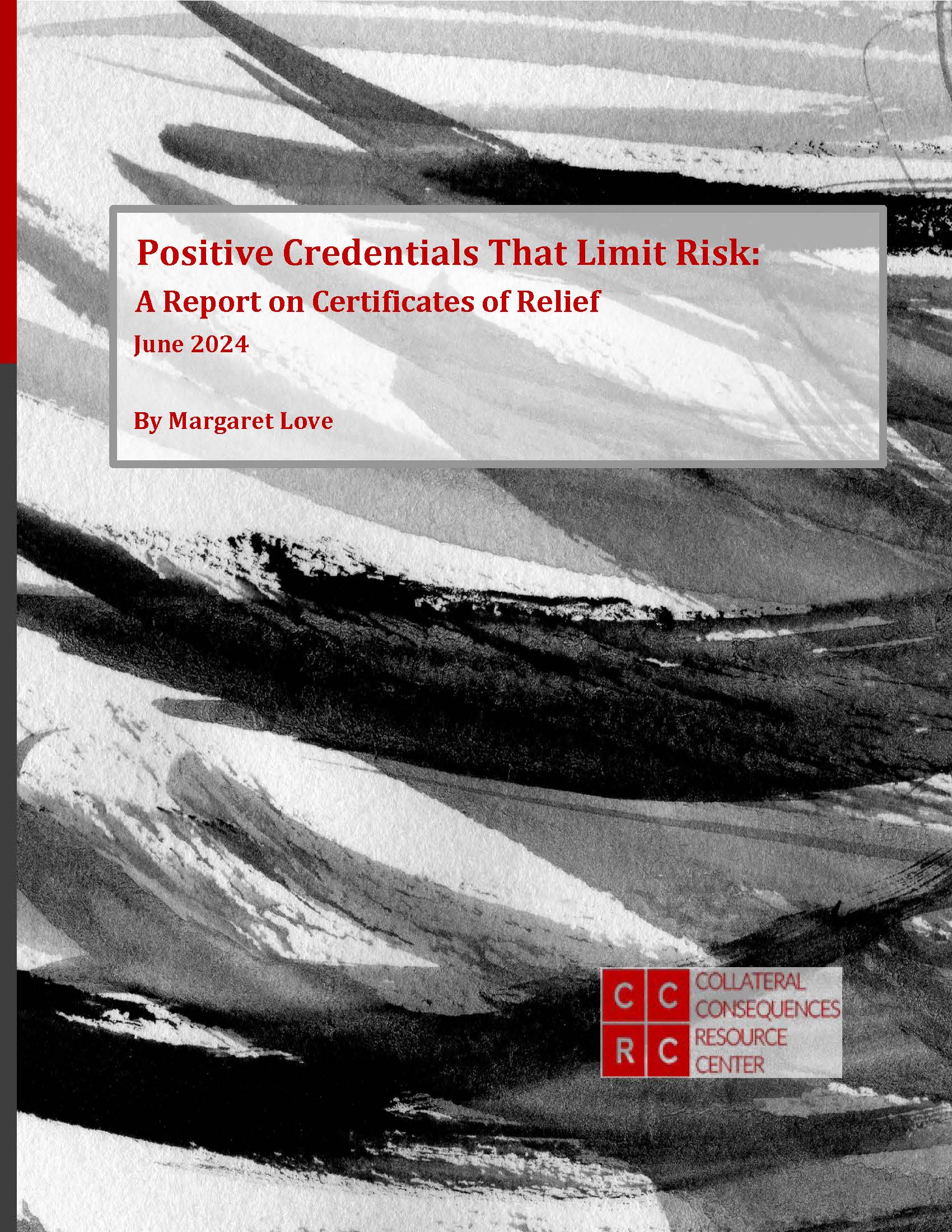
“Positive Credentials That Limit Risk: A Report on Certificates of Relief”

We are pleased to present a new report dealing with “certificates of relief,” a form of relief from the collateral consequences of conviction that is less far-reaching than record clearing but potentially available to more people at an earlier point in time. These certificates, offered by a court or correctional agency, do not limit public access to a person’s record but are effective in reducing many record-related disadvantages in the workplace, including by providing employers and others with protection against the risk of being sued for negligence.

Positive Credentials That Limit Risk: A Report on Certificates of Relief makes the case that, at least as long as expungement and sealing remain unavailable to many people with a felony conviction record, or are available only after lengthy waiting periods, certificates of relief can provide an important addition to a state’s reentry scheme, and serve as a bridge to more thorough forms of record relief like expungement or pardon.

At the same time, in a promising development, certificates are beginning to be widely used by prison and parole agencies to encourage employment opportunities and otherwise facilitate reentry for those exiting prison or completing supervision.

Given the perceived limits of record clearing as a comprehensive reentry strategy, social science researchers have become interested in studying the effect of laws that aim to increase the positive information about individuals with a criminal record to counter the negative effect of the record itself. This report is intended to support these research efforts by describing the state of the law relating to certificates of relief in the 21 states that now offer them, and by suggesting directions of further research. A follow-up study will look at pardons.

We hope that this report will stimulate public interest in a type of relief that has been neglected in recent years as background screening has become widespread, and suggest ways to make it more widely appreciated and available. Our goal is to encourage a view of certificates and expungement as complementary parts of a single structured system of serially available criminal record relief.

As state certificate programs are referenced in the body of this report, readers may want to refer to the comparison charts and state-by-state summaries of the law included in the Appendices.  Certificates can be put into the broader context of a state’s other record relief mechanisms in the state profiles from CCRC’s Restoration of Rights Project.


DC enacts progressive new record-clearing law

Until last month, the District of Columbia had one of the most complex and restrictive record relief laws in the country. D.C.’s sealing law even applied the same burdensome petition-based procedures, extended waiting periods, and onerous burdens of proof to non-conviction records that applied to convictions. In testimony before the D.C. Council in 2021, CCRC’s Margaret Love noted: “Compared to states across the country, DC’s record relief laws are very prohibitive and unusually complex.” CCRC’s Reintegration Report Card published in March 2022 commented that “the restoration laws in the District of Columbia are noteworthy for a remarkable study in contrasts: D.C. has extraordinarily progressive laws in civil areas like voting, employment, housing, and occupational licensing, and among the most regressive laws in the Nation in every category of criminal record relief, likely reflecting the heavy hand of the federal authorities that are responsible for most prosecutions under the D.C. Code.”

Last month, everything changed. The Second Chance Amendment Act of 2022 (D.C. Law 24-284, codified at D.C. Code § 16-801 et seq.), which became final after the required period of congressional review on March 16, 2023, gave the District one of the broadest record-clearing laws in the country, including both petition-based relief for all but the most serious violent felony convictions, and automatic relief for misdemeanors and non-conviction records.  D.C. now becomes the 11th U.S. jurisdiction to enact a “clean slate” law that applies to both conviction and non-conviction records.

The new D.C. record-clearing law is the product of more than two years of hard work by the D.C. Council and a broad coalition of advocacy groups in the District. When coupled with the District’s progressive civil restoration laws referenced above, this new law propels DC from middle-of-the-pack to the top tier of jurisdictions in the Nation where fair treatment of justice-affected individuals is concerned. It will certainly advance DC’s candidacy for Reintegration Champion of 2023.

Though D.C. Law 24-284 is enacted, it is unfunded, which means it cannot be used. Currently, the FY24 Budget Support Act of 2023 set the effective date for the Second Chance Act as 1/1/26 for most of the law and 10/1/29 for the automatic sealing provisions.

The new law’s specific provisions are described in greater detail below, and in the DC profile from CCRC’s Restoration of Rights Project.

The new D.C. law provides for petition-based sealing for all non-conviction records at disposition, for all misdemeanors after a five-year waiting period, and for all but a specified group of the most serious felony convictions after an eight-year waiting period.  The waiting period begins following completion of all aspects of the sentence, except that it does not require payment of fines and other court debt. The law also facilitates procedures: e.g., not all eligible records need be sealed at the same time, as under the old law, and there are no “disqualifying offenses” that could extend the waiting period even for non-conviction records.

It also eases standards, particularly for sealing non-conviction records: it deleted a provision allowing the court to consider “the weight of the evidence against the person” and any priors sealings of arrest records.  It specifically directs the court in all cases to consider “The community’s interest in furthering the movant’s rehabilitation and enhancing the movant’s reintegration into society through education, employment, and housing.” As noted, D.C.’s existing sealing law extended to same burdensome procedures and standards to non-conviction records that applied to sealing of convictions.

The new law makes sealing automatic beginning in 2027 for non-conviction records, and for most misdemeanor convictions after a 10-year waiting period. It also provides for automatic expungement of marijuana convictions effective January 1, 2025, and for expungement by petition on grounds of actual innocence. Provisions in existing law authorizing expungement for victims of human trafficking and sealing for juvenile defendants were not changed.

D.C. now joins the 19 states that have enacted automatic record-clearing relief for arrest records and other non-convictions.  More than half of these state laws have been enacted in the three years since publication of CCRC’s Model Law on Non-Conviction Records, which advocated for automatic expungement of all non-conviction records, including records with no final disposition, except for pending matters. Like CCRC’s model law, which was cited as authority by several parties during the hearings before the D.C. Council, the new D.C. law recommends restrictions on accessing, inquiring about, and commercially disseminating non-conviction records.

Sealed records are placed in a non-public file but remain available to law enforcement, courts, prosecutors, licensing agencies, public employers, and schools and child care facilities, to be used “for any lawful purpose.” Sealed records may also be used in civil litigation relating to the arrest or conviction, and may be made available to others “upon order of the Court for good cause shown.”  An individual whose record has been sealed may deny the arrest or conviction “for any purpose”, without penalty of perjury or other provision of the law for giving a false statement. This appears to be a change from the 2006 law, which required testimony about prior arrests and convictions “in response to an inquiry from one of the entities expressly authorized to access the records.” In other words, while certain entities may gain access to sealed records, the subject of the record may lawfully deny its existence without penalty.

The 2022 law imposes certain requirements on “criminal history providers” that provide criminal history background screening reports, requirements that mirror those provided by the federal Fair Credit Reporting Act.  It requires providers to provide the subject of a background report with a copy of the report and identify the source of the report, and to use at least two identifiers (e.g., birthdate and name); prohibits reporting records that have been sealed, expunged or set aside; and pohibits reporting information that has not been updated within 30 days of the report.  Complaints of a violation of these provisions may be filed with the DC Office of Human Rights (but not in court), and fines are specified for violations.

There are still ways that D.C.’s sealing law could be improved.  For example, there appears to be no good reason why sealed non-conviction records should remain available to employers and licensing agencies, and in most states they are not. Automatic relief should be extended to all convictions now subject to sealing by petition, and the waiting periods for both petition-based and automatic relief seem excessive by standards in recently enacted record-clearing laws.  See CCRC’s 2022 report on waiting periods, Waiting for Relief: A National Survey of Waiting Periods for Record Clearing (February 2022).  But those caveats aside, the new law represents the most substantial progress in record clearing of any U.S. jurisdiction since 2018, when North Dakota and New Mexico enacted a broad sealing scheme for the first time.  Congratulations to the D.C. Council!


The Frontiers of Dignity: Clean Slate and Other Criminal Record Reforms in 2022

At the beginning of each year since 2017, CCRC has issued a report on legislative enactments in the year just ended, new laws aimed at reducing the barriers faced by people with a criminal record in the workplace, at the ballot box, and in many other areas of daily life.  These annual reports document the steady progress of what our report two years ago characterized as “a full-fledged law reform movement” aimed at restoring rights and dignity to individuals who have successfully navigated the criminal law system.

In the three years between 2019 and 2021, more than 400 new criminal record reforms were enacted.  Many states enacted new laws every year, and all but two states enacted at least one significant new law during this period.

The modern record reform movement reflected in our annual reports is bipartisan, grounded in and inspired by the circumstance that almost a third of adults in the United States now have a criminal record, entangling them in a web of legal restrictions and discrimination that permanently excludes then from full participation in the community. It reflects a public recognition that the “internal exile” of such a significant portion of society is not only unsafe and unfair, but it is also profoundly inefficient.

We are pleased to present our report on new laws enacted in 2022, titled The Frontiers of Dignity: Clean Slate and Other Criminal Record Reforms in 2022. While this report shows that the legislative momentum gathering since 2018 slowed somewhat in the past year, there has still been progress, with more new laws enacted this year than in 2018 when the current reform movement took off in earnest.

The title of this report is borrowed from the Basic Law adopted by the Federal Republic of Germany after World War II, which declared that “Human dignity shall be inviolable. To respect and protect it shall be the duty of state authority.” Most European countries incorporate this foundational premise, as well as a concern for individual privacy, into their treatment of criminal records, by making them largely unavailable to the public and by limiting how they are used to deny rights and opportunities.

In part because American legal systems are not similarly grounded in respect for dignity and privacy, our progress toward a fair and efficient criminal records policy has been slow and uneven. Yet it has been steady, animated in recent years both by a concern for racial justice and by economic self-interest. This report, like our past annual reports, attempts to capture this steady progress toward recognizing the worth and dignity of the millions of Americans whose past includes a record of arrest or conviction. Read more