Category: Advocacy Groups

Will restrictions on banking jobs be relaxed for people with a record?

More than two dozen organizations dedicated to improving employment opportunities for people with a criminal record have written to the FDIC urging that it give regulated financial institutions greater latitude to hire qualified people without having to ask the FDIC’s permission.  The occasion is the FDIC’s proposal to reduce to a formal rule its longstanding policy on employment of convicted individuals by banks, a proposal that suggests the FDIC may be open to giving banks more hiring autonomy by relaxing several controversial provisions.  For 20 years, the FDIC has kept a tight grip on banks, requiring them to obtain a waiver before they may hire anyone with a record even in an entry-level non-professional position.  In operation, this policy has been an effective bar to bank employment for most people with a conviction record (and even for some who have never been convicted).

The letter, organized by the National Employment Law Project and the Leadership Conference on Civil and Human Rights, points out that FDIC’s exclusionary policy is not required by its enabling statute, and urges the agency to bring its policy on hiring waivers into line with national efforts to further reintegration, in several different ways, some of which are discussed below.  The letter cites the bipartisan federal Fair Chance Act and corresponding reforms in states across the country (as reported by CCRC), as well as many letters from bank industry leaders urging the FDIC to relax its rigid policy that has frustrated efforts to diversify the financial sector’s work force.

The comment below provides some background for the FDIC’s proposal, and comments on where some relaxation of its present policy is likely.  It concludes with a note about the generally confusing and inconsistent treatment of state relief mechanisms like expungement and pardon in federal laws and regulations, suggesting that this is an area sorely in need of further study and proposals for reform.

Read more

COVID-19: State-by-state resources on how to use the pardon power

At this time of pandemic, we have been following the discussions of how jail, prison, and immigration detention conditions are highly concerning, including the very useful collection of links provided by Professor Doug Berman, the demands published by advocacy organizations, and the collection of policy responses by the Prison Policy Initiative.  We agree that every available legal mechanism must be enlisted to secure the release of prisoners and detainees who pose little or no threat to public safety, and whose health and safety are themselves severely threatened by their enforced captivity.  This includes the great constitutional powers given to governors and pardon boards.  We therefore commend our newly revised pardon resources to advocates and policy makers to support their advocacy and action.

While our pardon-related research focuses primarily on how the power is used to restore rights and status to those who are no longer in prison, much of our information about how the pardon process is structured and operates is relevant to how the power might be used (or is already being used) to commute prison sentences during the pandemic.  Our revised pardon resources are part of a major revision of the CCRC Restoration of Rights Project, not only to make sure its information is current in light of the many recent changes in the law, but also reorganizing and revising its resources for clarity and easier access.  In the process, we have updated and revamped our state-by-state material on how the pardon process operates in each jurisdiction, noting that the process has become more regular and productive in a few states in the past several years.

Our 50-state pardon comparison is organized into four sections:

  • Section 1 provides a chart comparing pardon policy and practice across jurisdictions.
  • Section 2 lists jurisdictions by frequency and regularity of their pardon grants.
  • Section 3 sorts jurisdictions by how the administration of the power is structured.
  • Section 4 provides state-by-state summaries of pardon policy and practice, with links to more detailed analysis and legal citations.

We hope this information will be helpful to advocates across the country as we work to keep all people safe and healthy, including those in our prisons and jails.

New Jersey steps out as Reintegration Champion of 2019

Editors’ note: CCRC recently released its report on 2019 criminal record reforms, which recognized New Jersey as the “Reintegration Champion” of 2019, for having the most consequential legislative record of any state in the past year.  The following comment describes New Jersey’s laws enacted in 2019.  New Jersey’s various restoration of rights laws are further described in the state’s profile in the CCRC Restoration of Rights Project.

In December 2019, Governor Phil Murphy signed into law S4154, now L.2019, c.269, as part of his Second Chance Agenda.  The law is a strong step towards criminal justice reform, and places New Jersey on the map as a leader in expungement policy.  Along with easing access to the existing expungement process,  it creates a new “clean slate” system that provides for expungement of all but the most serious violent offenses after ten years. It additionally sets in motion a process aiming to automate all clean slate expungements.  The substantive provisions of the law are set to go into effect on June 15, 2020, and we anticipate a large increase in expungements following its implementation.

Read more

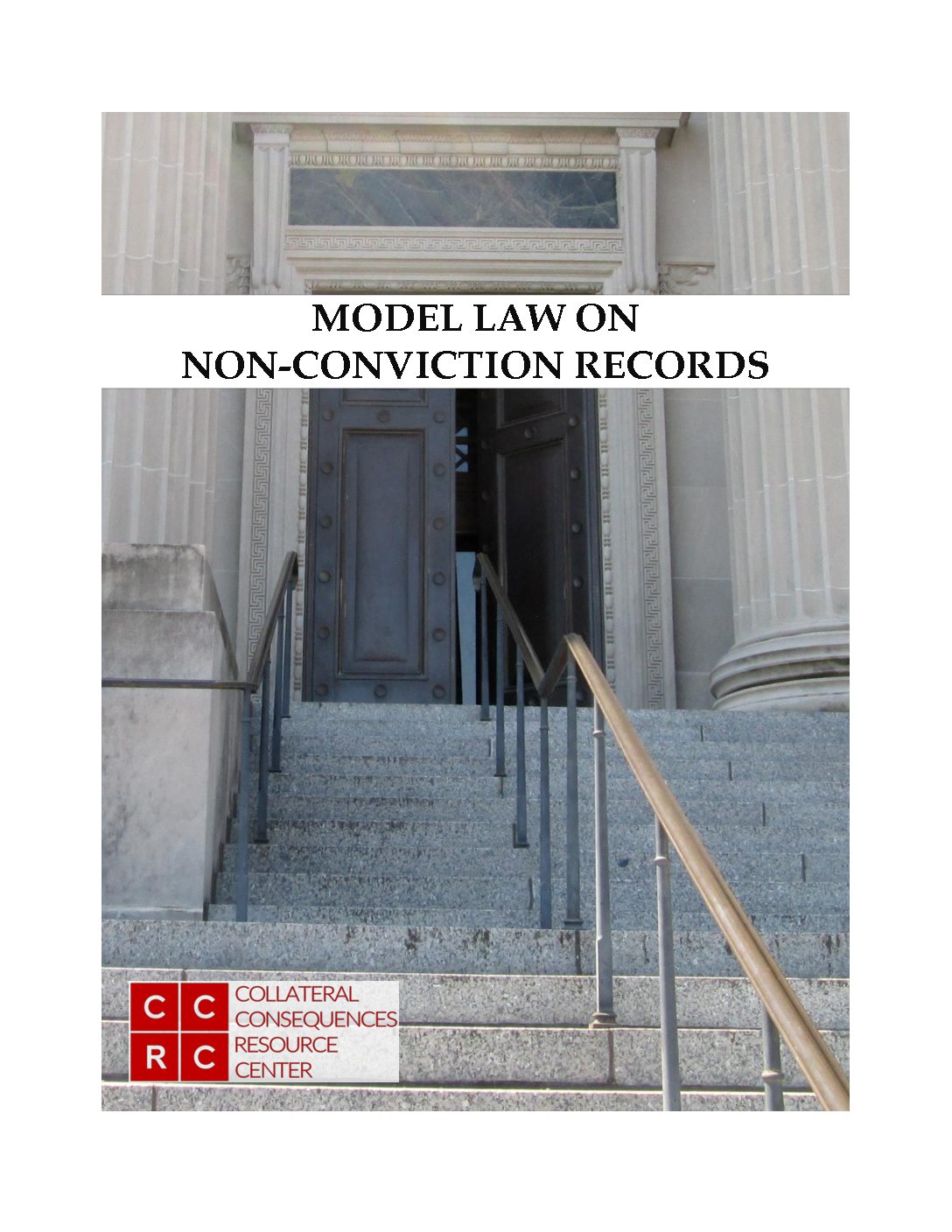
Model law proposes automatic expungement of non-conviction records

An advisory group drawn from across the criminal justice system has completed work on a model law that recommends automatic expungement of most arrests and charges that do not result in conviction.  Margaret Love and David Schlussel of the Collateral Consequences Resource Center served as reporters for the model law.  It is available in PDF and HTML formats.

“Many people may not realize how even cases that terminate in a person’s favor lead to lost opportunities and discrimination,” says Sharon Dietrich, Litigation Director of Community Legal Services of Philadelphia, and one of the advisors of the model law project.  “Over the years, my legal aid program has seen thousands of cases where non-convictions cost people jobs.”

In proposing broad restrictions on access to and use of non-conviction records, the project aims to contribute to conversations underway in legislatures across the country about how to improve opportunities for people with a criminal record.  Already in 2019, states have enacted more than 130 new laws addressing the collateral consequences of arrest and conviction.  The group regards its model as the first step in a broader law reform initiative that will address conviction records as well.

Law enforcement officials make over 10 million arrests each year, a substantial percentage of which do not lead to charges or conviction.  Records of these arrests have become widely available as a result of digitized records systems and a new commerce in background screening and data aggregation.  These checks often turn up an “open” arrest or charges without any final disposition, which may seem to an employer or landlord more ominous than a closed case.

Very few states have taken steps to deal with the high percentage of records in repositories and court systems with no final disposition indicated.  Paul McDonnell, Deputy Counsel for New York’s Office of Court Administration and a project advisor, noted: “Criminal records that include no final disposition make it appear to the untrained eye that an individual has an open, pending case, which can have serious results for that person. New York has recently made legislative progress in addressing this problem, though more can be done.”

Current state and federal laws restricting access to and use of non-conviction records have limited application and are hard to enforce.  Eligibility criteria tend to be either unclear or restrictive, and petition-based procedures tend to be burdensome, expensive, and intimidating.  In recent years, lawmakers and reform advocates have expressed a growing interest in curbing the widespread dissemination and use of non-convictions, leading some states to simplify and broaden eligibility for relief, reduce procedural and financial barriers to access, and in a handful of states to make relief automatic.

Rep. Mike Weissman, a Colorado State Representative and model law project advisor, noted that Colorado has recently overhauled its laws on criminal records with broad bipartisan support.  “It is heartening to see similar reforms underway in other states, both red and blue, as well.  I commend the practitioners and researchers who helped formulate the model law for illustrating avenues for further progress in reducing collateral consequences.”

The model law would take this wave of criminal record reforms to a new level.  It recommends that expungement be immediate and automatic where all charges are terminated in favor of an accused.  Uncharged arrests should also be automatically expunged after a brief waiting period, as should dismissed or acquitted charges in cases where other charges result in conviction.  Cases that indicate no final disposition should also be expunged, unless there is indication that they are in fact pending.

The model law also recommends that expunged non-conviction records should not be used against a person in a range of criminal justice decisions, including by law enforcement agencies.  It would prohibit commercial providers of criminal background checks from disseminating expunged and dated non-conviction records, and civil decision-makers from considering them.

David LaBahn, President of the national Association of Prosecuting Attorneys, indicated that organization’s support for the model law, stating that the collateral consequences of non-convictions “do not serve to make the community safer,” and that “the current structures in place to expunge a non-conviction record can be confusing and difficult for the layperson to navigate alone.”

This model law sets the stage for jurisdictions to address record relief for convictions more generally, and its structure and principles can be brought to bear on that important work.

The Collateral Consequences Resource Center organized this model law project.  An early draft of the model law was discussed at an August 2019 Roundtable conference at the University of Michigan that was supported by the Charles Koch Foundation.  The model law report was supported by Arnold Ventures.

Read the model law in PDF or HTML.

Association of Prosecuting Attorneys joins Restoration of Rights Project as partner

The Collateral Consequences Resource Center is pleased to announce that the Association of Prosecuting Attorneys (APA) has joined as a partner in our Restoration of Rights Project (RRP).  The APA is a membership organization of elected and appointed prosecutors whose mission is to provide training and technical assistance to prosecutors in the United States,  and to facilitate collaboration with criminal justice partners on emerging issues related to the administration of justice.  APA President and CEO David LaBahn participated in the roundtable on non-conviction records held in August at the University of Michigan Law School, a project that relies heavily on the state law research in the RRP.  The RRP’s other partner organizations are the National Association of Criminal Defense Lawyers, National Legal Aid & Defender Association, and National HIRE Network.

The RRP describes current U.S. law and practice concerning restoration of rights and record relief following arrest or conviction in the 50 states, D.C., Puerto Rico, Virgin Islands, and federal system, in three formats: summaries of every jurisdiction, detailed profiles of each jurisdiction, and 50-state comparison charts.  Topics include sealing and expungement, employment and licensing, pardons, voting, jury service, public office, and firearms rights.   People visit the RRP more than 1,000 times every day looking for information about ways to alleviate the burdens of a criminal record.

We are very excited to have this respected national prosecutor organization as a partner in the RRP enterprise, to help bring the RRP’s resources to the prosecutor community, along with a greater awareness of the need for and availability of mechanisms to mitigate the collateral consequences of arrest and conviction.  We look forward to the new perspectives the APA can bring to bear as we work to expand the RRP and make it more useful to all those interested in restoration of rights and record relief.