The Purgatory of Digital Punishment

It doesn’t matter whether they’re accurate—criminal records are all over the internet, where anyone can find them. And everyone does.

On a frozen December day in Minneapolis, William walked into a free legal aid seminar, to try to fix his criminal record. Lumbering toward a lawyer, his arms full of paperwork, William tried to explain his situation quickly. “I want to show you my record here that I got from my probation officer. Here.” Frustrated, William waved papers in the air.

After an employer and a landlord both denied his applications following private background checks, William started to suspect something was wrong with his criminal record. When he finally got a copy, the data made no sense. One arrest was dated to 1901. Another arrest was linked to an active warrant.

“Now, here’s a thing about it. I got one [conviction] in ’82; that was the last time I was in jail.” William paused to scan the document. “And that was that charge here. All of this,” he said, pointing to the paper, “is not me.” It seemed as if someone with a similar name—and a far more extensive criminal history—had been matched to William’s identity in a state police or court record database. He quickly realized that not only was his record incorrect, but it had spread across databases used by background check companies—and was posted on the internet. It was as if someone had stolen his identity—but instead of using his identity to buy something, they used it to slip stolen goods into his pocket.

The lawyers warned William of the Kafkaesque bureaucracy he would face. He had to fix the mismatched identity with the state police, ask the court to fix the 1901 data error, and close the mistaken (but open) warrant. Because he could not afford a lawyer, William had to rely on free legal aid or deal directly with the courts and state bureaus himself. This wasn’t what he wanted to hear. He had been trying for months to get help. The first time he’d tried to meet with a volunteer attorney, he was given an incorrect address and walked around downtown Minneapolis for hours trying to find the office. All of this confusion and frustration led him to the seminar today. He was about ready to give up.

“It’s too much. It’s too frustrating,” William said. “You know, you ain’t done nothing in 30-something years and then all of a sudden you want to get an apartment and you can’t. You’re just stuck the way you are at. That’s just terrible. It’s a bad feeling. It’s like I’ve been on a standstill.”

The problems William faced are rapidly multiplying across the country, in various forms. Incorrect or misleading records from years past pop up on Google searches. Criminal convictions that accurately appear on one background check don’t appear on another. Sealed, expunged, and juvenile records that are legally hidden from public view continue to live on across databases and websites.

Read more

CCRC research featured in Florida felony voting case briefs

Last week, we published our amicus brief in an appeal about the constitutionality of Florida’s system for restoring the vote to people with felony convictions.  We urged the Eleventh Circuit to affirm a district court decision that Florida’s “pay-to-vote” system is unconstitutional, relying on our research report showing that few states have as restrictive a scheme as Florida’s.  Other groups also weighed in, including 19 states and D.C. and several organizations that draw on CCRC’s research to argue in favor of the decision below.  CCRC board members Jack Chin and Nora Demleitner joined a group of 93 law professors who also argued in favor of the district court’s determination that Florida’s scheme is unconstitutional.

Read more

Fair chance employment and occupational licensing: A national survey

*Update (9/8/20): the full national report, “The Many Roads to Reintegration,” is now available.

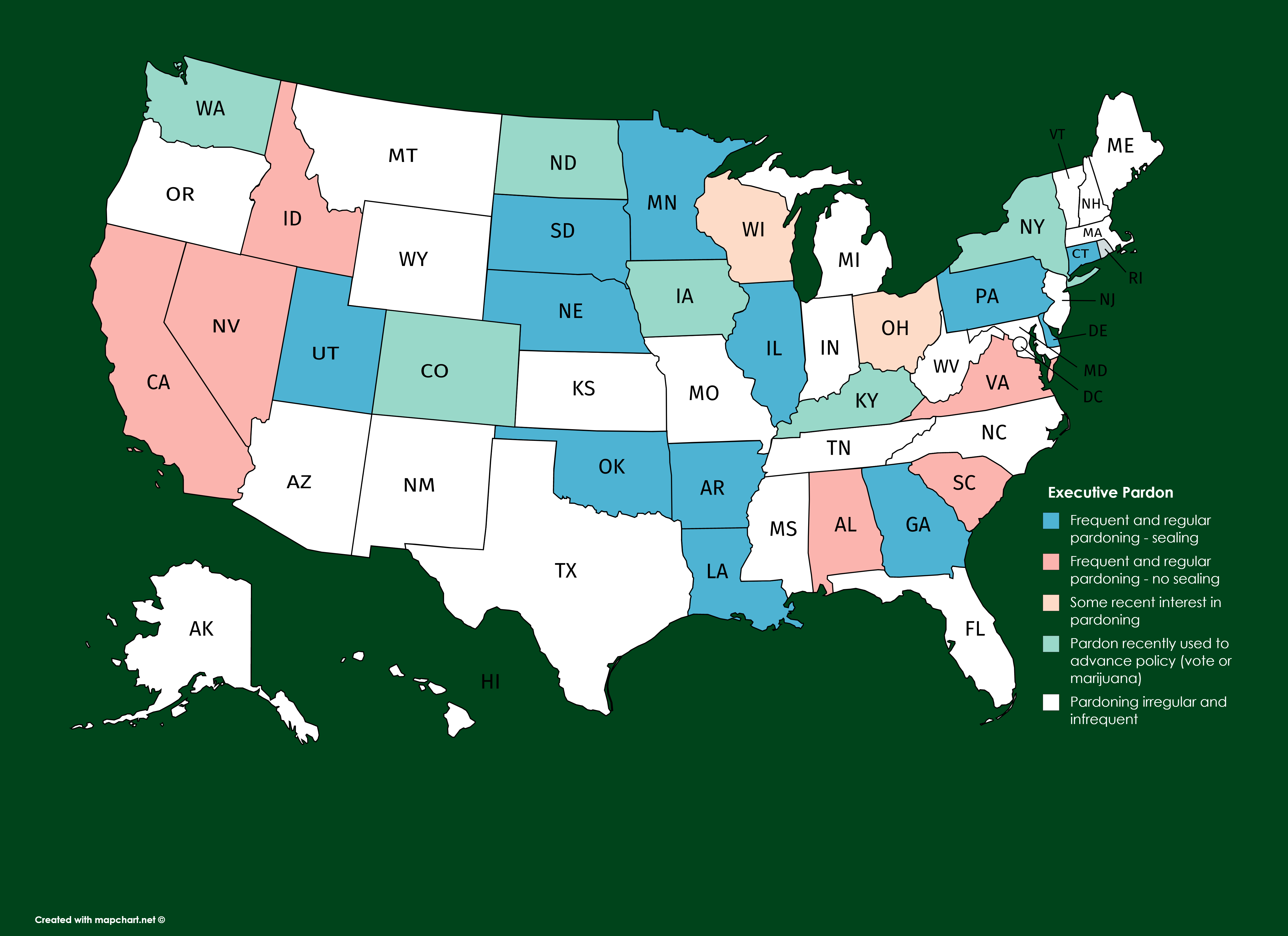
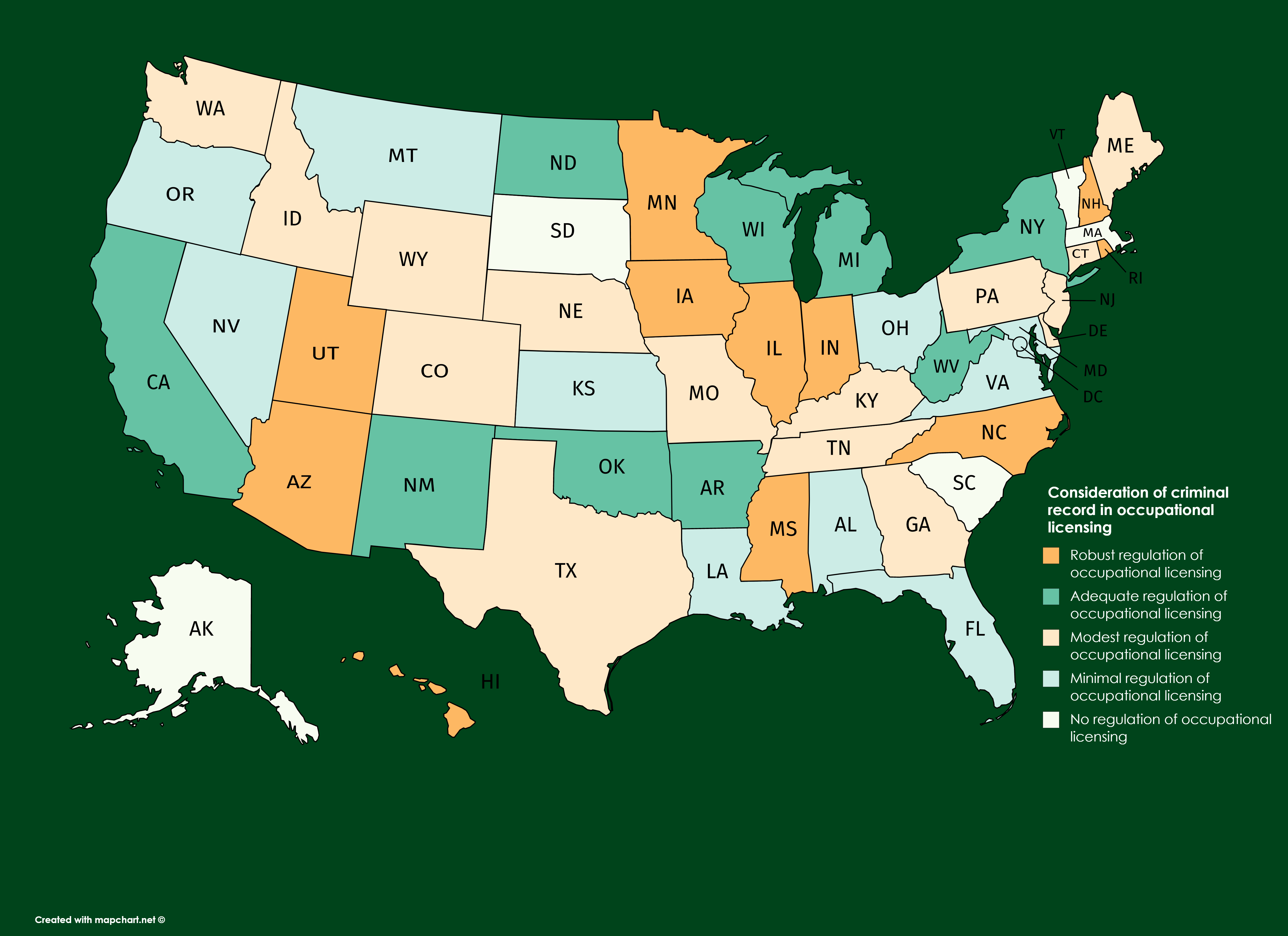
Last week we announced the forthcoming publication of a national report surveying mechanisms for restoring rights and opportunities following arrest or conviction, titled “The Many Roads to Reintegration.”  Also last week, we published the first chapter of that report on loss and restoration of voting and firearms rights.  Today we publish a near-final draft of the third chapter of the “Many Roads” report, dealing with laws that systematically regulate how criminal record is considered in the workplace, by employers and by occupational licensing authorities.  Next week we expect to publish the second chapter of the report on “record relief” (including record-sealing, pardon, and judicial certificates).  The research, drawn from CCRC’s Restoration of Rights Project, reveals a trend in the states toward restricting the power of occupational licensing agencies to reject applicants with criminal records based upon factors not directly related to their qualifications.

There has also been marked progress in extending fair chance employment laws, primarily through limiting inquiry into criminal record in the early stages of the hiring process and setting standards for later consideration of the record.  These trends, which have accelerated in the past three years, recall and in many cases build on an earlier period of criminal record reforms in the 1970s.  At the conclusion of the chapter are report cards with color-coded maps ranking state laws by specific criteria, to facilitate comparisons between and among states.

There are some surprises.  For one thing, there is not a particularly strong correlation between how states rate in each of the two areas.  That is, states that have a robust system of fair chance employment laws may not and frequently do not have a similarly strong system for regulating how occupational licensing agencies treat people with a criminal record.  In fact, only two states (Illinois and Minnesota) scored at the top of both categories.  Three other states that scored well on employment also scored reasonably well on occupational licensing (California, New York, and Wisconsin), but the last two jurisdictions in the top employment category (Hawaii and the District of Columbia) scored poorly on occupational licensing.  Conversely, four states that ranked in the top tier for occupational licensing had no law at all regulating consideration of criminal record in employment (Iowa, Mississippi, New Hampshire, and North Carolina) and two others had only minimal regulation of public employment (Indiana and Utah).  Three states had no law at all governing either employment or occupational licensing (Alaska, South Carolina, and South Dakota).

Another result that may surprise those who have not been following recent developments in this area of the law, is that high marks for reining in the exclusionary policies of licensing boards go to some states not ordinarily considered politically and socially progressive.  The unexpectedly strong performance of some states in regulating occupational licensing boards may be attributable to antipathy toward government interference in free markets as well as an interest in efficiency and fairness.

A PDF of this chapter is available here.  The full text follows, with end notes. Coming next, the report’s chapter on “Record Relief.”

Read more

CCRC urges 11th Circuit to uphold Florida felony voting decision

Yesterday, we filed an amicus brief in the U.S. Court of Appeals for the Eleventh Circuit in a case about the constitutionality of Florida’s system for restoring the vote to people with felony convictions.  We urge the court to affirm the lower court decision’s that declared Florida’s “pay-to-vote” system unconstitutional.  The brief draws on our new 50-state research report to show that Florida’s approach to this issue is an outlier among the states.

We were ably represented by Andrew L. Frey, Scott A. Chesin, and Luc W. M. Mitchell of Mayer Brown and very much appreciate their work.

Our brief is a contribution to high-stakes federal litigation in Florida over that state’s 2018 ballot initiative, Amendment 4, which many expected would restore voting rights to more than a million people disenfranchised because of their criminal record, in some cases for crimes that occurred decades ago.  However, the initiative has been interpreted by Florida’s legislature and supreme court to condition reenfranchisement on payment of all outstanding fines, fees, costs, and restitution, which threatens to drastically limit its anticipated reach.

Read more

The Clean Slate Initiative works to advance automated record clearance

We are pleased to publish a description of the Clean Slate Initiative we invited from its newly installed Managing Director.

The Clean Slate Initiative: Working to Ensure A Criminal Record is Not a Life Sentence to Poverty

By Sheena Meade*

As our nation responds to the COVID-19 pandemic, it is an imperative that lawmakers enact policies that include the tens of millions of justice-involved people and their families— already facing economic vulnerability from the stigma of a criminal record. One in three Americans, 70 million people, have some type of criminal record, and these records can create lifelong barriers to opportunity for them and their families. 

Nearly 9 in 10 employers, 4 in 5 landlords, and 3 in 5 colleges are now using background checks. Any record—no matter how old or minor—can put employment, housing, education, and other basics permanently out of reach. 

This harm is generational: Nearly half of children have at least one parent with a criminal record, resulting in difficulty for their parents to secure stable employment, economic stability and housing — all of which lead to less educational opportunities and hindered cognitive development. 

While most states allow people to petition for expungement or sealing of at least certain types of records, due to the cumbersome and complicated petition-based system used in most states, only a tiny fraction of people eligible for expungement or sealing ever obtain the relief they need. Navigating the complex record-clearing process can prove extremely challenging, often requiring expensive legal assistance and court fees—making it impossible for millions to move on with their lives.

As a national bipartisan coalition, the Clean Slate Initiative is working to fix this broken system in states across the country by advancing policies to automatically clear eligible criminal records. By sealing or expunging certain records after an individual remains crime free for a period of time we can remove these barriers, get people back to work and open the door to opportunity for them and their family.  Read more