The High Cost of a Fresh Start: New Report Examines Court Debt as a Barrier to Clearing a Conviction Record
BOSTON – A new report from the National Consumer Law Center and the Collateral Consequences Resource Center explores the extent to which court debt—such as criminal fines, fees, costs, and restitution—is a barrier to record clearing that prevents poor and low-income people from getting a second chance. For the nearly one-third of adults in the U.S. with a record of arrest or conviction, their record is not simply part of their past but a continuing condition that impacts nearly every aspect of their life. Their record makes it hard to get a 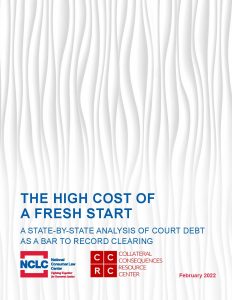 job and support a family, secure a place to live, contribute to the community, and participate fully in civic affairs.
“Criminal record clearing must not be reserved only for those who can easily pay for it,” said Margaret Love, executive director of CCRC. “States should ensure people are not being priced out of a chance at a fresh start.”
The High Cost of a Fresh Start: A State-by-State Analysis of Court Debt as a Bar to Record Clearing analyzes whether outstanding court debt bars record clearing under the laws of each of the 50 states, the District of Columbia, and the federal system. The report finds that in almost every jurisdiction, outstanding court debt is a barrier to record clearing, either rendering a person entirely ineligible or making it more difficult for them to qualify.
In recent years, most states have passed laws aimed at restoring economic opportunity, personal freedoms, and human dignity to millions of people by providing a path to clear their record. But for too many, this relief remains out of reach because of monetary barriers, including not only the cost of applying for record clearing but also requirements in many jurisdictions that applicants pay off debt incurred as part of the underlying criminal case before they can have their record cleared. This debt can include fees imposed for every month someone spends on probation or on GPS monitoring, and for their representation by a public defender—a fee that is levied only on people whom the court has deemed too poor to pay for their own defense. Interest and payment penalties can add to this court debt over time.
“The total amount of court debt can run to thousands of dollars for even minor infractions, which presents a high bar to clear,” said Ariel Nelson, staff attorney at NCLC. “Perversely, because a record makes it much harder to get a job, having an open record makes it harder to pay off court debt and therefore harder to qualify for record clearing.”
This burden falls especially heavily on Black and Brown communities, which are more likely to have high concentrations of both criminal records and poverty because of long-standing structural racism in criminal law enforcement and in the economy.
Based on their research, the authors offer the following recommendations:
- Court debt should never be a barrier to record clearing.Qualification for record clearing should not be conditioned on payment of court debt, and outstanding court debt should not be a basis for denying relief, regardless of whether record clearing is petition-based or automatic.
- Costs to apply for record clearing, including filing fees, should never be a barrier to record clearing. States should adopt automatic record-clearing processes that do not require individuals to incur costs to have their records cleared.
- Jurisdictions should collect and report data on monetary barriers to record clearing.Jurisdictions where record clearing may be denied on the basis of outstanding court debt should collect and report data reflecting the impact of these barriers on record clearing.
Download the full report for report findings, recommendations, maps, graphics, and state-by-state analysis: https://bit.ly/lp-high-cost-of-a-fresh-start-22
The report’s appendix cointains a state-by-state analysis of the role played by outstanding court debt in qualifying for record clearing. It may be separately downloaded at this link: https://www.nclc.org/images/pdf/criminal-justice/High-Cost-of-Fresh-Start-Appendix.pdf
###
The nonprofit National Consumer Law Center® (NCLC®) works for economic justice for low-income and other disadvantaged people in the U.S. through policy analysis and advocacy, publications, litigation, and training.
The Collateral Consequences Resource Center (CCRC) works to restore rights and opportunities to people with a history of arrest or conviction through research and policy advocacy.
—