Category: Diversion/deferred dispositions

Virginia poised to enact “transformative” record clearance law

Editor’s Note:  We are delighted to post a description of the broad new record relief bill now awaiting Governor Northam’s signature, by an attorney-advocate who was actively involved in the campaign to secure its passage. Rob Poggenklass describes the ambitious new law and how it came to be enacted, as well as likely next steps for record clearance in a jurisdiction that is swiftly becoming one of the nation’s leaders in record reforms. In addition to automatic sealing, the bill’s provisions for appointment of counsel, elimination of a fingerprint requirement for petitions, and regulation of private screening companies are particularly significant for reducing access barriers and ensuring effectiveness.

The Virginia General Assembly has passed transformative legislation to allow sealing of convictions, including low-level felonies, for the first time in the Commonwealth, and to establish a system of automatic sealing of police and court records for many offenses. About 1.6 million Virginians have a criminal record, which creates significant barriers to employment, housing, education, and other necessities of life.

The legislation reflects a compromise between an automatic expungement bill sponsored by Del. Charniele Herring and a mostly petition-based one brought by Sen. Scott Surovell. It also reflects the sustained work of directly impacted individuals and other advocates who organized and insisted on far-reaching, automatic, and equitable expungement legislation.

The legislation must be signed by Governor Ralph Northam before it becomes law, but the governor is expected to sign it. After the House and Senate could not agree on record sealing legislation during a special session in the fall of 2020, the governor hired a mediator to help negotiate the compromise bill that passed both chambers in 2021.

The legislation includes five key provisions. The bill:

  1. Establishes a system of automatic sealing for misdemeanor non-convictions, nine types of misdemeanor convictions, and deferred dismissals for underage alcohol and marijuana possession.
  2. Allows for contemporaneous sealing of felony acquittals and dismissals with the consent of the prosecuting attorney.
  3. Provides for sealing a broad range of misdemeanor and low-level felony convictions and deferred dismissals through a petition-based court process. Notably, court debt will not be a barrier to record clearance under the legislation.
  4. Introduces a system of court-appointed counsel for individuals who cannot afford an attorney for the petition-based sealing process.
  5. Forces private companies that buy and sell criminal records to routinely delete sealed records and creates a private right of action for individuals against companies that refuse to do so.

Most provisions of the bill are not currently set to take effect until July 1, 2025, to give the Virginia State Police and the courts sufficient time to update their computer systems. Increased funding or other future action by the General Assembly could change the effective date.

Read more
Study: Texas diversion provides dramatic benefits for people facing their first felony

Increased use of diversion is a key feature of America’s new age of criminal justice reform. Whether administered informally by prosecutors or under the auspices of courts, diversionary dispositions aim to resolve cases without a conviction—and in so doing, conserve scarce legal resources, provide supportive services, reduce recidivism, and provide defendants with a chance to avoid the lingering stigma of a conviction record.

Despite the growing popularity of diversion in this country and around the world, there has been little empirical study of its impacts on future behavior. Until now.

By conjecture, the opportunity to steer clear of a criminal conviction might affect future behavior in opposing ways. An optimist might expect that diversion would motivate a person to avoid returning to court in the future, while preserving the ability to hold lawful employment, especially in places where criminal background checks are used to screen applicants. A skeptic might argue that diversion represents a lesser punishment that could increase offending by reducing either a specific or general deterrence effect.

Without research showing the likelihood of one or the other outcome, policymakers, prosecutors, and judges have had to operate on untested assumptions, hoping for the best. This vacuum has now been filled by a new study of Texas’ court-managed diversion program by two economists, which should be welcome news for the optimists.

Read more

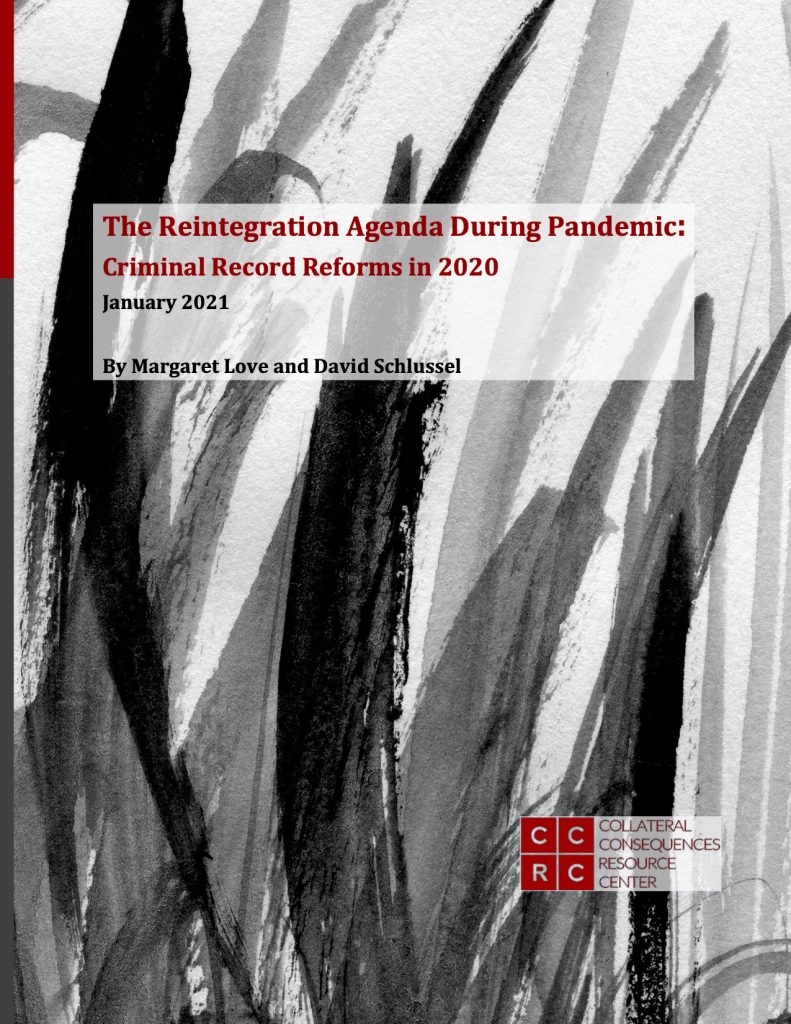
Legislative Report Card: “The Reintegration Agenda During Pandemic”

CCRC’s new report documents legislative efforts in 2020 to reduce the barriers faced by people with a criminal record in the workplace, at the ballot box, and in many other areas of daily life. In total, 32 states, D.C., and the federal government enacted 106 bills, approved 5 ballot initiatives, and issued 4 executive orders to restore rights and opportunities to people with a record.

Our Legislative Report Card recognizes the most (and least) productive state legislatures last year. Hands down, Michigan was the Reintegration Champion of 2020 with 26 new record reform laws, while Utah was runner-up, and seven other states were commended for their work.

Read more

“The Reintegration Agenda During Pandemic: Criminal Record Reforms in 2020”

In each of the past five years, CCRC has issued an end-of-year report on legislative efforts to reduce the barriers faced by people with a criminal record in the workplace, at the ballot box, and in many other areas of daily life.[i] These reports document the progress of what has become a full-fledged law reform movement to restore individuals’ rights and status following their navigation of the criminal law system.

Our 2020 report, linked here, shows a continuation of this legislative trend. While fewer states enacted fewer laws in 2020 than in the preceding two years, evidently because of the disruptions caused by the pandemic, the fact that there was still considerable progress is testament to a genuine and enduring public commitment to a reintegration agenda.

In 2020, 32 states, the District of Columbia, and the federal government enacted 106 legislative bills, approved 5 ballot initiatives, and issued 4 executive orders to restore rights and opportunities to people with a criminal record.

Read more

Are Trump’s Pardons a Blessing in Disguise?

The title of this post is the title of my piece in Lawfare arguing that, in response to President Trump’s reckless pardoning,  Congress should reroute many of pardon’s routine functions into the federal courts. The piece is reprinted below:


Are Trump’s Pardons a Blessing in Disguise?

As President Trump’s irregular and self-serving pardons roll out, incoming President Biden has been urged to repair or replace the process for advising the president on the use of this extraordinary constitutional power.

It makes sense that critics have directed their ire and reform energies toward the mechanics of the pardon process, particularly since President Trump is on the record as disdaining it. But improvements in the process will not solve the problem laid bare by this president’s reckless pardoning. We should instead be asking more basic questions about what if any role the pardon power should play in the ordinary operation of the federal justice system. That system has asked far too much of pardon in recent years, and increased demand has played a major role in the power’s abuse. Congress needs to reroute many of pardon’s routine functions into the federal courts.

Read more