Category: Caselaw

11th Circuit upholds voting rights for Floridians unable to pay fines and fees

*Update (3/31/20): the Eleventh Circuit has denied Florida’s petition for rehearing en banc.

A decision yesterday from the U.S. Court of Appeals for the Eleventh Circuit is a major victory for voting rights and criminal justice reform advocates.  It has the potential to dramatically expand access to the ballot for people with felony convictions in Florida.  The decision concerns Florida’s 2018 ballot initiative Amendment 4, which restored the vote to state residents who have completed the terms of their sentence, which includes fines, fees, and restitution imposed by the court.  The appeals court’s decision held that Florida may not deny the vote to individuals who can demonstrate that they are genuinely unable to pay outstanding court debt.  The decision also called into question the very requirement that financial penalties must be satisfied in order to regain the vote under Amendment 4, and potentially similar requirements in several other states.

Read more

Broken records: criminal history errors cost jobs and housing

Ariel Nelson of the National Consumer Law Center has authored an important new report, Broken Records Redux, which describes how errors by criminal background check companies harm consumers seeking jobs and housing.  In particular, the report shows how background screeners continue to include sealed and expunged records in criminal background check reports, omit disposition information, misclassify offenses, mismatch the subjects of records, and include other misleading information.  The report also examines problems arising from the use of automated processes to evaluate prospective employees and tenants.

This report, a sequel to a 2012 NCLC report on criminal background errors, observes that since 2012 advocates and federal agencies have litigated many actions for violations of the Fair Credit Reporting Act (FCRA), leading to settlements and judgments requiring background screeners to reform their processes and pay millions in penalties and relief to consumers.  Despite these lawsuits, “companies continue to generate inaccurate reports that have grave consequences for consumers seeking jobs and housing.”  Based on these issues, the report recommends a broad array of legislative and regulatory changes at the federal and state level.  Accompanying the report is an article: Fertile Ground for FCRA Claims, which describes FCRA violations that can result from “inaccurate, incomplete, or outdated” background checks.

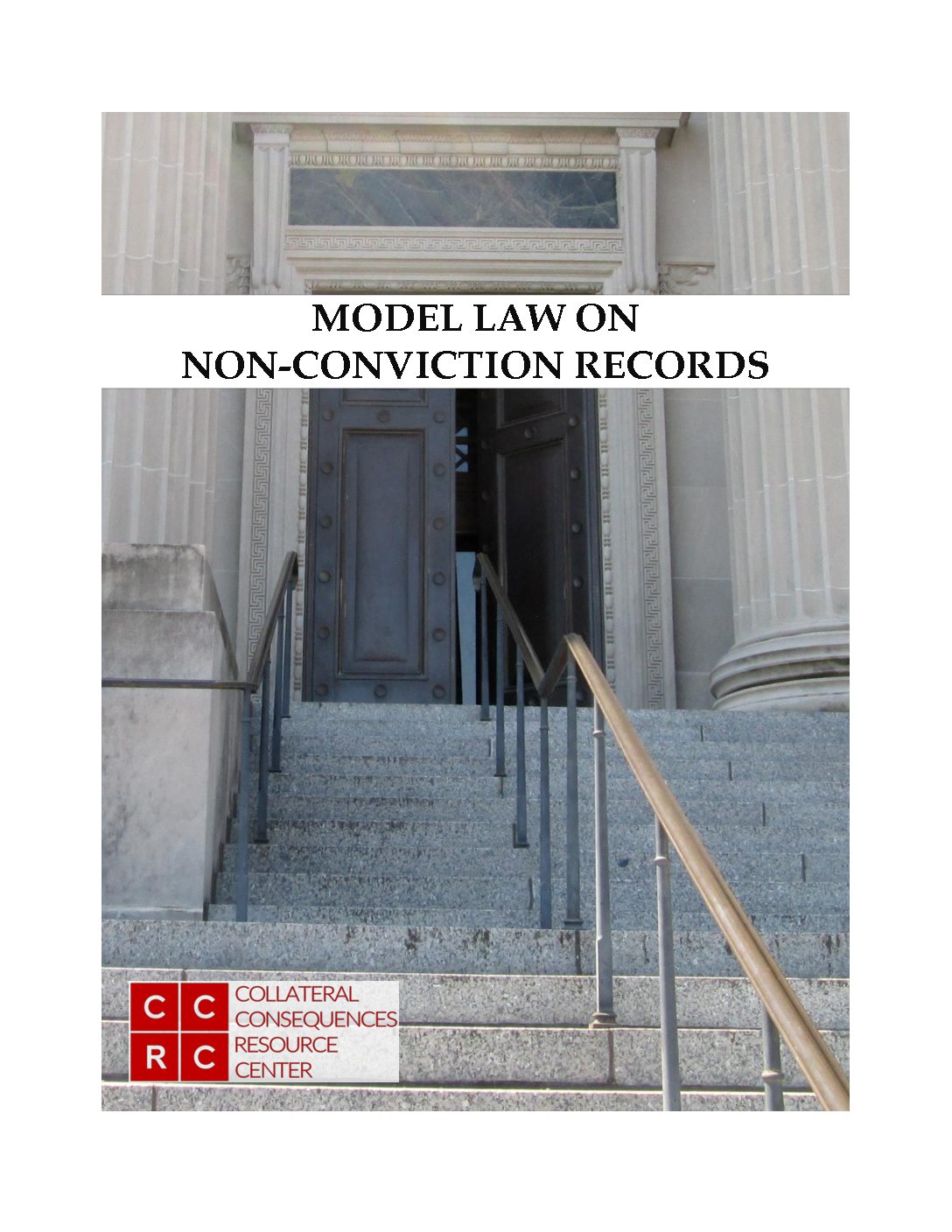
This new report also provides support for policy recommendations in our recently released Model Law on Non-Conviction Records, including restrictions on the dissemination of expunged records and records indicating no disposition by commercial providers of criminal records.

“For expungement and clean slate laws to succeed in removing barriers to employment and housing, they must take into account issues like background check reporting, data aggregation, and the use of stale data,” says Nelson, the author of the NCLC report. “I’m happy to see that CCRC’s Model Law on Non-Conviction Records provides guidance for addressing those issues.”

Model law proposes automatic expungement of non-conviction records

An advisory group drawn from across the criminal justice system has completed work on a model law that recommends automatic expungement of most arrests and charges that do not result in conviction.  Margaret Love and David Schlussel of the Collateral Consequences Resource Center served as reporters for the model law.  It is available in PDF and HTML formats.

“Many people may not realize how even cases that terminate in a person’s favor lead to lost opportunities and discrimination,” says Sharon Dietrich, Litigation Director of Community Legal Services of Philadelphia, and one of the advisors of the model law project.  “Over the years, my legal aid program has seen thousands of cases where non-convictions cost people jobs.”

In proposing broad restrictions on access to and use of non-conviction records, the project aims to contribute to conversations underway in legislatures across the country about how to improve opportunities for people with a criminal record.  Already in 2019, states have enacted more than 130 new laws addressing the collateral consequences of arrest and conviction.  The group regards its model as the first step in a broader law reform initiative that will address conviction records as well.

Law enforcement officials make over 10 million arrests each year, a substantial percentage of which do not lead to charges or conviction.  Records of these arrests have become widely available as a result of digitized records systems and a new commerce in background screening and data aggregation.  These checks often turn up an “open” arrest or charges without any final disposition, which may seem to an employer or landlord more ominous than a closed case.

Very few states have taken steps to deal with the high percentage of records in repositories and court systems with no final disposition indicated.  Paul McDonnell, Deputy Counsel for New York’s Office of Court Administration and a project advisor, noted: “Criminal records that include no final disposition make it appear to the untrained eye that an individual has an open, pending case, which can have serious results for that person. New York has recently made legislative progress in addressing this problem, though more can be done.”

Current state and federal laws restricting access to and use of non-conviction records have limited application and are hard to enforce.  Eligibility criteria tend to be either unclear or restrictive, and petition-based procedures tend to be burdensome, expensive, and intimidating.  In recent years, lawmakers and reform advocates have expressed a growing interest in curbing the widespread dissemination and use of non-convictions, leading some states to simplify and broaden eligibility for relief, reduce procedural and financial barriers to access, and in a handful of states to make relief automatic.

Rep. Mike Weissman, a Colorado State Representative and model law project advisor, noted that Colorado has recently overhauled its laws on criminal records with broad bipartisan support.  “It is heartening to see similar reforms underway in other states, both red and blue, as well.  I commend the practitioners and researchers who helped formulate the model law for illustrating avenues for further progress in reducing collateral consequences.”

The model law would take this wave of criminal record reforms to a new level.  It recommends that expungement be immediate and automatic where all charges are terminated in favor of an accused.  Uncharged arrests should also be automatically expunged after a brief waiting period, as should dismissed or acquitted charges in cases where other charges result in conviction.  Cases that indicate no final disposition should also be expunged, unless there is indication that they are in fact pending.

The model law also recommends that expunged non-conviction records should not be used against a person in a range of criminal justice decisions, including by law enforcement agencies.  It would prohibit commercial providers of criminal background checks from disseminating expunged and dated non-conviction records, and civil decision-makers from considering them.

David LaBahn, President of the national Association of Prosecuting Attorneys, indicated that organization’s support for the model law, stating that the collateral consequences of non-convictions “do not serve to make the community safer,” and that “the current structures in place to expunge a non-conviction record can be confusing and difficult for the layperson to navigate alone.”

This model law sets the stage for jurisdictions to address record relief for convictions more generally, and its structure and principles can be brought to bear on that important work.

The Collateral Consequences Resource Center organized this model law project.  An early draft of the model law was discussed at an August 2019 Roundtable conference at the University of Michigan that was supported by the Charles Koch Foundation.  The model law report was supported by Arnold Ventures.

Read the model law in PDF or HTML.

CCRC urges Supreme Court to reverse Iowa expungement decision

*Update 2: On November 25, 2019, the Supreme Court denied the petition.

*Update (11/1/2019):  On September 23, 2019, the Supreme Court asked Iowa to respond to the cert petition.  Iowa’s response is here.  The petitioner’s reply is here.

On September 9, we filed an amicus brief at the U.S. Supreme Court urging the justices to review and reverse a decision out of Iowa that upholds wealth-based barriers to expungement.  We were joined by the Institute for Justice, a libertarian public interest law firm.  At issue in the case is an Iowa law that bars a person from obtaining expungement of a dismissed or acquitted case if they owe any court fees in the case.  We point out the inequity of denying access to expungement based on socio-economic status:  “The irony of Iowa’s expungement law could not be clearer: a law that removes a hurdle to employment and economic security cannot be invoked by indigent individuals until outstanding costs and fees are paid to the state, effectively defeating the very purpose of providing expungement relief in the first place.”

This case arises from Jone Doe’s request in 2018 to expunge her dismissed criminal case from 2009.  But she still owes $550.38 for her court-appointed attorney, which she cannot afford to pay.  Doe argued the requirement to pay outstanding fees before obtaining expungement violates her equal protection rights under the constitution.  She pointed out that had she been able to hire a private attorney, she would be eligible for expungement, whether or not she owed attorney fees.  The lower court denied the request, finding that Doe “was made aware of reimbursing attorney fees and that expungement could not occur until all fees and assessed costs were paid.”  The Iowa Supreme Court, by a 4-3 vote, upheld the requirement, finding the state has a legitimate purpose “to encourage payment of court debt.”  On petition to the Supreme Court, we urge the Court to “grant certiorari and hold that one’s inability to pay court fees may not restrict access to statutorily-created expungement rights.”

We were represented by Ethan P. Fallon and Thomas M. Bondy of Orrick, Herrington, & Sutcliffe LLP, and appreciate their work on this case.  The full amicus brief is available here.

Florida gov asks state court to resolve felony voting dispute

Florida Governor Ron DeSantis has opened up a new front in the legal battle in Florida over voting rights for people with felony convictions.  DeSantis is asking the state supreme court for an opinion on whether Amendment 4, passed by Florida voters in 2018, restores the vote for people with outstanding court-ordered fines and fees.  DeSantis signed a law passed by the legislature saying no, but that law is being challenged in federal court.

Amendment 4

Amendment 4 automatically restored the right to vote for people convicted of felonies, other than murder or sexual offenses, upon “completion of all terms of sentence including parole or probation.”   On June 28, 2019, DeSantis signed legislation (SB7066) that defines “completion of all terms of sentence” to include legal financial obligations (LFOs), including if a court has converted the LFOs to a civil lien.  Supporters of SB7066 point to a previous hearing before the Florida Supreme Court—regarding whether Amendment 4 should be on the 2018 ballot—where the Amendment’s sponsors told the Justices that completion of sentence includes court-ordered fines and costs.

In federal court, individuals and supporters of Amendment 4 have brought several challenges to SB7066 as violating the U.S. constitution on a variety of grounds.  One complaint argues that by disqualifying persons with outstanding LFOs, even if a person has no ability to pay and even if the court has converted an LFO to a civil lien, the law violates the Equal Protection and Due Process guarantees of the Fourteenth Amendment.  It also argues that the law burdens the fundamental right to vote, is an unconstitutional poll tax, infringes on free speech and association, and was enacted with a racially discriminatory purpose.

UCLA law professor Beth Colgan recently published a survey of wealth-based penal disenfranchisement in the U.S.  She argues that while this widespread practice has been upheld in the lower courts under rational basis review, properly considered as a form of punishment it violates the Equal Protection Clause of the Fourteenth Amendment.

Request for Opinion

On August 8, DeSantis filed a four-page letter asking the Florida Supreme Court to weigh in on the meaning of the amendment.  “I will not infringe on the proper restoration of an individual’s right to vote under the Florida Constitution,” DeSantis states, asking the justices for “your interpretation of whether ‘completion of all terms of sentence’ encompasses financial obligations, such as fines, fees and restitution (‘legal financial obligations’ or ‘LFOs’) imposed by the court in the sentencing order.”