Category: Caselaw

CCRC urges 11th Circuit to uphold Florida felony voting decision

Yesterday, we filed an amicus brief in the U.S. Court of Appeals for the Eleventh Circuit in a case about the constitutionality of Florida’s system for restoring the vote to people with felony convictions.  We urge the court to affirm the lower court decision’s that declared Florida’s “pay-to-vote” system unconstitutional.  The brief draws on our new 50-state research report to show that Florida’s approach to this issue is an outlier among the states.

We were ably represented by Andrew L. Frey, Scott A. Chesin, and Luc W. M. Mitchell of Mayer Brown and very much appreciate their work.

Our brief is a contribution to high-stakes federal litigation in Florida over that state’s 2018 ballot initiative, Amendment 4, which many expected would restore voting rights to more than a million people disenfranchised because of their criminal record, in some cases for crimes that occurred decades ago.  However, the initiative has been interpreted by Florida’s legislature and supreme court to condition reenfranchisement on payment of all outstanding fines, fees, costs, and restitution, which threatens to drastically limit its anticipated reach.

Read more
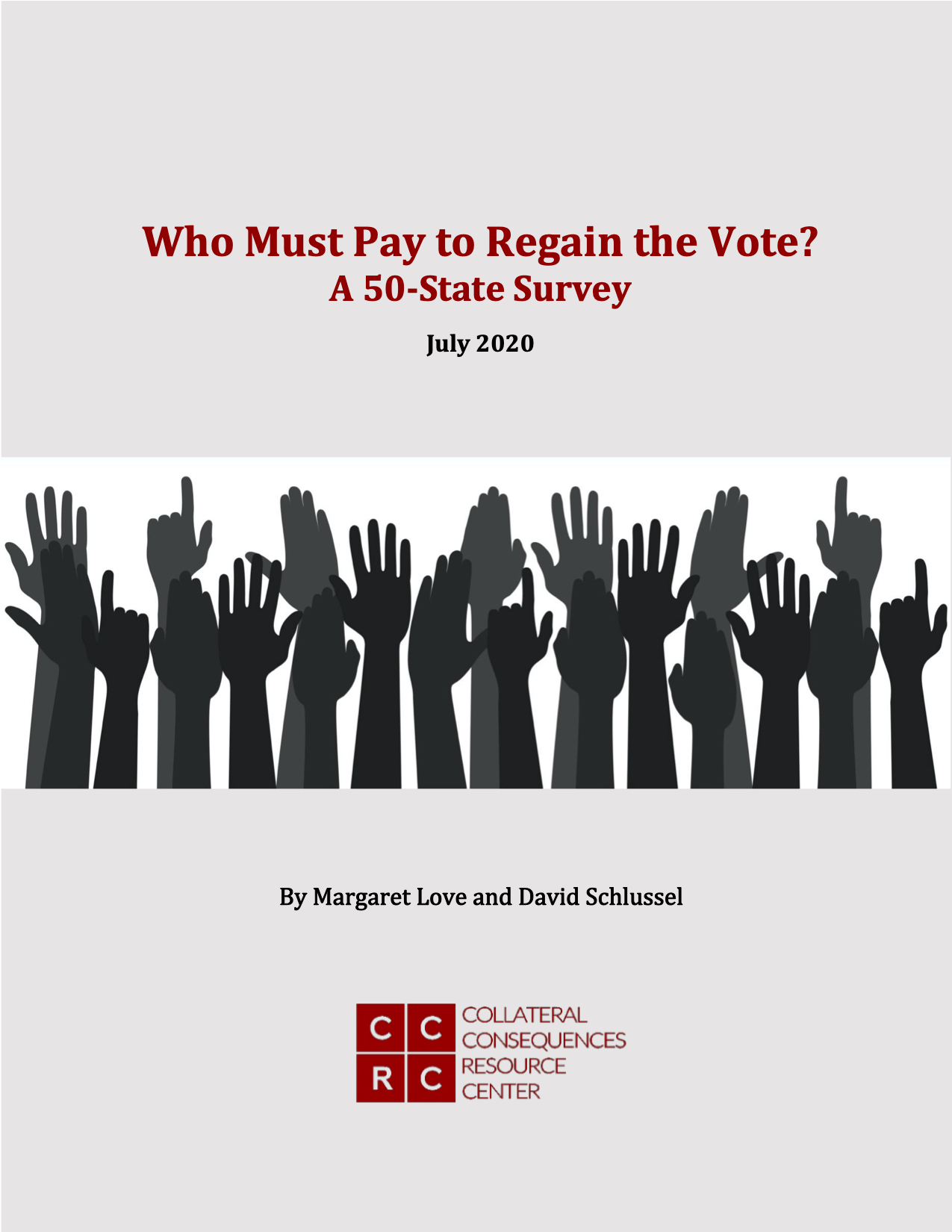
Who Must Pay to Regain the Vote? A 50-State Survey

We are pleased to publish a new 50-state report on how unpaid court debt blocks restoration of voting rights lost as a result of conviction:

Who Must Pay to Regain the Vote? A 50-State Survey

This report examines the extent to which state reenfranchisement laws consider payment of legal financial obligations (LFOs), including fines, fees, and restitution, in determining whether and when to restore voting rights to people disenfranchised due to a felony conviction.

This issue has come to the fore as a result of the high-stakes federal litigation in Florida over that state’s 2018 ballot initiative, which many expected would restore voting rights to more than a million people disenfranchised because of their criminal record, in some cases for crimes that occurred decades ago. However, the initiative has been interpreted by Florida’s legislature and supreme court to condition reenfranchisement on payment of all outstanding fines, fees, costs, and restitution, which threatens to drastically limit its anticipated reach.

After a group of voters and organizations sued, a federal judge found this “pay-to-vote” system unconstitutional. The case is currently on appeal in the U.S. Court of Appeals for the Eleventh Circuit. CCRC expects to file an amicus brief next week that will include an abbreviated version of this report. Our brief will address the claim that many states have reenfranchisement schemes like Florida’s, and that the trial court’s decision would therefore cast doubt on a widespread national practice. But our research finds that very few states have laws like Florida’s that indefinitely deny reenfranchisement based on any unpaid debt related to a disqualifying conviction. In fact, only two other states, Alabama and Arkansas, share the specifics of Florida’s approach.

The issues in the Florida case and the findings of our report are detailed below.

Read more

SBA throws in the towel and Congress extends the PPP deadline

After Congress authorized hundreds of billions of dollars for small business relief during COVID-19, the Small Business Administration (SBA) by rule and by policy imposed restrictions on applicants with an arrest or conviction history.  As we have documented, these SBA barriers, neither required nor contemplated by Congress, unlawfully impeded access to the Paycheck Protection Program (PPP) and the Economic Injury Disaster Loan (EIDL) program.  Over many weeks, the Administration stubbornly defended those barriers.  Finally, facing a bipartisan chorus of criticism including from members of Congress, and lawsuits in federal court, the Administration threw in the towel.

On June 12, shortly after the SBA eased some of the PPP restrictions, lawsuits were filed in federal court by several Maryland business owners challenging those restrictions.  On June 24, SBA further relaxed its PPP barriers, this time in a far more significant fashion, notably making the business owners who had sued the SBA eligible.  But the latest policy change came with less a week before the June 30 application deadline.

Then, just one day before the deadline, a federal judge ruled that the SBA’s criminal history restrictions on PPP, except for the June 24 policy change, were likely unlawful.  The court extended the deadline to apply, but only for the small business owners who had sued.

In a dramatic finale, Congress extended the PPP application deadline to August 8 for everyone.  This extension, signed into law on July 4, gives business owners made eligible under the June 24 policy a meaningful opportunity to learn about their eligibility and complete the application process.  A good outcome all around, thanks to the many people who refused to take no for an answer!

Read more

New efforts to channel federal relief to small business owners with a record

*UPDATE (7/7/20):  “SBA throws in the towel and Congress extends the PPP deadline

After Congress authorized hundreds of billions of dollars in funds for small business relief during COVID-19, the Small Business Administration (SBA) imposed restrictions on applicants with an arrest or conviction history.  These barriers, neither required nor contemplated by Congress, impede access to the two major relief programs for small businesses, nonprofits, and independent contractors during the COVID-19 crisis.  The two programs are the newly created Paycheck Protection Program (PPP) and the ramped-up Economic Injury Disaster Loan (EIDL) program.

Three developments within the past week signal major pushback against or the possible reversal of at least some of these burdensome restrictions, which unfairly deny relief to worthy applicants.

First, at least 65 organizations submitted five public comments in opposition to the SBA’s criminal history restrictions for PPP relief.  Our organization joined 25 other groups in submitting a comment asking the SBA to rescind or modify the regulation on legal and policy grounds, citing recent court decisions that suggest the SBA may lack authority to impose record-based disqualifications at all.

These comments are the most recent expression of what has become a wave of bipartisan opposition to the SBA’s exclusionary policies, and growing coverage of the issues in the press.  We have been collecting relevant documents on our small business relief resource page.

Second, Treasury Secretary Steven Mnuchin signaled in a recent conversation with key Senators that he may be open to easing restrictions on PPP applicants with felony records from the last five years.

Third, the HEROES Act, passed by the House on Friday, includes provisions that would significantly constrain the SBA’s authority to deny applicants based on a record of arrest or conviction in both the PPP and EIDL programs.  If enacted into law, these provisions would mark a turning point in how federal law deals with discrimination based on criminal record.

We discuss these developments in detail after the jump.  Read more

11th Circuit declines to rehear decision upholding felony voting rights

Yesterday, the full U.S. Court of Appeals for the Eleventh Circuit denied Florida’s petition to rehear en banc a decision from a three-judge panel, which held on Feb. 19 that Florida may not deny the vote to people with felony convictions who have otherwise served their sentences, but may have outstanding court debt that they are unable to pay.

The panel decision concerns Florida’s 2018 ballot initiative Amendment 4, which restored the vote to state residents with felony convictions who have completed the terms of their sentence (murder and sex offense convictions are excluded).  The Florida Supreme Court held earlier this year that this required payment of fines, fees, and restitution.  The Eleventh Circuit panel, affirming a district court preliminary injunction, not only held that Florida may not deny the vote to those who can demonstrate that they are genuinely unable to pay outstanding court debt, but it also called into question the very requirement that legal financial obligations must be satisfied in order to regain the vote.  Our full discussion of that decision is included below.

Absent intervention by the Supreme Court, Florida will be now be required to 1) implement the lower court’s preliminary injunction (which affected only the 17 plaintiffs named in the lawsuit); and 2) return to the district court for further litigation to address the rights of all other similarly situated Floridians, in accordance with the seeming broader directive of the appeals court.

Yesterday’s decision sends a strong signal to the states that currently impose similar financial barriers to restoring the franchise to those who have otherwise served their sentences.  But it also suggests that states should reconsider the many other troublesome barriers that governments impose on people who have otherwise served their sentences and are looking to fully participate in society, but still carry outstanding court debt.  In this vein, we have recently written about the denial of small business loans and ineligibility for expungement of non-conviction records because of outstanding fines and fees.

Read more