Tag: pardon

Minnesota enacts four major record reforms in 2023

Thanks to a series of criminal-justice reforms enacted earlier this year, Minnesota has burnished its reputation as a national leader in reintegration and criminal record reform.  In a year in which there have been far fewer criminal record reforms than in the recent past, Minnesota’s performance stands out for the variety and breadth of relief granted, in many cases automatically. Here are the four major new laws: Expungement was made automatic for both non-convictions and a range of conviction records, effective January 1, 2025 The pardon process was entirely overhauled to make this relief more available, and expungement for pardoned convictions was made automatic Felony disenfranchisement was limited to periods of actual incarceration A law legalizing adult possession of cannabis made expungement automatic for a broad range of cannabis convictions. These four major new authorities are described below. We expect that the Minnesota legislature’s exemplary performance in enacting these important new provisions will be in for further recognition in our annual round-up of new record reforms. Automatic expungement First, as part of an omnibus criminal justice package passed in May (SF 2909), Minnesota made expungement automatic for a wide range of records already eligible for expungement by petition, becoming the 12th state to do so. Effective January 1, 2025, convictions for petty misdemeanors (aside from traffic and parking offenses), most misdemeanors, and many non-violent felonies will be automatically expunged, after conviction-free waiting periods ranging from two to five years. Non-conviction records, including cases involving deferred and stayed adjudication, will also be expunged automatically. (“Expungement” is used interchangeably with “sealing” in Minnesota, but a preexisting law provides for destruction of uncharged arrest records by the Bureau of Criminal Apprehension.)  These reforms will apply retroactively, and the law sets up a process by which the Bureau of Criminal Apprehension will identify eligible records within 30 days of the effective date, expunge its own records, and notify the courts so that they may take corresponding action. This wide-ranging reform builds on a 2014 law that established a petition process for people to expunge their records. Many—though not all—of the offenses that were previously eligible for expungement by petition will now be expunged automatically. For a full list of which offenses were excluded from the 2023 reform, see Minn. Stat. § 609A.015, subd. 3(b)(2-4). The 2023 law also amended the laws governing expungement by petition, reducing waiting periods and making additional drug convictions eligible for the first time. Pardon and clemency reform SF 2909 also dramatically overhauled the pardon system in Minnesota. Under the Minnesota Constitution, the state’s Board of Pardons is comprised of the governor, the attorney general, and the chief justice of the state supreme court. However, a state law required the Board’s decisions to be unanimous, a requirement that was upheld by the Minnesota Supreme Court in its 2022 decision, Shefa v. Ellison. In addition, the pardon process was opaque and cumbersome, tending to discourage applicants and produce few grants. The slate of reforms to the pardon process is evidently intended to reverse this trend. To begin with, SF 2909 does away with the requirement of unanimity, allowing the Board to approve pardons based on a majority vote, so long as the governor is in the majority. SF 2909 also created a new, nine-member Clemency Review Commission to hold hearings and advise the Board, replacing a system that effectively gave the commissioner of corrections veto power over clemency applications. As just one example of how applicants were discouraged, under the pre-existing process the board’s staff made a preliminary determination about an applicant’s eligibility for relief before they were even given an application form to fill out. Thanks to the 2023 law, applicants may generally seek clemency for any conviction five years after discharge, rescinding the 10-year eligibility waiting period that applied to certain more serious convictions. The new Commission was established effective August 1, 2023, and the new procedure will take effect on July 1, 2024. To better ensure due process and minimize arbitrary decision-making, the Commission must abide by an extensive list of criteria when evaluating applications and provide for open and public hearings. Moreover, once a conviction has been pardoned, Minnesota will now for the first time automatically expunge all records relating to that conviction. Expungement of pardoned convictions will be retroactive. The New York Times published a lengthy story about the operation of the Minnesota Pardon Board under the new law’s modification of the prior unanimity requirement, which is well worth a read. “‘I Want to Be Forgiven. I Just Want to Be Forgiven.’ When the Minnesota Board of Pardons meets, supplicants have 10 minutes to make the case for mercy.”  It remains to be seen whether the restructured pardon process, which will be fully effective in the summer of 2024, will make pardon more freely available than in the past. Restoring the right to vote In addition, under another newly signed bill (HF 28), individuals who lost their right to vote because of a felony conviction will have that right restored if they are not actually incarcerated, joining 21 other states with similar limits to felony disenfranchisement. Prior to the 2023 law, it was an open question if a person could still be denied the right to vote based on unpaid fines and fees. But with HF 28, Minnesota has made it clear that it rejects this modern-day poll tax. Cannabis expungement The last of the four major new authorities legalized adult possession of cannabis, and will offer a clean slate to thousands of Minnesotans who have been convicted in the past of marijuana offenses, in some cases automatically. Under HF 100, misdemeanor convictions for the sale or possession of marijuana in the fourth and fifth degree will be automatically expunged, as well as non-conviction records. According to the state’s Bureau of Criminal Apprehension, more than 60,000 marijuana misdemeanor cases will be eligible for automatic expungement, though it may take the Bureau up to a year to fully wipe the slate clean in those cases. HF 100 also created a new Cannabis Expungement Board, which will review nonviolent felony marijuana conviction records and determine if they should be expunged or resentenced. Misdemeanor and petty misdemeanor records that were not eligible for automatic expungement may also qualify for review by the Board. Under this process, expungement is “presumed to be in the public interest unless there is clear and convincing evidence that an expungement or resentencing to a lesser offense would create a risk to public safety.” At the bill’s signing. Governor Walz noted that “Legalizing adult-use cannabis and expunging or resentencing cannabis convictions will strengthen communities. This is the right move for Minnesota.” Lt. Gov. Peggy Flanagan added on this same occasion: “By expunging nonviolent cannabis convictions, we are removing the barriers that prevent thousands of Minnesotans from fully returning to work, to their communities, and to their lives.” This is how we make safer communities.” Additional detail about these new laws is provided in the Minnesota profile from the Restoration of Rights Project. Read more

“Executive Clemency in the United States”

This is the title of CCRC Executive Director Margaret Love’s new article for the Oxford Research Encyclopedia.  The article describes the historic role played by the executive pardon power in reducing punishments (including collateral ones) and explains clemency’s diminished vitality and reliability in modern times in most states and in the federal system.  Love concludes that “[i]t appears unlikely that an unregulated and unrestrained executive power will ever be restored to its former justice-enhancing role, so that those concerned about fairness and proportionality in criminal punishments must engage in the more demanding work of democratic reform.” Here’s the abstract: Executive clemency has a rich history in the United States, both as an agent of justice and as a tool of politics. A presidential power to pardon was included in Article II of the Constitution, and all but one of the state constitutions provides for a clemency mechanism. States have established a variety of ways to manage and sometimes limit a governor’s exercise of the constitutional pardoning power, but the president’s power has remained unlimited by law. Until quite recently, clemency played a fully operational part in both federal and state justice systems, and the pardoning power was used regularly and generously to temper the harsh results of a criminal prosecution. Presidents also used their power to calm and unify the country after a period of strife, and to further policy goals when legislative solutions fell short. But in modern times unruly clemency’s justice-enhancing role has been severely diminished, initially because reforms in the legal system made it less necessary, but later because of theoretical and practical objections to its regular use. A reluctance on the part of elected officials to take political risks, as well as clemency-related controversies, have further eroded clemency’s legitimacy. As a result, in most U.S. jurisdictions clemency now plays a limited role, and the public regards its exercise with suspicion. There are only about a dozen states in which clemency operates as an integral part of the justice system, in large part because its exercise is protected from political pressures by constitutional design. At the same time, the need for an effective clemency mechanism has never been greater, particularly in the federal system, because of lengthy mandatory prison sentences and the lifelong collateral civil consequences of conviction. It appears unlikely that an unregulated and unrestrained executive power will ever be restored to its former justice-enhancing role, so that those concerned about fairness and proportionality in criminal punishments must engage in the more demanding work of democratic reform. Read more

Introducing the new Restoration of Rights Project

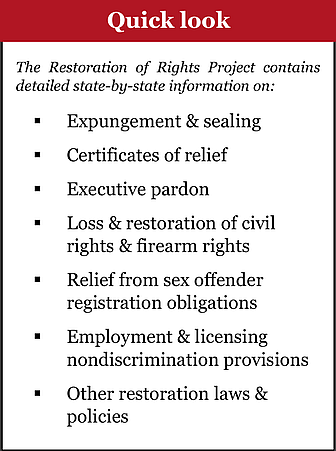
  The Collateral Consequences Resource Center and its partner organizations, the National Association of Criminal Defense Lawyers, the National Legal Aid and Defender Association, and the National HIRE Network, are pleased to announce the launch of the newly expanded and fully updated Restoration of Rights Project. The Restoration of Rights Project is an online resource that offers state-by-state analyses of the law and practice in each U.S. jurisdiction relating to restoration of rights and status following arrest or conviction.   Jurisdictional “profiles” cover areas such as loss and restoration of civil rights and firearms rights, judicial and executive mechanisms for avoiding or mitigating collateral consequences, and provisions addressing non-discrimination in employment and licensing.  Each jurisdiction’s information is separately summarized for quick reference.    In addition to the jurisdictional profiles, a set of 50-state comparison charts summarizes the law and illustrates national patterns in restoration laws and policies.   We expect to supplement these resources in weeks to come with jurisdiction-specific information about organizations that may be able to assist individuals in securing relief, and information on other third-party resources. The resources that comprise the Restoration of Rights Project were originally published in 2006 by CCRC Executive Director Margaret Love, and she has continued to keep them updated.  As a result, the profiles and comparison charts have expanded over the years to broaden their scope and to account for the many changes in this complex area of the law.  Love’s research has recently been hosted by CCRC and NACDL, and it appears as an appendix to the treatise on collateral consequences published jointly by NACDL and Thompson Reuters (West). Project resources have now been re-organized into a unified online platform that makes them easier to access, use, and understand. The short “postcard” summaries of the law in each state — which serve as a gateway to more detailed information — have also been reviewed and revised to provide a more current and accurate snapshot of applicable law in each state. The Project is intended as a resource for practitioners in all phases of the criminal justice system, for courts, for civil practitioners assisting clients whose court-imposed sentence has exposed them to additional civil penalties, for policymakers and advocates interested in reentry and reintegration of convicted persons, and for the millions of Americans with a criminal record who are seeking to put their past behind them. The Restoration of Rights Project is available now at: http://restoration.ccresourcecenter.org Read more

“Old Writ Could Give Ex-Offenders a New Start”

Joe Palazzolo has posted at the Wall Street Journal Blog an article describing an amicus brief filed yesterday in United States v. Jane Doe (Jane Doe II), one of two federal expungement cases before Judge John Gleeson that we’ve been following.  Argument in Jane Doe II is now scheduled for October 26.  (The government has appealed Judge Gleeson’s May 21 expungement order in Jane Doe I to the Second Circuit Court of Appeals.)  The brief begins like this: This Court invited the views of Amica on the Court’s authority to issue “a certificate of rehabilitation in lieu of expungement” and the appropriateness of issuing such a certificate in this case. While there is no federal statute that authorizes a court to issue relief styled as a “certificate of rehabilitation,” Amica wishes to bring to the Court’s attention two mechanisms, each perhaps underappreciated but with deep historical roots, by which the Court may recognize an individual’s rehabilitation and otherwise address issues such as those raised by petitioner’s case. The first is by exercising its statutory authority to issue a writ of audita querela, which is available in extraordinary circumstances under the All Writs Act, 28 U.S.C. §1651, to grant a measure of relief from the collateral consequences of conviction. The second is by recommending to the President that he grant clemency. The blog post describing the brief is reprinted in full after the jump. October 9, 2015 Old Writ Could Give Ex-Offenders a New Start by Joe Palazzolo A federal case in Brooklyn may offer a solution for some ex-offenders struggling to find work because of their criminal convictions. Most states permit certain types criminal records to be expunged, sealed or otherwise concealed from public view. Some allow ex-offenders to seek certificates of rehabilitation that exempt them from felony-related sanctions such as those barring people with criminal records from obtaining professional licenses. But in the federal system, which has nothing akin to expungement or a certificate program, convictions can mark people for life, compromising their prospects for jobs and housing, among other things. Many believe such consequences are an appropriate deterrent. A growing number of policymakers, judges and law enforcement officials, however, question the wisdom of limiting job opportunities for ex-offenders, who are less likely to return to prison when they find stable employment, research shows. Margaret C. Love, a former Justice Department pardon attorney, and a group of lawyers from Jones Day LLP have dusted off an 18th century law that they believe has a modern application for ex-offenders who have served their time but face obstacles related to their convictions. Part of the 1789 All Writs Act, the writ of audita querela allows courts to relieve the consequences of an otherwise valid judgment. It was used by debtors against creditors in the nation’s early days, but federal and state courts have more recently recognized the writ’s usefulness in other cases, including when a criminal conviction “gives rise to a subsequent injustice,” the lawyers wrote in a brief filed Friday in federal district court in Brooklyn. Ex-offenders could make a strong case for audita querela relief when a law or regulation strips them of a right to which they otherwise would be entitled, the brief said. For instance, a conviction-based restriction that results in job loss could violate due process rights by depriving an ex-offender of a fundamental property interest. Losing the ability to possess a gun as a result of a conviction could violate the Second Amendment. “In such a case, a person convicted of an applicable crime would have a legal or, technically, constitutional objection to the continued enforcement of the judgment, thereby meeting the requirements for audita querela relief,” the brief said. Ex-offenders could also seek relief under the writ “where the totality of the circumstances make continued enforcement of the judgment, in whole or in part, unjust,” the lawyers wrote. Courts could grant their requests by vacating convictions or issuing orders lifting sanctions against ex-offenders. The brief was filed at the invitation of U.S. District Judge John Gleeson in a case involving a woman convicted of health-care fraud who is seeking to have her record expunged. Judge Gleeson expunged the conviction of another defendant in the scheme earlier this year, in what legal experts said was the first instance of a federal judge erasing a criminal record on the grounds that it interfered with employment. The Justice Department is appealing his order in that case. The woman in the latest case, identified as 56-year-old Jane Doe in court documents, drove a car in a staged collision and claimed to have received medical services, as part of a scheme to collect insurance money. She was sentenced in 2003 to 15 months in prison, and her nurse’s license was suspended for two years. Her criminal record has prevented her from maintaining employment, she said in her June petition. The Justice Department disputed that federal judges can erase convictions for “equitable reasons,” such as difficulty finding work, and even if they could, her case wouldn’t merit it, prosecutors said in court documents. No federal appeals court has held that judges have the power to expunge valid convictions absent “extreme circumstances,” the department said. Read more

Clemency is Not the Answer (Updated)

This piece was originally published in The Crime Report on July 13, and republished in revised form on July 16. On Monday President Obama announced in a video address that he had commuted the sentences of 46 people sentenced to long prison terms for drug offenses.  His counsel, Neil Eggleston, stated that “While I expect the President will issue additional commutations and pardons before the end of his term, it is important to recognize that clemency alone will not fix decades of overly punitive sentencing policies.“ Mr. Eggleston added that “the President is committed to using all the tools at his disposal to remedy unfairness in our criminal justice system.” However, judging from his speech to the NAACP the next day, clemency is the only one of those tools that is calculated to result in any more prison releases. The President has now issued 89 commutations, the most since Lyndon Johnson.  But even if the President ends up granting triple that number or more, it will hardly make a dent in the number of those in prison potentially eligible for relief under the announced standards of the Administration’s clemency initiative.   As Douglas Berman observed recently in his Sentencing Law and Policy blog, if the President one week were to commute as many as 80 federal drug prisoners, “this would still not be as substantively consequential for the federal prison population as the 400-plus drug defendants who will be sentenced to lengthy federal prison terms the very same week!” Meanwhile, the system for administering the clemency initiative is reportedly having difficulty gaining traction.  On July 4, the New York Times reported in a front page story that more than 30,000 federal prisoners have filed applications for commutation of sentence with Clemency Project 2014, the consortium of private organizations formed last year to assist the Justice Department in identifying worthy cases, but that a “cumbersome review process” has allowed only “a small fraction” of them to reach the President’s desk. A press release issued by Clemency Project 2014 shortly after the grants were announced conceded that only four of the 46 cases had been submitted under its auspices, and a review of the recipients of clemency reveals that several did not satisfy the Justice Department’s declared eligibility requirement of ten years already spent in prison.  Some prisoners have now expressed concern that perhaps the blessing of this Project was not the “fast track” to relief they had imagined. There is a growing sense of urgency among those who are responsible for organizing the clemency effort, in the Department of Justice and in the private bar.  In a recent training of volunteer counsel representing clemency applicants, Pardon Attorney Deborah Leff urged them not to delay in getting their clients’ petitions filed. “If there is one message I want you to take away today, it’s this: Sooner is better,” Leff said. Some federal public defender offices have been urged by Clemency Project 2014 to identify worthy applicants from among their client base and submit petitions for them prior to January 20, 2017, since it may take as much as a year for the Administration to review them. But even with the extraordinary resources that have been devoted to identifying prisoners who meet the Justice Department’s eligibility criteria, it seems unlikely that this task can be given more than a lick and a promise before the clock runs out on President Obama’s term. It is not clear if it was the Administration’s original intention to try to reach all deserving cases through clemency, but that goal seems chimerical.  It must now be conceded that a large percentage of the applications that have been filed, whether with Clemency Project 2014 or directly with the Pardon Attorney, will not have even been looked at by the end of this President’s term. Looking back on the 18 months since the clemency initiative was launched, what have we learned? For starters, we’ve learned that the problem of unjust sentences is simply too large and too pervasive to deal with through the clemency mechanism.  When Lyndon Johnson commuted 200 drug sentences in the 1960s, almost everyone then in prison who deserved relief got it, thanks to the staffing efforts of the Bureau of Prisons.  Today, given the massive number of people prosecuted for federal drug crimes in the past 25 years and the fundamental rethinking of federal drug sentences now underway, potentially deserving prisoners are legion. Between 1990 and 2007, nearly 10,000 people were sentenced to prison terms of 30 years or more for crimes involving drugs or firearms.  Twice that number received sentences of at least 20 years.  Trying to produce useful and reliable advice for the President about more than a token number of these individuals is too great a burden for the Justice Department’s tiny pardon staff. But the President cannot be expected to put his reputation on the line on the basis of anything less. In addition to the practical problems raised by trying to force so many prisoner petitions through an administrative bottleneck onto a busy President’s plate, there are institutional reasons why executive clemency is the wrong tool for dealing with systemic problems in the penal system.  Even if a more efficient way of administering the pardon power could have been devised (say, the high-level clemency commission that some states use), this would not have fully put to rest the perennial suspicion the public has about pardoning.   As I wrote shortly after the final Clinton pardons, “as a practical matter [the pardon power] cannot be exercised except pursuant to a process that is perceived as accessible and fair.” As far as substantive fairness is concerned, that has never been expected of clemency.  On the other hand, the diversity within the group of 46 grantees just in terms of length of time in prison has raised questions among prisoners and their lawyers about the fairness of the Justice Department’s method of selection, and about why more of those proposed for relief by Clemency Project 2014 were not chosen. Now that clemency has been harnessed to deal with a system-wide problem involving thousands of potentially eligible individuals, many expect greater attention to a justice-based model of fairness. The words “random” and “lottery” that had temporarily disappeared from conversations about clemency began to surface as soon as the grants were announced. Other institutional concerns are raised by too great a reliance on clemency to deal with a systemic problem in the legal system: this disrespects both the key role played by courts in determining the quantum of punishment under federal sentencing policies, and the legitimate concerns of Congress for the rule of law. Finally, there are philosophical as well as institutional and practical reasons why our justice system is built upon accountable judicial decision-making under statutory authority, and not upon the unstructured and unexplained discretion of a president exercising a plenary constitutional power.  With all due respect to Alexander Hamilton’s Federalist 74, most scholars today subscribe to the vision of Enlightenment philosopher Cesare Beccaria, who proposed in 1764 that “Clemency is a virtue which belongs to the legislator, and not to the executor of the laws; a virtue which ought to shine in the code, and not in private judgment.” (Hamilton might have agreed with Beccaria had he not had such a bad experience with the Continental Congress and such a good one with his mentor George Washington.) Perhaps the most that can be hoped for from the Obama clemency initiative is that it will shine a light on excessive federal prison sentences as a pressing problem of justice, extend mercy to a few fortunate individuals, and signal the need for a more systematic approach. In a word, if clemency is not the entire answer to the systemic problem of excessive sentences, it can still serve its time-honored function of pointing the way to a resolution through the legal system. Looking ahead to the likely denouement of its clemency initiative with only a few hundred token grants, the Obama Administration ought to be exploring ways it can bring cases back to court for the relief so many deserve.  Thankfully, this will not require new legislation or new funds, since there is already on the books a judicial sentence reduction authority that could easily be used. Specifically, 18 U.S.C. § 3582(c)(1)(A)(i) provides that a court may at any time reduce a sentence upon motion of the Bureau of Prisons (BOP) for “extraordinary and compelling reasons.” The Sentencing Commission is authorized under 28 U.S.C. § 994(t) to establish policy for courts considering BOP motions under § 3582(c)(1)(A)(i), which it has done under USSG ¶ 1B1.13. Under this policy guideline, “extraordinary and compelling reasons” that may justify sentence reduction include illness, disability, old age, exigent family circumstances, and any other reason that the Justice Department may determine falls within that category. It is noteworthy that several of the organizations currently participating in the clemency initiative, including the American Bar Association, are on record with the Sentencing Commission as favoring a more expansive menu of “extraordinary and compelling reasons” warranting sentence reduction, including one that now seems prescient: “The defendant would have received a significantly lower sentence under a subsequent change in applicable law that has not been made retroactive.” Less than two years ago, BOP issued a new policy statement with a list of circumstances in which it may seek a sentence reduction, a list that is evidently not intended to be exhaustive.  Accordingly, there is no reason why BOP could not determine that “extraordinary and compelling reasons” exist in any case meeting the criteria set forth by Administration as warranting a grant of clemency. The coincidence of the standards in the two contexts would be particularly fitting in light of the fact that the judicial sentence reduction authority in § 3582(c)(1)(A)(i) was originally enacted in 1976, at the Justice Department’s instance, to expedite sentence reductions that previously had required a clemency application to be submitted to the President.   All it would take to make this happen would be a resolve on the part of the Department to use this statute for the purpose it was originally intended. Augmenting the Administration’s clemency initiative through broader use of a judicial sentence reduction mechanism, which the Justice Department’s own Inspector General has repeatedly criticized as underutilized (most recently for aging prisoners), would put sentence reduction on a sounder long-term footing that is more consistent with the principles of determinate sentencing, be more predictable and accountable as a practical matter, and respond to any concerns about the unaccountable use of executive power. And, because a large scale sentence reduction program is already underway in the federal courts, economies of scale would be possible. Many years ago, when I was serving as Pardon Attorney, then-Deputy Attorney General Philip Heymann asked me why we should ask the President to commute the sentence of an elderly prisoner when (he said) “we can do the job ourselves.” Now I would ask the current Deputy Attorney General the same question.   NOTE: On August 7, the United States Sentencing Commission announced its decision to make possible amendments to USSG § 1B1.13, the guideline for courts considering motions for sentence reduction filed under 18 USC § 3582(c)(1)(A)(i), a priority for the 2016 amendment cycle.  The Practitioners’ Advisory Group is expected to urge the Commission to expand the guideline to reach cases that would ordinarily be considered for clemency relief, including those of prisoners who would have received a less severe sentence under current law.      Read more