Tag: Colorado

Oklahoma and California win Reintegration Champion awards for 2022 laws

On January 10 we posted our annual report on new laws enacted in 2022 to restore rights and opportunities to people with a record of arrest or conviction. Like our earlier reports, it documents the steady progress of what we characterized two years ago as “a full-fledged law reform movement” aimed at restoring rights and dignity to individuals who have successfully navigated the criminal law system.

This year’s criminal record reforms bring the total number of separate laws enacted in the past five years to more than 500. Posted below is our fourth annual legislative Report Card recognizing the most productive states in 2022.

Reintegration Awards for 2022

While more than a handful of states enacted noteworthy laws in 2022, two states stand out for the quantity and quality of their legislation:  California and Oklahoma share our 2022 Reintegration Champion award for their passage of at least two major pieces of record reform legislation.

  • California – Enacted a whopping 11 new laws, including the broadest general record clearing law in the nation, a direction to courts to effectuate clearing of marijuana records, removal of restitution as a bar to clearing criminal records, easing access to judicial certificates of rehabilitation, and simplification of the process for certifying people with criminal records to work in community care. California’s governor also vetoed a bill that would have facilitated background screening by eliminating court-imposed restrictions on online access to personal identifying information.
  • Oklahoma – Enacted a major automatic record clearing law and the most sweeping update to an occupational licensing scheme of any state in the country this year. Oklahoma also passed a significant law allowing young people who successfully complete the state’s youthful offender program to have their charges dismissed and expunged.

Another eight states earned an Honorable Mention for their enactment of at least one significant new record reform law: Read more

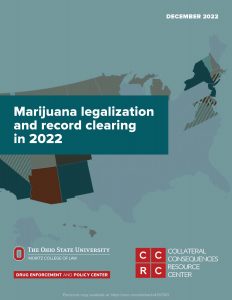
Marijuana legalization and record clearing in 2022

CCRC is pleased to announce a new report on recent cannabis-specific record sealing and expungement reforms in the past 18 months. The report, extending CCRC’s fruitful collaboration with the Drug Enforcement and Policy Center at The Ohio State University, is available here

An accompanying infographic (reproduced at the end of this postr) summarizes the report’s findings, and includes a color-coded US map showing which states have enacted cannabis-specific record-clearing provisions.  To supplement the map, the report includes an appendix classifying and describing marijuana-specific record clearing statutes in all 50 states, based on CCRC’s 50-state comparison chart on “Marijuana Legalization, Decriminalization, Expungement and Clemency.” 

To put our new report in context, CCRC and DEPC reported 18 months ago on an “unprecedented period for policymaking at the intersection of marijuana legalization and criminal record reform in the first months of 2021,” with four states (New Jersey, New Mexico, New York, and Virginia) legalizing marijuana possession and at the same time providing criminal record relief for past convictions along with a variety of social equity provisions. 

Our report shows this trend continuing into 2022. Since our 2021 report, four additional states (Connecticut, Maryland, Missouri, and Rhode Island) have adopted similar record-clearing provisions in connection with adult-use cannabis legalization, authorizing sealing and expungement provisions that in most cases extend well beyond convictions for legalized conduct.

All four states made at least some relief automatic, removing the burden of a criminal record from many individuals while raising the bar on standards for marijuana record relief nationwide. Like the four states discussed in our earlier report, these four also address racial disparities in marijuana criminalization by directing tax revenue and business opportunities for legal marijuana to individuals and communities disproportionately affected by criminal law enforcement. During this same timeframe, three additional states (California, Colorado, and Massachusetts) enhanced their existing marijuana-specific record sealing statutes.

Read more

Dozens of new expungement laws already enacted in 2021

This year is turning out to be another remarkable year for new record relief enactments. In just the first six months of 2021, 25 states enacted no fewer than 51 laws authorizing sealing or expungement of criminal records, with another 5 states enrolling 11 bills that await a governor’s signature. Three of these states authorized sealing of convictions for the first time, seven states passed laws (or enrolled bills) providing authority for automatic sealing, and a number of additional states substantially expanded the reach of their existing expungement laws.

This post hits the highlights of what may well be the most extraordinary six-month period in the extraordinary modern period of criminal record reform that begin in 2013.  The only closely comparable period is the first six months of 2018, when 11 states enacted major reforms limiting consideration of criminal records in occupational licensing.  Further details of the laws mentioned below can be found in the relevant state profiles from the Restoration of Rights Project.

(An earlier post noted new occupational licensing laws in 2021, and subsequent ones will describe significant extensions of the right to vote so far this year, and summarize the more than 100 record reforms enacted to date.) Read more

New Jersey puts “fair chance housing” on the national agenda

People with a record frequently experience challenges in obtaining or maintaining housing. For those who have been incarcerated, on supervision, charged, and/or arrested, the background check for rental applications can be a persistent obstacle. Lack of stable housing is a major roadblock to successful reintegration into the community or the pursuit of social and economic opportunities. It is therefore encouraging that states have begun to enact laws limiting record-based disqualifications in housing decisions.

On June 18, New Jersey Governor Phil Murphy signed into law the Fair Chance in Housing Act, the most rigorous state legislation to date limiting consideration of criminal records in housing decisions. During a ceremony to commemorate Juneteenth, he described the new law as a step to “level what has been for too long an uneven playing field when it comes to access to housing,” explaining that it will bar landlords from asking about criminal history in most instances. The NAACP New Jersey State Conference, Latino Action Network, Fair Share Housing Center, and New Jersey Religious Action Center of Reform Judaism led organizational advocacy for the measure. Senator Troy Singleton, one of the bill’s primary sponsors, cited the “staggering amount of data on the national level that shows securing housing is one of the key barriers to reducing recidivism,” according to the New York Times. “This measure will allow those who have paid their debt to society to move forward with their lives in a productive manner.” Another sponsor, Assemblyman Benjie Wimberly, noted that “We’re fighting generational poverty, homelessness, and hopelessness through social justice reform measures such as this one.”

With New Jersey’s legislation—following on the heels of laws enacted in 2019 in Colorado, Illinois, and New York, legislation in D.C. in 2017, and a slew of local ordinances since 2016— “fair chance housing” has arrived on the national reintegration agenda. While many states have adopted reforms that limit the use of criminal records in employment and occupational licensing, until these recent developments housing does not appear to have been a priority for lawmakers, at least at the state level.

Read more

Illinois set to become fifth state to cover criminal record discrimination in its fair employment law

NOTE: Governor Pritzker signed S1480 into law on March 23.

In our recent report on criminal record reforms enacted in 2020, we noted that there were only four states that had fully incorporated criminal record into their fair employment law as a prohibited basis of discrimination. These states (New York, Wisconsin, Hawaii, and California) provide that employers can only disqualify a person based on their record if it meets a specific standard, such as being related to the work in question or posing an unreasonable risk to public safety. Illinois will become the fifth state to take this important step as soon as Governor Pritzker signs S1480.

Illinois has been working up to this, having amended its Human Rights Act in 2019 to prohibit employment discrimination based on “an arrest not leading to a conviction, a juvenile record, or criminal history record information ordered expunged, sealed, or impounded.” With S1480, Illinois has now taken the final step of incorporating criminal record fully into the law’s structure, which includes authorization to file a lawsuit in the event administrative enforcement is unsatisfactory. A preliminary analysis of the new Illinois law indicates that it now offers more protection for more people with a criminal record in the employment context than any state in the Nation other than California.

The provisions of the Illinois bill, enrolled and sent to the governor for signature on February 12, are described below.  We then compare them with the laws in the four other states that incorporate criminal record into their fair employment law. This post notes the handful of additional states that have fortified their record-related employment protections in recent years, then summarizes relevant reforms that were enacted in 2020.

Read more