Living with a marijuana conviction after legalization (updated)

Jacob Sullum, senior editor at Reason, has written a fabulous article about expungement of marijuana convictions in places that have since legalized marijuana: so far 10 states, DC, and the Northern Mariana Islands have legalized.  The piece is currently available to Reason subscribers and will be available to the public in the coming weeks (we will update this post with the link).

Sullum tells the stories of eleven individuals, from the jurisdictions that have legalized, who describe how their marijuana convictions have impacted their lives before and after legalization.  He documents the lingering legal and social sanctions that burden people long after they have served their sentences, sanctions that “seem especially unjust and irrational in the growing number of U.S. jurisdictions that have legalized marijuana for recreational use.”

Read more

Expungement in Indiana – A radical experiment and how it is working so far

Note: This is the first of what we anticipate will be a series of reports on some of the more progressive restoration schemes enacted in the past several years.  

Marion County Deputy Prosecutor Andrew Fogle says the four years since Indiana enacted a broad “second chance” law have been like “the Wild West.”  Fogle, who oversees petitions for expungement for his office in Indiana’s most populous county, agreed to be interviewed about what may be the Nation’s most comprehensive and creative scheme to overcome the adverse effects of a criminal record.  We also spoke about the law to a number of criminal defense attorneys and legal service providers in the State.  

Indiana’s expungement law, first enacted in 2013 and amended several times since, extends to all but the most serious offenses, although the effect of relief as well as the process for obtaining it differs considerably depending on the offense involved.  Perhaps most important, the term “expungement” doesn’t have the same meaning in Indiana as it has in most states, because it doesn’t necessarily result in limiting access to the record.1

Read more

New report: Roundup of 2017 expungement and restoration laws

A new report from the Collateral Consequences Resource Center shows that states across the country are continuing to expand opportunities to avoid or mitigate the adverse effects of a criminal record.  If anything, the trend first documented last winter in Four Years of Second Chance Reforms, 2013 – 2016 has accelerated in 2017. 
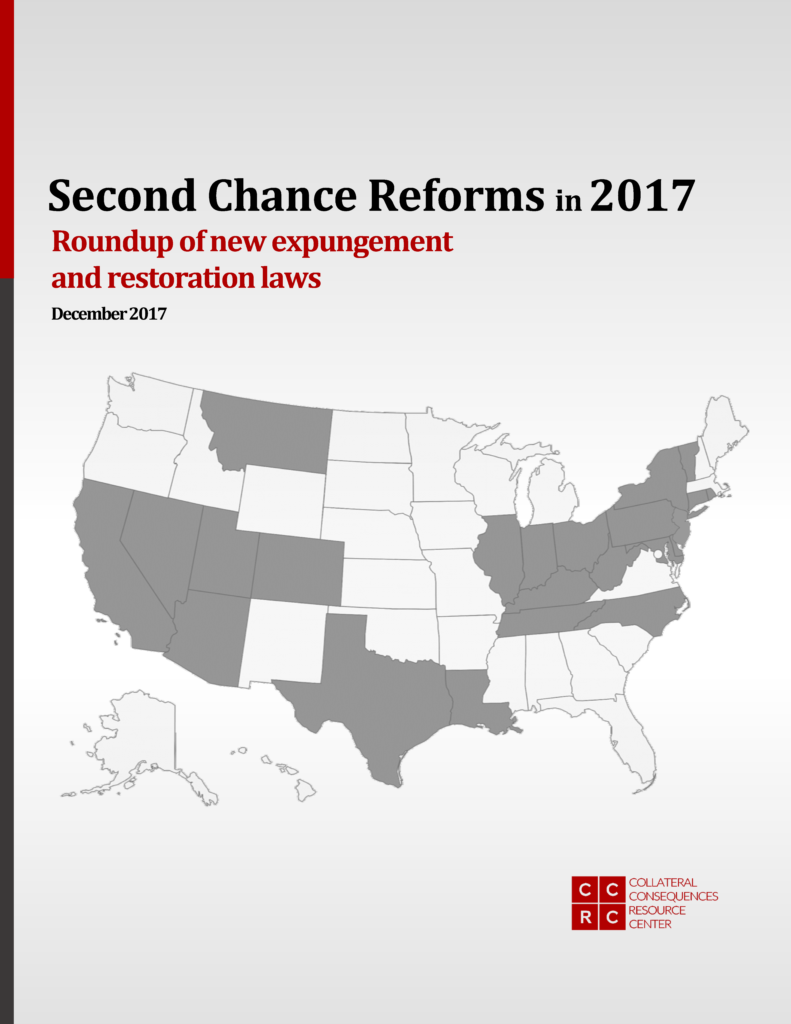
Second Chance Reforms in 2017 identifies 23 states, blue and red, that in the past year broadened existing second chance laws or enacted entirely new ones, enhancing the prospects for successful reentry and reintegration for many thousands of Americans.  Using research from the Restoration of Rights Project, the report describes specific changes to the law in each state during the past year along with relevant citations, analyzing and comparing approaches taken by different states.

The most frequent type of reform involves limiting public access to criminal records: new sealing or expungement laws were enacted in several states that previously had none, eligibility requirements were relaxed for many existing record-sealing authorities, and new limits were imposed on access to non-conviction and juvenile records – all making it easier for more individuals to get relief at an earlier date. However, there is remarkably little consistency among state record-closing schemes, and most states extend relief only to less serious offenses after lengthy eligibility waiting periods. Moreover, eligibility criteria are frequently so complex as to defeat the sharpest legal minds. Other recurring reforms limit employer inquiries into criminal history at the application stage, and a few states enacted administratively enforceable standards for consideration of criminal history in employment and licensing.

The fast pace of reform in the states reflects a dawning realization that the problem of mass conviction is at least as significant in economic and social terms as the problem of mass incarceration.  At the same time, the dizzying variety and complexity of the new provisions indicates that there is still no consensus about the most effective way to avoid or mitigate the adverse effects of a criminal record. Because there has been very little empirical research into the relative effectiveness of different forms of relief, it is not surprising that experimentation seems to be the order of the day.

These new laws and significant reform proposals of the past several years – notably the collateral consequences provisions of the Model Penal Code: Sentencing – will be discussed at a Roundtable conference in Washington, D.C. on January 12, 2018, sponsored by the American Law Institute and the National Conference of State Legislatures.

Each new reform is more fully explained in the state-by-state profiles in the Restoration of Rights Project.  The Executive Summary follows, and the full report is available here.    

Read more

CCRC files amicus brief in Illinois sex offender case

The CCRC has filed an amicus brief in the Illinois Supreme Court in support of the appellant in People v. Bingham, a case challenging the constitutionality of a state law requiring registration as a “sexual predator” based on the commission of a non-sexual offense.  The relevant facts of the case are as follows.

Jerome Bingham was convicted of attempted sexual assault in 1983 and served several years in prison on that charge.  At the time, Illinois did not have a sex offender registration requirement.  Thereafter, Bingham was convicted of a number of petty drug and theft offenses.  In 2012, Illinois enacted an amendment to its sex offender registration act (SORA) providing that its registration requirement would apply retroactively to anyone who had previously committed a qualifying sex offense and, subsequent to the 2012 act, committed any felony.  In 2013, Bingham stole goods worth $72 from a K-Mart storage lot.  Although this would ordinarily have been a misdemeanor, the fact that he had a prior similar offense permitted it to be charged as a felony, which it was, thereby subjecting him to the sex offender registration requirement.

Read more

CCRC publishes California Compilation of Collateral Consequences

The CCRC is pleased to announce the publication of the California Compilation of Collateral Consequences (CCCC), a searchable online database of the restrictions and disqualifications imposed by California statutes and regulations because of an individual’s criminal record.  Federal collateral consequences can also be searched through the CCCC database.

This new resource follows on the heels of similar compilations of collateral consequences that CCRC has developed of federal laws and rules, and of two other state systems (Wisconsin and Vermont).  The database builds on research originally published in 2014 by the American Bar Association, brought up to date and restructured to permit more precise searches of the specific activities and rights affected by various consequences.  A redesigned search function makes it easier to explore the relationship between consequences and their implementing regulations, and among different consequences in state and federal law. Users may access directly complete and current statutory and regulatory text for each consequence.

Read more