Category: Uncategorized

Oklahoma enacts automatic record clearing law

On May 2, 2022, Oklahoma Governor Stitt signed into law a comprehensive process making expungement automatic for all otherwise eligible misdemeanors and a range of non-conviction records.  See HB 3316, enacting 22 Okla. Stat. Ann. § 18(C).  Oklahoma thus becomes the tenth state to join the bipartisan trend toward broadening the availability of record clearing to people with convictions, without requiring them to file a petition and go to court for relief.  In addition to these states, another 10 states now make expungement automatic for non-conviction records. 

The Oklahoman reported that the “clean slate” bill passed the House and Senate with strong bipartisan support, with a combined five votes against, and it was promptly signed into law by Oklahoma’s Republican governor.  The bill’s primary sponsor Rep. Nicole Miller, R-Edmond, said that “There was certainly a general consensus that, you know, this this isn’t anything that’s partisan related; what it’s about is it’s about humans. So this is really a measure to help people.” 

Under Oklahoma law expunged records are sealed, but remain available to law enforcement and may be used in subsequent prosecutions.  Any record that has been sealed may be ordered “obliterated or destroyed” after an additional 10 years.  § 19(K).  Oklahoma also authorizes its courts to expunge up to two non-violent felonies, andn also pardoned felonies, but these were not included in the new law (styled “clean slate”).  The law is effective November 1, 2022, and the process for automatic expungement is to commence three years after that date.   

The Oklahoma process for expunging records without a petition is spelled out in a new § 19(B): the Oklahoma Bureau of Criminal Investigation must provide a list of eligible cases to the prosecutor on a monthly basis for a 45-day review.  The prosecutor mayh object only for specified reasons:  the case does not meet the definition of a clean slate eligible case; the individual has not paid court-ordered restitution to the victim; or “the agency has a reasonable belief, grounded in supporting facts, that an individual with a clean slate eligible case is continuing to engage in criminal activity, whether charged or not charged, within or outside the state.”  A list of cases as to which there has been no objection is then sent to the court for expungement.  The court must expunge all cases on the list sent to it, and notify all agencies holding records directing them to expunge as well.  The law does not provide for notifying individuals in case of prosecutor objection, or after their record has been expunged, al though the state supreme court and the BCI are authorized to make rules governing the process.  The BCI is required to provide to the legislature a list of individuals whose records have been expunged on an annual basis.  Read more

Executive Pardon: A National Survey

Last week we announced the forthcoming publication of a national report surveying various legal mechanisms for restoring rights and opportunities following arrest or conviction, a revision and updating of our 2020 report “The Many Roads to Reintegration.” The first post in the series (“Expungement, Sealing & Set-Aside of Convictions“), published on February 25, gives some additional background about the report. The second post in this “preview” series (“Fair Chance Employment & Occupational Licensure“) was published on February 26.

Today’s post concerns the role that executive pardon plays in supplementing and in some cases providing the only record relief following conviction. We expect to publish the whole national report, plus our Reintegration Report Card for 2022, later this week.

*******

Executive Pardon: A National Survey

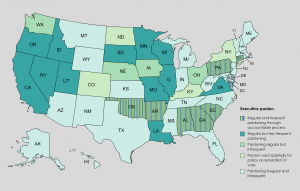
Pardon has been described as the patriarch of restoration mechanisms, whose roots in America are directly traceable to the power of the English crown. Just as a power to pardon was assigned to the president in Article II of the U.S. Constitution, the constitution of every state save two provides for an executive pardoning power.[1]  Both in theory and practice, pardon is the ultimate expression of forgiveness and reconciliation from the sovereign that secured the conviction.

For almost two centuries, executive pardon played a routine operational role in criminal justice systems throughout the United States, dispensing with or mitigating court-imposed punishments and, after a sentence had been served, restoring rights and status after conviction.

Nowadays, in many U.S. jurisdictions pardon is a shadow of its once-robust self, particularly in those where it is exercised without institutional restraint or encouragement. Since the 1980s, governors and presidents alike have been wary of exposing themselves to public criticism from an ill-advised grant.  In many jurisdictions pardoning has stopped being thought of as part of the chief executive’s job — though being labeled “soft on crime” seems thankfully no longer a political kiss of death. Still, it is not surprising that reformers tend to regard pardon with suspicion, dubious about its legitimate operational role in the modern justice system.

Yet pardon fills significant gaps in record relief schemes across the country, supplementing judicial record relief mechanisms like sealing and expungement. For example, in 20 states pardon offers the only way to regain firearms rights lost because of conviction, including California, Colorado, Florida, Georgia, Nebraska, Oklahoma, and Wyoming. In 11 states ineligibility for jury service is permanent without a pardon, including Arkansas, Delaware, Oklahoma, Pennsylvania, South Carolina, and Texas. (By comparison, expungement restores firearms rights in only five states, and jury rights in only two.[2]) A pardon may be necessary to enable a person to stand for elected office, or to demonstrate the requisite good character to secure a professional or business license.

Read more

Fair Chance Employment and Occupational Licensure: A National Survey

Yesterday we announced the forthcoming publication of a national report surveying various legal mechanisms for restoring rights and opportunities following arrest or conviction, a revision and updating of our 2020 report “The Many Roads to Reintegration.” The first post in the series (“Expungement, Sealing & Set-Aside of Convictions“) gives some additional background about the report. This second post in this “preview” series deals with how the law regulates consideration of criminal history in employment and occupational licensing. We expect to publish the whole report, plus our Reintegration Report Card for 2022, early next week.

Fair Chance Employment & Occupational Licensing
Introduction

There is perhaps no more critical aspect of a reintegration agenda than removing the many unjustified and unjustifiable barriers faced by people with a criminal record in the workplace.[1] In an era of near-universal background checking and search engines, the “Mark of Cain” these individuals bear will sooner or later be known to potential employers and licensing boards even if criminal record information is not requested on an initial application.

Some barriers take the form of laws formally disqualifying people with certain types of convictions from certain types of jobs or licenses. More frequently, barriers result from informal discrimination grounded in an aversion to risk and, too frequently, racial stereotypes. Whether it is securing an entry level job, moving up to management responsibilities, or being certified in a skilled occupation, people with a criminal record are at a competitive disadvantage, if they are even allowed to compete. As between two individuals with hypothetically equal qualifications, it is easy for a risk-averse prospective employer or licensing agency to justify breaking the tie in favor of the person who has never been arrested.

Individualized record relief mechanisms like expungement or pardon are intended to improve employment opportunities, and they can be helpful on a case-by-case basis to those who are eligible and able to access them.[2] But equally important are fair employment and licensing laws that impose general standards limiting consideration of criminal record and provide for their enforcement, offering class-wide relief to all similarly situated individuals. States have enacted an impressive number of this sort of systemic “clean slate” law[3] just since 2015, some building on laws enacted in an earlier period of reform half a century ago in the 1960s and 1970s,[4] and others breaking new ground in regulating how employers and licensing agencies consider an applicant’s criminal record.

In employment, one of the most striking legislative trends in the past decade is the embrace of limits on inquiry into criminal history in the early stages of the hiring process, particularly for public employment. The so-called “ban-the-box” campaign that began modestly more than 20 years ago in Hawaii and took off nationwide after it was adopted in California, has now produced new laws or executive orders in more than two-thirds of the states and in over one hundred cities and counties. More efficient and broadly effective than after-the-fact lawsuits, ban-the-box laws now represent the primary tool for eliminating unwarranted record-based employment discrimination on a system-wide basis. They are premised on an expectation that getting to know applicants before learning about adverse information in their background is likely to lead to a fairer and more defensible hiring decision. This should be particularly true when a records check is permitted only after a conditional offer of employment has been made, so there is little doubt about the reason in the event of a later withdrawal.[5] A few states (though still too few) have coupled ban-the-box strategies with standards for considering a person’s record after inquiry is permitted.
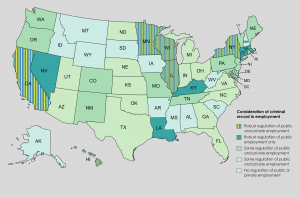
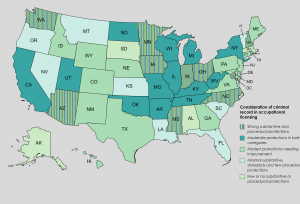
Occupational licensing has also seen an acceleration of legislative efforts to limit the arbitrary rejection of qualified workers. Significant procedural and substantive reforms have been enacted in more than two thirds of the states in the last five years, in some cases building on reforms originally adopted in the 1970s, and in others following models recently proposed by policy advocacy organizations from across the political spectrum whose model laws aim to make licensing authorities newly accountable for their actions and individuals newly able to obtain and practice a skill with enhanced career prospects. Following these models, states have

  • substituted objective standards related to the specific occupation for vague “good moral character” criteria;
  • afforded individuals a preliminary decision about whether their record will be disqualifying before they invest in education or training;
  • prohibited consideration of certain records considered unrelated to job performance, including based on their minor or dated nature;
  • required licensing agencies to justify negative decisions, frequently in terms of public safety, and to afford disappointed applicants an opportunity to appeal;
  • imposed legislative oversight requirements to hold licensing agencies accountable for their performance.

As shown in the following discussion and in the “Report Card” maps that follow the section, almost every state now has at least some law aimed at limiting record-based discrimination in employment or licensure, and most have both. Enforcement of these new laws may in many cases depend on education and persuasion rather than on lawsuits and executive orders, but this may make systemic change come sooner and have a more lasting effect. The very exercise of repeatedly having to decide the relevance of an individual’s past conduct through a transparent and accountable process is likely to result in more reliable decision-making, and a better understanding of those relatively few instances when denial of opportunity is justifiable. We discuss the state of the law in greater detail in the following sections.

Read more

CCRC seeks intern to assist with Restoration of Rights Project

The CCRC is seeking an Intern to assist its legal staff in maintaining the Restoration of Rights Project. The RRP is a collection of laws and policies in each U.S. jurisdiction relating to restoration of rights and status following arrest or conviction.

The RRP Intern’s primary duties would include tracking relevant legislative bills and collecting and summarizing new enactments, for analysis and entry into the RRP by CCRC legal staff. The RRP Intern may also have an opportunity to work on other issues, including keeping the practice resources on the CCRC website up to date and drafting short pieces for website publication. Duties and responsibilities will vary depending upon the interests and abilities of the incumbent.

The responsibilities of the position are more fully described here.

The RRP Intern position will be part-time, with hours and compensation negotiable. The Intern will work directly with the CCRC Executive Director, and it would be a suitable position either for a college student interested in the law or for a law student.

Qualifications:
• Interest in criminal law issues generally, with specific interest in policies related to the consequences of arrest or conviction.
• Research and writing ability, with a premium on attention to detail, thoroughness, and curiosity. Familiarity with criminal law and with the legislative process desirable.
• Microsoft Office skills, including Outlook, and experience in internet research. Experience with WordPress programs desirable.

TO APPLY: Submit the following materials to CCRC Executive Director Margaret Love at margaretlove@pardonlaw.com.
• Letter of interest
• Resume
• Writing sample


Oregon ramps up its clemency, record relief, and resentencing programs

Note: This is the second post in a series on state pardoning. The first discussed Governor Tony Evers’ reinvigoration of clemency in Wisconsin.

Oregon Governor Kate Brown, along with the state legislature, have reimagined how Oregon grants executive clemency, early release, and record relief. Brown has issued more pardons and commutations than any Oregon governor in recent history, according to Aliza Kaplan, the Director of the Criminal Justice Reform Clinic at Lewis and Clark University. In addition, Brown signed two bills into law this year that will significantly improve access to judicial remedies for people with a conviction record, thereby reducing the need for executive pardons. The bills, discussed in greater detail below, reduce barriers to record clearance via set-aside and sealing, and create a mechanism for prosecutors to agree to vacate a conviction or reduce a person’s sentence when it no longer serves the interests of justice.

In the first five years of her tenure, Governor Brown granted 20 pardons. From March 9, 2020, through November 2021, Governor Brown has granted 35 pardons. (This letter from the Governor to the state legislature covers the period from March 9, 2020 to June 25, 2021; according to Kaplan, Brown granted two more pardons between June and November.) Governor Brown pardoned people with a wide range of offenses, from murder, to DUI, narcotics possession, and other offenses. In at least one case pardon was granted based on a determination of innocence.

Read more