Category: Relief

Symposium on felony disenfranchisement set for Friday in Missouri

On Friday, April 12, a day-long symposium on felony disenfranchisement will be held at the University of Missouri in Columbia, MO.  The event, hosted by the Missouri Law Review and Kinder Institute on Constitutional Democracy, is open to the public.

Three panels of scholars will address: (1) the historical origins of conviction-based disenfranchisement and its consequences for democracy—featuring CCRC board member Gabriel “Jack” Chin, among other panelists; (2) felony disenfranchisement, voting rights, and elections; and (3) the democratic challenges of voting rights restoration.  Pamela S. Karlan will deliver the keynote.

For further reference, see our 50-state comparison chart documenting the loss and restoration of voting rights across the country; Gabriel “Jack” Chin’s recent book review: “New book argues collateral consequences can’t be justified”; and our comment on Professor Beth Colgan’s article on how inability to pay economic sanctions associated with a criminal conviction results in continuing disenfranchisement nationwide.
Bumper crop of new expungement laws expected in 2019

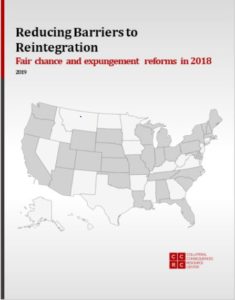
Earlier this year we reported that, in 2018, legislatures enacted an unprecedented number of new laws aimed at restoring rights and opportunities for people with a criminal record.  (Last year 32 states, D.C., and the U.S. Virgin Islands enacted 61 new laws to facilitate reentry and reintegration.)  The first quarter of 2019 has already produced a baker’s dozen of new restoration laws, some quite significant, indicating that this year is likely to be every bit as productive as last.  The 13 new laws enhance access to record-clearing relief, occupational licensing and employment, and executive clemency.  Also notable, if only for the sheer number of people who will benefit when the law goes into effect on July 1, is the Virginia legislature’s accession to Governor Ralph Northam’s request that it “eliminate[] the unfair practice of revoking a person’s driver’s license for failure to pay court fines and fees,” which will immediately reinstate driving privileges to more than 627,000 Virginians.

This year to date, state lawmakers have focused most of their attention on improving access to record-clearing: 8 of the 13 new laws expand eligibility for expungement and sealing and streamline applicable procedures.  The two most significant new laws were enacted in Western states.  Utah’s HB 431—signed by Governor Gary Herbert on March 28, 2019—provides for automated sealing relief for certain non-conviction, infraction, and misdemeanor conviction records.  When it takes effect on May 1, 2020, it will be the nation’s second “clean slate” law in operation (Pennsylvania’s first-in-the-Nation 2018 clean slate law will be implemented over a 12-month period beginning in June 2019).  Utah also clarified that employers may not ask about—and an applicant for employment need not disclose—expunged convictions (except under narrow exceptions for public employment).

Read more

PA’s new pardon chief was just pardoned himself

Freed from prison nine years ago, Brandon Flood is new secretary of Pa.’s pardon board

Philadelphia Inquirer, April 7, 2019

by Will Bunch

This column will probably come as something of a shock to all the people in Harrisburg who only know Brandon Flood – a bow-tied, bespectacled policy wonk with sartorial flair – as the persona that he laughingly calls “Urkel Brandon,” in a homage to one of TV’s most famous nerds.

Flood, now 36, readily admits most folks who know him from nearly a decade as a legislative aide or lobbyist will be shocked to learn of his past that includes boot camp for juvenile offenders, a physical scuffle with Harrisburg’s then-police chief, and finally felony convictions and two lengthy prison stints for dealing crack cocaine and carrying an unlicensed gun.

But starting last week, Flood’s turnaround saga has become a talking point and a mission statement for his new job as secretary of the five-member Pennsylvania Board of Pardons – anchoring one leg of a broader push in Harrisburg for criminal justice reform, aimed at giving more convicted felons a chance for clemency or to wipe their slate clean with a pardon.

What makes Flood’s appointment even more remarkable is that – to steal a phrase from TV infomercial lore – he’s not just Pennsylvania’s new top pardons administrator, he’s also a client. Gov. Wolf signed off on Flood’s own board-approved pardon, erasing his past convictions, just a few weeks before Flood stepped in as secretary.

Read more

Updated report on 2018 fair chance and expungement reforms

On January 10, 2019, we released a report documenting the extraordinary number of laws passed in 2018 aimed at reducing barriers to successful reintegration for individuals with a criminal record.  Since that time, we discovered five additional laws enacted in 2018 (in AL, PA, OR, MO, and the U.S. Virgin Islands), and have updated our report accordingly.

In 2018, 32 states, the District of Columbia, and the U.S. Virgin Islands enacted at least 61 new laws aimed at avoiding or mitigating the collateral consequences of arrest and conviction, consequences that may otherwise last a lifetime. The CCRC report analyzes last year’s lawmaking and summarizes all 61 new authorities, which include 57 statutes, 3 executive orders, and one ballot initiative.

Last year saw the most productive legislative year since a wave of “fair chance” reforms began in 2013.  CCRC documented these earlier developments in reports on the 2013-2016 reforms and 2017 reforms.  In the period 2012–2018, every state legislature has in some way addressed the problem of reintegration.  Congress has not enacted any laws dealing with the problems presented by collateral consequences for more than a decade.

The state laws enacted in 2018 aim to break down legal and other barriers to success in the courts, the workplace, the pardon process, and at the ballot box:

Read more

“High Time for Marijuana Expungement”

Any state that legalizes or decriminalizes marijuana should automatically include an expungement provision that clears the criminal record of individuals who engaged in activities deemed lawful under the new legalization or decriminalization laws.  This is the thesis of my new article, “High Time for Criminal Justice Reform: Marijuana Expungement Statutes in States with Legalized or Decriminalized Laws.”  At the federal level, Senator Cory Booker’s recently reintroduced Senate Bill 597, the “Marijuana Justice Act of 2019,” would do just that: remove marijuana from the Schedule of Controlled Substances and expunge records of marijuana possession and use convictions.  At the same time, some local governments are focusing on more efficient and expeditious expungement processes.  Earlier this year, the San Francisco District Attorney partnered with Code for America to identify and process eligible marijuana cases, including past convictions dating back to 1975.  The Denver District Attorney launched “Turn Over a New Leaf Program,” which helps individuals who committed now-repealed marijuana-related offenses vacate the records of their convictions.  While Colorado has a marijuana sealing statute (Col. Rev. Stat. § 24-72-710 allows sealing of misdemeanor marijuana possession or use offenses if an individual files a petition, pays a filing fee plus $65, and proves that the offense is no longer considered a crime), the New Leaf Program has attorneys from the Denver City Attorney’s Office guide individuals through the process and ask courts to vacate, dismiss, and seal convictions for marijuana offenses that are no longer illegal.

However—as I document in my article—of the ten states that have legalized, only four states have enacted marijuana-expungement legislation; of the thirteen states that have decriminalized marijuana, only three have enacted marijuana-expungement legislation.  My article includes charts compiling the status of expungement statutes in states that have legalized or decriminalized recreational marijuana and includes a model marijuana expungement statute.  My article draws on previous scholarship in this area by Professor Douglas Berman (Leveraging Marijuana Reform to Enhance Expungement Practices) and CCRC fellow David Schlussel (The Mellow Pot-Smoker: White Individualism in Marijuana Legalization Campaigns).

Read more