Category: Reports

“Tribal Pardons: A Comparative Study”

This is the title of a fascinating new working paper by Andrew Novak, Assistant Professor of Criminology, Law and Society at George Mason University, about a little-studied issue: collateral consequences of tribal convictions and how they are mitigated or avoided.  This is an important topic not currently addressed in our national resources on restoration of rights and record relief.  Here is the abstract: This paper surveys American Indian tribal justice systems to assess whether collateral consequences attach to convictions and whether a pardon or expungement process exists to remove tribal convictions. Tribal criminal jurisdiction is often limited to lesser crimes and only those occurring on a reservation by members of the tribe; with exceptions, other cases are transferred to U.S. state or federal court. The framework of the tribal pardon power varies widely across jurisdictions: it may be exercised by a tribal executive, a tribal legislature or council, a specially appointed pardons board or committee, a vote of the tribal membership, or some combination of the above. Some jurisdictions instead have a traditional peacemaking, forgiveness, or reconciliation ritual process in lieu of a true pardon or expungement process. Many Indian tribes impose collateral consequences for convictions both in tribal court […]

Read more

How states reduce jury diversity by excluding people with a record

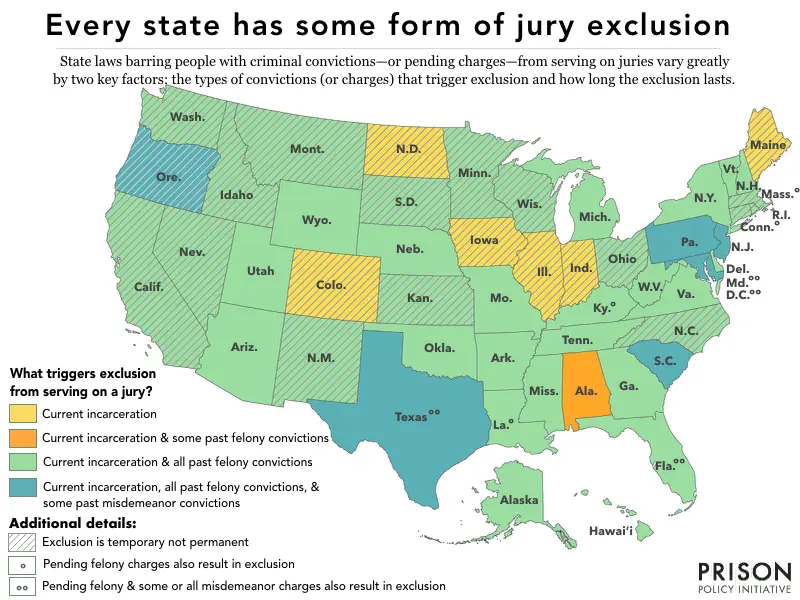
Last month, the Prison Policy Initiative released a report called Rigging the Jury, showing how all 50 states reduce jury diversity by excluding some people because of their criminal record, in some cases permanently. The report, which includes a map, table, and detailed appendix explaining each state’s policies, shows that: 44 states bar people with felony convictions from jury service when they are no longer incarcerated. (By comparison, 30 states bar voting by those who are not incarcerated.) 6 states go even further, barring people with some misdemeanor convictions from juries. 7 states bar legally innocent people from juries if they are called to serve while charges are pending against them. The report also explains how excluding people with records makes juries less diverse (e.g., one  in three Black men have felony convictions), why jury diversity is essential to the fairness of a trial, and what must be done to fix this unfair system.                           The full report is here. Note: Our Restoration of Rights Project also provides state-by-state and 50-state information on loss and restoration of rights to serve on a jury due to a record. We […]
Read more

Online Criminal Records Impose ‘Digital Punishment’ on Millions

We are pleased to republish this excellent article by Andrea Cipriano, which describes a new study of online non-conviction records, with permission from The Crime Report. The study concludes that law enforcement records may remain freely available online indefinitely, notwithstanding state laws calling for automatic expungement of such records. (For more information on expungement of non-conviction records, see CCRC’s 50-state chart and CCRC’s model law on the subject.)   Online Criminal Records Impose “Digital Punishment’ on Millions of Americans by Andrea Cipriano    February 9, 2021 An analysis of Internet data portals that house personally identifiable information (PII) of people involved in the justice system found that compromising information on millions of Americans has been posted online by criminal justice agencies, even if they have not been convicted of a crime. “Public records…are less likely to reveal information about the criminal justice system itself, and instead more likely to reveal information about people arrested [for] – but often not convicted of – crimes,” said researchers from Rutgers, Loyola Chicago, and UC-Irvine who conducted the analysis. The analysis, published in the Law & Social Inquiry Journal, concluded that the amount of data accessible online effectively operates as a “digital punishment.” They noted […]

Read more

Legislative Report Card: “The Reintegration Agenda During Pandemic”

CCRC’s new report documents legislative efforts in 2020 to reduce the barriers faced by people with a criminal record in the workplace, at the ballot box, and in many other areas of daily life. In total, 32 states, D.C., and the federal government enacted 106 bills, approved 5 ballot initiatives, and issued 4 executive orders to restore rights and opportunities to people with a record. Our Legislative Report Card recognizes the most (and least) productive state legislatures last year. Hands down, Michigan was the Reintegration Champion of 2020 with 26 new record reform laws, while Utah was runner-up, and seven other states were commended for their work.

Read more

“The Reintegration Agenda During Pandemic: Criminal Record Reforms in 2020”

In each of the past five years, CCRC has issued an end-of-year report on legislative efforts to reduce the barriers faced by people with a criminal record in the workplace, at the ballot box, and in many other areas of daily life.[i] These reports document the progress of what has become a full-fledged law reform movement to restore individuals’ rights and status following their navigation of the criminal law system. Our 2020 report, linked here, shows a continuation of this legislative trend. While fewer states enacted fewer laws in 2020 than in the preceding two years, evidently because of the disruptions caused by the pandemic, the fact that there was still considerable progress is testament to a genuine and enduring public commitment to a reintegration agenda. In 2020, 32 states, the District of Columbia, and the federal government enacted 106 legislative bills, approved 5 ballot initiatives, and issued 4 executive orders to restore rights and opportunities to people with a criminal record.

Read more