Category: Policy

New 2019 laws on diversion and other non-conviction dispositions

This comment on new laws authorizing non-conviction dispositions is the fourth in a series of comments describing some of the 153 laws passed in 2019 restoring rights or delivering record relief.  The full report on 2019 laws is available here.

Diversionary and other non-conviction dispositions

In 2019, 18 states enacted 26 laws creating, expanding, reorganizing, or otherwise supporting diversionary and deferred dispositions, to enable individuals charged with criminal offenses to avoid a conviction record.  The 2019 enactments on diversionary dispositions reflect the clear trend across the country toward increasing opportunities to steer certain categories of individuals out of the system, through informal diversions, specialized treatment or intervention courts, or completing a deferred adjudication and probation period.  Laws enacted in 2019 extended this favorable treatment to juveniles, military service personnel and veterans, persons with mental illness, drug and alcohol users, human trafficking victims, caregivers of children, and even certain persons charged with sex offenses.

Of particular note, Colorado enacted a major revision of its juvenile records scheme, the second in three years, making almost all juvenile offenses eligible for diversion, and expungement automatic upon successful completion of diversion “without the need fora court order,” as long as the prosecutor or victim do not object.  Colorado also authorized funding for mental health diversion courts. Tennessee and Vermont also significantly expanded their programs of juvenile diversion, while Mississippi reorganized its system of specialized courts as “intervention courts.”  Oregon modified diversion to avoid deportation consequences of a guilty plea.  California enacted perhaps the most novel (and promising) diversion program we’ve seen in several years, authorizing the creation of pretrial diversion for primary caregivers of children,who are charged with a misdemeanor or non-serious felony offenses, except for offenses against the cared-after child.  These and other diversion laws are described briefly below:

  • Colorado enacted a major revision of its juvenile records scheme, the second in three years, making almost all juvenile offenses eligible for diversion, and expungement automatic upon successful completion “without the need for a court order.” See HB 1335, revising Colo. Rev. Stat. § 19-1-306(4)(b)(I). This law also authorized the court to discontinue sex offender registration.  Colorado also authorized funding for mental health diversion courts. (SB 211).   Colorado’s impressive record of legislating on criminal records issues in recent years, for adult as well as juvenile records, is described in detail in the state’s profile in the Restoration of Rights Project.
  • Tennessee addressed diversion both in the context of juveniles (HB 1319) and those charged with sex offenses (HB 624). The latter law revises provisions governing the circumstances under which a person’s name must be removed from the sex offender registry, to add successful completion of judicial diversion for certain offenses.  Juveniles will now be eligible for diversion not only after a plea, but also after an adjudication.   In its third new law affecting diversion, Tennessee rescinded the $350 filing fee for a defendant applying for expunction of an offense following the completion of a diversion program.  See HB941.
  • Vermont authorized its courts to expunge records of juvenile diversion cases after two years without a subsequent conviction, if restitution has been paid. See S105. While referral for juvenile diversion remains in the control of the district attorney, courts are authorized to impose a deferred sentence for a less serious crime even if the prosecutor objects. 13 V.S.A. § 7041.  This provision was amended by S105 to delete the age limits on the court’s authority under this section, so that it no longer applies only where the defendant is under 28 years of age.
  • Mississippi reorganized its system of specialized problem-solving courts (including drug courts, mental health courts, and veterans’ courts) as “intervention courts,” and made an Intervention Courts Advisory Committee responsible for coordinating the policies and operation of these courts through the State.  See HB 1352, Code Ann. §§ 9-23-1, 9-23-9.  These courts are primarily aimed at reducing the incidence of drug abuse as a driver of criminal behavior, but they are aimed at different populations and have differing eligibility requirements.   See, e.g., § 9-25-1 (veterans courts); § 9-27-7 (mental health courts).   These courts all offer the possibility that successful participants in their programs may avoid conviction and become eligible for expungement of the record upon successful completion.
  • Oregon enacted a law formalizing the terms of conditional discharge in controlled substance cases, specifically omitting the requirement under preexisting law that a defendant must first plead or be found guilty. (HB 3201).  Under the new law, a participant must enter into a “probation agreement” waiving various trial and appellate rights, and must agree to pay restitution and court-appointed attorney fees, with no provision for waiver, following an unfortunate practice of restricting the benefit of certain non-conviction dispositions to people who can pay for them.  The agreement “may not contain a requirement that the defendant enter a plea of guilty or no contest on any charge in the accusatory instrument,” a provision evidently intended to avoid the collateral consequences of a finding of guilt.  This law is also covered in the section on relief from immigration consequences.

In more incremental extensions of diversion:

  • California authorized the creation of pretrial diversion for primary caregivers of children,who are charged with a misdemeanor or non-serious felony offenses, except for offenses against the cared-after child. (SB 394). See Cal. Penal Code § 1001.83.
  • Missouri (HB 547) and Oregon (HB 2462) enacted laws aimed at giving service members and veterans the benefit of diversion.
  • Idaho (H78) and South Carolina (H3601) authorized diversion in DUI cases.
  • Texas expanded eligibility for deferred adjudication to victims of human trafficking (HB 2758), and created a family violence pretrial diversion pilot program in Bexar County (HB 3529), and authorized deferred adjudication for certain intoxication offenses (HB 3582).
  • Washington established a substance abuse diversion program (SB 5380), and authorized a law enforcement grant program to expand alternatives to arrest and jail processes (HB 1767).
  • Nebraska authorized restorative justice as a form or condition of diversion (LB595).
  • Nevada expanded eligibility for veterans and military service members specialty court programs (AB222).
  • Wyoming addressed diversion in its expansion of juvenile expungement in HB 44, discussed in the section on expungement.
  • Florida put in place a system of reporting for its various problem-solving courts (HB 7125).
  • Minnesota authorized cities and counties to create driver’s license reinstatement diversion programs (SF 8).
  • Rhode Island authorized superior court diversion programs (SB 962). See R.I. Gen. Laws § 8-2-39.3.
  • West Virginia established a specialized court program for military service members (SB 40).  See W. Va.Code §§ 62-16-1, et seq.
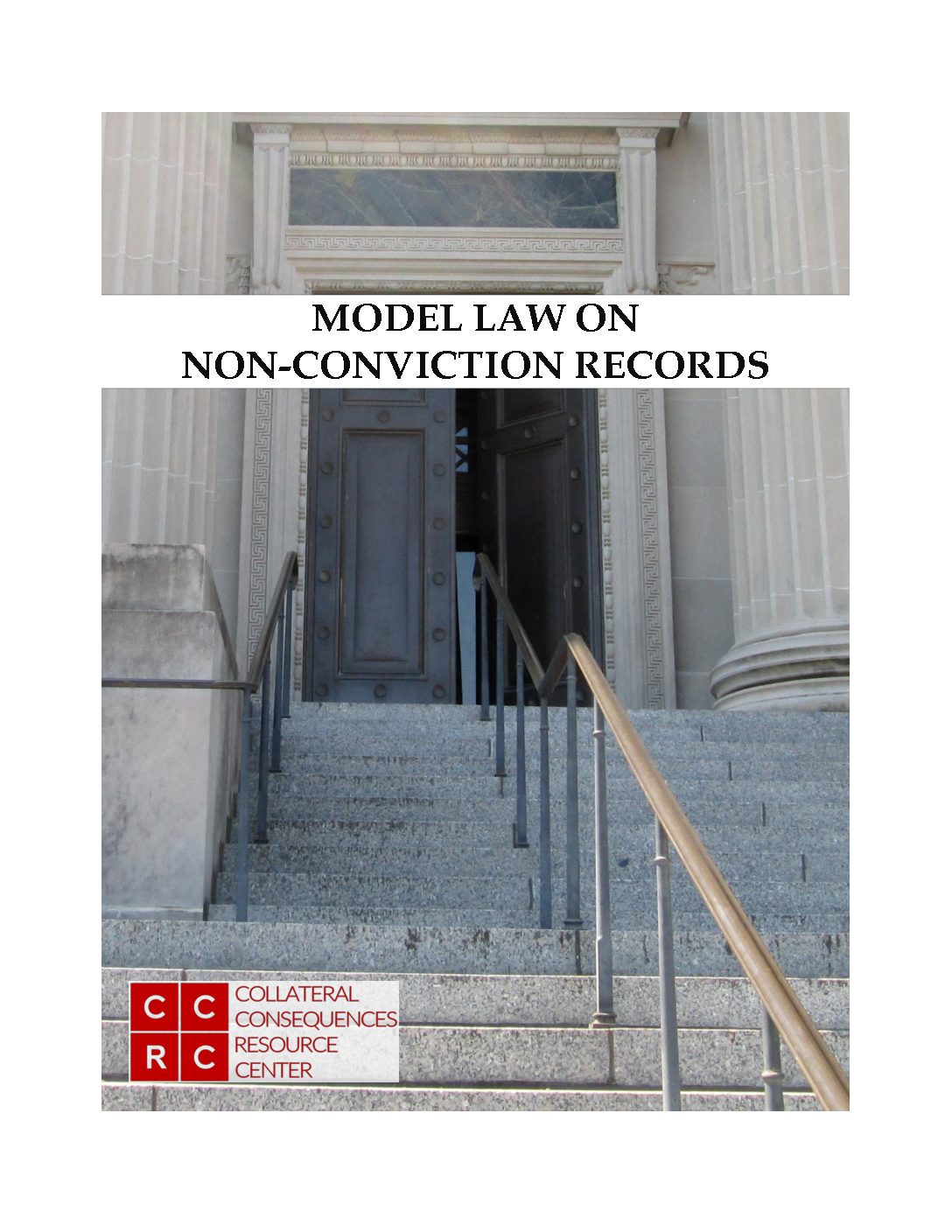
Model law proposes automatic expungement of non-conviction records

An advisory group drawn from across the criminal justice system has completed work on a model law that recommends automatic expungement of most arrests and charges that do not result in conviction.  Margaret Love and David Schlussel of the Collateral Consequences Resource Center served as reporters for the model law.  It is available in PDF and HTML formats.

“Many people may not realize how even cases that terminate in a person’s favor lead to lost opportunities and discrimination,” says Sharon Dietrich, Litigation Director of Community Legal Services of Philadelphia, and one of the advisors of the model law project.  “Over the years, my legal aid program has seen thousands of cases where non-convictions cost people jobs.”

In proposing broad restrictions on access to and use of non-conviction records, the project aims to contribute to conversations underway in legislatures across the country about how to improve opportunities for people with a criminal record.  Already in 2019, states have enacted more than 130 new laws addressing the collateral consequences of arrest and conviction.  The group regards its model as the first step in a broader law reform initiative that will address conviction records as well.

Law enforcement officials make over 10 million arrests each year, a substantial percentage of which do not lead to charges or conviction.  Records of these arrests have become widely available as a result of digitized records systems and a new commerce in background screening and data aggregation.  These checks often turn up an “open” arrest or charges without any final disposition, which may seem to an employer or landlord more ominous than a closed case.

Very few states have taken steps to deal with the high percentage of records in repositories and court systems with no final disposition indicated.  Paul McDonnell, Deputy Counsel for New York’s Office of Court Administration and a project advisor, noted: “Criminal records that include no final disposition make it appear to the untrained eye that an individual has an open, pending case, which can have serious results for that person. New York has recently made legislative progress in addressing this problem, though more can be done.”

Current state and federal laws restricting access to and use of non-conviction records have limited application and are hard to enforce.  Eligibility criteria tend to be either unclear or restrictive, and petition-based procedures tend to be burdensome, expensive, and intimidating.  In recent years, lawmakers and reform advocates have expressed a growing interest in curbing the widespread dissemination and use of non-convictions, leading some states to simplify and broaden eligibility for relief, reduce procedural and financial barriers to access, and in a handful of states to make relief automatic.

Rep. Mike Weissman, a Colorado State Representative and model law project advisor, noted that Colorado has recently overhauled its laws on criminal records with broad bipartisan support.  “It is heartening to see similar reforms underway in other states, both red and blue, as well.  I commend the practitioners and researchers who helped formulate the model law for illustrating avenues for further progress in reducing collateral consequences.”

The model law would take this wave of criminal record reforms to a new level.  It recommends that expungement be immediate and automatic where all charges are terminated in favor of an accused.  Uncharged arrests should also be automatically expunged after a brief waiting period, as should dismissed or acquitted charges in cases where other charges result in conviction.  Cases that indicate no final disposition should also be expunged, unless there is indication that they are in fact pending.

The model law also recommends that expunged non-conviction records should not be used against a person in a range of criminal justice decisions, including by law enforcement agencies.  It would prohibit commercial providers of criminal background checks from disseminating expunged and dated non-conviction records, and civil decision-makers from considering them.

David LaBahn, President of the national Association of Prosecuting Attorneys, indicated that organization’s support for the model law, stating that the collateral consequences of non-convictions “do not serve to make the community safer,” and that “the current structures in place to expunge a non-conviction record can be confusing and difficult for the layperson to navigate alone.”

This model law sets the stage for jurisdictions to address record relief for convictions more generally, and its structure and principles can be brought to bear on that important work.

The Collateral Consequences Resource Center organized this model law project.  An early draft of the model law was discussed at an August 2019 Roundtable conference at the University of Michigan that was supported by the Charles Koch Foundation.  The model law report was supported by Arnold Ventures.

Read the model law in PDF or HTML.

UPDATED: 50-State Chart on Relief from Sex Offender Registration

We have completed an overhaul of our 50-State chart on relief from sex offender registration obligations, to bring it up to date and ensure that it is thorough and accurate.  This chart documents the duration of sex offender registration requirements, as well as legal mechanisms for early termination from such requirements.

In conducting this review, we have identified a handful of states that have, since the chart was last revised in November 2017, expanded the availability of relief from sex offender registration requirements, including for people who have successfully completed diversionary dispositions, people with serious disabilities, and people who are registered based on out-of-state offenses.  These recent changes in the law, incorporated in the chart, are summarized below. Read more

Association of Prosecuting Attorneys joins Restoration of Rights Project as partner

The Collateral Consequences Resource Center is pleased to announce that the Association of Prosecuting Attorneys (APA) has joined as a partner in our Restoration of Rights Project (RRP).  The APA is a membership organization of elected and appointed prosecutors whose mission is to provide training and technical assistance to prosecutors in the United States,  and to facilitate collaboration with criminal justice partners on emerging issues related to the administration of justice.  APA President and CEO David LaBahn participated in the roundtable on non-conviction records held in August at the University of Michigan Law School, a project that relies heavily on the state law research in the RRP.  The RRP’s other partner organizations are the National Association of Criminal Defense Lawyers, National Legal Aid & Defender Association, and National HIRE Network.

The RRP describes current U.S. law and practice concerning restoration of rights and record relief following arrest or conviction in the 50 states, D.C., Puerto Rico, Virgin Islands, and federal system, in three formats: summaries of every jurisdiction, detailed profiles of each jurisdiction, and 50-state comparison charts.  Topics include sealing and expungement, employment and licensing, pardons, voting, jury service, public office, and firearms rights.   People visit the RRP more than 1,000 times every day looking for information about ways to alleviate the burdens of a criminal record.

We are very excited to have this respected national prosecutor organization as a partner in the RRP enterprise, to help bring the RRP’s resources to the prosecutor community, along with a greater awareness of the need for and availability of mechanisms to mitigate the collateral consequences of arrest and conviction.  We look forward to the new perspectives the APA can bring to bear as we work to expand the RRP and make it more useful to all those interested in restoration of rights and record relief.

Commercializing criminal records and the privatization of punishment

The deeply ingrained, indeed, constitutionally protected, U.S. tradition of the public trial and public records has led to a system where there are few restrictions on public access to criminal record information.  Europe, by contrast, is more willing to limit the press in service of important goals such as reintegration of people with convictions. Alessandro Corda and Sarah E. Lageson have published an important new study on how this works on the ground.  Disordered Punishment: Workaround Technologies of Criminal Records Disclosure and The Rise of A New Penal Entrepreneurialism, in the British Journal of Criminology, explains how these traditions play out practically in the United States and Europe.

The paper notes that systematically in the United States, and increasingly in Europe, private actors are “extracting, compiling, aggregating and repackaging records from different sources;” as the authors put it, they are “producing” not merely reproducing criminal records.  In so doing they expand the reach of punishment.  To the extent that any random Joe or Jane can obtain criminal records, then potential associates can make decisions based on records, accurate or inaccurate, showing convictions or even mere arrests or charges which were dismissed, diverted, or led to an acquittal.

The case study of the United States notes that employers, landlords, universities and civic organizations often engage in criminal background screening, but these uses are regulated by the Fair Credit Reporting Act.   However, internet databases scrape and buy official and semi-official sources, criminal, financial, licensing, and many others, and make compilations available for a fee.  These “people search” services, thus far, have successfully claimed they are mere information aggregators not subject to FCRA: “these websites provide disclaimers warning users they are not to use the information for any sort of decision-making (such as hiring or housing decisions) but rather can only use the information for review of public records in an information-gathering spirit.” One wonders: How often might employers, landlords and other decisionmakers skip official FCRA reports and go to an unregulated, perhaps cheaper, web search?  Since the chances of getting caught and punished seem small, one might assume it happens a lot. In addition, the quality of this data is sometimes poor; are such things as expungements and set-asides pursuant to state law are reliably added to the databases?

The result is what the authors term “disordered punishment,” imposition of punishment is not restricted to the state: “Employers, insurers and landlords—but also neighbours, acquaintances and potential partners—ultimately determine whether impactful consequences are imposed and, if so, with what magnitude.”  As a result, the consequences of a crime or an accusation become unpredictable.  In some cases, the consequences will be vastly disproportionate to the underlying conduct, for example, when a serious charge has been made but dropped because authorities believe the accused is innocent or even prove the guilt of someone else.  In such cases, decisionmakers may still conclude that looking for another tenant, employee, or date is the safest course.

The paper does not propose solutions, but the CCRC project on non-conviction records may lead to some reforms that could mitigate the problem.  Perhaps the government should not make some records available at all, perhaps some entities now not subject to FCRA should be included, and at a minimum the law should be set up so that if a conviction has been subject to some sort of set-aside, that fact also must be disclosed.