Category: New legislation

The Clean Slate Initiative works to advance automated record clearance

We are pleased to publish a description of the Clean Slate Initiative we invited from its newly installed Managing Director.

The Clean Slate Initiative: Working to Ensure A Criminal Record is Not a Life Sentence to Poverty

By Sheena Meade*

As our nation responds to the COVID-19 pandemic, it is an imperative that lawmakers enact policies that include the tens of millions of justice-involved people and their families— already facing economic vulnerability from the stigma of a criminal record. One in three Americans, 70 million people, have some type of criminal record, and these records can create lifelong barriers to opportunity for them and their families. 

Nearly 9 in 10 employers, 4 in 5 landlords, and 3 in 5 colleges are now using background checks. Any record—no matter how old or minor—can put employment, housing, education, and other basics permanently out of reach. 

This harm is generational: Nearly half of children have at least one parent with a criminal record, resulting in difficulty for their parents to secure stable employment, economic stability and housing — all of which lead to less educational opportunities and hindered cognitive development. 

While most states allow people to petition for expungement or sealing of at least certain types of records, due to the cumbersome and complicated petition-based system used in most states, only a tiny fraction of people eligible for expungement or sealing ever obtain the relief they need. Navigating the complex record-clearing process can prove extremely challenging, often requiring expensive legal assistance and court fees—making it impossible for millions to move on with their lives.

As a national bipartisan coalition, the Clean Slate Initiative is working to fix this broken system in states across the country by advancing policies to automatically clear eligible criminal records. By sealing or expunging certain records after an individual remains crime free for a period of time we can remove these barriers, get people back to work and open the door to opportunity for them and their family.  Read more

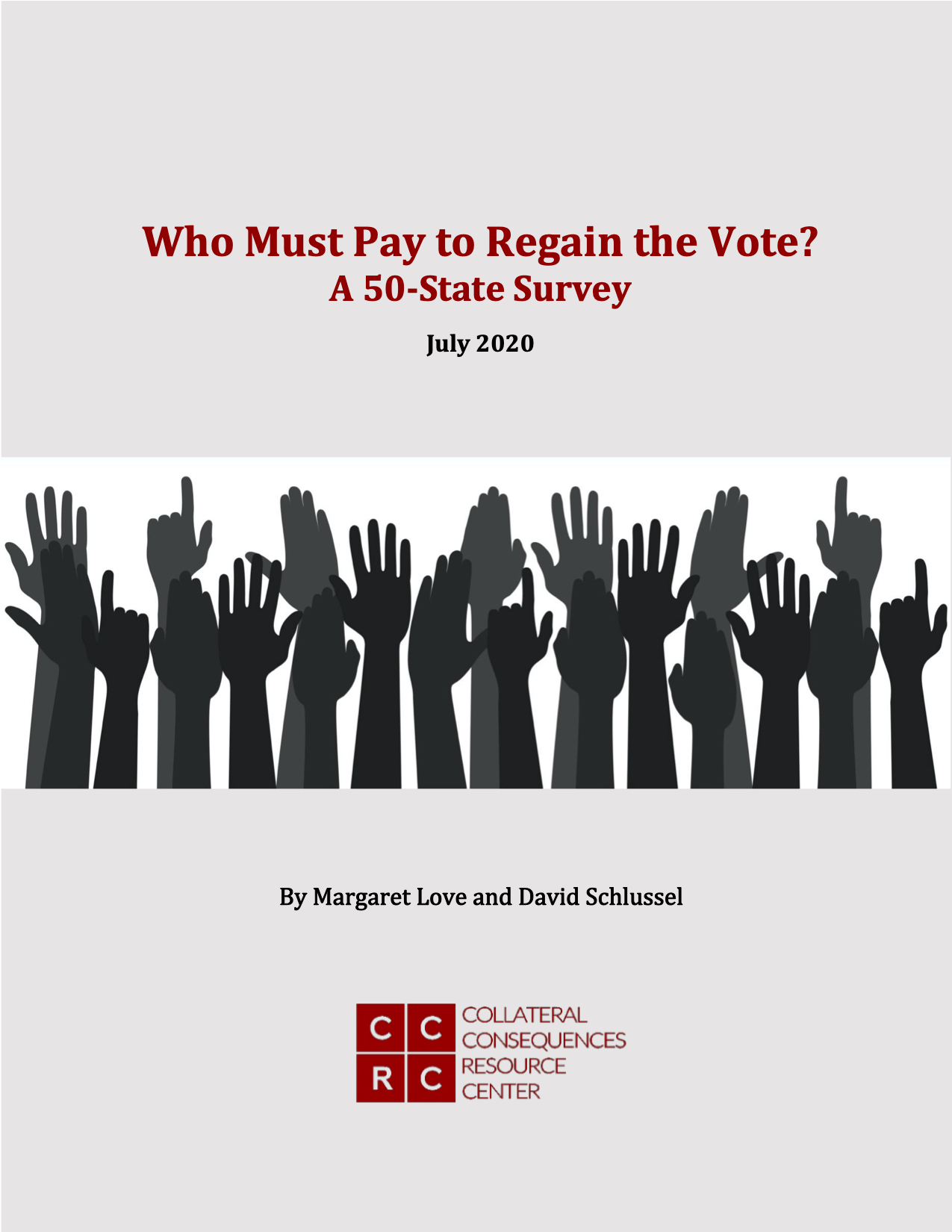
Who Must Pay to Regain the Vote? A 50-State Survey

We are pleased to publish a new 50-state report on how unpaid court debt blocks restoration of voting rights lost as a result of conviction:

Who Must Pay to Regain the Vote? A 50-State Survey

This report examines the extent to which state reenfranchisement laws consider payment of legal financial obligations (LFOs), including fines, fees, and restitution, in determining whether and when to restore voting rights to people disenfranchised due to a felony conviction.

This issue has come to the fore as a result of the high-stakes federal litigation in Florida over that state’s 2018 ballot initiative, which many expected would restore voting rights to more than a million people disenfranchised because of their criminal record, in some cases for crimes that occurred decades ago. However, the initiative has been interpreted by Florida’s legislature and supreme court to condition reenfranchisement on payment of all outstanding fines, fees, costs, and restitution, which threatens to drastically limit its anticipated reach.

After a group of voters and organizations sued, a federal judge found this “pay-to-vote” system unconstitutional. The case is currently on appeal in the U.S. Court of Appeals for the Eleventh Circuit. CCRC expects to file an amicus brief next week that will include an abbreviated version of this report. Our brief will address the claim that many states have reenfranchisement schemes like Florida’s, and that the trial court’s decision would therefore cast doubt on a widespread national practice. But our research finds that very few states have laws like Florida’s that indefinitely deny reenfranchisement based on any unpaid debt related to a disqualifying conviction. In fact, only two other states, Alabama and Arkansas, share the specifics of Florida’s approach.

The issues in the Florida case and the findings of our report are detailed below.

Read more

Loss and restoration of voting and firearms rights after conviction: A national survey

*Update (9/8/20): the full national report, “The Many Roads to Reintegration,” is now available.

Earlier today we announced the forthcoming publication of a national report on mechanisms for restoring rights and opportunities following arrest or conviction, titled “The Many Roads to Reintegration.”  As promised, here is the first chapter of that report on loss and restoration of voting and firearms rights, a subject that needs little or no introduction.  The research, drawn from the Restoration of Rights Project, reveals a trend since 2015 toward expanding opportunities to regain the vote that has accelerated just in the past two years.

This trend seems particularly timely in light of the pending constitutional challenge to Florida’s restoration system, which raises the question whether the state may constitutionally require people to pay outstanding legal financial obligations (LFOs) before being allowed to vote, even if they cannot afford to do so.  There are now only two states in addition to Florida in which the vote is permanently lost for those unable to pay all LFOs associated with a disqualifying conviction.  An additional seven states permanently deny the vote for those unable to pay certain types of LFOs.  (Early next week, we will publish a report surveying state laws and practices on this issue, which will be included in abbreviated form in an amicus brief we plan to file in the court of appeals in support of the Florida plaintiffs.)

In contrast to voting rights law, there has been almost no change in the past half dozen years in how state and federal law treats firearms restoration after conviction.  In most states, firearms dispossession remains indefinite for anyone convicted of a felony, and restoration depends upon petitioning a court for discretionary relief or asking for a pardon. In 11 of the 26 states in which all firearms rights are permanently lost upon conviction of any felony, and for those with a federal conviction, a pardon is the exclusive restoration mechanism.

A PDF of this chapter is available here.  Coming next week, the report’s chapter on “Employment and Occupational Licensing.”

Read more

Pennsylvania expands access to 255 licensed occupations for people with a record

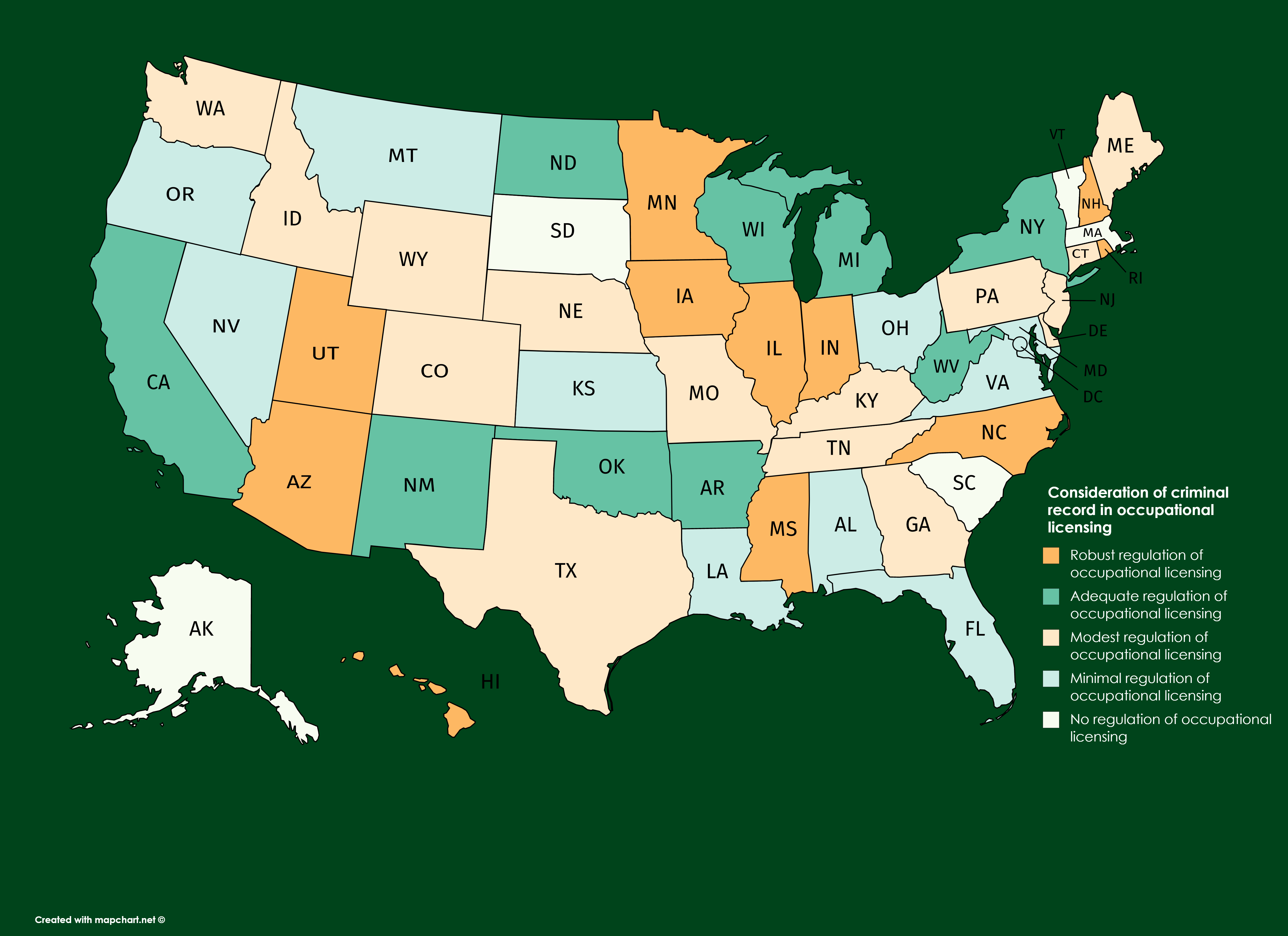
On July 1, Pennsylvania Governor Tom Wolf signed into law an expansive new regulation of the state’s occupational licensing process, giving the agencies that control access to 255 occupations detailed new standards for considering criminal records in the licensing process.  Pennsylvania has not addressed these issues on a state-wide basis since the 1970’s, and with proper implementation the new law promises a path to the middle class for skilled individuals whose career prospects might otherwise be limited.

While Pennsylvania’s law is by far the most ambitious one of its kind passed this year, five other states have also passed laws since the beginning of 2020 regulating consideration of criminal record in occupational licensing.  Two were states that previously had no general law governing this issue (Idaho and Missouri) and three were states that extended laws passed in recent years (Iowa, Utah and West Virginia).

Pennsylvania’s new law is analyzed in detail below.  The provisions of the other five states’ new licensing laws are summarized briefly at the end of the post, and the laws of all six states are written up in greater detail in the relevant state profiles in the Restoration of Rights Project.

Read more

North Carolina enacts Second Chance Act

CCRC Board member John Rubin of the University of North Carolina faculty has provided us with a detailed account of NC’s brand new Second Chance Act, and we are pleased to post it below.  We are particularly pleased to see North Carolina join the 13 other states that have enacted automatic record relief for dismissals and acquittals, and remove its prior felony bar to eligibility.  It appears that only a handful of states still retain this unfortunate provision, including Rhode Island, Oklahoma, and West Virginia.  We look forward to studying the new law in detail, and will shortly incorporate its provisions into the NC profile and 50-state charts from the Restoration of Rights Project.

We are also pleased to introduce our new 50-state chart on “Process for expunging or sealing non-convictions,” which indicates that there are now a total of 20 states that deliver relief for dismissals and acquittals that is either automatic or expedited at time of disposition.  At least half of these laws have been enacted in the past two years.  But there are still 24 states and D.C. that require people to file petitions, satisfy complex eligibility requirements, and jump through a variety of procedural hoops to limit public access to these records, and one state (Arizona) and the federal system offer no relief at all.  There is no excuse for allowing these records to remain publicly available and the source of discrimination, when the government was unwilling or unable to prosecute their charges to conviction.  We will continue to work for reforms based on the Model Law on Non-Conviction Records, and are happy to offer advice and assistance to any jurisdiction that decides to take on these issues.

A Second Chance in North Carolina Through Expanded Record Clearance
John Rubin
© UNC School of Government

North Carolina continues to make gradual strides in helping people clear their criminal records and enhance their opportunities going forward. Last week the Governor signed the Second Chance Act, S.L. 2020-35 (S 562), which passed the General Assembly unanimously. The Second Chance Act expands expunction opportunities and streamlines the process for people trying to clear their records. The product of negotiation and compromise, it reflects the interests of prosecutors, law enforcement, and court administrators as well. The act illustrates many of the record clearance issues being considered around the country, including automatic expunction of nonconviction records (to begin in North Carolina at the end of 2021), removal of barriers to expunctions of nonconviction records (most notably, no longer will prior convictions, whether for a felony or misdemeanor, be a bar), somewhat greater opportunities to expunge older convictions if “nonviolent,” and greater access by prosecutors and law enforcement to expunged case information. This summary does not try to explore the many nooks and crannies in the legislation. It is a first pass at describing the changes. Read more