Category: New legislation

Illinois enacts boadest sealing law in Nation

On Fiday Illinois governor Bruce Rauner signed into law what appears to be the broadest sealing law in the United States, covering almost all felonies and requiring a relatively short eligibility waiting period of three years. We expect to provide a more in-depth discussion of the law next week from practitioners working on the ground in the state, and will soon update the Illinois Restoration of Rights Project profile to reflect these important changes.  In the meantime, we share the following from Cabrini Green Legal Aid, which was among the organizations that helped push the legislation through. This afternoon, Governor Bruce Rauner signed into law six pieces of legislation that impact people with arrest and conviction records, including HB 2373 – the sealing expansion bill. This marks the LARGEST expansion of a sealing law in the United States and is a huge win in criminal justice reform. Effective immediately, this new law will provide thousands of people in Illinois the opportunity for criminal records relief by allowing them to petition the court to remove barriers in their lives as a result of their past criminal record. On behalf of our partners with the Restoring Rights and Opportunities Coalition of Illinois (RROCI),* Cabrini Green Legal Aid (CGLA) appreciates the support and involvement of so many of you who took action making phone calls, sending emails and traveling to Springfield. We are extremely grateful to the members of the RROCI coalition and CGLA’s Leadership Council and Visible Voices members who had a weekly presence in Springfield throughout the legislative session, using their voices in the halls of the capitol to humanize this issue and lead the effort. We facilitated 56 trips that required 14 hour commitments by the individuals advocating for this bill. Through leadership development, training and support, CGLA’s goal is to engage those who are directly impacted by systemic change to lead advocacy and education around these issues. This will be a game changer for CGLA. Over the years, we have met thousands of individuals who did not qualify for sealing. Not only can we start saying YES to those seeking a better future, we can begin to spread hope and strengthen the lives of individuals and families throughout Illinois. If you want to be part of this effort, please join us! Attorneys can volunteer to help us prepare petitions for clients to seal their records and other volunteers can assist with communications to clients needing additional information about new legislation. Email volunteer@cgla.net Request a presentation from our Leadership Council in your community to help raise awareness about sealing expansion. Email advocacy@cgla.net Send people to our Help Desk that are now eligible, located at the Daley Center in Room 1006, open Monday through Thursday 9-12 and Thursday afternoon from 1-4. Make sure they obtain a copy of their criminal history reports from the Chicago Police Department (3510 S. Michigan), open 8-12, Monday through Friday. The cost is $16 and they should request their City and Illinois State Police reports. Thank you again for your support and advocacy on behalf of individuals, families and communities impacted by the collateral consequences of the criminal justice system! Today is indeed, a good day…     Read more
National law reform proposal on collateral consequences

A long-running national law reform project that is reaching its final stages includes a broad and progressive scheme for dealing with the collateral consequences of conviction.  The American Law Institute (ALI), the nation’s oldest and most respected law reform organization, will meet in Washington on May 22-24 to approve a revision of the sentencing articles of the Model Penal Code, the first such revision in 60 years. The revised MPC: Sentencing includes an ambitious and comprehensive scheme for managing and limiting collateral consequences.  [NOTE: The MPC: Sentencing draft was given final approval by the ALI Annual Meeting on May 24.] In commentary published last month on the ALI website, MPC Reporters Kevin Reitz and Cecelia Klingele discussed the role of sentencing commissions in managing collateral consequences under the MPC provisions, as well as its provisions relating to notice and relief.   As under the original 1962 Code, the 2017 Code gives the sentencing court the key roles in ensuring that defendants have an opportunity to overcome the adverse effects of collateral consequences.  The 2017 Code provisions also include an important role for sentencing commissions in establishing policy and practice for the courts. The commentary is well worth reading by anyone searching for innovative ways to lighten the burden of a criminal record. Under the MPC’s collateral consequences provisions, sentencing courts must see that defendants are informed about applicable collateral consequences at key stages of the criminal case, and have the power to remove mandatory consequences that impede a defendant’s reentry and reintegration.  They may also certify a defendant’s rehabilitation, and a court-issued certificate provides specific protection for employers and landlords against negligence lawsuits. Sentencing commissions play an equally important institutional role under the 2017 MPC, in compiling collateral consequences and limiting their scope through the development of guidance for sentencing courts considering their removal.  In some ways, the MPC provisions resemble the template of the Uniform Collateral Consequences of Conviction Act (UCCCA), but in others they go further.  While the two proposals are similar in the role they give the sentencing court, the MPC limits the legislature’s power to enact and enforce collateral penalties, if only indirectly, through establishing standards for their removal in particular cases.  The MPC also improves the UCCCA model by limiting how discretionary decision-makers may take conviction into account. While the MPC and UCCCA are directed primarily at states, Congress would do well to study their basic structure and specific provisions, to determine whether some of their elements could profitably be introduced into the federal sentencing system.  And, there is much that the U.S. Sentencing Commission could do to improve the administration of collateral consequences even without additional legislation, including compiling relevant federal laws and rules, developing guidance to ensure that defendants are adequately informed about the consequences of a guilty plea, and advising Congress about the need for new legislation and the form it might take. Finally, the ALI initiative could further encourage federal courts to take steps even without specific statutory authority to help defendants deal with the burdens of a criminal record, either through non-conviction dispositions or informal certificates of rehabilitation. Read more

Strong momentum for fair-chance hiring and occupational licensing reform in 2017

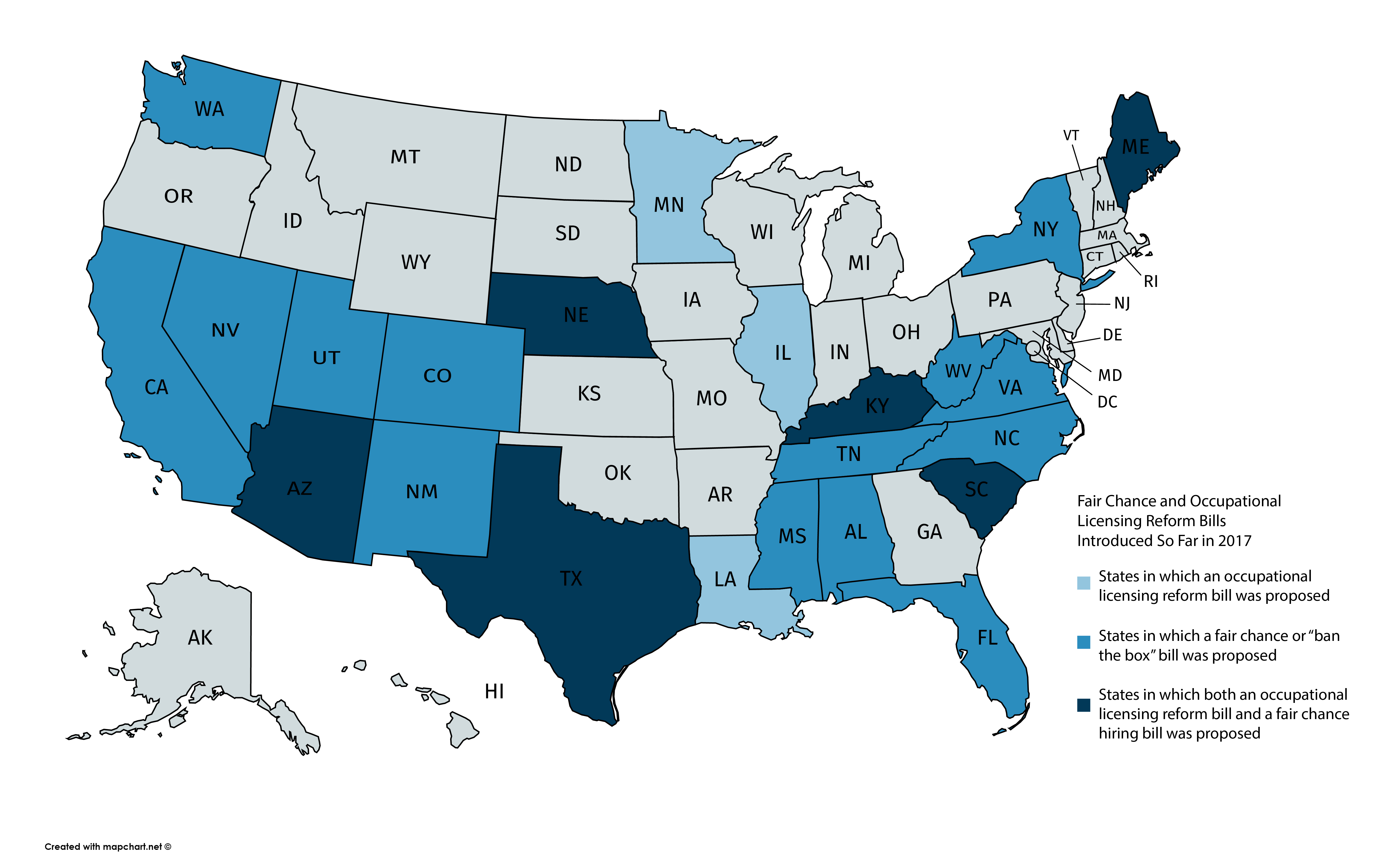
The following piece by Beth Avery was originally published on the blog of the National Employment Law Project.   Building upon the successes of 2016, legislatures across the country are off to a strong start this year toward adopting laws that increase fairness in hiring and employment opportunities for the one-in-three U.S. adults with arrest or conviction records. This progress should come as no surprise—in recent years broad support has emerged from coast to coast for a number of reforms that address the criminal justice system and its disproportionate impact on people of color. Along with critical efforts to increase expungement and sealing, adopt bail and sentencing reforms, and expand voting rights for people with convictions, a powerful movement is also advancing two crucial policies that improve access to employment for people with records: “fair chance hiring” or “ban the box” laws and reforms to occupational licensing requirements.   In just the first four months of 2017, “fair chance” hiring and “ban the box” bills have already been introduced in at least 19 states, which collectively represent over half of the U.S. population. (And bipartisan legislation has also been introduced in Congress.) While these bills vary in many respects, each emphasizes delaying employer inquiries about job applicants’ records until later in the hiring process—ensuring that applicants are judged on their qualifications before the stigma of a record enters the equation. So far this year, major successes have included Utah’s fair-chance bill (HB 156), which sped through the legislature and was signed into law by Governor Gary Herbert (R) on March 22—making Utah the 26th state to ban the box for either public or private employers. And Utah wasn’t even the first state to ban the box in 2017—Kentucky clinched that title on February 1 through an executive order by Governor Matt Bevin (R). Ban-the-box bills also passed one legislative house in Arizona, Nevada, and Virginia. At least 11 of the 19 states pursuing fair-chance bills this session have considered going beyond banning the box for government employees by proposing fair-chance policies also applicable to private-sector hiring. Already adopted in nine states and 15 localities, these laws expand opportunities for workers with records by requiring private-sector employers to consider a job applicant’s qualifications before asking about his or her record. Recently, New Mexico almost became the tenth state with such a law after SB 78 cleared both houses of the legislature, but a short-sighted veto by the governor earlier this month deprived New Mexicans with records of this key policy reform. Private-sector bills have also cleared at least one house in the legislatures of Colorado, New York, and Washington. Complementing these fair-chance hiring efforts, legislators in at least nine states have also proposed bills aimed at reducing the severe barriers to occupational licenses faced by people with records. Nearly one-quarter of U.S. workers require a license to do their jobs—and licenses are often unfairly denied to applicants with records. Because barriers to licenses prevent or deter workers with records from pursuing employment in some of the most desirable and fastest-growing fields, numerous state legislatures are considering ways to expand access to licenses for people with records. For example, Kentucky just adopted a criminal justice reform bill (SB 120) that addresses occupational licensing. Among other changes, the Kentucky bill removes certain broad exceptions to the requirement that an offense be directly related to an occupation in order for it to justify denial. The bill also requires licensing boards to consider time passed since the offense, and eliminates broad discretion to deny a license based on the vague, albeit common, criterion that an applicant must possess “good moral character.” Legislators in other states have proposed reforms ranging from those addressing specific licenses and licensing authorities to those that more broadly reform licensing procedures throughout the state, using a variety of approaches aimed to expand access for those with records. While not all of these bills will be signed into law this year, their introduction still serves as strong proof of the momentum that is growing across the country in support of ban the box and occupational licensing background check reforms. For many valid reasons—economic health, public safety, justice system costs, belief in the American dream—people across the political spectrum are rallying in support of these commonsense reform efforts, and it’s about time government officials responded to their calls for action.   Read more