Category: New legislation

Updated report on 2018 fair chance and expungement reforms

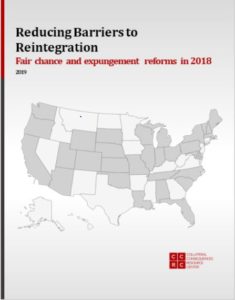
On January 10, 2019, we released a report documenting the extraordinary number of laws passed in 2018 aimed at reducing barriers to successful reintegration for individuals with a criminal record.  Since that time, we discovered five additional laws enacted in 2018 (in AL, PA, OR, MO, and the U.S. Virgin Islands), and have updated our report accordingly.

In 2018, 32 states, the District of Columbia, and the U.S. Virgin Islands enacted at least 61 new laws aimed at avoiding or mitigating the collateral consequences of arrest and conviction, consequences that may otherwise last a lifetime. The CCRC report analyzes last year’s lawmaking and summarizes all 61 new authorities, which include 57 statutes, 3 executive orders, and one ballot initiative.

Last year saw the most productive legislative year since a wave of “fair chance” reforms began in 2013.  CCRC documented these earlier developments in reports on the 2013-2016 reforms and 2017 reforms.  In the period 2012–2018, every state legislature has in some way addressed the problem of reintegration.  Congress has not enacted any laws dealing with the problems presented by collateral consequences for more than a decade.

The state laws enacted in 2018 aim to break down legal and other barriers to success in the courts, the workplace, the pardon process, and at the ballot box:

Read more

Federal farm bill legalizes hemp, but bars participation based on criminal record

In the past six years, almost every state has taken at least some steps to chip away at the negative effects of a criminal record on a person’s ability to achieve employment, housing, education and public benefits, and participation in civil society.  In stark contrast, Congress has not dealt with the problem of reintegration for more than a decade—either by reducing federal collateral consequences or by restoring rights to people with federal convictions.  The new farm bill continues this trend.

Enacted on December 20, 2018, the bill puts in place a new regulatory regime for the legalized cultivation and sale of hemp, a variety of the cannabis plant grown for industrial uses.  At the same time, the bill adds a new collateral consequence to federal law (which already has more than a thousand): anyone convicted of a drug-related felony may not participate in legalized hemp production for 10 years after their date of conviction, unless they are part of a hemp pilot program authorized by the 2014 farm bill.  An earlier version of the farm bill would have banned people with drug-related felony convictions from participating in hemp production for life, so the final bill is somewhat more progressive.

This new restriction reflects and contributes to an ongoing practice in which many jurisdictions that have legalized marijuana have excluded people with marijuana convictions from participating in this booming new industry.  Moving in the other direction, some jurisdictions such as California and Massachusetts—recognizing racial disparities and other injustices of the war on drugs—have enacted policies to clear marijuana convictions, allocate marijuana tax revenue to communities disproportionately affected by past drug policies, and encourage full participation in legalized marijuana industries by members of disproportionately affected communities.

Press release: New report on 2018 fair chance and expungement reforms (updated)

Washington, D.C. — The Collateral Consequences Resource Center (CCRC) has released a new report documenting the extraordinary number of laws passed in 2018 aimed at reducing barriers to successful reintegration for individuals with a criminal record.  In the past twelve months, 32 states, the District of Columbia, and the U.S. Virgin Islands have enacted 61 new laws aimed at avoiding or mitigating the collateral consequences of arrest and conviction, consequences that may otherwise last a lifetime.  The CCRC report analyzes the past year’s lawmaking and summarizes all 61 new authorities, which include 57 statutes, 3 executive orders, and one ballot initiative.  The report, titled “Reducing Barriers to Reintegration: Fair chance and expungement reforms in 2018,” is available to download here

Last year saw the most productive legislative year since a wave of “fair chance” reforms began in 2013.  CCRC documented these earlier developments in reports on the 2013-2016 reforms and 2017 reforms.  In the period 2012–2018, every state legislature has in some way addressed the problem of reintegration.  Congress has not enacted any laws dealing with the problems presented by collateral consequences for more than a decade.

The state laws enacted in 2018 aim to break down legal and other barriers to success in the courts, the workplace, the pardon process, and at the ballot box:

Read more

California enacts modest occupational licensing reform

On September 30, 2018, California Governor Jerry Brown signed into law AB 2138, making California the twelfth state this year to enact occupational licensing reform. This flurry of legislation will make it easier for people with a criminal record to obtain occupational and professional licenses. (As discussed in recent posts, the Institute for Justice’s model occupational licensing act and the National Employment Law Project’s model state law have influenced this legislative trend.) However, California’s take on licensing reform is relatively tepid compared to more extensive reforms in states like Indiana, Kansas, New Hampshire, Tennessee, and Wisconsin.

In California, nearly 30 percent of jobs require licensure, certification, or clearance. When AB 2138 takes effect in 2020, it will prohibit licensing boards from denying a license based on certain acts not resulting in conviction, or certain less serious convictions after seven years. The law will require boards to consider rehabilitation evidence for any conviction (not just misdemeanors, as under existing law), to establish more detailed criteria for evaluating convictions, and to issue annual reports.

While a more robust version of the bill first passed the California Assembly, it was weakened in the California State Senate, and ultimately, the Senate’s version prevailed. The legislative process and bill’s provisions are discussed in more detail below.

Read more

David Schlussel joins CCRC as its first Fellow

I am delighted to announce that David Schlussel will join CCRC as its first Fellow at the end of this month.  Most recently, David served as a law clerk for the Honorable David O. Carter on the U.S. District Court for the Central District of California. While attending law school at Berkeley, David represented clients in juvenile delinquency, school discipline, and clean slate proceedings as a clinical student for the East Bay Community Law Center. He also interned at public defender offices, taught outreach courses in Juvenile Hall, and wrote a law review note on marijuana, race, and collateral consequences. David has been interested in inequities in the criminal justice system since college, when he volunteered as a GED tutor at the New Haven jail.

During his fellowship year, David will be maintaining CCRC resources, including the Restoration of Rights Project; reporting on new laws and developments in the courts; and drafting analytical pieces on significant scholarship and research relating to collateral consequences.  One of his first assignments will be preparing a round-up of the “second chance” legislation enacted during 2018 – to date, more than 50 separate laws in thirty-two states.  During his tenure, David hopes to participate in drafting an amicus brief, an opportunity that could come very soon with a major new challenge to Pennsylvania’s sex offender registration scheme pending in the Pennsylvania Supreme Court.
David’s piece on California’s new occupational licensing law that will post later today on the site is the first of what I expect will be many of his thought-provoking analyses of significant new “second chance” legislation.