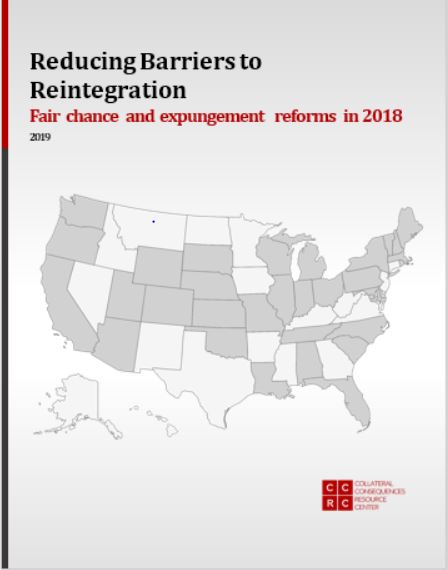
Washington, D.C. — The Collateral Consequences Resource Center (CCRC) has released a new report documenting the extraordinary number of laws passed in 2018 aimed at reducing barriers to successful reintegration for individuals with a criminal record. In the past twelve months, 32 states, the District of Columbia, and the U.S. Virgin Islands have enacted 61 new laws aimed at avoiding or mitigating the collateral consequences of arrest and conviction, consequences that may otherwise last a lifetime. The CCRC report analyzes the past year’s lawmaking and summarizes all 61 new authorities, which include 57 statutes, 3 executive orders, and one ballot initiative. The…
Read moreCategory: New legislation
California enacts modest occupational licensing reform
On September 30, 2018, California Governor Jerry Brown signed into law AB 2138, making California the twelfth state this year to enact occupational licensing reform. This flurry of legislation will make it easier for people with a criminal record to obtain occupational and professional licenses. (As discussed in recent posts, the Institute for Justice’s model occupational licensing act and the National Employment Law Project’s model state law have influenced this legislative trend.) However, California’s take on licensing reform is relatively tepid compared to more extensive reforms in states like Indiana, Kansas, New Hampshire, Tennessee, and Wisconsin. In California, nearly 30 percent…
Read moreDavid Schlussel joins CCRC as its first Fellow
I am delighted to announce that David Schlussel will join CCRC as its first Fellow at the end of this month. Most recently, David served as a law clerk for the Honorable David O. Carter on the U.S. District Court for the Central District of California. While attending law school at Berkeley, David represented clients in juvenile delinquency, school discipline, and clean slate proceedings as a clinical student for the East Bay Community Law Center. He also interned at public defender offices, taught outreach courses in Juvenile Hall, and wrote a law review note on marijuana, race, and collateral consequences. David…
Read moreMarijuana decriminalization drives expungement reform
The national trend toward expanding opportunities for restoration of rights after conviction has continued to accelerate throughout 2018. By our count, so far this year alone 31 states have broadened existing second chance laws or enacted entirely new ones, enhancing the prospects for successful reentry and reintegration for many thousands of Americans. On November 6, Florida could take the most politically momentous step of the year if its voters approve a ballot initiative amending the state constitution to re-enfranchise more than a million and a half individuals who are now permanently barred from voting because of a past felony conviction. We…
Read moreNH limits denial of licenses based on criminal record
On July 2, 2018, New Hampshire’s Governor Sununu signed into law SB 589, making his state the 10th so far in 2018 to approve comprehensive limits on consideration of criminal record in occupational and professional licensing. Like enactments earlier this year in Indiana, Kansas, Tennessee, and Wisconsin, New Hampshire’s new law is intended to ensure that people with the requisite professional qualifications will not be unfairly denied a license based on their record of arrest or conviction. In this respect, it reflects the provisions of the Institute for Justice’s model occupational licensing act. New Hampshire’s new law, which goes into effect on August…
Read more