Category: Diversion/deferred dispositions

“The Many Roads to Reintegration”: A 50-state report on laws restoring rights and opportunities

We are pleased to release a new report describing the present landscape of laws in the United States aimed at restoring rights and opportunities after an arrest or conviction. This report, titled The Many Roads to Reintegration, is an update and refresh of our previous national survey, last revised in 2018.

The report covers voting and firearms rights, an array of record relief remedies such as expungement and pardon, and consideration of criminal record in employment and occupational licensing.

In each section of the report we assign a grade to each state for each type of relief. We collate these grades to produce an overall ranking on the nine categories that we graded. That ranking is reproduced below.

We are encouraged by the amazing progress that has been made in the past few years toward neutralizing the effect of a criminal record since the present reform era got underway less than a decade ago. The last two years in particular have produced a bumper crop of new laws in almost every U.S. jurisdiction.

Some of our top performers have been long-time leaders in promoting reintegration, including Illinois, Utah, and Minnesota. But some of the most progressive lawmaking has come from states newer to the field, like Nevada, Colorado, and North Dakota. These and the other states in our Top Ten set an example that we hope will inspire other jurisdictions in the months and years to come.

The executive summary of the report is reprinted below. The full report is available in PDF and HTML formats.

Read more

Non-conviction records: A national survey

*Update (9/8/20): the full national report, “The Many Roads to Reintegration,” is now available.

In July, we announced the forthcoming publication of a national report surveying mechanisms for restoring rights and opportunities following arrest or conviction, titled “The Many Roads to Reintegration.” So far, we have previewed the report by publishing draft chapters covering “loss and restoration of voting and firearms rights” and “fair employment & occupational licensing.” We also published “pardon policy and practice” and “deferred adjudication” sections of the chapter on record relief, a term comprising the various remedies that revise or supplement a person’s criminal record to reduce or eliminate barriers to opportunity in civil society.

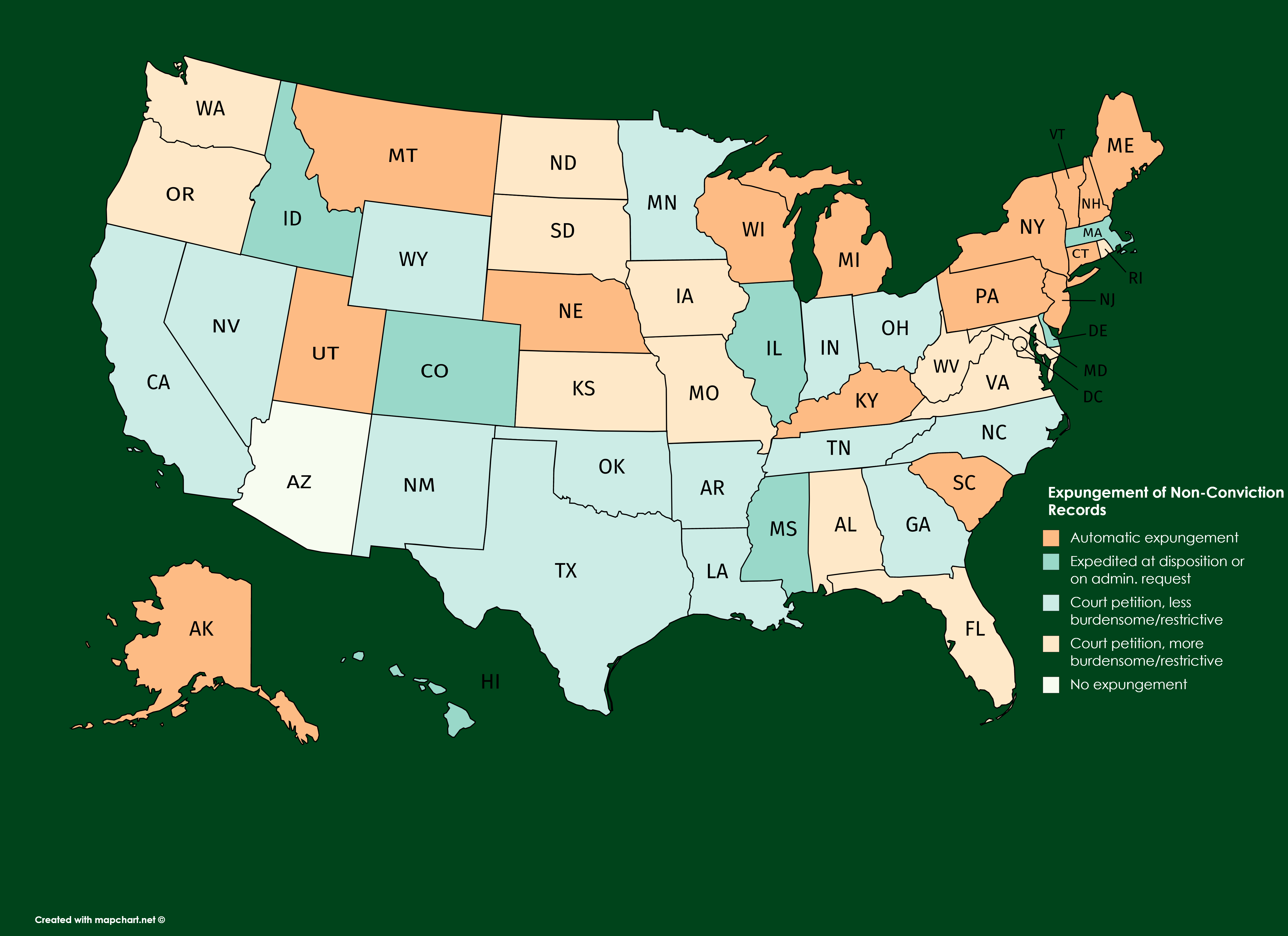
Today we are publishing a third section of the record relief chapter on non-conviction records: arrest and court records that can create lifelong barriers in employment, housing, and other areas of daily life. More than half the states still require a restrictive and burdensome court procedure to expunge or seal non-convictions. Our Model Law on Non-Conviction Records recommends automatic expungement of these records, an approach that has been enacted in 17 states. Later this week we will publish additional sections of this chapter, on conviction relief, judicial certificates, and juvenile records. We expect to publish the entire “Many Roads” report by the end of the month.

A PDF of the section on non-convictions is available here. The full text follows, with end notes.

Read more

Deferred adjudication: A national survey

*Update (9/8/20): the full national report, “The Many Roads to Reintegration,” is now available.

In July, we announced the forthcoming publication of a national report surveying mechanisms for restoring rights and opportunities following arrest or conviction, titled “The Many Roads to Reintegration.” So far, we have previewed the report by publishing draft chapters covering “loss and restoration of voting and firearms rights” and “fair employment & occupational licensing.” Yesterday we published “pardon policy and practice,” a section of the chapter on record relief, a term comprising the various remedies that revise or supplement a person’s criminal record to reduce or eliminate barriers to opportunity in civil society.

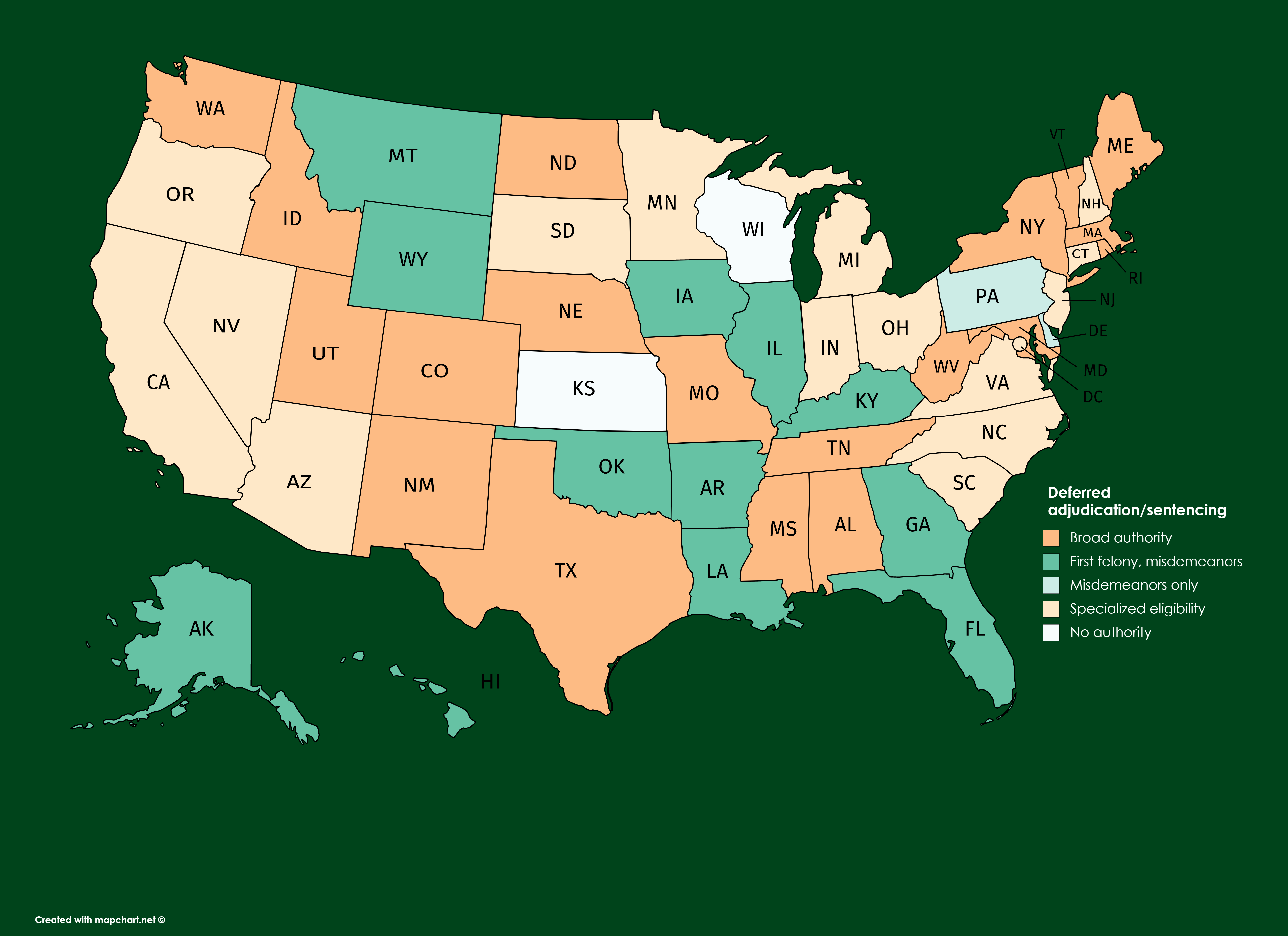
Today we are publishing a second section of the record relief chapter on deferred adjudication, a disposition whose goal is to divert individuals away from a conviction record at the front end of a criminal case. Next week we will publish additional sections of this chapter, on expungement, record-sealing, set-aside, judicial certificates, and juvenile records. We expect to publish the entire “Many Roads” report by the end of the month.

A PDF of the section on deferred adjudication is available here. The full text follows, with end notes.

Read more

SBA eases some criminal history barriers and faces litigation

*UPDATE (7/7/20):  “SBA throws in the towel and Congress extends the PPP deadline

After Congress authorized hundreds of billions of dollars for small business relief during COVID-19, the Small Business Administration (SBA) imposed restrictions on applicants with an arrest or conviction history.  We have written much in recent weeks about how these barriers, neither required nor contemplated by Congress, impede access to the two major relief programs for small businesses, nonprofits, and independent contractors: the Paycheck Protection Program (PPP) and the Economic Injury Disaster Loan (EIDL) program.

Following the introduction of a bipartisan Senate bill to roll back most of these barriers, Treasury Secretary Steven Mnuchin agreed on June 10 to revise the PPP restrictions.  On Friday, June 12, SBA issued new regulations and application forms to ease some of the barriers in the PPP.  The changes are more limited than the proposed Senate bill, and continue to reflect an SBA overreach in its approach to loan applicants with criminal records, at a time when we are nearing the June 30 closing date to apply for this much-needed assistance.

Meanwhile, two lawsuits have been filed against the SBA in federal court in Maryland, asserting that the SBA’s criminal history restrictions are beyond the agency’s authority, arbitrary and capricious, and contrary to the text of the CARES Act.  The first lawsuit, filed on June 10, is brought by The New Civil Liberties Alliance on behalf of a corner store in Hagerstown, Maryland, which was denied PPP assistance based on its owner’s 2004 felony conviction, for which he is on parole.  The second lawsuit, filed on June 16 by the ACLU, Public Interest Law Center, and Washington Lawyers’ Committee for Civil Rights and Urban Affairs, also asserts that the restrictions fall hardest on minority businesses due to the impact of over-criminalization on communities of color.  The suit is on behalf of the owner of an electrical contracting business on parole for a 2012 drug conviction, a graphic designer with pending misdemeanor charges, and a nonprofit that provides job and entrepreneurial training for currently and formerly incarcerated individuals.  None of the business owner plaintiffs in these two lawsuits would be eligible under the SBA’s new policies, which we analyze below.  (Further information on the lawsuits is also below.)

Read more

Bipartisan coalition calls on SBA to roll back record-related restrictions in COVID-19 small business loan programs

On April 17 a diverse bipartisan group of civil rights, advocacy, and business organizations, including CCRC, sent a letter to Treasury Secretary Mnuchin and SBA Administrator Carranza expressing concern over the restrictions imposed by the SBA on people with a record of arrest or conviction under two programs recently authorized by Congress in response to the COVID-19 crisis.  The letter points out that these unwarranted restrictions on loan programs intended to aid small businesses and non-profits will have a significant and detrimental impact in communities across the country, and a particularly harsh effect on minority business owners and employees who are disproportionately affected by the criminal legal system as a result of institutional discrimination.  It urges that federal relief be made equitably accessible to all who need it.

The letter describes how the SBA’s program restrictions based on record are

  • unnecessary and confusing
  • inconsistent with Congress’ intent in enacting the CARES Act
  • overbroad and unfair
  • racially discriminatory

In conclusion, the letter urges the SBA to take the following steps:

  • At a minimum, bring the record restrictions for PPP and EIDL programs in line with those that applied to Section 7(a) and 7(b) loans under regulations adopted prior to enactment of the CARES Act.
  • Relax existing rules and policies that restrict access to PPP or EIDL financial assistance for people with a record in the urgent circumstances presented by the pandemic, in line with the purposes of the CARES Act.
  • Ensure that the application forms for SBA financial assistance accurately reflect the eligibility requirements and are written in a clear manner.

An Appendix to the letter describes how the new rules and policies governing the Payroll Protection Program are more restrictive than those governing the 7(a) program generally, and how barriers based on arrest or conviction may also disqualify people with any sort of a record from loans under the EIDL program authorized under the SBA’s existing 7(b) disaster loan program.

The letter —available in PDF and reprinted below – was sent by the following organizations:

American Civil Liberties Union
Chicago Lawyers’ Committee for Civil Rights
Collateral Consequences Resource Center
Community Legal Services of Philadelphia
Drug Policy Alliance
FreedomWorks
Georgia Justice Project
Interfaith Action for Human Rights
Jewish Council for Public Affairs
Justice & Accountability Center of Louisiana
Justice Action Network
Leadership Conference on Civil and Human Rights
National Association of Criminal Defense Lawyers
National Employment Law Project
Public Interest Law Center
Reproductive Justice Inside
Safer Foundation
Washington Lawyers’ Committee for Civil Rights and Urban Affairs
Women Against Registry

Read more