Category: Commentary

Mnuchin defends record restrictions for SBA stimulus loans

*UPDATE (7/7/20):  “SBA throws in the towel and Congress extends the PPP deadline

We have written much in recent days about how the SBA has imposed new restrictions on participation in the Paycheck Protection Program (PPP) by small business owners with a record of arrest or conviction.  We were therefore surprised to hear Secretary Mnuchin at the White House press briefing yesterday assert that the new SBA rules are actually more favorable to this population than the old ones.  That is simply not true.

Prior to enactment of the CARES Act, the SBA’s rules for its 7(a) loan program—of which the PPP is the newest part—disqualified only people with open criminal cases.  People with past records were subject to an individual evaluation.  In launching the PPP, the SBA imposed entirely new mandatory disqualifications that were neither part of SBA’s preexisting regulations nor required by the CARES Act.  New PPP rules and policies prohibit loans to any small business owner who, in the past five years, had a felony conviction, plea, or was placed on probation, parole, or diversion, even without a conviction.

Yet at a press conference yesterday following Senate approval of additional PPP funds, Mnuchin claimed exactly the opposite.  Responding to a question about the President’s comment the day before that he would look into the issue of people with records being denied access to small business loans, the Secretary stated that he had “worked with the White House” to “specifically design” the PPP program to reflect criminal justice reform efforts led by Jared Kushner and others in the Trump Administration.  As a result, he said, the new five-year disqualification period is “significantly shorter than what had been done before . . . . There were a lot of people who wouldn’t have had access previously and we changed those regulations.”  (The clip is here, starting at 7:38; a transcript is below.)

The Secretary’s explanation is so wildly off the mark that it is hard to believe he was simply misinformed.  More likely, he was reporting on how the SBA’s 7(a) loan program has been administered in practice, unwittingly revealing an unwritten policy of categorical exclusion in spite of formal policies calling for individual review.  That peek at how a risk-averse bureaucracy actually operates out of the public eye would be no surprise to people who have experienced it.

In the run-up to the drafting of the new stimulus bill, several bipartisan coalitions and policy experts urged Congress and the SBA to ensure that  justice-involved people who have started small businesses—and their employees—can obtain stimulus funds.  But Mnuchin yesterday seemed to shut that door: “For now, we’re not going to do that.”

We strongly encourage the Secretary to take another look, and to do it quickly, before the new PPP funds are authorized and distributed.  As Marc Levin of the Texas Public Policy Foundation wrote in this space yesterday, “During this trying time, the SBA must reexamine these regulations to ensure that small businesses that made the most of one second chance don’t have it taken away through no fault of their own.”

Read more

Prosecutors’ role in deciding how long people stay in prison

A timely new article from CCRC board member Nora V. Demleitner, law professor at Washington and Lee University, considers the central role of prosecutors in determining who goes to jail and prison and how long they stay there.  Demleitner reviews—as a “case study of prosecutorial authority”—prosecutors’ actions to reduce confined populations during the COVID-19 crisis.  While prosecutors’ key role in charging and sentencing at the front end of a criminal case is well-established, in ordinary times their influence in its later stages, including in prison release decisions, is not so obvious.  Professor Demleitner shows how the pandemic “highlights the tools prosecutors have at their disposal and how they can directly impact the size of the criminal justice system.”  This in turn leads her to consider how “prosecutorial thinking” focused on public safety as opposed to public health “increasingly influences other branches of government” even in the midst of a pandemic.

Professor Demleitner’s article, “State Prosecutors at the Center of Mass Imprisonment and Criminal Justice Reform,” will be published in the April 2020 issue of the Federal Sentencing Reporter.  The abstract is included below:

Read more

The Marshall Project reports on criminal history barriers to small business relief

In the past two weeks we have written at length about the U.S. Small Business Administration (SBA)’s “bumpy guidance on criminal history requirements” for small business financial relief during the COVID-19 pandemic (see also “Applying for an SBA loan with a criminal record“).  Today, Eli Hager of The Marshall Project has picked up the story with a new piece that draws on our research and will bring the story to a wider audience.  We hope this will prompt the SBA to revise its policy, or guide Congress toward clearer and fairer standards if it passes a planned new round of small business assistance.

Before the pandemic, the SBA didn’t automatically disqualify people for small business loans based on a past criminal record, and we can’t understand why it would suddenly decide to do so now, when small businesses across the country are struggling to stay afloat.  (Preexisting policy, described here, disqualifies a business if it has a principal who is incarcerated, is under supervision, is facing charges, or lacks “good character.”)  The new SBA policy—which automatically disqualifies even certain people who have completed a diversionary program and were never convicted—seems entirely at odds with the wave of recent state and federal law reforms aimed at encouraging reintegration.

The Marshall Project piece notes that “never in recent U.S. history have so many conservatives and liberals agreed that people with criminal histories deserve a second chance—especially job-creating small-business owners.”  It is no wonder that the SBA “did not respond Tuesday to multiple requests for clarification,” when its new policy is so indefensible.

An excerpt from The Marshall Project piece, “Trump Administration Tells Some Business Owners ‘Do Not Apply’ for Coronavirus Loans,” is included below:

Michelle E. of Scottsdale, Arizona, was relieved when President Trump last month signed into law the sweeping stimulus package intended to keep the U.S. economy afloat during the coronavirus pandemic.

Michelle and her husband have owned a small hardwood flooring business for 18 years. She hoped the law’s $350 billion for small-business loans would help them avoid laying off any of their five employees, whom she said are like family. So she got a loan application through her bank.

But as she filled it out, Michelle saw the question: Had any of the business owners pleaded guilty to or been on probation for a criminal offense? Michelle immediately thought of her husband, who is on probation because he took a guilty plea on a theft charge after taking home the scope of someone else’s rifle on a hunting trip, something he says he did accidentally. His name and her last name are being withheld because his criminal case, and the couple’s loan application, are pending.

“Because of that, our employees can’t get help from the United States government?” Michelle said.

It’s a little noticed frustration compared to the logistical problems of the Trump administration’s rollout of the CARES Act. A set of new regulations for implementing the law, issued by the Small Business Administration, prohibits small-business owners with criminal records from accessing the desperately needed loans.

“We have never seen such a sweeping mandatory disqualification based on a criminal record, in any area of the law,” wrote the Collateral Consequences Resource Center, a nonprofit, nonpartisan website that tracks how federal, state and local laws affect people with past charges or convictions. The site is run by Margaret Love, who was the U.S. Pardon Attorney during the Clinton administration.

[. . . .]

Critics of the new regulations said the rules waste precious time examining people’s pasts when so many are, with each new day, losing their lives or livelihoods.  One New Jersey pet-supply store owner with a 10-year-old felony conviction put it this way in an email to the Collateral Consequences Resource Center: It is as if, after Hurricane Katrina flooded New Orleans, rescuers flying in helicopters asked families stranded on their roofs if they had ever faced a criminal charge.“

And if anyone answered yes,” he wrote, “they would move along to the next house.”

Report Card: Grading states on 2019 record reforms

The following is an excerpt from our recent annual report on legislative reforms, Pathways to Reintegration: Criminal Record Reforms in 2019.

Report Card

For the first time this year we have prepared a “Report Card” on how state legislatures performed in 2019 in advancing the goals of reintegration.  We have not covered all states, only those we thought most and least productive.  We hope this new feature of our annual reports will provide an incentive to legislatures across the nation, and a tool for legislative advocates.

New Jersey gets the top mark as Reintegration Champion of 2019 for the most consequential legislative record of any state last year.

In this inaugural year, New Jersey gets the top mark as Reintegration Champion of 2019 for the most consequential legislative record of any state last year.  New Jersey’s “Clean Slate” law authorized an automated record-clearing process for many thousands of misdemeanor and felony convictions going back decades, and extended eligibility and improved procedures for petition-based discretionary expungement  relief.  New Jersey enacted two other important laws promoting reintegration.  One limited felony disenfranchisement to people in prison, immediately restoring the vote to about 80,000 people still completing their sentences in the community.  Unlike the executive orders that have this effect in New York and Kentucky, New Jersey’s law will not be easily retracted when the statehouse changes hands.  Another new law repealed provisions mandating suspension of driver’s licenses for conviction of drug and other non-driving crimes, for failure to pay court debt, and for failure to pay child support.

In commending New Jersey’s legislative accomplishments, we would be remiss not to recognize the key role played by Governor Phil Murphy in making criminal record reform the cornerstone of his legislative agenda, and by key legislative leaders, who together persuaded the legislature to enact in a single year a bolder set of reintegration laws than any other in the country to the present time.[i]

As runner-up, Colorado enacted 10 laws on criminal records, voting rights, ban-the-box, and immigration.

Colorado is runner up for our new Reintegration Champion award, based on a prolific legislative record that is a close second to New Jersey’s.  In 2019 Colorado enacted ten record reform laws, among them an ambitious rewriting of its code chapter on criminal records, a law restoring voting rights to parolees and one extending ban-the-box to private employers, and two new measures to avoid deportation as a consequence of conviction. Colorado’s productive 2019 followed an almost equally productive 2018, when its legislature regulated occupational licensing agencies and gave its courts authority to remove mandatory collateral penalties.

Honorable mention goes to 6 states (IL, MS, NV, NM, ND, WV) for productive legislative seasons, while 5 other states (AR, DE, CA, NY, UT) were recognized for a specific notable new law.    

Honorable mention for a productive legislative season goes to six states: Illinois and Nevada (with nine and eight laws, respectively, some significant); New Mexico and North Dakota (for their comprehensive first-ever record-sealing schemes, and ban-the-box bills);  Mississippi (for its extensive regulation of occupational licensing, management of diversion courts, and repeal of mandatory driver’s license penalties for drug and other non-driving crimes); and West Virginia (for two significant laws, on record relief and occupational licensing, as well as a diversion bill).  Five additional states deserve recognition for notable enactments:  Arkansas for a major revision of its occupational licensing law; California and Utah for their automated record relief laws (though Utah’s scheme is not as far-reaching as New Jersey’s, and California’s is prospective only); New York for two measures to limit access to undisposed (pending) cases; and Delaware for its first comprehensive expungement scheme.

Low marks go to three of the seven states that enacted no record reform laws at all in 2019: the legislatures of Alaska, Georgia, and Michigan have been the least productive in the land in recent years where restoration of rights and status is concerned.  Kansas, Massachusetts, Wisconsin, and Pennsylvania also produced no new laws in 2019, but all four states enacted major record reforms in 2018 so we give them a pass.

We conclude by noting that many of the states not mentioned in this inaugural Report Card made progress last year in limiting access to and use of criminal records, and we were hard-pressed not to single a few more of them out for credit.  It is clear to us that almost every state sees criminal record reform as an important and challenging legislative agenda.  We anticipate that in 2020 states that have been comparatively cautious in their recent law-making will be inspired to take larger steps as they see what more ambitious jurisdictions have already been able to accomplish.

Note: In response to this report, New Jersey Governor Phil Murphy tweeted:

Read the full report here.

[i] See, e.g., Governor Murphy’s statement accompanying his “conditional veto” in August 2019 of an early version of the bill that would become the Clean Slate law that he signed on December 19, 2019.  In that statement, after applauding the legislature’s extension of eligibility for petition-based expungement, he noted the example set by Pennsylvania’s own Clean Slate law the year before:

“Only those individuals who actually apply for an expungement, meaning those who are aware of this potential remedy and have the wherewithal to navigate the legal process or afford an attorney to assist them, would be able to seek the relief afforded by the expungement process. This method is not the most efficient means for clean slate expungement, nor will it deliver relief to all eligible individuals who need it. To avoid this shortcoming, we should follow the lead of Pennsylvania and undertake the necessary steps to establish an automated, computerized expungement system that would allow people with multiple convictions for less serious, non-violent crimes who maintain a clean record for ten years to clear their criminal histories without having to hire a lawyer or wade through a paperwork-intensive process. Our system is not set up to do this now, and undertaking this task will require buy-in and commitment from all three branches of government. On behalf of the executive branch, that is a commitment I am more than willing to make.”

See https://www.state.nj.us/governor/news/news/562019/docs/S3205CV.pdf.  Senator Sandra Cunningham, Senate President Sweeney and Speaker Coughlin were particularly effective partners in the negotiations that resulted in the bill that was approved by the legislature in December.

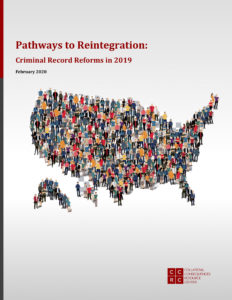
Record-breaking number of new expungement laws enacted in 2019

This is the third in a series of comments describing some of the 153 laws passed in 2019 restoring rights or delivering record relief.  The full report on 2019 laws is available here.

Criminal record relief (expungement, sealing, set aside)

As in past years, the reform measure most frequently enacted in 2019 was record relief, i.e. expungement, sealing, or other mechanism to limit access to criminal records or set aside convictions.  This past year, 31 states and D.C. enacted no fewer than 67 separate bills creating, expanding, or streamlining record relief.  This total does not include a dozen other new laws authorizing non-conviction dispositions that will be eligible for record-clearing under existing law.  A trend we observed in our 2018 report toward “a growing preference for more transparent restoration mechanisms” that limit use of a criminal record, as opposed to access, does not appear so obvious to us this year.  If anything, jurisdictions appear to be looking for new efficiencies in clearing records.

In 2019, 27 states and D.C. made certain classes of convictions newly eligible for expungement, sealing, or vacatur relief.  Five of those states enacted their first general authority for expunging or sealing convictions (North Dakota, New Mexico, West Virginia, Delaware, Iowa), making record relief available for the first time to thousands of people.   Nonetheless, most potential beneficiaries of these new relief schemes find them hard to navigate:  eligibility criteria are frequently complex and unclear, and court procedures are usually intimidating, burdensome and expensive.  These and other barriers to access have been shown to discourage the law’s intended beneficiaries.

To obviate the need for individual applications, in 2019 three states followed the example set by Pennsylvania’s 2018 “Clean Slate Act” by enacting automatic relief for a range of conviction and non-conviction records (Utah, California, New Jersey).  Specific provisions of these important new laws are described in the following pages, and in greater detail in the relevant state profiles in the Restoration of Rights Project.  Six additional states focused automatic relief provisions on specific offenses or dispositions (

, Illinois, New York, Virginia, Nebraska, Texas).

Also notable were bills providing relief for victims of human trafficking and for marijuana offenses.  Seven states and D.C. authorized relief for victims of human trafficking, allowing them to vacate, expunge, and seal a range of criminal records resulting from their status as a victim.   Seven other states—all of which have legalized or decriminalized marijuana—authorized record relief for certain marijuana offenses, including two automated relief measures (New York and Illinois).

In addition to these marijuana measures, which often extend to arrests and other non-conviction records, eleven states extended relief to certain non-conviction records for the first time.  Most far-reaching, new provisions in New York’s annual budget bill limited access to cases in which there has been no docket entry for five years; precluded the inclusion of such undisposed cases in background check reports; and extended New York’s automatic sealing of non-convictions to cases decided prior to the enactment of that relief in 1992

Finally, thirteen states enacted 18 laws to streamline and/or make more effective the procedures for obtaining relief under existing mechanisms.  Three states (Colorado, Washington, and New York) made particularly noteworthy and broad-based procedural reforms to their criminal records laws.

***********

To summarize the bounteous haul of record relief laws enacted in 2019, we have organized them into three categories: (1) new automatic relief schemes; (2) new petition-based relief; and (3) improved procedures and effect of existing record relief mechanisms.

Read more