Tag: Rhode Island

Oklahoma and California win Reintegration Champion awards for 2022 laws

On January 10 we posted our annual report on new laws enacted in 2022 to restore rights and opportunities to people with a record of arrest or conviction. Like our earlier reports, it documents the steady progress of what we characterized two years ago as “a full-fledged law reform movement” aimed at restoring rights and dignity to individuals who have successfully navigated the criminal law system. This year’s criminal record reforms bring the total number of separate laws enacted in the past five years to more than 500. Posted below is our fourth annual legislative Report Card recognizing the most productive states in 2022. Reintegration Awards for 2022 While more than a handful of states enacted noteworthy laws in 2022, two states stand out for the quantity and quality of their legislation:  California and Oklahoma share our 2022 Reintegration Champion award for their passage of at least two major pieces of record reform legislation. California – Enacted a whopping 11 new laws, including the broadest general record clearing law in the nation, a direction to courts to effectuate clearing of marijuana records, removal of restitution as a bar to clearing criminal records, easing access to judicial certificates of rehabilitation, and simplification of the process for certifying people with criminal records to work in community care. California’s governor also vetoed a bill that would have facilitated background screening by eliminating court-imposed restrictions on online access to personal identifying information. Oklahoma – Enacted a major automatic record clearing law and the most sweeping update to an occupational licensing scheme of any state in the country this year. Oklahoma also passed a significant law allowing young people who successfully complete the state’s youthful offender program to have their charges dismissed and expunged. Another eight states earned an Honorable Mention for their enactment of at least one significant new record reform law: Colorado – Expanded automatic sealing to include all offenses eligible for petition-based sealing, reduced the waiting period for low-level drug possession from three years to two, and enhanced procedural rights of those applying for occupational licenses. Connecticut – Made it easier for people with felony convictions to work in dozens of occupations under the state department of public health and authorized a binding preliminary determination. Delaware – Enacted the “Fair Chance Licensing Act,” establishing a binding preliminary application process, providing that many records may not be grounds for denial (convictions over 10 years old with no intervening convictions; pardoned, sealed, or expunged convictions; non-conviction records; and juvenile adjudications). Even “substantially related” crimes must be given an opportunity for a waiver via a board vote. Delaware also authorized automatic expungement of records of charges lacking a final disposition and prohibited higher education institutions from inquiring into an applicant’s criminal history. Indiana – Eliminated the one-year waiting period for sealing non-conviction records, including uncharged arrests, and made this relief automatic. Louisiana – Strengthened and extended its occupational licensing law, by establishing a binding preliminary determination, providing for appeal, bringing many new boards under its general licensing limits, and adopting new factors to be considered in determining “direct relationship.” The state also provided unusually broad record relief for victims of human trafficking. Maryland – Legalized the personal use of up to 1.5 ounces of cannabis for adults 21 and older, authorized resentencing and expungement of marijuana conviction records and established a business assistance fund that prioritizes individuals with cannabis convictions. Maryland also enacted a law removing state authority over the delinquency of children aged 13 and under. Missouri – Missouri voters amended the state constitution to legalize personal use of marijuana, and at the same time authorized release from prison for those serving prison sentences for marijuana trafficking, provided for automatic expungement for numerous marijuana convictions upon completion of sentence, and extended preference in commercial licensure to sell legalized marijuana to those with convictions. In addition, Governor Mike Parson has become the most prolific pardoner in the state in more than 40 years, working efficiently to reduce a case backlog built up over many years. Rhode Island – Legalized adult possession of small amounts of marijuana, provided for automatic expungement of convictions for decriminalized marijuana offenses, and waived costs as a bar to expungement for anyone who has been incarcerated for a marijuana offense. Low marks go to two states that enacted no record reform laws at all in 2022. While there are many other states in this category this year, the legislatures of Alaska and Wisconsin earn their place at the bottom of the heap for having been equally unproductive in 2021, 2020 and 2019, years in which almost every other state passed at least some law limiting access to and use of criminal records.  Wisconsin’s one saving grace is the extensive record of pardoning by Governor Tony Evers in the past 30 months, during which he has pardoned more than 600 individuals, 325 in 2022 alone. Looking ahead to 2023, we expect to see a continuing expansion of eligibility for record clearing, and reduction of access barriers like lengthy waiting periods, outstanding court debt and application-related costs.  We also predict efforts to improve records management to accommodate automation of record clearance.  We look for extension of state fair employment laws, and further facilitation of occupational licensing, both areas where bipartisan reforms have benefitted from helpful model laws. We are slightly less optimistic about additional progress toward dismantling the structure of felony disenfranchisement, which has become mired in faction looking toward the presidential race in 2024. Hopefully, 2023 will see some record reform action in Congress and federal agencies, including measures to extend access to government-guaranteed loans and contracting opportunities to small businesses owned or managed by people with a criminal history. We have come a long way just in the past five years, but there is still a long way to go.     Read more

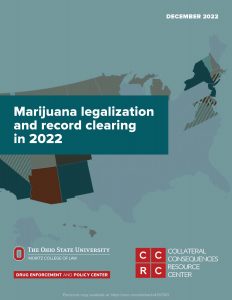
Marijuana legalization and record clearing in 2022

CCRC is pleased to announce a new report on recent cannabis-specific record sealing and expungement reforms in the past 18 months. The report, extending CCRC’s fruitful collaboration with the Drug Enforcement and Policy Center at The Ohio State University, is available here.  An accompanying infographic (reproduced at the end of this postr) summarizes the report’s findings, and includes a color-coded US map showing which states have enacted cannabis-specific record-clearing provisions.  To supplement the map, the report includes an appendix classifying and describing marijuana-specific record clearing statutes in all 50 states, based on CCRC’s 50-state comparison chart on “Marijuana Legalization, Decriminalization, Expungement and Clemency.”  To put our new report in context, CCRC and DEPC reported 18 months ago on an “unprecedented period for policymaking at the intersection of marijuana legalization and criminal record reform in the first months of 2021,” with four states (New Jersey, New Mexico, New York, and Virginia) legalizing marijuana possession and at the same time providing criminal record relief for past convictions along with a variety of social equity provisions.  Our report shows this trend continuing into 2022. Since our 2021 report, four additional states (Connecticut, Maryland, Missouri, and Rhode Island) have adopted similar record-clearing provisions in connection with adult-use cannabis legalization, authorizing sealing and expungement provisions that in most cases extend well beyond convictions for legalized conduct. All four states made at least some relief automatic, removing the burden of a criminal record from many individuals while raising the bar on standards for marijuana record relief nationwide. Like the four states discussed in our earlier report, these four also address racial disparities in marijuana criminalization by directing tax revenue and business opportunities for legal marijuana to individuals and communities disproportionately affected by criminal law enforcement. During this same timeframe, three additional states (California, Colorado, and Massachusetts) enhanced their existing marijuana-specific record sealing statutes. The report summarizes the cannabis-specific record clearing provisions enacted since publication of our earlier report in the spring of 2021 in California, Colorado, Connecticut, Maryland, Massachusetts, Missouri and Rhode Island. Missouri’s record-clearing provisions, adopted through a ballot initiative and effective immediately, are particularly impressive: individuals currently incarcerated for possession of up to three pounds of marijuana may petition for release and expungement (with certain offenses excepted), most individuals currently under supervision are automatically released from their sentence and their record expunged, and individuals convicted of all marijuana-related misdemeanors and most felonies have their records automatically expunged upon completion of sentence. See Section III(C) of the Missouri profile from the Restoration of Rights Project for additional information about this extraordinary ballot initiative. As in the 2021 report, we include laws authorizing marijuana-specific automatic record clearing provisions that are not scheduled to be implemented until some future date, with an appropriate notation. We focus exclusively on authorities that specifically expunge or seal marijuana convictions, and do not take into consideration more general record clearing laws that may also apply to marijuana convictions (frequently more broadly).  Additional information about state record relief laws, including those that apply specifically to marijuana records, can be found in the state profiles in the Restoration of Rights Project. In addition to the 50-state overview of marijuana-specific record clearing provisions, the appendix also includes a summary of the marijuana-specific pardon initiatives undertaken by several states in recent years. Read the report Explore the infographic (click to enlarge)                   Read more

Two significant new occupational licensing laws enacted in 2021

After 11 states enacted 19 laws limiting consideration of criminal records by occupational licensing agencies last year, the first significant record reforms of 2021 are occupational licensing laws enacted by Ohio and the District of Columbia.  D.C.’s new law is particularly comprehensive, and applies both to health-related and other licensed professions in the District. The new District of Columbia law, Act A23-0561, is described in detail in the DC profile from the Restoration of Rights Project.  It provides that no one may be denied a license based on conviction of a crime unless it is “directly related” to the licensed occupation, as determined by a detailed set of standards; prohibits inquiry about a record until an applicant has been found otherwise qualified and then prohibits consideration of certain records (including non-conviction and sealed convictions); and provides procedural protections in the event of denial. The new law also establishes a pre-application petition process for individuals with a record to determine their eligibility, and requires the Mayor to report annually to the Council on each board’s record.  The Institute for Justice has described the “landmark” new D.C. law as “the best in the nation, second only to Indiana.” The new Ohio law, HB 263, is more complex and less protective than DC’s, requiring licensing boards to publish lists of two types of convictions: those that “shall” be disqualifying (overcome only by a court-ordered certificate) and those that “may” be found disqualify based on their “direct relationship” to the licensed occupation. Other convictions and non-conviction records may not be grounds for denying a license, and vague terms like “moral character” and “moral turpitude” may not be used. If a conviction is on the list of those “directly related,” the board must still consider certain standards linked to an applicants overall record that are linked to public safety, and may not deny after a period of either five or 10 years depending on the offense.  In the event of denial, a board must provide procedural protections including written reasons and a hearing.  These new features supplement the provision for a binding preliminary determination enacted by Ohio in 2019. Michigan’s governor also signed a series of bills regulating occupational licensure on the last day of 2020, which include some of the features of the schemes described above but retain the unfortunate disqualification standard of “good moral character.” While Michigan’s licensing law could use improvement, it contributed to the state’s earning the title of Reintegration Champion of 2020. Our report on new legislation in 2020, documenting that 11 states enacted 19 licensing reform laws, noted that “[o]f all the criminal record reforms enacted during this modern reintegration reform era, no other approaches the regulation of occupational licensing agencies in terms of breadth, consistency, and likely efficacy.”  We reprint the discussion of 2020 licensing reform from our report here: In 2020, 11 states enacted 19 laws limiting consideration of criminal records by occupational licensing agencies. Four states (Idaho, Iowa, Missouri, and Rhode Island) regulated licensing agencies statewide for the very first time; two other states (Utah and West Virginia) improved upon their first venture into licensing regulation in 2019; and Pennsylvania made improvements in licensing standards originally adopted in an earlier era of reform in the 1970s. These enactments continue a trend begun in 2017 that has transformed the licensing policy landscape across the Nation and opened opportunities in regulated professions for many thousands of people. As explained in our national report The Many Roads to Reintegration, these licensing reforms are particularly important in supporting reintegration, since studies have shown that more than 25% of all jobs in the United States require a government-issued license.  Occupational licenses offer a gateway to the middle class, particularly for people who may have learned a trade or gained a skill while in prison. The new wave of licensing reforms resurrects a progressive approach to occupational opportunity that dates from the 1970s.  In recent years it has been strongly influenced by model legislation developed by the Institute of Justice (IJ), a libertarian public interest law firm, and the National Employment Law Project (NELP), a workers’ rights research and advocacy group.  Despite their origin in differing regulatory philosophies, the IJ and NELP model laws reflect a similar approach:  they 1) limit the kinds of records that may result in disqualification, rejecting vague “good moral character” and other criteria irrelevant to competence; and 2) insist that individual denials be grounded in findings of rehabilitation and public safety with rigorous due process guarantees, making agency procedures more transparent and accountable.  In the IJ model, applicants may seek binding preliminary determinations of qualification, and agency compliance is monitored by disclosure and reporting requirements. Some of the more familiar provisions of these new laws are drawn from the IJ or NELP models: Preliminary determination: Providing for a preliminary determination of qualification, for a small fee with quick turnaround and written reasons Relevant standards: Deleting vague standards like “good moral character” in favor of standards likely to evidence low risk and rehabilitation Prohibited considerations: Barring consideration of certain types of records and other types after a specified time Transparency: Requiring agencies to publish a list of disqualifying convictions and to provide written reasons for rejection in individual cases Accountability: Including reporting requirements intended to monitor agency compliance. The new occupational licensing laws in 2020 are summarized below: Colorado enacted the “Occupational Credential Portability Program,” which authorizes approval of an application for reciprocal licensure by anyone licensed in another jurisdiction, apparently without regard to whether they meet Colorado’s standards for licensure that relate to consideration of criminal record, unless they have committed an act that would be grounds for disciplinary action in Colorado (HB 20-1326). Colo. Rev. Stat. §§ 12-20-202(3)(a), (b), (f)(III). In addition, HB 20-1424 creates “social equity licenses” to operate legal marijuana businesses, available to people who: (1) themselves or their family members were arrested, convicted, or subject to a civil forfeiture for a marijuana offense; (2) have a low income; or (3) live in an “opportunity zone” or “disproportionate impacted area.” Iowa had no general law regulating consideration of criminal record in occupational licensing prior to 2020. HF 2627 adds a new section to Chapter 272C of the Iowa Code to impose an unusually robust and license-specific “direct relationship” test on all but a few health-related licenses. Each covered board must provide a list of offenses that “directly relate[] to the duties and responsibilities of the profession,” and may not deny a license based on non-conviction records or any finding that an applicant “lacks good character” or “suffers from moral turpitude.” Iowa Code Ann. §272C.15. Under the new section, an agency “shall grant” an exception to an individual “who would otherwise be denied a license due to a criminal conviction” if the individual is determined to be rehabilitated and an “appropriate candidate for licensure” based on a list of factors that include the nature and seriousness of the crime, the passage of time, and other mitigating or aggravating factors. There is a rebuttable presumption that an applicant is “rehabilitated” five years after release from incarceration unless the conviction was for certain violent or sexual crimes. The board shall consider whether a “certification of employability” has been issued and any letters of reference. A prospective applicant may petition for a preliminary determination, for which a board may charge a fee of $25. Grounds for denial must be in writing, and the applicant must be given an opportunity to appeal and informed that evidence of rehabilitation will be considered on reapplication. The board’s findings on each criterion specified must be “sufficient for review by a court.” The board has the burden of proving direct relationship. An individual may be requested to submit a “complete criminal record,” which includes the complaint and judgment for each conviction. Idaho had no general law regulating consideration of criminal record in occupational licensing, prior to 2020. SB 1351 adds a new chapter 94 to Title 67 of the Idaho Code, inter alia establishing a committee “to study and review occupational licensing and certification laws in general in order to determine, as applicable, how the legislature may be able to ease occupational licensing barriers while still protecting the public health and safety.” The new law authorizes a non-binding preliminary determination as to whether a person’s conviction would be disqualifying, and establishes a multi-factor test to determine whether a person’s criminal record is “currently relevant to the applicant’s fitness” to engage in the occupation. A license may not be denied on the basis of “vague or generic terminology related to a criminal conviction, including but not limited to ‘moral turpitude’ or ‘moral character.'” “Where such terms appear in code or rule with respect to a criminal conviction, a licensing authority shall conduct a relevancy evaluation pursuant to subsection (1) of this section.” The “relevancy” standard was inserted in a variety of licensing chapters as a basis for denial or revocation of a license, replacing a formulation that permitted adverse action based on “conviction of any felony, or conviction of any other crime involving moral turpitude.” It was also inserted into the rules of the division of human resources and the personnel commission that regulate public employment in the state. Louisiana’s SB 354 provides for issuing a card to individuals leaving prison that includes a list of all vocational licensing and certification programs completed while incarcerated. Michigan enacted a series of bills applicable to occupational licensure to limit agency consideration of certain types of criminal record. HB 4488 and related bills retained the standard of “good moral character” as a basis for restricting licenses to those with a criminal record but limited it for most licenses to exclude non-convictions, misdemeanors that do not carry a prison term, and convictions “unrelated to an individual’s capacity to serve the public.”  The new law requires each licensing agency to specify the crimes that are likely to fall into the last-mentioned category. They must also provide a statement of reasons in the event of denial (“including a complete record of the evidence upon which the determination was based”), an opportunity to appeal, and judicial review. An annual report must be submitted with the number of applications denied because of lack of good moral character and a summary of the convictions on which denials were based. Missouri provided very little protection to a person with a criminal record in the licensing process prior to 2020. The Fresh Start Act (HB 2046) requires that a disqualifying criminal record must be “directly related” to the license, also specifying that certain violent crimes “shall” be considered “directly related” to whatever license is involved even if sentence is not imposed. Drug crimes “may” be disqualifying for certain occupations, while fraud offenses “may” be disqualifying for other occupations. If convicted of a lesser included offense, the period of disqualification as “directly related” lasts only for four years after release from incarceration. “Direct relationship” is determined by a multi-factor test. Applicants may apply for a preliminary determination that is binding on the agency. If a person is denied a license, they have a right to a hearing, as well as written findings addressing each factor on which the agency relied sufficient for a reviewing court. “In any administrative hearing or civil litigation authorized under this subsection, the licensing authority shall carry the burden of proof on the question of whether the applicant’s criminal conviction directly relates to the occupation for which the license is sought.” The new law does not apply to significant classes of licenses, including teachers, various health professionals, accountants, real estate brokers and agents, and peace officers. Pennsylvania enacted SB 637 to bolster its weak occupational licensing law dating from the 1970s. SB637 supersedes any law that disqualifies an individual for a license or provides for “good moral character” findings, requires that there be a “direct relationship” between the crime and the profession and whether licensing the individual poses a public safety risk, as determined by an “individualized assessment” under a long list of specified factors. It excludes those convicted of sexual offenses from health care licensure and establishes a separate set of standards for those convicted of violent crimes. Prohibits consideration of juvenile adjudications, non-conviction records, and records of convictions that have been expunged or sealed). It also authorizes restricted licenses for applicants who cannot immediately demonstrate fitness due to a criminal conviction, and it provides for a “preliminary determination” for applicants considering undergoing training for a license, which is binding unless the crime is one on the list of crimes “directly related,” in which case it may be subject to further inquiry when a formal application is filed. The law falls short in not ruling out consideration of dated or minor convictions, although it does rely on a public safety standard for denial of a license and gives those recently released from prison a chance to demonstrate their abilities. While existing law requires boards to defend record-related denials with written reasons, neither old nor new law provides an opportunity for an administrative appeal, requiring a disappointed applicant to file a lawsuit. Rhode Island enacted its first generally applicable law regulating the occupational licensing process, extending it as well to professional and business licenses issued by state agencies. S 2824 applies a “substantial relationship” standard to licensing boards under most departments of state government, establishes standards for determining substantial relationship, excludes certain records from consideration, allows applicants to establish rehabilitation by detailed standards, provides detailed procedures in the event of denial, suspension or revocation, and includes accountability standards. Records that may not be considered include non-conviction records, juvenile records, expunged records, records of misdemeanors that may not be punished by incarceration, and any crime that is not substantially related. If a licensing authority intends to deny, suspend, or revoke an occupational license solely or in part because of a conviction, the person must be given reasons in writing, and if the conviction is “substantially related” an analysis under each of the criteria. The person must be permitted to respond and given an opportunity to appeal. Every agency must post on its website each year a report with “(1) the number of applicants granted licenses, the number of applicants denied licenses for any reason, and, to the extent available, the demographic breakdown of the applicants, including race, ethnicity, and gender, and city or town of residence; and (2) The number of applicants denied solely, or in part, because of a criminal conviction. The law took effect on January 1, 2021. Utah’s legislature acted to enhance a 2019 law that provided for a preliminary determination of qualification for licensure applicable to many state licensing boards, upgrading its standard for decision-making from “reasonable relationship” to “substantial relationship.” SB 201 takes regulation of licensing a step further, establishing heightened standards for consideration of licensure of applicants with criminal records. Licensing boards must “provide individualized consideration to the applicant or licensee,” and “determine whether the criminal conviction bears a substantial relationship to the applicant’s or licensee’s ability to safely or competently practice the occupation or profession.” In this determination the board will “consider the applicant’s or licensee’s current circumstances” measured by a number of the customary factors such as age when offense committed, time since conviction, and various indicia of rehabilitation. Applicants are provided an opportunity to appeal a denial. § 58-1-402. Certain convictions are per se “not evidence of unprofessional conduct,” including non-convictions, and convictions where seven years have passed since release from incarceration without a conviction or guilty plea. Convictions for violent and sexual crimes, and for fraud or embezzlement are excepted. § 58-1-501(4). Vermont has very weak regulation of occupational licensing agencies, allowing denial or discipline for “unprofessional conduct” based on “[c]onviction of a crime related to the practice of the profession or conviction of a felony, whether or not related to the practice of the profession.” 233 did nothing to tighten this standard, providing only that its licensing boards must offer interested persons a pre-application determination regarding whether their criminal background will be disqualifying. This request shall provide documentation related to the individual’s conviction or convictions, evidence of rehabilitation, and identification of the profession or professions for which the individual seeks licensure. An applicant would pay a $25 fee for this so-called “second chance determination,” and this fee would be deducted from the license application fee if the applicant does thereafter seek licensure. The new law applies to the professions and occupations regulated by the Office of Professional Regulation, the Department of Environmental Conservation (for well drillers), the Standards Board for Professional Educators, the Board of Medical Practice, the Electricians’ Licensing Board, and the Plumbers’ Examining Board. Washington enacted HB 2870 to create a “social equity program” to reduce barriers to entry to the cannabis industry for individuals and communities most adversely impacted by the enforcement of cannabis-related laws. West Virginia enacted two laws (HR4352 and HR4353) extending regulation enacted in 2019 to a variety of different licenses, applying a “rational nexus” standard for denial, lifting mandatory bars after five years, and authorizing a preliminary determination. Read more

Civil death lives!

The first and foremost collateral consequence in Colonial America was civil death; based on the grim fact that felonies were punished by execution, upon conviction, the law began to wrap up the convict’s affairs.  As the law developed, capital punishment ceased to be the default punishment, and civil death was seen as too harsh for a felon who might serve a probationary sentence instead of being executed or even going to prison at all.  The Rhode Island Supreme Court recently issued an opinion demonstrating that this ancient doctrine is not entirely obsolete. In Gallup v. Adult Correctional Institutions, the court upheld dismissal of a complaint alleging that the state negligently allowed the plaintiff, a prisoner serving life, to be assaulted by another inmate.  The court pointed to the state’s civil death statute, which applies to prisoners serving life in an adult correctional institution. Such persons “shall, with respect to all rights of property, to the bond of matrimony and to all civil rights and relations of any nature whatsoever, be deemed to be dead in all respects, as if his or her natural death had taken place at the time of conviction.”  Of U.S. jurisdictions, only Rhode Island, New York, and the Virgin Islands maintain civil death, and New York’s statute has many exceptions.  There is, accordingly, not much modern law on the scope of civil death statutes. One wonders whether the Rhode Island statute could really extend to the full scope of its language; could a lifer be denied, for example, freedom of religion and speech under the U.S. and/or Rhode Island constitutions?  Suggesting that the answer is “no” is the fact that the court granted the plaintiff leave to plead a 42 U.S.C. § 1983 action based on the same underlying facts; the court recognized that a state statute cannot eliminate federal rights. That acknowledgement raises the hard question of the extent to which the federal Constitution protects the property, right to marry, and “civil rights and relations” of even a person serving a life sentence. Read more

New research report: Four Years of Second Chance Reforms, 2013-2016

Introduction Since 2013, almost every state has taken at least some steps to chip away at the negative effects of a criminal record on an individual’s ability to earn a living, access housing, education and public benefits, and otherwise fully participate in civil society.  It has not been an easy task, in part because of the volume and complexity of state and federal laws imposing collateral consequences.  To encourage employers and other decision-makers to give convicted individuals a fair chance, some states have enacted or modified judicial restoration mechanisms like expungement, sealing, and certificates of relief.  Others have extended nondiscrimination laws, limited criminal record inquiries, and facilitated front-end opportunities to avoid conviction. In partnership with the NACDL Restoration of Rights Project, the CCRC maintains a comprehensive and current state-by-state guide to mechanisms for restoration of rights and status after conviction.  As a part of keeping that resource up to date, we have inventoried measures enacted and policies adopted by states in the past four years to mitigate or avoid the disabling effects of a criminal record, and present it here as a snapshot of an encouraging national trend. Summary of findings Between 2013 and 2016, forty-two states and the District of Columbia adopted significant reforms of various types.  The most common of these reforms are ban-the-box laws and policies that prohibit employers from inquiring into an applicant’s criminal history during the initial stages of the application process.  Twenty-one states banned the box in public employment, and eight (CT, DC, IL, MN, NJ, OR, RI, and VT) expanded their ban-the-box prohibitions to cover private employers as well. Expungement and sealing authorities were also expanded in a significant number of states. Arkansas, Indiana, and Minnesota enacted comprehensive new expungement/sealing schemes that grant many individuals an opportunity to have their records sealed from public view and/or rights restored for the first time.  Additionally, California, Illinois, Kentucky, Louisiana, and Missouri all expanded existing expungement/sealing laws to make certain felonies eligible.  Maryland, Pennsylvania, and South Dakota enacted entirely new authorities limiting public access to misdemeanor records. Another fifteen states expanded existing expungement or sealing opportunities, either to increase the number and type of eligible offenses and dispositions, or to broaden the protections afforded to, or rights restored by, an expunged or sealed record. Unfortunately, stiff filing fees in states like Louisiana and Kentucky will inevitably discourage people of limited means from taking advantage of these new authorities. Judicial and/or administrative “certificates of relief” were also made available in nine states for the first time. These certificates adhere to a “forgiving,” as opposed to “forgetting,” model of criminal record mitigation. The new certificates with the broadest application and effect are those in Ohio and Vermont, both of which are modeled after provisions in the Uniform Collateral Consequences of Conviction Act (UCCCA) that authorize courts to completely remove specified mandatory collateral consequences imposed by law, allowing individuals to be considered for employment or licensing opportunities on the merits. Colorado’s new “order of collateral relief” provides relief from mandatory consequences specified in the order, with exceptions, but is only available for non-prison sentences. The new certificate authorities in most other states either protect employers and/or other private entities from negligent hiring or retention claims based solely upon their agent’s conviction, or prohibit employers or licensing bodies from denying applicants “based solely upon” their conviction.  The effect or availability of pre-existing certificate authorities were expanded in another three states. Another notable trend was the expansion of the effect and availability of deferred adjudication and diversion mechanisms, which allow individuals to avoid conviction altogether following successful completion of probation or other conditions. Five states (AL, CA, DE, GA, NJ) enacted legislation explicitly authorizing expungement or sealing of deferred adjudication records for the first time, while Colorado and Illinois enacted entirely new deferred adjudication authority.  These programs provide a great benefit to those who can take advantage of them, but, in many states, prosecutorial control of these programs can result in disparate treatment and costly relief. >>View the full report below or download here<<       Read more