Tag: Many roads

“The Many Roads From Reentry to Reintegration”

We are pleased to publish the March 2022 revision of our national survey of laws restoring rights and opportunities after arrest or conviction, “The Many Roads from Reentry to Reintegration. Like the earlier report, this report contains a series of essays on various relief mechanisms operating in the states, including legislative restoration of voting and firearms rights, various types of criminal record relief (expungement and sealing, pardon, judicial certificates), and laws limiting consideration of criminal record in fair employment and occupational licensing.

Drawing on material from CCRC’s flagship resource the Restoration of Rights Project, the report grades each state for the scope and efficacy of its laws in nine different relief categories. Based on these grades, it compiles an overall ranking of the states. As described below, most of the states identified as reform leaders in our 2020 report still rank highly, but several new states have joined them. Half a dozen other states made substantial improvements in their ranking by virtue of progressive legislation enacted in 2020 and 2021, in two cases (D.C. and Virginia) rising from the bottom ten to the top 20.

The legal landscape has been changing rapidly in the 18 months since the first edition of this report was published in September 2020. Substantial progress has been made in a number of states, and in the Nation as a whole, toward devising and implementing an effective and functional system for relieving collateral consequences. The bipartisan public commitment to a reintegration agenda seems more than ever grounded in economic imperatives, as pandemic dislocations have brought home the need to support, train, and recruit workers, who are essential to rebuilding the small businesses that are the lifeblood of healthy communities.

The greatest headway has been made in restoring the vote and broadening workplace opportunities controlled by the state, both areas where there are national models and best practices. The area where there is least consensus, and that remains most challenging to reform advocates, is managing dissemination of criminal record information. Time will tell how the goal of a workable and effective criminal record relief system is achieved in our laboratories of democracy.

One area of record relief on which there does appear to be an emerging bipartisan consensus is that non-conviction records should be automatically sealed or expunged on case disposition. We are particularly pleased to see how many states have enacted laws limiting access to the record of cases disposed in favor of the defendant just since publication of our Model Law on Non-Conviction Records in 2019.

Read more

Fair Chance Employment and Occupational Licensure: A National Survey

Yesterday we announced the forthcoming publication of a national report surveying various legal mechanisms for restoring rights and opportunities following arrest or conviction, a revision and updating of our 2020 report “The Many Roads to Reintegration.” The first post in the series (“Expungement, Sealing & Set-Aside of Convictions“) gives some additional background about the report. This second post in this “preview” series deals with how the law regulates consideration of criminal history in employment and occupational licensing. We expect to publish the whole report, plus our Reintegration Report Card for 2022, early next week.

Fair Chance Employment & Occupational Licensing
Introduction

There is perhaps no more critical aspect of a reintegration agenda than removing the many unjustified and unjustifiable barriers faced by people with a criminal record in the workplace.[1] In an era of near-universal background checking and search engines, the “Mark of Cain” these individuals bear will sooner or later be known to potential employers and licensing boards even if criminal record information is not requested on an initial application.

Some barriers take the form of laws formally disqualifying people with certain types of convictions from certain types of jobs or licenses. More frequently, barriers result from informal discrimination grounded in an aversion to risk and, too frequently, racial stereotypes. Whether it is securing an entry level job, moving up to management responsibilities, or being certified in a skilled occupation, people with a criminal record are at a competitive disadvantage, if they are even allowed to compete. As between two individuals with hypothetically equal qualifications, it is easy for a risk-averse prospective employer or licensing agency to justify breaking the tie in favor of the person who has never been arrested.

Individualized record relief mechanisms like expungement or pardon are intended to improve employment opportunities, and they can be helpful on a case-by-case basis to those who are eligible and able to access them.[2] But equally important are fair employment and licensing laws that impose general standards limiting consideration of criminal record and provide for their enforcement, offering class-wide relief to all similarly situated individuals. States have enacted an impressive number of this sort of systemic “clean slate” law[3] just since 2015, some building on laws enacted in an earlier period of reform half a century ago in the 1960s and 1970s,[4] and others breaking new ground in regulating how employers and licensing agencies consider an applicant’s criminal record.

In employment, one of the most striking legislative trends in the past decade is the embrace of limits on inquiry into criminal history in the early stages of the hiring process, particularly for public employment. The so-called “ban-the-box” campaign that began modestly more than 20 years ago in Hawaii and took off nationwide after it was adopted in California, has now produced new laws or executive orders in more than two-thirds of the states and in over one hundred cities and counties. More efficient and broadly effective than after-the-fact lawsuits, ban-the-box laws now represent the primary tool for eliminating unwarranted record-based employment discrimination on a system-wide basis. They are premised on an expectation that getting to know applicants before learning about adverse information in their background is likely to lead to a fairer and more defensible hiring decision. This should be particularly true when a records check is permitted only after a conditional offer of employment has been made, so there is little doubt about the reason in the event of a later withdrawal.[5] A few states (though still too few) have coupled ban-the-box strategies with standards for considering a person’s record after inquiry is permitted.
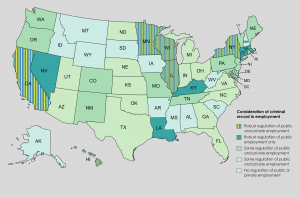
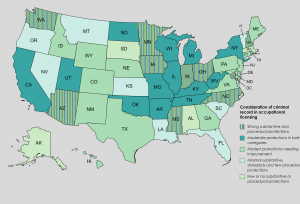
Occupational licensing has also seen an acceleration of legislative efforts to limit the arbitrary rejection of qualified workers. Significant procedural and substantive reforms have been enacted in more than two thirds of the states in the last five years, in some cases building on reforms originally adopted in the 1970s, and in others following models recently proposed by policy advocacy organizations from across the political spectrum whose model laws aim to make licensing authorities newly accountable for their actions and individuals newly able to obtain and practice a skill with enhanced career prospects. Following these models, states have

  • substituted objective standards related to the specific occupation for vague “good moral character” criteria;
  • afforded individuals a preliminary decision about whether their record will be disqualifying before they invest in education or training;
  • prohibited consideration of certain records considered unrelated to job performance, including based on their minor or dated nature;
  • required licensing agencies to justify negative decisions, frequently in terms of public safety, and to afford disappointed applicants an opportunity to appeal;
  • imposed legislative oversight requirements to hold licensing agencies accountable for their performance.

As shown in the following discussion and in the “Report Card” maps that follow the section, almost every state now has at least some law aimed at limiting record-based discrimination in employment or licensure, and most have both. Enforcement of these new laws may in many cases depend on education and persuasion rather than on lawsuits and executive orders, but this may make systemic change come sooner and have a more lasting effect. The very exercise of repeatedly having to decide the relevance of an individual’s past conduct through a transparent and accountable process is likely to result in more reliable decision-making, and a better understanding of those relatively few instances when denial of opportunity is justifiable. We discuss the state of the law in greater detail in the following sections.

Read more

Expungement, Sealing & Set-Aside of Convictions: A National Survey

We are pleased to announce the forthcoming publication of a national survey of the various legal mechanisms that exist in each state to restore rights and opportunities after arrest or conviction. Titled “The Many Roads from Reentry to Reintegration,” the report revises and updates the survey CCRC originally published in the summer of 2020.  Like that earlier report, it includes grades for each state in nine different categories of relief, and an overall ranking of the states according to the efficacy of their combined restoration measures. Those who are familiar with the rankings in our 2020 report will find that since then many states have improved their position substantially (mostly at the higher end of the ranking scale, with several impressive exceptions) and many have not (mostly at its lower end).

We hope that this report will allow us to take stock of the extraordinary things that legislatures across the country have been able to accomplish in just the past 18 months, enacting a total of more than 250 separate laws to restore the franchise, clear criminal records, and ensure fair consideration in employment and licensing.  We expect to publish the entire new “Many Roads” report next week, along with a new version of our Reintegration Report Card that showcases the states that have made the most progress and suggests how each state may improve its ranking for the next report.

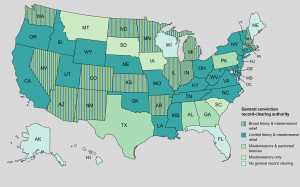
Today we are publishing an excerpt from the new “Many Roads” report on two of its nine categories: record clearing for felony and misdemeanor convictions. Each state is graded separately in the two categories, although the map that is included midway through this post combines them, as they are combined in the 50-state chart from the Restoration of Rights Project. Record clearing for non-conviction records is covered in a separate section, and will be published here in the next few days.

***********

Expungement, Sealing & Set-Aside of Convictions: A National Survey

Tens of millions of Americans have been convicted of a felony or misdemeanor.[1] This number has grown substantially in the last four decades as a result of the policies of “mass incarceration” and so-called “war on crime,” with disproportionate impacts on Black and Brown people.[2] The vast network of collateral consequences that can flow from a conviction in the modern era has been described as a new form of “civil death.”[3] In addition to formal consequences imposed by law and rule, widespread dissemination of criminal records online and in background checks operates as a form of continuing “digital punishment.”[4]  In recent years collateral consequences of a less formal variety have extended even to mere arrest records not followed by conviction.[5] The American way of dealing with a person’s criminal history is unburdened with the considerations of privacy, utility, and basic fairness that have shaped European systems.[6]

Read more

Two significant new occupational licensing laws enacted in 2021

After 11 states enacted 19 laws limiting consideration of criminal records by occupational licensing agencies last year, the first significant record reforms of 2021 are occupational licensing laws enacted by Ohio and the District of Columbia.  D.C.’s new law is particularly comprehensive, and applies both to health-related and other licensed professions in the District.

The new District of Columbia law, Act A23-0561, is described in detail in the DC profile from the Restoration of Rights Project.  It provides that no one may be denied a license based on conviction of a crime unless it is “directly related” to the licensed occupation, as determined by a detailed set of standards; prohibits inquiry about a record until an applicant has been found otherwise qualified and then prohibits consideration of certain records (including non-conviction and sealed convictions); and provides procedural protections in the event of denial. The new law also establishes a pre-application petition process for individuals with a record to determine their eligibility, and requires the Mayor to report annually to the Council on each board’s record.  The Institute for Justice has described the “landmark” new D.C. law as “the best in the nation, second only to Indiana.”

The new Ohio law, HB 263, is more complex and less protective than DC’s, requiring licensing boards to publish lists of two types of convictions: those that “shall” be disqualifying (overcome only by a court-ordered certificate) and those that “may” be found disqualify based on their “direct relationship” to the licensed occupation. Other convictions and non-conviction records may not be grounds for denying a license, and vague terms like “moral character” and “moral turpitude” may not be used. If a conviction is on the list of those “directly related,” the board must still consider certain standards linked to an applicants overall record that are linked to public safety, and may not deny after a period of either five or 10 years depending on the offense.  In the event of denial, a board must provide procedural protections including written reasons and a hearing.  These new features supplement the provision for a binding preliminary determination enacted by Ohio in 2019.

Michigan‘s governor also signed a series of bills regulating occupational licensure on the last day of 2020, which include some of the features of the schemes described above but retain the unfortunate disqualification standard of “good moral character.” While Michigan’s licensing law could use improvement, it contributed to the state’s earning the title of Reintegration Champion of 2020.

Our report on new legislation in 2020, documenting that 11 states enacted 19 licensing reform laws, noted that “[o]f all the criminal record reforms enacted during this modern reintegration reform era, no other approaches the regulation of occupational licensing agencies in terms of breadth, consistency, and likely efficacy.”  We reprint the discussion of 2020 licensing reform from our report here:

Read more

The Reintegration Report Card

We are pleased to publish “The Reintegration Report Card,” a new resource that ranks and grades all 50 states on how their laws address voting rights, record relief (including expungement and pardon), fair employment, and occupational licensing for people with a criminal record.

This Report Card supplements our recent 50-state report, “The Many Roads to Reintegration.” That report surveys U.S. laws aimed at restoring rights and opportunities after arrest or conviction. It grades the states on nine different types of restoration laws, including voting rights, six different record relief remedies, and laws regulating consideration of criminal record in employment and occupational licensing. Based on these grades, the report includes an overall ranking of the states and D.C.

This Report Card provides the grades and rankings in a more easily accessible form. It also includes a brief narrative summary of how each state’s law stacks up in the different graded categories. Our hope is that these summaries will suggest ways in which a state might improve its laws and hence its overall ranking. An appendix collects all the grades and rankings (the rankings are also at the end of this post).

We emphasize once again that our grades are based solely on the text of each state’s law, leaving more nuanced judgments about their actual operation to practitioners, researchers, and the law’s intended beneficiaries. We expect to look more closely at the operation of some of the record relief laws in the near future, and welcome comments and suggestions from those who have experience with them. In the meantime, we hope our grades will challenge, encourage, and inspire additional reforms in the months and years ahead.

The Reintegration Report Card is available at this link. For more details and legal citations for each state, see the Restoration of Rights Project. For essays surveying each topic, consult “The Many Roads to Reintegration.”

Read more