Tag: Institute for Justice

New occupational licensing laws in 2021

In the first five months of 2021, seven states and the District of Columbia enacted nine separate laws improving opportunities for people with a criminal record to obtain occupational licenses. This continues a four-year trend begun in 2017 that has seen 33 states and the District of Columbia enact 54 separate laws regulating consideration of criminal record in the licensing process.

Our report on new legislation in 2020 noted that “[o]f all the criminal record reforms enacted during this modern reintegration reform era, no other approaches the regulation of occupational licensing agencies in terms of breadth, consistency, and likely efficacy.” Laws enacted during this four-year period have “transformed the licensing policy landscape across the Nation and opened opportunities in regulated professions for many thousands of people.” The only period of law reform that rivals the present one came during the early 1970s, when many of the laws now being revised and extended were first enacted. The effectiveness of advocacy efforts by the Institute for Justice and National Employment Law Project in influencing this trend cannot be overstated.

So far during 2021, the U.S. jurisdiction to have enacted the most ambitious and comprehensive licensing scheme is the District of Columbia, and its new law (described in detail below) is one of the most progressive in the nation. New Jersey, New Mexico and Washington had not previously legislated in this area for many years, and all three extended and improved laws first enacted in the 1970s. Arizona, Georgia, Ohio, and Tennessee extended recently enacted laws, with Arizona legislating for the fourth time in this area in as many years!

The nine new laws are described below, and have been added to the state profiles and 50-state charts of the Restoration of Rights Project.

Read more
Fair chance employment and occupational licensing: A national survey

*Update (9/8/20): the full national report, “The Many Roads to Reintegration,” is now available.

Last week we announced the forthcoming publication of a national report surveying mechanisms for restoring rights and opportunities following arrest or conviction, titled “The Many Roads to Reintegration.”  Also last week, we published the first chapter of that report on loss and restoration of voting and firearms rights.  Today we publish a near-final draft of the third chapter of the “Many Roads” report, dealing with laws that systematically regulate how criminal record is considered in the workplace, by employers and by occupational licensing authorities.  Next week we expect to publish the second chapter of the report on “record relief” (including record-sealing, pardon, and judicial certificates).  The research, drawn from CCRC’s Restoration of Rights Project, reveals a trend in the states toward restricting the power of occupational licensing agencies to reject applicants with criminal records based upon factors not directly related to their qualifications.

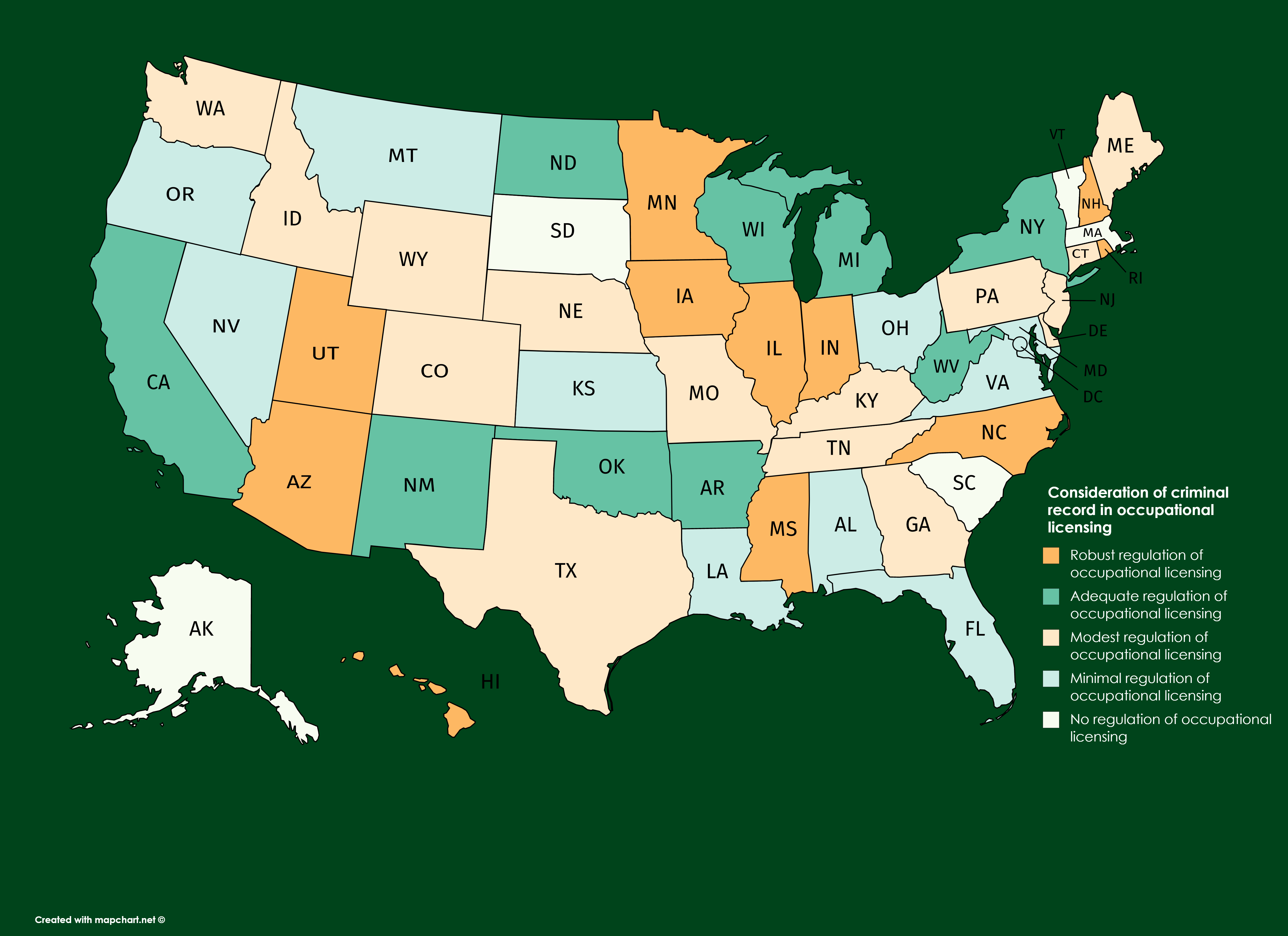
There has also been marked progress in extending fair chance employment laws, primarily through limiting inquiry into criminal record in the early stages of the hiring process and setting standards for later consideration of the record.  These trends, which have accelerated in the past three years, recall and in many cases build on an earlier period of criminal record reforms in the 1970s.  At the conclusion of the chapter are report cards with color-coded maps ranking state laws by specific criteria, to facilitate comparisons between and among states.

There are some surprises.  For one thing, there is not a particularly strong correlation between how states rate in each of the two areas.  That is, states that have a robust system of fair chance employment laws may not and frequently do not have a similarly strong system for regulating how occupational licensing agencies treat people with a criminal record.  In fact, only two states (Illinois and Minnesota) scored at the top of both categories.  Three other states that scored well on employment also scored reasonably well on occupational licensing (California, New York, and Wisconsin), but the last two jurisdictions in the top employment category (Hawaii and the District of Columbia) scored poorly on occupational licensing.  Conversely, four states that ranked in the top tier for occupational licensing had no law at all regulating consideration of criminal record in employment (Iowa, Mississippi, New Hampshire, and North Carolina) and two others had only minimal regulation of public employment (Indiana and Utah).  Three states had no law at all governing either employment or occupational licensing (Alaska, South Carolina, and South Dakota).

Another result that may surprise those who have not been following recent developments in this area of the law, is that high marks for reining in the exclusionary policies of licensing boards go to some states not ordinarily considered politically and socially progressive.  The unexpectedly strong performance of some states in regulating occupational licensing boards may be attributable to antipathy toward government interference in free markets as well as an interest in efficiency and fairness.

A PDF of this chapter is available here.  The full text follows, with end notes. Coming next, the report’s chapter on “Record Relief.”

Read more

Report card on licensing laws finds progress, but still a way to go

The Institute for Justice, a leader in advocacy for reforming occupational licensing laws, has just issued a major new report grading the states on the opportunities they give to people with a criminal record.  The press release and links are below.  We are not at all surprised that Indiana got the best grade—or that so many states “tied for dead last.” Coincidentally, the legislatures in Iowa, Missouri, and Pennsylvania have in recent days sent broad new occupational licensing reform measures to their governors’ desks, so at least three states seem poised to climb out of IJ’s basement.    

Stay tuned for an update of our own survey of employment and licensing laws nationwide, which will be part of the revised Forgiving and Forgetting report that we expect to issue in a few weeks.  In the meantime, many congratulations to IJ for its pioneering law reform work on behalf of people with a record.

IJ press release:

Barred from Working: People with Criminal Records Are Unfairly Denied Licenses to Work

New Nationwide Report Offers the Most Comprehensive Look at the Occupational Licensing Barriers Facing Ex-Offenders

Arlington, Va.—Even as states debate opening the economy back up, millions of Americans with criminal records are still locked out of the job market. Today, nearly one in five workers needs a license to work, while one in three Americans has a criminal record of some kind.

Providing the most in-depth and up-to-date look at this intersection between occupational licensing and the criminal-justice system, a new report from the Institute for Justice (IJ), Barred from Working, analyzes and grades the legal protections offered to ex-offenders who apply for licenses to work.

Many state laws fail to make the grade: just nine states received a B- or better. Indiana ranked as the best state in the nation, earning the report’s only A grade. Meanwhile, six states—Alabama, Alaska, Nevada, Rhode Island, South Dakota, and Vermont—all tied for dead last due to their utter lack of protections for former felons seeking licenses.

“An honest living is one of the best ways to prevent re-offending. But strict occupational licensing requirements make it harder for ex-offenders to find work,” said IJ Legislative Analyst Nick Sibilla, who authored the report. “Undoubtedly, some license restrictions make sense: No one wants child molesters working in daycare centers or school bus drivers with DUIs. But as this report shows, many licensing barriers have little basis in common sense or public safety and unfairly deny a fresh start to countless Americans.”

Read more

Two Southern states enact impressive occupational licensing reforms

The 2019 legislative session saw two Southern states enact impressive new laws limiting the ability of occupational licensing boards to exclude qualified applicants based on their criminal record.  North Carolina and Mississippi each passed strong new substantive and procedural licensing rules, and both of the new laws show the influence of the Model Law developed by the Institute for Justice.  Both states have now eliminated vague “good moral character” criteria, and extended procedural protections that should make it substantially harder for boards to deny licenses based on criminal history.

As a result of these bills, both states now prohibit disqualification from licensure unless a crime is “directly related” to the license involved, both require written reasons in the event of denial, and both provide for a preliminary determination as to whether an individual will be favorably considered.  In North Carolina’s case, this “predetermination” is binding on the board when the applicant later applies.  North Carolina’s new law also requires licensing boards to report annually to the legislature on their consideration of applications from people with a criminal record.

In 2019, the following additional states have enacted new restrictions on the occupational licensing process:  Arizona, Arkansas, Florida, Nevada, Ohio, Texas, Utah and West Virginia.  All told, in the past eight months 14 states have enacted 18 laws regulating occupational licensing in one form or another, with Texas accounting for five of the 18.  These new laws are described in the relevant state profiles of the RRP, and they will be discussed in greater detail in our year-end report.  They will also be incorporated into the updating of our general survey of U.S. relief and restoration mechanisms (“Forgiving and Forgetting in American Justice”),  which is now underway.

Read more

CCRC urges Supreme Court to reverse Iowa expungement decision

*Update 2: On November 25, 2019, the Supreme Court denied the petition.

*Update (11/1/2019):  On September 23, 2019, the Supreme Court asked Iowa to respond to the cert petition.  Iowa’s response is here.  The petitioner’s reply is here.

On September 9, we filed an amicus brief at the U.S. Supreme Court urging the justices to review and reverse a decision out of Iowa that upholds wealth-based barriers to expungement.  We were joined by the Institute for Justice, a libertarian public interest law firm.  At issue in the case is an Iowa law that bars a person from obtaining expungement of a dismissed or acquitted case if they owe any court fees in the case.  We point out the inequity of denying access to expungement based on socio-economic status:  “The irony of Iowa’s expungement law could not be clearer: a law that removes a hurdle to employment and economic security cannot be invoked by indigent individuals until outstanding costs and fees are paid to the state, effectively defeating the very purpose of providing expungement relief in the first place.”

This case arises from Jone Doe’s request in 2018 to expunge her dismissed criminal case from 2009.  But she still owes $550.38 for her court-appointed attorney, which she cannot afford to pay.  Doe argued the requirement to pay outstanding fees before obtaining expungement violates her equal protection rights under the constitution.  She pointed out that had she been able to hire a private attorney, she would be eligible for expungement, whether or not she owed attorney fees.  The lower court denied the request, finding that Doe “was made aware of reimbursing attorney fees and that expungement could not occur until all fees and assessed costs were paid.”  The Iowa Supreme Court, by a 4-3 vote, upheld the requirement, finding the state has a legitimate purpose “to encourage payment of court debt.”  On petition to the Supreme Court, we urge the Court to “grant certiorari and hold that one’s inability to pay court fees may not restrict access to statutorily-created expungement rights.”

We were represented by Ethan P. Fallon and Thomas M. Bondy of Orrick, Herrington, & Sutcliffe LLP, and appreciate their work on this case.  The full amicus brief is available here.