Tag: expungement

Study measures gap between availability and delivery of “second chance” relief

Professor Colleen V. Chien of Santa Clara University has published a major empirical study in the Michigan Law Review that examines the gap between eligibility for and actual delivery of relief from contact with the criminal justice system, a construct she calls the “second chance gap.” (The term is defined with examples here.) Last week, Chien led a team of law students, researchers and data analysts from Santa Clara University in launching the Paper Prisons Initiative, a project that draws on her study’s methodology to estimate this gap for each state’s record relief laws.

During the current wave of criminal record reforms that began around 2013, every state legislature has taken steps to chip away at the negative effects of a record through authorizing or expanding expungement, sealing, and other forms of record relief. At the same time, it has become evident that bureaucratic and structural obstacles prevent many of these laws from achieving their full promise—particularly when they require a potential beneficiary to navigate a complex and burdensome judicial or administrative process.

Last June, Professors Sonja B. Starr and J.J. Prescott published the first broad-based empirical study of a state law limiting public access to criminal records, revealing that just 6.5% of those eligible for relief in Michigan successfully completed the application process within five years. This conclusion has given additional impetus to the movement to make record-sealing automatic: six states now authorize “clean slate” relief for a range of conviction records, 16 states do so for non-conviction records, and clean slate campaigns are underway in several additional states.

In “America’s Paper Prisons: The Second Chance Gap,”  Professor Chien provides a more general perspective on the gap between eligibility and delivery of second chance relief documented for Michigan by Starr and Prescott. In her article, Chien looks at three forms of relief from contact with the criminal justice system—record-clearing, restoration of voting rights, and shortening prison sentences. Based on her analysis, the paper concludes that in many cases only a small fraction of those eligible for relief (usually less than 10%) have received it. Most notably, she uses novel data collection and analysis to estimate that at least 20 to 30 million American adults have non-conviction records that appear to be clearable under existing law but that have not been cleared. In follow-up state-specific papers available on the Paper Prisons Initiative website, she and her team have estimated the second chance expungement gap in convictions relief for a number of states.

I.

The first part of “America’s Paper Prisons” explores the reasons for the “second chance gap”:

In the same way that the accused remain innocent until proven guilty in the U.S. criminal justice system, many second chance programs require defendants to “prove” that they deserve second chances before awarding them. As such, getting one’s second chance through petition-based processes may include enduring a bureaucratic process, amassing information through a variety of sources, and being evaluated by an adjudicative or administrative body. The high cost of doing so in many cases may be insurmountable.

Chien divides the barriers that contribute to the second chance gap into three categories: administrative barriers, like informational and transactional costs; structural barriers, like a requirement to pay court debt and participate in a formal court hearing; and substantive barriers, like perceptions that the costs of the process outweigh its benefits.[1]

II.

The second part of Chien’s paper estimates the second chance gap for an assortment of relief mechanisms, drawing on both original data collection and secondary sources. Chien uses two metrics: the “uptake gap,” which measures the share of individuals over time who are eligible and have not applied or not received relief; and the “current gap,” which looks at the share of individuals at the certain moment in time who are eligible but have not received relief. Her analysis shows, on a nearly uniform basis, that only a small percentage of eligible individuals obtain relief in petition-based programs.

The relief mechanisms she studies confer different benefits, are animated by differing policy objectives, and vary in eligibility criteria and administrative process. Still, a general pattern is clear across the following second chance gaps that Chien presents:

Read more
The Clean Slate Initiative works to advance automated record clearance

We are pleased to publish a description of the Clean Slate Initiative we invited from its newly installed Managing Director.

The Clean Slate Initiative: Working to Ensure A Criminal Record is Not a Life Sentence to Poverty

By Sheena Meade*

As our nation responds to the COVID-19 pandemic, it is an imperative that lawmakers enact policies that include the tens of millions of justice-involved people and their families— already facing economic vulnerability from the stigma of a criminal record. One in three Americans, 70 million people, have some type of criminal record, and these records can create lifelong barriers to opportunity for them and their families. 

Nearly 9 in 10 employers, 4 in 5 landlords, and 3 in 5 colleges are now using background checks. Any record—no matter how old or minor—can put employment, housing, education, and other basics permanently out of reach. 

This harm is generational: Nearly half of children have at least one parent with a criminal record, resulting in difficulty for their parents to secure stable employment, economic stability and housing — all of which lead to less educational opportunities and hindered cognitive development. 

While most states allow people to petition for expungement or sealing of at least certain types of records, due to the cumbersome and complicated petition-based system used in most states, only a tiny fraction of people eligible for expungement or sealing ever obtain the relief they need. Navigating the complex record-clearing process can prove extremely challenging, often requiring expensive legal assistance and court fees—making it impossible for millions to move on with their lives.

As a national bipartisan coalition, the Clean Slate Initiative is working to fix this broken system in states across the country by advancing policies to automatically clear eligible criminal records. By sealing or expunging certain records after an individual remains crime free for a period of time we can remove these barriers, get people back to work and open the door to opportunity for them and their family.  Read more

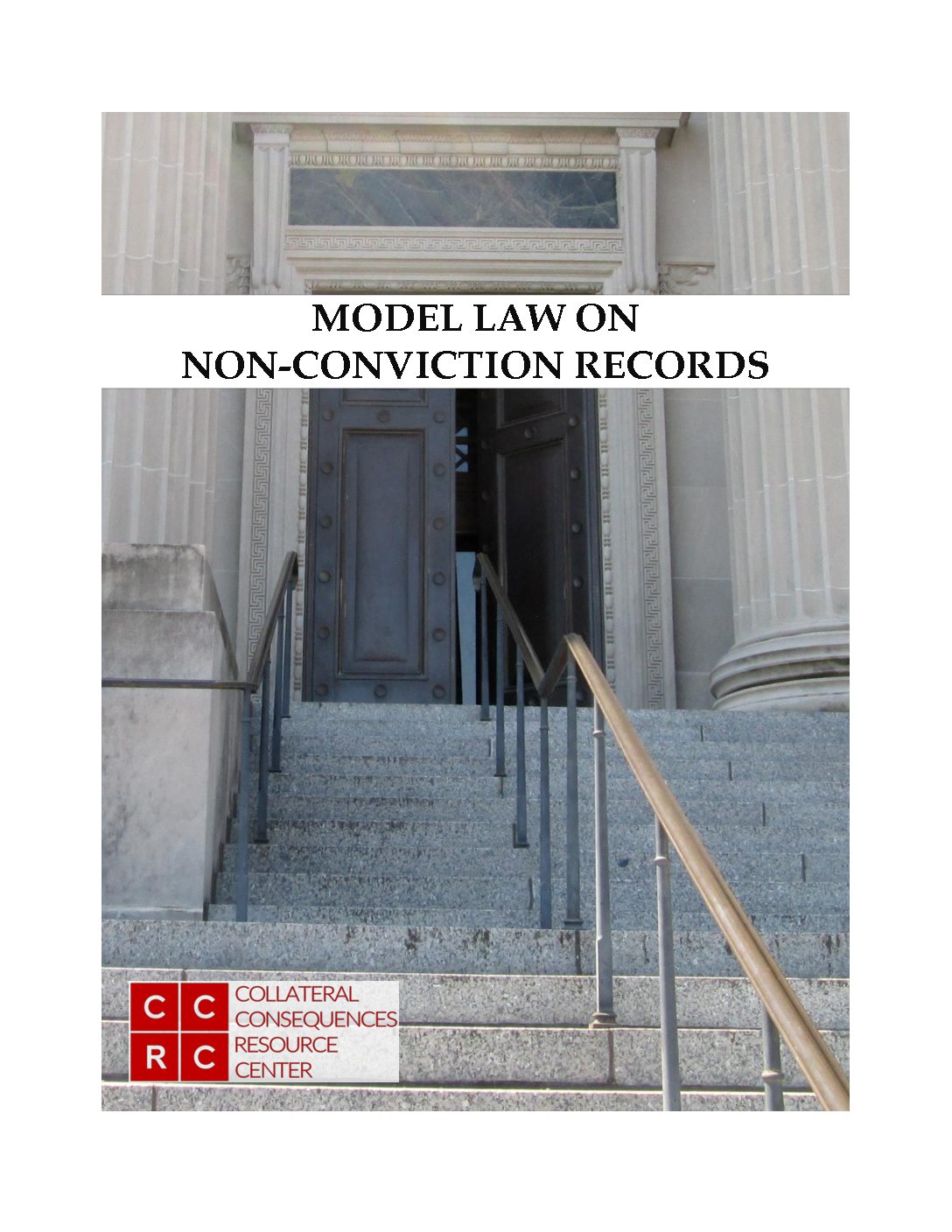
Model law proposes automatic expungement of non-conviction records

An advisory group drawn from across the criminal justice system has completed work on a model law that recommends automatic expungement of most arrests and charges that do not result in conviction.  Margaret Love and David Schlussel of the Collateral Consequences Resource Center served as reporters for the model law.  It is available in PDF and HTML formats.

“Many people may not realize how even cases that terminate in a person’s favor lead to lost opportunities and discrimination,” says Sharon Dietrich, Litigation Director of Community Legal Services of Philadelphia, and one of the advisors of the model law project.  “Over the years, my legal aid program has seen thousands of cases where non-convictions cost people jobs.”

In proposing broad restrictions on access to and use of non-conviction records, the project aims to contribute to conversations underway in legislatures across the country about how to improve opportunities for people with a criminal record.  Already in 2019, states have enacted more than 130 new laws addressing the collateral consequences of arrest and conviction.  The group regards its model as the first step in a broader law reform initiative that will address conviction records as well.

Law enforcement officials make over 10 million arrests each year, a substantial percentage of which do not lead to charges or conviction.  Records of these arrests have become widely available as a result of digitized records systems and a new commerce in background screening and data aggregation.  These checks often turn up an “open” arrest or charges without any final disposition, which may seem to an employer or landlord more ominous than a closed case.

Very few states have taken steps to deal with the high percentage of records in repositories and court systems with no final disposition indicated.  Paul McDonnell, Deputy Counsel for New York’s Office of Court Administration and a project advisor, noted: “Criminal records that include no final disposition make it appear to the untrained eye that an individual has an open, pending case, which can have serious results for that person. New York has recently made legislative progress in addressing this problem, though more can be done.”

Current state and federal laws restricting access to and use of non-conviction records have limited application and are hard to enforce.  Eligibility criteria tend to be either unclear or restrictive, and petition-based procedures tend to be burdensome, expensive, and intimidating.  In recent years, lawmakers and reform advocates have expressed a growing interest in curbing the widespread dissemination and use of non-convictions, leading some states to simplify and broaden eligibility for relief, reduce procedural and financial barriers to access, and in a handful of states to make relief automatic.

Rep. Mike Weissman, a Colorado State Representative and model law project advisor, noted that Colorado has recently overhauled its laws on criminal records with broad bipartisan support.  “It is heartening to see similar reforms underway in other states, both red and blue, as well.  I commend the practitioners and researchers who helped formulate the model law for illustrating avenues for further progress in reducing collateral consequences.”

The model law would take this wave of criminal record reforms to a new level.  It recommends that expungement be immediate and automatic where all charges are terminated in favor of an accused.  Uncharged arrests should also be automatically expunged after a brief waiting period, as should dismissed or acquitted charges in cases where other charges result in conviction.  Cases that indicate no final disposition should also be expunged, unless there is indication that they are in fact pending.

The model law also recommends that expunged non-conviction records should not be used against a person in a range of criminal justice decisions, including by law enforcement agencies.  It would prohibit commercial providers of criminal background checks from disseminating expunged and dated non-conviction records, and civil decision-makers from considering them.

David LaBahn, President of the national Association of Prosecuting Attorneys, indicated that organization’s support for the model law, stating that the collateral consequences of non-convictions “do not serve to make the community safer,” and that “the current structures in place to expunge a non-conviction record can be confusing and difficult for the layperson to navigate alone.”

This model law sets the stage for jurisdictions to address record relief for convictions more generally, and its structure and principles can be brought to bear on that important work.

The Collateral Consequences Resource Center organized this model law project.  An early draft of the model law was discussed at an August 2019 Roundtable conference at the University of Michigan that was supported by the Charles Koch Foundation.  The model law report was supported by Arnold Ventures.

Read the model law in PDF or HTML.

Vermont AG supports opportunities for diversion and expungement

Vermont Business Magazine recently showcased the leadership shown by Vermont Attorney General TJ Donovan in criminal justice reform.  Most notably, he has streamlined the process for seeking expungement, and increased opportunities to avoid a record entirely through greater use of diversion for less serious offenses.  The importance of enabling people to avoid a criminal record altogether through these two mechanisms cannot be overstated.  Donovan also championed last year’s bail reforms that will ensure low-income individuals are not held in jail prior to trial simply because they are poor. The article is worth posting in full as an illustration of a new breed of prosecutor committed to reducing the ill effects of the “tough on crime” era on individuals and communities least able to overcome them.

Read more

More states enact major “second chance” reforms

In recent weeks, three more states — Colorado, Louisiana and Vermont — have enacted laws intended to make it easier for people with a criminal record to find and keep employment, or otherwise to regain rights and status.

We are just now noting Wyoming’s enactment in March 2018 of general standards for professional and occupational licensure, which impose new restrictions on how criminal record may be taken into account by licensing agencies, and its amendment of more than a dozen specific licensing laws.

In the first five months of 2018 alone, a total of 21 states have enacted legislation to improve opportunities for people with a criminal record, with more similar laws evidently on the way.  States have enacted several different types of “second chance” laws this year, from expansion of voting rights to expansion of judicial authority to relieve collateral consequences at sentencing.

Read more