Tag: expungement

A closer look at Indiana’s expungement law

More than four years ago, Indiana’s then-Governor Mike Pence signed into law what was at the time perhaps the Nation’s most comprehensive and elaborate scheme for restoring rights and status after conviction.  In the fall of 2014, as one of CCRC’s very first posts, Margaret Love published her interview with the legislator primarily responsible for its enactment, in which he shared details of his successful legislative strategy.  Later posts on this site reported on judicial interpretation of the law.  Since that time, a number of other states have enacted broad record-closing laws, including Louisiana, Missouri, Nevada, New York, and most recently Illinois. We have been impressed by the evident enthusiasm for Indiana’s “expungement” law within the state, from the courts, the bar, the advocacy community, and even from prosecutors.  So we thought it might be both interesting and useful to take a closer look at how the Indiana law has been interpreted and administered, how many people have taken advantage of it, and how effective it has been in facilitating opportunities for individuals with a criminal record, particularly in the workforce.  We also wanted to see what light this might shed on what has brought to the forefront of reform so many politically-conservative states.  Spoiler alert: the Chamber of Commerce was one of the strongest proponents of the law. We expect to be able to post our account of the Indiana expungement law shortly after Labor Day.  In the meantime, we thought it might be useful to reprint our 2014 interview with former Rep. Jud McMillan, which has been among our most viewed posts. Indiana’s new expungement law the product of “many, many compromises” In May of 2013, Indiana Governor Mike Pence signed into law what is possibly the most comprehensive and forward-looking restoration of rights statute ever enacted in this country.  Under the new law, courts are empowered to “expunge” most criminal records, after waiting periods keyed to the seriousness of the offense.  The effect of an expungement order varies to some extent according to the nature of the crime, but its core concept is to restore rights and eliminate discrimination based on criminal record in the workplace and elsewhere.  This new law has already resulted in relief for hundreds of individuals, due in large part to the proactive approach of the state courts in facilitating pro se representation. We recently had a chance to talk to the person primarily responsible for shepherding this law through the Indiana legislature, and his experience should be instructive to reform advocates in other states.  Jud McMillin, a conservative former prosecutor who chairs the House Committee on Courts and Criminal Code, might once have been regarded as a rather unusual champion of this unique and progressive legislation.  But in an age of bipartisan support for criminal justice reform, apparently anything can happen.   Rep. McMillin told us how he was able to persuade his colleagues in the legislature by careful groundwork, and overcome opposition from prosecutors and courts by making what he described as “many, many compromises.” One of the most important of those compromises was limiting use of criminal records rather than limiting public access to them, at least in the case of more serious offenses. Before letting Rep. McMillan describe in his own words how he secured passage of this relief scheme, here is a brief description of the law’s most salient features. (A more detailed description can be found here.)     All criminal records (except convictions involving serious violence, public corruption, and sexual offenses) are eligible for expungement from the court of conviction, after waiting periods ranging from one year (for non-conviction records) to ten years (for the most serious eligible felonies). After the court has issued an expungement order, records not resulting in conviction and records of misdemeanors and minor felonies are automatically sealed.  After a record is sealed, even a prosecutor may not access it without a court order. Expunged records of more serious convictions “remain public,” although they must be “clearly and visibly marked or identified as being expunged.”  However, all expungement orders similarly limit the use to which a criminal record can be put, as described below. Expungement may be granted by the court without a hearing unless the prosecutor objects.  Those filing for expungement of a conviction must pay the filing fees required for filing a civil action ($141), and this requirement may not be waived. Defendants are not permitted to waive the right to seek expungement as part of a plea agreement. A petitioner may seek to expunge more than one conviction at the same time, but may be granted expungement only once in his or her lifetime. If the first petition fails, there is a three-year waiting period before a person may reapply, and the only convictions expungeable are those in the original petition. It is unlawful discrimination for any person to refuse to employ or license a person because of a conviction or arrest record that has been expunged or sealed, and a person may not be questioned about a previous criminal record except in terms that exclude expunged convictions or arrests. Expunged convictions are not admissible as evidence of negligence in a civil action against a person who relied on the expungement order, and they may not be reported by credit reporting companies. The Attorney General may enforce the provisions relating to credit reporting companies through injunction and fines, and a private individual injured by a violation of these sections may recover damages, court costs and attorney fees. The Indiana courts have published a detailed explanation of the law and sample petitions for expungement that are tailored to the particular categories of eligible cases, to enable a person to seeking expungement without hiring a lawyer. * * * * * * * * * Here is our interview with Rep. McMillin: How did you get interested in the subject of criminal records? As a former prosecutor, and now someone who does some criminal defense work while serving in the legislature, I think I have seen the justice system from several sides.  Also, as a fiscal conservative it just makes practical sense to me that when somebody has served their court-imposed sentence there has to be a pathway back into society for them. Without this, we can’t expect them to become productive members of society.  The Indiana Constitution requires our criminal justice system to be based upon the principles of reformation and not vindication. I firmly believe that our expungement law moves substantially in that direction. How did you build support for the concept of expungement among your colleagues in the legislature? This was a process that played out over several years.  We proceeded in incremental steps, building on existing law and gaining supporters from various constituencies. We started by expanding an existing provision of the Indiana code that allowed courts to reduce a minor felony to a misdemeanor upon completion of the sentence, to allow people to come back after a waiting period to get the felony reduced, as long as they had no further charges.  I thought if I could just start the conversation with a simple bill that did not involve more serious offenses I would be able to get people to see how detrimental having a felony conviction can be for someone who wants to get back into the work force.  I took a practical approach, and was able to persuade some of my fiscally conservative colleagues that there can be economic benefits through the reduction of recidivism.  After getting that initial language enacted I came back the next session to work on full expungement, and found that there was support on both sides of the aisle as many people were able to see the benefits. There were those who had general objections to the legislation, some for ideological reasons, some for practical reasons, but we were able to overcome all of them with solid logic when it came to debating this issue.  We were even able to win over some of the prosecutors, enough that the opposition of the holdouts didn’t derail the legislation’s chances.  One of the most effective supporters was the Indianapolis Chamber of Commerce, which helped me convince people that expungement could be beneficial to business owners and economy as a whole. Obviously there were a lot of compromises we had to make, and it’s not hard to see what some of them were, like the lifetime limit to one expungement, the prohibition on seeking expungement of offenses committed after a petition has been denied, and the filing fee that is hefty for many.  Certain violent and sexual offenses had to be excluded from coverage or it would have torpedoed the effort before we got it off the ground. It was sometimes difficult to give up some things just to get the bill passed, while still ending up with a law that actually made a difference. We were able to resist several offers to compromise that would have simply gutted the bill.  We had to keep our eye on the core purposes of the legislation, which are to restore rights and give people a fair chance in the workplace and elsewhere.  We will see how the law works.  If some of the compromises we made need to be revisited, we can do that.  In fact, in the 2014 session we made quite a number of reasonably minor adjustments in the law, notably to permit more government entities including licensing agencies access to sealed records. How were you able to defuse opposition from the prosecutors? Because I anticipated the prosecutors would be the main opponents, I reached out to them early in the process, and worked with the ones who were willing to consider the concept. Here again I took a practical view, asking if they really wanted people they had prosecuted to return to the system, or whether they wanted them to succeed.  I had to persuade them that expunging a record did not reflect badly on the prosecution or create problems for law enforcement.  While their ideas were substantially different than mine, I felt it was important to incorporate many of them, and so we were able to reach a middle ground. That is how we came to have a multi-tiered system, with limits on sealing for more serious offenses, a role for prosecutors in the expungement process, the possibility of unsealing in the event of a new crime, and a lifetime limit of one expungement.   This is not to say that prosecutors across Indiana ended up supporting expungement. In fact many of them remain its most ardent opponents. However, asking for their input early and making them a part of the process instead of a constant and united opponent was instrumental in getting the job done. What about other sources of opposition or support? Many judges objected and some of the clerks were opposed to the additional work that the legislation would make for them.  The credit reporting companies were also not happy but they did not mount any substantial resistance.  As noted, the business community was surprisingly supportive.  Many employers liked the protections afforded them in the bill — including not being held responsible for information there were not permitted to have.  Governor Pence was a supporter from the beginning.  Early in his term he adopted a slogan that “Indiana should be the worst place to commit a crime, but the best place to get a second chance.” This slogan fit perfectly into the concept of this legislation. How has the law been working in its first year? Once the law was passed, the courts took a proactive role in carrying out their new responsibilities.  They took it upon themselves to develop a variety of forms for different kinds of cases, and publish them on a website so that people could apply for expungement without the need to hire a lawyer.   Legal services organizations have been spreading the word around the state, and are helping to clarify what appears to have been some initial confusion because of the law’s complexity.  There have been a few kinks, and as I said we have already passed several bills to make slight adjustments mostly of a procedural nature.  I anticipate that there will more a few more tweaks this year.  Thankfully the concept has been received wonderfully by the public so making the changes at this point is relatively easy and meets little resistance. Why is the relief called “expungement” if many records remain open to the public? I get this question frequently, and yes I agree it is a bit confusing to use a term that ordinarily implies some limits on access.  The original concept was that an expungement order would seal all records except for law enforcement purposes.  But that was not an approach that I could sell, in or out of the legislature, especially for more serious offenses.  As the bill ended up with tiered approaches, there really was not a single term that fit the whole — and as we studied what other states do, I am not even sure the term “expungement” has a single meaning. Also, even if a record is actually destroyed, it may be impossible to ever remove all evidence of it.   In the end, I was convinced that “expungement” was the best term to use to ensure that people who need relief would take advantage of it.  There’s no doubt that most people believe that you only get a second chance if your record is clear in a literal sense.  But even where a record is sealed, our law does not permit people to deny that they were arrested or convicted; rather, they cannot be asked about a record that has been expunged.  In this way we were able to reconcile keeping the record open with the core concept of restoring rights.  By limiting the use of a record we hope to clear away the cloud that these individuals have been living under. What advice do you have for legislators in other states and for advocates who want to try to develop a comprehensive scheme like Indiana’s? To begin with, to pass a bill like this you have to have someone in a leadership role who really understands the inside and out of the criminal justice system, and who is willing to live and breathe this concept through the entire legislative process and see it all the way through to completion. You have to start the conversation very early, and learn patience. It takes a long time to convince people who may only have a passing interest (or no real interest at all) in something like this, and no personal experience with the justice system, to understand why it is a good idea and why they should take the perceived risk of supporting this concept. In the political world it is very easy for those who oppose this concept to get their hooks into legislators early by telling them that this is “soft on crime” and that it will damage them politically to support it. In order to combat this I think it is necessary for the legislator who is carrying the bill to spend one-on-one time sitting down with other legislators. While advocates are important and certainly should be recruited, I find that nothing is as persuasive as the legislators themselves discussing the concept.  The other really important thing is to secure the support of the business community.   You should also find examples of individuals who have been battling for years if not decades to be successful in society while carrying the weight of a criminal record. Their anecdotal testimony can be extremely powerful. I also recommend reaching out to those you anticipate will oppose the bill and asking them to help with the bill. If they are not on the inside helping they will be on the outside opposing. Even if the “help” they are giving is not always consistent with the concept you are trying to advance, you are still much better off having those people working with you on developing language than trying to kill any language that you come up with. It is helpful to defuse opposition if you couch the conversation in terms of the social and economic benefit to society rather than always talking about the benefit to the individuals who might seek expungement. It is very important to make people see that while our human compassion should want to give people a second chance, our duty is to be fiscally responsible to our constituents, and that for numerous reasons (recidivism, costs of incarceration, costs of providing welfare, public safety, etc.) this concept is the right one for all of our constituents. In the end, you really do have to be willing to compromise, recognizing that if you get the key concepts enacted you can always come back later and change the details.     Read more

Introducing the new Restoration of Rights Project

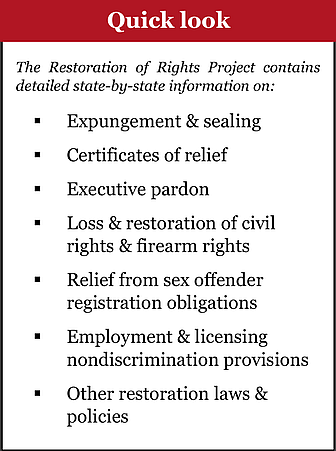
  The Collateral Consequences Resource Center and its partner organizations, the National Association of Criminal Defense Lawyers, the National Legal Aid and Defender Association, and the National HIRE Network, are pleased to announce the launch of the newly expanded and fully updated Restoration of Rights Project. The Restoration of Rights Project is an online resource that offers state-by-state analyses of the law and practice in each U.S. jurisdiction relating to restoration of rights and status following arrest or conviction.   Jurisdictional “profiles” cover areas such as loss and restoration of civil rights and firearms rights, judicial and executive mechanisms for avoiding or mitigating collateral consequences, and provisions addressing non-discrimination in employment and licensing.  Each jurisdiction’s information is separately summarized for quick reference.    In addition to the jurisdictional profiles, a set of 50-state comparison charts summarizes the law and illustrates national patterns in restoration laws and policies.   We expect to supplement these resources in weeks to come with jurisdiction-specific information about organizations that may be able to assist individuals in securing relief, and information on other third-party resources. The resources that comprise the Restoration of Rights Project were originally published in 2006 by CCRC Executive Director Margaret Love, and she has continued to keep them updated.  As a result, the profiles and comparison charts have expanded over the years to broaden their scope and to account for the many changes in this complex area of the law.  Love’s research has recently been hosted by CCRC and NACDL, and it appears as an appendix to the treatise on collateral consequences published jointly by NACDL and Thompson Reuters (West). Project resources have now been re-organized into a unified online platform that makes them easier to access, use, and understand. The short “postcard” summaries of the law in each state — which serve as a gateway to more detailed information — have also been reviewed and revised to provide a more current and accurate snapshot of applicable law in each state. The Project is intended as a resource for practitioners in all phases of the criminal justice system, for courts, for civil practitioners assisting clients whose court-imposed sentence has exposed them to additional civil penalties, for policymakers and advocates interested in reentry and reintegration of convicted persons, and for the millions of Americans with a criminal record who are seeking to put their past behind them. The Restoration of Rights Project is available now at: http://restoration.ccresourcecenter.org Read more

50-state guide to expungement and sealing laws

The 50-state chart of judicial relief mechanisms from the NACDL Restoration of Rights Resource, which is also posted on this site, is a comprehensive survey of all authorities for judicial relief in the states and federal system. We wanted to bring it to our readers’ attention in light of the new federal interest in helping individuals with a criminal record overcome barriers to employment and licensing through clearing their records. The National Clean Slate Clearinghouse, recently announced as part of President Obama’s reentry initiative, will “provide technical assistance to local legal aid programs, public defender offices, and reentry service providers to build capacity for legal services needed to help with record-cleaning, expungement, and related civil legal services.” This joint project of the Labor and Justice Departments will doubtless make it a first priority to survey the laws providing judicial and other relief in different states, to determine what sort of assistance lawyers will need to neutralize the adverse employment consequences of conviction, though the courts or otherwise.  We hope these resources will prove useful in that effort. Note that terminology and procedure differ significantly from state to state, so that those interested in more specific information about the scope, operation and effect of a particular state’s laws should consult the state-by-state profiles accessible through the Resources tab on the home page of this site.  For example, while the term “expungement” may involve destruction of records in a few states (e.g., Pennsylvania), more frequently it means a limited restriction on public access to records.  For example, in Kansas certain employers and licensing agencies continue to have access to criminal records notwithstanding an expungement order from the court.  In Indiana “expungement” entails no limit of public access at all — although some records may be sealed after expungement.  In some states a judicial set-aside or vacatur involves a sealing of the record (e.g., Michigan, Washington) but in others it doesn’t (e.g., California).  Most jurisdictions authorize sealing or expungement of non-conviction records upon petition to the court. In the past few years a number of states have modified their provisions for sealing or expungement of records, but most of these new laws reach only minor offenses or non-conviction records, and frequently involve long eligibility waiting periods that defeat their usefulness for reentry purposes. Conspicuous exceptions are the comprehensive new judicial relief schemes enacted in Indiana and Minnesota, and Arkansas’ reorganization and expansion of its existing expungement laws. A few states, notably Kansas and Utah, have broad expungement laws dating from the 1970s. Note that there is no statute providing for expungement of federal convictions, and almost no authority to limit access to non-conviction records — a circumstance that has led several federal sentencing courts to consider expungement through their ancillary jurisdiction. The most well-known of these cases is U.S.v. Jane Doe, now on appeal in the Second Circuit, in which Judge John Gleeson ordered expungement of a fraud conviction of a woman he had sentenced 13 years before.  (Briefs in the Doe case are available here.) Read more

Another federal expungement case from Brooklyn – is this the beginning of a trend?

On October 8, a former chief judge of the Eastern District of New York held that he was “constrained by controlling precedent” to deny the expungement petition of a woman who feared that her 23-year-old fraud conviction would prevent her from obtaining a nurse’s license.  See Stephenson v. United States, No. 10-MC-712.  Judge Raymond Dearie declined to find the “extreme circumstances” warranting expungement under Second Circuit precedent, noting that the petitioner before him was fully employed and that her aspiration to become a nurse was realistic, in light of the protection afforded her by New York’s nondiscrimination laws.  He proposed that his own willingness to certify her rehabilitation could help satisfy the “good moral character” standard for a nursing license. (Could this be the sort of “certificate of rehabilitation” contemplated by Judge John Gleeson in his second Jane Doe expungement case?  If so, it would seem to require no specific statutory authority for him to issue it to an individual he sentenced, no matter how long ago.) Judge Dearie contrasted the case before him with the one in which Judge Gleeson ordered expungement in May, where the petitioner’s criminal record was having “a dramatic adverse impact on her ability to work,” citing Jane Doe I at *5.   The government has appealed Judge Gleeson’s expungement order. At the same time, Judge Dearie stressed his agreement with Judge Gleeson — and disagreement with prevailing caselaw — that economic hardship or negative employment consequences may warrant expungement. Much has changed, however, in the four decades since the Second Circuit first wrote that “extreme circumstances” must be present to warrant expungement. For one, there is now a great deal of solid evidence establishing that a criminal conviction often is a significant obstacle to employment, in some situations even creating the dire financial circumstances that, in turn, are strongly linked with recidivism. A now-countless number of studies have concluded that a conviction—even a very old conviction—is a substantial barrier to employment. Judge Dearie noted the “irony” of his petitioner’s case that “precisely because she has been so successful in turning her life around, she has not demonstrated ‘exceptional circumstances’ warranting expungement.” Judge Dearie concludes his opinion by calling on all three branches to make it possible for federal offenders to “pay their debt to society,” Congress through legislation, the executive through pardons, and the courts through doctrinal change: There are 65 million Americans living with criminal convictions and suffering adverse consequences. Against that backdrop, Ms. Stephenson’s predicament is not “exceptional”—they are uncomfortably commonplace. While she is not entitled to expungement of her record today given the state of the law, her petition raises the larger question of how we treat convictions and criminal records as a society. Basic values and notions of fairness stemming from our nation’s history animate the principle that individuals should be given an opportunity to start afresh or wipe the slate clean. This notion of forgiveness underlies the promise we so extend to individuals making their way through our criminal justice system: if you “pay your debt to society”—whether through a sentence or a fine—you are afforded a second chance in life.  Lately, this has been a promise left largely unfulfilled. Criminal records are remarkably public and permanent, and their effects are pernicious. A criminal sentence too often becomes “a lifetime of unemployment.” Doe, 2015 WL 2452613, at *5. It is time for a change. That change could come from Congress, which has twice proposed but never enacted expungement legislation, putting the federal system woefully behind state criminal justice systems. Change could also come from the executive in the form of pardons, which today are only issued in a tiny fraction of cases and almost never years after a sentence is completed. See Leon Neyfakh, The Pardon Process Is Broken, Slate, Sept. 4, 2015. The U.S. Attorney’s Office or the Department of Justice could change its position on expungement petitions, and only oppose such requests where the government has a compelling interest in the particular case. As a judiciary, it may be time to revisit the standard for granting expungement and consider, based on what we know now, whether expungement should be limited to only the most “exceptional” cases.   Read more

“Old Writ Could Give Ex-Offenders a New Start”

Joe Palazzolo has posted at the Wall Street Journal Blog an article describing an amicus brief filed yesterday in United States v. Jane Doe (Jane Doe II), one of two federal expungement cases before Judge John Gleeson that we’ve been following.  Argument in Jane Doe II is now scheduled for October 26.  (The government has appealed Judge Gleeson’s May 21 expungement order in Jane Doe I to the Second Circuit Court of Appeals.)  The brief begins like this: This Court invited the views of Amica on the Court’s authority to issue “a certificate of rehabilitation in lieu of expungement” and the appropriateness of issuing such a certificate in this case. While there is no federal statute that authorizes a court to issue relief styled as a “certificate of rehabilitation,” Amica wishes to bring to the Court’s attention two mechanisms, each perhaps underappreciated but with deep historical roots, by which the Court may recognize an individual’s rehabilitation and otherwise address issues such as those raised by petitioner’s case. The first is by exercising its statutory authority to issue a writ of audita querela, which is available in extraordinary circumstances under the All Writs Act, 28 U.S.C. §1651, to grant a measure of relief from the collateral consequences of conviction. The second is by recommending to the President that he grant clemency. The blog post describing the brief is reprinted in full after the jump. October 9, 2015 Old Writ Could Give Ex-Offenders a New Start by Joe Palazzolo A federal case in Brooklyn may offer a solution for some ex-offenders struggling to find work because of their criminal convictions. Most states permit certain types criminal records to be expunged, sealed or otherwise concealed from public view. Some allow ex-offenders to seek certificates of rehabilitation that exempt them from felony-related sanctions such as those barring people with criminal records from obtaining professional licenses. But in the federal system, which has nothing akin to expungement or a certificate program, convictions can mark people for life, compromising their prospects for jobs and housing, among other things. Many believe such consequences are an appropriate deterrent. A growing number of policymakers, judges and law enforcement officials, however, question the wisdom of limiting job opportunities for ex-offenders, who are less likely to return to prison when they find stable employment, research shows. Margaret C. Love, a former Justice Department pardon attorney, and a group of lawyers from Jones Day LLP have dusted off an 18th century law that they believe has a modern application for ex-offenders who have served their time but face obstacles related to their convictions. Part of the 1789 All Writs Act, the writ of audita querela allows courts to relieve the consequences of an otherwise valid judgment. It was used by debtors against creditors in the nation’s early days, but federal and state courts have more recently recognized the writ’s usefulness in other cases, including when a criminal conviction “gives rise to a subsequent injustice,” the lawyers wrote in a brief filed Friday in federal district court in Brooklyn. Ex-offenders could make a strong case for audita querela relief when a law or regulation strips them of a right to which they otherwise would be entitled, the brief said. For instance, a conviction-based restriction that results in job loss could violate due process rights by depriving an ex-offender of a fundamental property interest. Losing the ability to possess a gun as a result of a conviction could violate the Second Amendment. “In such a case, a person convicted of an applicable crime would have a legal or, technically, constitutional objection to the continued enforcement of the judgment, thereby meeting the requirements for audita querela relief,” the brief said. Ex-offenders could also seek relief under the writ “where the totality of the circumstances make continued enforcement of the judgment, in whole or in part, unjust,” the lawyers wrote. Courts could grant their requests by vacating convictions or issuing orders lifting sanctions against ex-offenders. The brief was filed at the invitation of U.S. District Judge John Gleeson in a case involving a woman convicted of health-care fraud who is seeking to have her record expunged. Judge Gleeson expunged the conviction of another defendant in the scheme earlier this year, in what legal experts said was the first instance of a federal judge erasing a criminal record on the grounds that it interfered with employment. The Justice Department is appealing his order in that case. The woman in the latest case, identified as 56-year-old Jane Doe in court documents, drove a car in a staged collision and claimed to have received medical services, as part of a scheme to collect insurance money. She was sentenced in 2003 to 15 months in prison, and her nurse’s license was suspended for two years. Her criminal record has prevented her from maintaining employment, she said in her June petition. The Justice Department disputed that federal judges can erase convictions for “equitable reasons,” such as difficulty finding work, and even if they could, her case wouldn’t merit it, prosecutors said in court documents. No federal appeals court has held that judges have the power to expunge valid convictions absent “extreme circumstances,” the department said. Read more