Author: CCRC Staff

Editorial staff of the Collateral Consequences Resource Center

“Certifying Second Chances”

This is the title of a provocative new article by Cara Suvall, Assistant Clinical Professor of Law at Vanderbilt Law School, and Director of the Youth Opportunity Clinic.  The article, forthcoming in the Cardozo Law Review, catalogues and analyzes the costs and burdens that deter people from accessing certificates intended to enhance employment opportunities.  Professor Suvall focuses particular attention on certificate programs in Tennessee, Georgia, and New York, which vary widely in eligibility criteria, administration, and legal effect.  She highlights the learning, compliance, and psychological barriers that limit effectiveness of existing certificate programs, and describes proposals to lower those barriers.

Here is the abstract:

Policymakers around the country are grappling with how to provide a second chance to people with criminal records. These records create collateral consequences—invisible punishments that inhibit opportunity in all facets of a person’s life. Over the past seven years, states have repeatedly tried to legislate new paths for people trying to move on with their lives. State legislators passed more than 150 laws targeting collateral consequences in 2019 alone.

But what happens when these paths to second chances are littered with learning, compliance, and psychological costs? The people who most need these new opportunities may find that they are out of reach. A major problem, I argue, is the administrative burdens involved in accessing these remedies. Because of these hurdles, people with fewer resources—the population that would most benefit from the help—are the ones most likely to find these second chances out of reach. The Article closely examines one increasingly popular type of second-chance program: certificate laws that remove employment barriers.

Building on recent research identifying the low usage rates of petition-based second-chance programs, this Article catalogues and analyzes the costs and burdens placed on people attempting to access employment certificates. Of particular concern is not only these low usage rates themselves, but also the identity of those least likely to access these interventions. Second-chance programs like employment certificates that provide a way forward for people with greater resources while leaving behind those without may be more harmful than helpful when placed in the larger context of mass criminalization and social change, even if they help the small number of individuals who do access them. In contrast, a well-designed second-chance initiative that appropriately considers administrative burdens and the way that interventions like employment certificates fit in to the broader picture of social change could provide short-term benefits to people with criminal records while also bolstering larger-scale reforms to the criminal legal system.

Study measures gap between availability and delivery of “second chance” relief

Professor Colleen V. Chien of Santa Clara University has published a major empirical study in the Michigan Law Review that examines the gap between eligibility for and actual delivery of relief from contact with the criminal justice system, a construct she calls the “second chance gap.” (The term is defined with examples here.) Last week, Chien led a team of law students, researchers and data analysts from Santa Clara University in launching the Paper Prisons Initiative, a project that draws on her study’s methodology to estimate this gap for each state’s record relief laws.

During the current wave of criminal record reforms that began around 2013, every state legislature has taken steps to chip away at the negative effects of a record through authorizing or expanding expungement, sealing, and other forms of record relief. At the same time, it has become evident that bureaucratic and structural obstacles prevent many of these laws from achieving their full promise—particularly when they require a potential beneficiary to navigate a complex and burdensome judicial or administrative process.

Last June, Professors Sonja B. Starr and J.J. Prescott published the first broad-based empirical study of a state law limiting public access to criminal records, revealing that just 6.5% of those eligible for relief in Michigan successfully completed the application process within five years. This conclusion has given additional impetus to the movement to make record-sealing automatic: six states now authorize “clean slate” relief for a range of conviction records, 16 states do so for non-conviction records, and clean slate campaigns are underway in several additional states.

In “America’s Paper Prisons: The Second Chance Gap,”  Professor Chien provides a more general perspective on the gap between eligibility and delivery of second chance relief documented for Michigan by Starr and Prescott. In her article, Chien looks at three forms of relief from contact with the criminal justice system—record-clearing, restoration of voting rights, and shortening prison sentences. Based on her analysis, the paper concludes that in many cases only a small fraction of those eligible for relief (usually less than 10%) have received it. Most notably, she uses novel data collection and analysis to estimate that at least 20 to 30 million American adults have non-conviction records that appear to be clearable under existing law but that have not been cleared. In follow-up state-specific papers available on the Paper Prisons Initiative website, she and her team have estimated the second chance expungement gap in convictions relief for a number of states.

I.

The first part of “America’s Paper Prisons” explores the reasons for the “second chance gap”:

In the same way that the accused remain innocent until proven guilty in the U.S. criminal justice system, many second chance programs require defendants to “prove” that they deserve second chances before awarding them. As such, getting one’s second chance through petition-based processes may include enduring a bureaucratic process, amassing information through a variety of sources, and being evaluated by an adjudicative or administrative body. The high cost of doing so in many cases may be insurmountable.

Chien divides the barriers that contribute to the second chance gap into three categories: administrative barriers, like informational and transactional costs; structural barriers, like a requirement to pay court debt and participate in a formal court hearing; and substantive barriers, like perceptions that the costs of the process outweigh its benefits.[1]

II.

The second part of Chien’s paper estimates the second chance gap for an assortment of relief mechanisms, drawing on both original data collection and secondary sources. Chien uses two metrics: the “uptake gap,” which measures the share of individuals over time who are eligible and have not applied or not received relief; and the “current gap,” which looks at the share of individuals at the certain moment in time who are eligible but have not received relief. Her analysis shows, on a nearly uniform basis, that only a small percentage of eligible individuals obtain relief in petition-based programs.

The relief mechanisms she studies confer different benefits, are animated by differing policy objectives, and vary in eligibility criteria and administrative process. Still, a general pattern is clear across the following second chance gaps that Chien presents:

Read more

President Biden orders DOJ to facilitate voting for people in federal custody or under supervision

On election day in 2016, Crystal Mason, a Texas mother of three, cast a provisional ballot. She was unaware that Texas considered her ineligible to vote because she was on federal supervised release at the time. Six months later she was arrested. A year and a half later, she was convicted of voter fraud and sentenced to five years in prison. Mason, who is Black, believes that her prosecution was “politically and racially charged.” An appeals court upheld the conviction, ruling that whether Mason knew she was ineligible to vote was irrelevant to the case against her. She is pursuing further appeals.

At trial, one of Mason’s supervision officers, Ken Mays, testified that he had not informed her that she could not vote in Texas while on federal supervised release because it was not part of standard procedure: “That’s just not something we do.”

Now, a few years later, a new executive order issued by President Joe Biden will change standard procedure to require the notice Ms. Mason never received. The order also directs the Justice Department to facilitate voting for people in federal custody or on supervision who are eligible to vote in their state of residence.

In recent years, there has been growing attention to the racist origins of felony disenfranchisement, to its racially disparate effect, and to how restoration of voting rights strengthens our democracy. This past Sunday, March 7, 2021, was the 56th anniversary of “Bloody Sunday,” an infamous day when Alabama troopers violently beat civil rights marchers—including the late John Lewis, civil rights leader and longtime member of Congress—on the Edmund Pettus Bridge in Selma. While delivering an address to mark the occasion, President Biden announced that he had issued an Executive Order directing every federal agency to promote access to voting.

The Order includes an ambitious directive to the Attorney General to provide voter education materials to hundreds of thousands of individuals in federal custody, under federal supervision, or formerly incarcerated, and to facilitate voting for those who are eligible under state law. See Sec. 9 (“Ensuring Access to Voter Registration for Eligible Individuals in Federal Custody”). This represents “the first time the federal government has ever taken action to ensure justice-involved voters can participate equally in our democracy.”

As Crystal Mason’s case demonstrates, many people with a record lack clear information about their eligibility to vote, due to misinformation and the complexity of state laws and policies governing voting rights for people with a record. (CCRC documents and explains these laws and policies in our 50-state resources.) Further, eligible voters in jail and prison face practical challenges that often make registration and voting difficult or impossible.

Newly-confirmed Attorney General Merrick Garland will surely direct sufficient resources and expertise to implementing this directive. The result could be a radical expansion of voting education and access for millions of individuals with federal criminal records, with ripple effects benefiting tens of millions with state criminal records. Moreover, given the widespread racial disparities in the criminal justice system, this effort could significantly improve access to voting for Black communities and other communities of color, issues that Garland prioritized at his Senate confirmation hearing.

This article briefly outlines the state of the law governing loss and restoration of voting rights due to conviction. It then reviews the specifics of Biden’s directive, discussing its potential impact on four groups: (1) individuals in the custody of the Federal Bureau of Prisons; (2) individuals detained in jails under contracts with U.S. Marshal Service; (3) individuals under the supervision of the Office of Probation and Pretrial Services in the Administrative Office of U.S. Courts; and (4) formerly incarcerated individuals.

Read more

How states reduce jury diversity by excluding people with a record

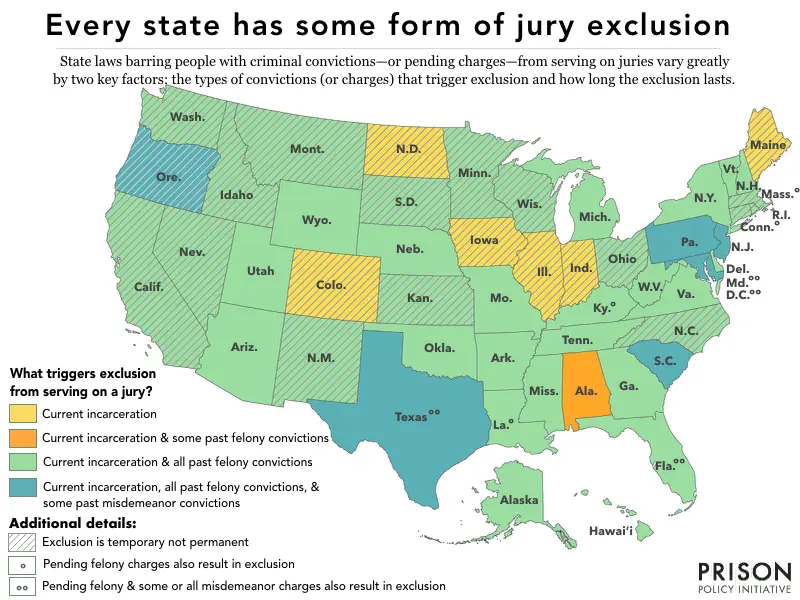
https://static.prisonpolicy.org/images/reportthumbs/juries_reportcover_250w.pngLast month, the Prison Policy Initiative released a report called Rigging the Jury, showing how all 50 states reduce jury diversity by excluding some people because of their criminal record, in some cases permanently.

The report, which includes a map, table, and detailed appendix explaining each state’s policies, shows that:

  • 44 states bar people with felony convictions from jury service when they are no longer incarcerated. (By comparison, 30 states bar voting by those who are not incarcerated.)
  • 6 states go even further, barring people with some misdemeanor convictions from juries.
  • 7 states bar legally innocent people from juries if they are called to serve while charges are pending against them.

The report also explains how excluding people with records makes juries less diverse (e.g., one  in three Black men have felony convictions), why jury diversity is essential to the fairness of a trial, and what must be done to fix this unfair system.

https://static.prisonpolicy.org/images/reportthumbs/juries_reportcover_250w.png


The full report is here.

Note: Our Restoration of Rights Project also provides state-by-state and 50-state information on loss and restoration of rights to serve on a jury due to a record. We updated and, in a few cases, corrected our data based on the PPI study – and thank its authors!  


Virginia poised to enact “transformative” record clearance law

Editor’s Note:  We are delighted to post a description of the broad new record relief bill now awaiting Governor Northam’s signature, by an attorney-advocate who was actively involved in the campaign to secure its passage. Rob Poggenklass describes the ambitious new law and how it came to be enacted, as well as likely next steps for record clearance in a jurisdiction that is swiftly becoming one of the nation’s leaders in record reforms. In addition to automatic sealing, the bill’s provisions for appointment of counsel, elimination of a fingerprint requirement for petitions, and regulation of private screening companies are particularly significant for reducing access barriers and ensuring effectiveness.

The Virginia General Assembly has passed transformative legislation to allow sealing of convictions, including low-level felonies, for the first time in the Commonwealth, and to establish a system of automatic sealing of police and court records for many offenses. About 1.6 million Virginians have a criminal record, which creates significant barriers to employment, housing, education, and other necessities of life.

The legislation reflects a compromise between an automatic expungement bill sponsored by Del. Charniele Herring and a mostly petition-based one brought by Sen. Scott Surovell. It also reflects the sustained work of directly impacted individuals and other advocates who organized and insisted on far-reaching, automatic, and equitable expungement legislation.

The legislation must be signed by Governor Ralph Northam before it becomes law, but the governor is expected to sign it. After the House and Senate could not agree on record sealing legislation during a special session in the fall of 2020, the governor hired a mediator to help negotiate the compromise bill that passed both chambers in 2021.

The legislation includes five key provisions. The bill:

  1. Establishes a system of automatic sealing for misdemeanor non-convictions, nine types of misdemeanor convictions, and deferred dismissals for underage alcohol and marijuana possession.
  2. Allows for contemporaneous sealing of felony acquittals and dismissals with the consent of the prosecuting attorney.
  3. Provides for sealing a broad range of misdemeanor and low-level felony convictions and deferred dismissals through a petition-based court process. Notably, court debt will not be a barrier to record clearance under the legislation.
  4. Introduces a system of court-appointed counsel for individuals who cannot afford an attorney for the petition-based sealing process.
  5. Forces private companies that buy and sell criminal records to routinely delete sealed records and creates a private right of action for individuals against companies that refuse to do so.

Most provisions of the bill are not currently set to take effect until July 1, 2025, to give the Virginia State Police and the courts sufficient time to update their computer systems. Increased funding or other future action by the General Assembly could change the effective date.

Read more