Category: News

New efforts to channel federal relief to small business owners with a record

*UPDATE (7/7/20):  “SBA throws in the towel and Congress extends the PPP deadline

After Congress authorized hundreds of billions of dollars in funds for small business relief during COVID-19, the Small Business Administration (SBA) imposed restrictions on applicants with an arrest or conviction history.  These barriers, neither required nor contemplated by Congress, impede access to the two major relief programs for small businesses, nonprofits, and independent contractors during the COVID-19 crisis.  The two programs are the newly created Paycheck Protection Program (PPP) and the ramped-up Economic Injury Disaster Loan (EIDL) program.

Three developments within the past week signal major pushback against or the possible reversal of at least some of these burdensome restrictions, which unfairly deny relief to worthy applicants.

First, at least 65 organizations submitted five public comments in opposition to the SBA’s criminal history restrictions for PPP relief.  Our organization joined 25 other groups in submitting a comment asking the SBA to rescind or modify the regulation on legal and policy grounds, citing recent court decisions that suggest the SBA may lack authority to impose record-based disqualifications at all.

These comments are the most recent expression of what has become a wave of bipartisan opposition to the SBA’s exclusionary policies, and growing coverage of the issues in the press.  We have been collecting relevant documents on our small business relief resource page.

Second, Treasury Secretary Steven Mnuchin signaled in a recent conversation with key Senators that he may be open to easing restrictions on PPP applicants with felony records from the last five years.

Third, the HEROES Act, passed by the House on Friday, includes provisions that would significantly constrain the SBA’s authority to deny applicants based on a record of arrest or conviction in both the PPP and EIDL programs.  If enacted into law, these provisions would mark a turning point in how federal law deals with discrimination based on criminal record.

We discuss these developments in detail after the jump.  Read more

CCRC awarded operating grant by Arnold Ventures

Press Release:
Arnold Ventures Awards Grant to the Collateral Consequences Resource Center

April 30, 2020

Washington, D.C. — The Collateral Consequences Resource Center (CCRC) is pleased to announce the award of an operating grant of $200,000 from Arnold Ventures.  The grant will support our program of research and technical assistance on restoration of rights and record relief following arrest or conviction, enabling us to expand our efforts to track and assess legislative trends as states around the Nation, and continue working to improve opportunities for people with a criminal record.

“We are delighted to be able to support the Collateral Consequences Resource Center’s pioneering work in support of reintegrating people with a criminal record,” said Jeremy Travis, Executive Vice President of Criminal Justice for Arnold Ventures.  “The Restoration of Rights Project is unique in its national scope and comprehensive nature, and it has become an authoritative resource for advocates and practitioners alike during an extraordinarily fruitful period of legal reforms.”

Read more

Model law proposes automatic expungement of non-conviction records

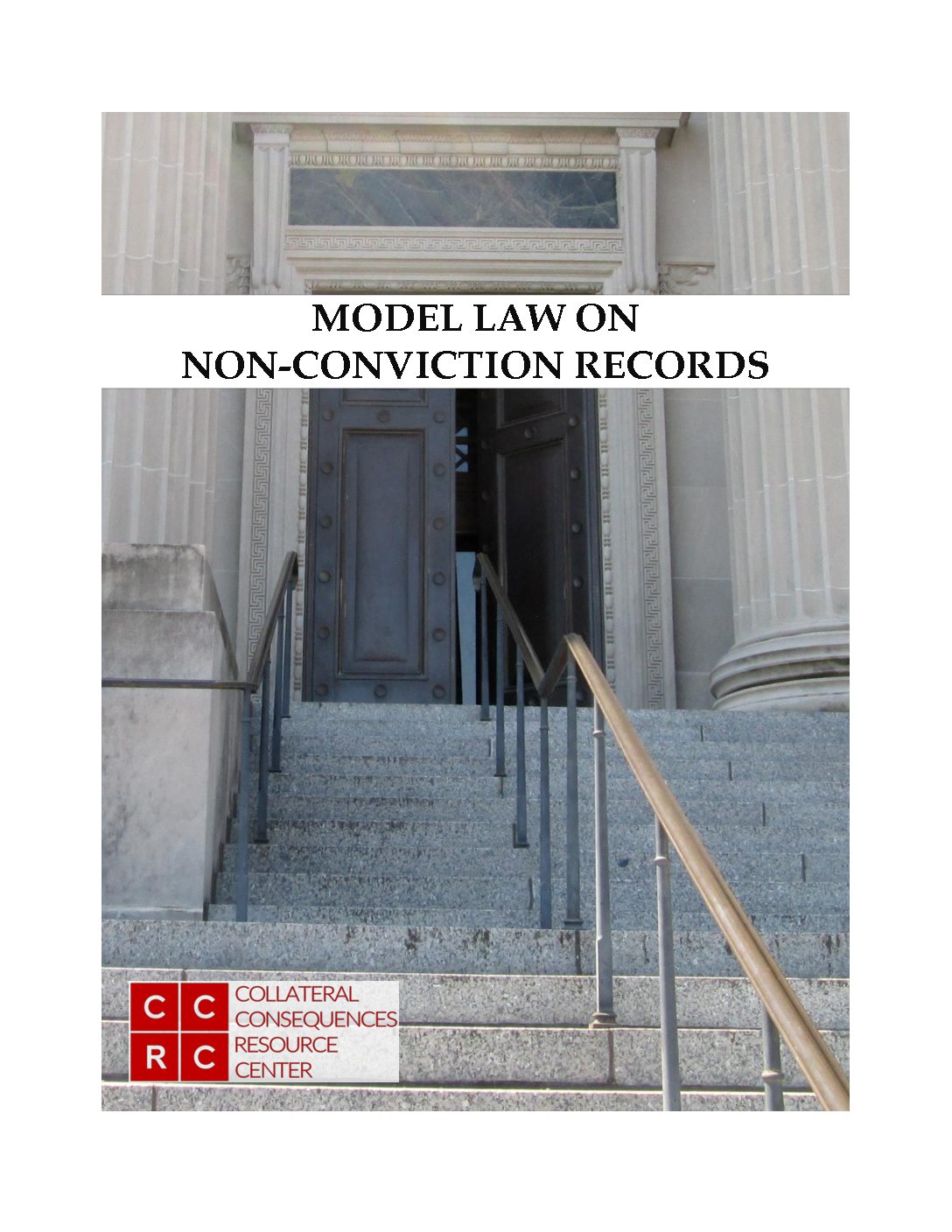
An advisory group drawn from across the criminal justice system has completed work on a model law that recommends automatic expungement of most arrests and charges that do not result in conviction.  Margaret Love and David Schlussel of the Collateral Consequences Resource Center served as reporters for the model law.  It is available in PDF and HTML formats.

“Many people may not realize how even cases that terminate in a person’s favor lead to lost opportunities and discrimination,” says Sharon Dietrich, Litigation Director of Community Legal Services of Philadelphia, and one of the advisors of the model law project.  “Over the years, my legal aid program has seen thousands of cases where non-convictions cost people jobs.”

In proposing broad restrictions on access to and use of non-conviction records, the project aims to contribute to conversations underway in legislatures across the country about how to improve opportunities for people with a criminal record.  Already in 2019, states have enacted more than 130 new laws addressing the collateral consequences of arrest and conviction.  The group regards its model as the first step in a broader law reform initiative that will address conviction records as well.

Law enforcement officials make over 10 million arrests each year, a substantial percentage of which do not lead to charges or conviction.  Records of these arrests have become widely available as a result of digitized records systems and a new commerce in background screening and data aggregation.  These checks often turn up an “open” arrest or charges without any final disposition, which may seem to an employer or landlord more ominous than a closed case.

Very few states have taken steps to deal with the high percentage of records in repositories and court systems with no final disposition indicated.  Paul McDonnell, Deputy Counsel for New York’s Office of Court Administration and a project advisor, noted: “Criminal records that include no final disposition make it appear to the untrained eye that an individual has an open, pending case, which can have serious results for that person. New York has recently made legislative progress in addressing this problem, though more can be done.”

Current state and federal laws restricting access to and use of non-conviction records have limited application and are hard to enforce.  Eligibility criteria tend to be either unclear or restrictive, and petition-based procedures tend to be burdensome, expensive, and intimidating.  In recent years, lawmakers and reform advocates have expressed a growing interest in curbing the widespread dissemination and use of non-convictions, leading some states to simplify and broaden eligibility for relief, reduce procedural and financial barriers to access, and in a handful of states to make relief automatic.

Rep. Mike Weissman, a Colorado State Representative and model law project advisor, noted that Colorado has recently overhauled its laws on criminal records with broad bipartisan support.  “It is heartening to see similar reforms underway in other states, both red and blue, as well.  I commend the practitioners and researchers who helped formulate the model law for illustrating avenues for further progress in reducing collateral consequences.”

The model law would take this wave of criminal record reforms to a new level.  It recommends that expungement be immediate and automatic where all charges are terminated in favor of an accused.  Uncharged arrests should also be automatically expunged after a brief waiting period, as should dismissed or acquitted charges in cases where other charges result in conviction.  Cases that indicate no final disposition should also be expunged, unless there is indication that they are in fact pending.

The model law also recommends that expunged non-conviction records should not be used against a person in a range of criminal justice decisions, including by law enforcement agencies.  It would prohibit commercial providers of criminal background checks from disseminating expunged and dated non-conviction records, and civil decision-makers from considering them.

David LaBahn, President of the national Association of Prosecuting Attorneys, indicated that organization’s support for the model law, stating that the collateral consequences of non-convictions “do not serve to make the community safer,” and that “the current structures in place to expunge a non-conviction record can be confusing and difficult for the layperson to navigate alone.”

This model law sets the stage for jurisdictions to address record relief for convictions more generally, and its structure and principles can be brought to bear on that important work.

The Collateral Consequences Resource Center organized this model law project.  An early draft of the model law was discussed at an August 2019 Roundtable conference at the University of Michigan that was supported by the Charles Koch Foundation.  The model law report was supported by Arnold Ventures.

Read the model law in PDF or HTML.

Marijuana reformers schedule National Expungement Week

Adam Vine of Cage-Free Cannabis & Cage-Free Repair has asked us to let visitors to our site know about a series of events this fall promoting expungement and other forms of relief from collateral consequences.  They are available to assist in plannig local events during National Expungement Week, including but not limited to events aimed at marijuana convictions:

The 2nd Annual National Expungement Week (N.E.W.) will be held from September 21-28, 2019. Advocates and organizers, primarily from the cannabis equity and justice movement, will once again host events across the U.S. that provide free legal services to people with eligible convictions. Last year, N.E.W. featured 18 events in 15 cities across the U.S., and the event helped 298 people begin the process clearing their records, while 450 people received services of some kind. One of the defining features of N.E.W. is the attempt to provide as many wraparound services as possible, which can include voter registration, employment advice, housing assistance, and other services that help people re-engage with their communities. N.E.W. is not focused exclusively on cannabis convictions in states that have legalized; some of our most successful events were held in states that criminalize marijuana possession. N.E.W. events welcome people with any convictions in any state that are eligible to be cleared, sealed, pardoned, or reclassified.  We simply want to provide legal relief to as many people as possible, while reminding the cannabis industry and policymakers alike that cannabis legalization must be accompanied by justice for those who have been harmed by the War on Drugs.

National Expungement Week is co-sponsored by the Equity First Alliance and Cage-Free Repair, and a toolkit for organizing events is available at the N.E.W. website.  


CCRC launches major study of non-conviction records

CCRC is pleased to announce that we are undertaking a major study of the public availability and use of non-conviction records – including arrests that are never charged, charges that are dismissed, deferred and diversionary dispositions, and acquittals.   Law enforcement agencies and courts frequently make these records available to the public allowing widespread dissemination on the internet, both directly and through private for-profit databases.  Their appearance in background checks can lead to significant discrimination against people who have never been convicted of a crime, and result unfairly in barriers to employment, housing, education, and many other opportunities.  Research has shown that limiting public access to these records through mechanisms like sealing and expungement is valuable in economic terms for those who receive this relief, and improvements in their economic status will in turn benefit their families and communities.

While almost every U.S. jurisdiction makes some provision for limiting public access to non-conviction records, such relief varies widely in availability and effect, and is often difficult to take advantage of without a lawyer.  What’s more, arrest records may remain accessible on the internet long after official court files have been made confidential or even destroyed.  While CCRC’s Restoration of Rights Project now includes state-by-state information on how non-conviction records may be sealed or expunged, our new project will examine the operation of applicable laws more closely.

The first phase of this project will produce by early June 2019 a detailed inventory of the laws in each U.S. jurisdiction for limiting public use of and access to records of arrests and/or judicial proceedings that do not result in conviction.  Among other things, this inventory will examine both: (1) categorical or automatic relief (such as general confidentiality laws and limits on considering non-conviction records by employers and licensing boards); and (2) case-specific relief (such as sealing and expungement, either automatic or by application).  For this second type of relief, the study will look at eligibility criteria (including waiting periods and overall criminal record), procedures (including filing fees or other financial barriers), and effect (entities excepted from restrictions on access and use). It will also note where state law or court rulings permit redaction of records so that dismissed charges may be sealed even if one or more charges in a case do result in conviction.

After completing the research phase of the project, CCRC will consult with scholars and practitioners to prepare a nationwide analysis, examining specific issues across all jurisdictions, identifying patterns and gaps in existing laws and policies.

The second and final phase of the project will be launched at a roundtable meeting on August 16-17, 2019, hosted by the University of Michigan Law School. The roundtable will produce a set of policy recommendations and model legislation aimed at neutralizing the effect of non-conviction records.  Professors JJ Prescott and Sonja Starr of the Law School faculty will serve as conference hosts and collaborators on this second phrase.  A number of legal scholars, practitioners, judges, law enforcement officials, and legislators have already agreed to participate.  At least three of those invited themselves have criminal records.  We expect to have several technology experts at the table to advise about the operational implications of the policies and legislation we are considering, in light of how states manage their criminal records systems.

Following the August roundtable, we will finalize its recommendations and model law with the assistance of scholars and other experts; publish them in a report; and promote them widely in the academic and advocacy community.

The principal value of this project will be to inform and strengthen efforts underway in legislatures and advocacy organizations across the country to mitigate the disabling effects of a criminal record on the lives of people who have one, on their families and on their communities.  We believe that reforming the law is as important a part of the reintegration agenda as advocating for and providing services to those who are seeking a second chance, and we hope this project will be the first stage of a larger national law reform effort to address access to and use of all types of criminal records. In light of the intense interest in legislatures across the country in mitigating the effect of criminal records, as evidenced in our 2018 report on relevant laws passed just last year, there is an obvious need for such guidance.  The first months of 2019 have evidenced an even greater level of legislative interest, on which we expect to report again shortly.

Read more