Tag: NACDL

New edition of collateral consequences treatise now available

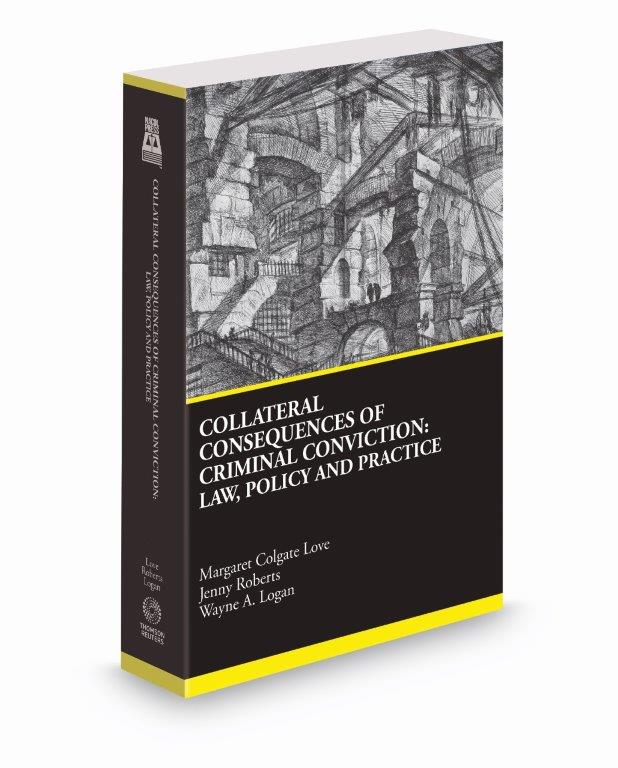
The 2018-2019 edition of the West/NACDL treatise on collateral consequences is now available for purchase, at a publisher’s promotional discount. Wayne A. Logan has joined Margaret Love and Jenny Roberts as a co-author of this comprehensive resource: Collateral Consequences of Criminal Conviction: Law, Policy & Practice. This third edition of the treatise has been entirely updated, and includes new material on regulation of criminal background checking; consideration of collateral consequences in the criminal case; laws providing for restoration of rights and status, including in employment and occupational licensing; and, recent court decisions on sex offender registration and related penalties.  Appendices include detailed state-by-state analysis of restoration laws, and other primary source materials.  The full table of contents for this 1048-page book is available here.  The publisher describes the book as follows:  Today, many millions of Americans have a criminal record of some kind, potentially triggering a vast array of highly burdensome and stigmatizing consequences that can have life-long debilitating effects. This volume provides comprehensive discussion and analysis of these after-effects of the nation’s ongoing “tough on crime” policies, ranging from loss of civil rights and employment opportunities, to registration and residency restrictions.  It serves as a single go-to resource for practicing lawyers, judges, and policymakers as they negotiate the often-complex and sometimes-obscure statutes and regulations that come into play as a result of arrest and conviction. Highlighted features: Describes specific types of consequences, including firearms dispossession, licensing and contracting bars, travel restrictions, immigration consequences, and sex offender registration Addresses legal and ethical duties of counsel and courts Analyzes constitutional law aspects of collateral consequences Explains varied methods of rights restoration and preservation in different U.S. jurisdictions Covers criminal practice-related issues (charging, negotiating pleas, sentencing, appeals and collateral relief) Addresses access to criminal records and regulation of criminal background checking Discusses current and possible future law reform efforts (ALI/MPC, state initiatives, etc.) Appendices contain summaries of state and federal laws on restoration of and status, and key documents on law reform proposals. The book is available for purchase, currently at a discounted price of $186.30 for paperback or e-book (though the discounted rate may not be shown on the West catalogue page).  For the discounted rate, please call the publisher at 800-328-9352, and press “2” to place an order. The book is also available on-line on Westlaw.  Endorsements from Bryan Stevenson, Jeremy Travis, Judge John Gleeson, and Jo-Ann Wallace can be seen here.     Read more

Introducing the new Restoration of Rights Project

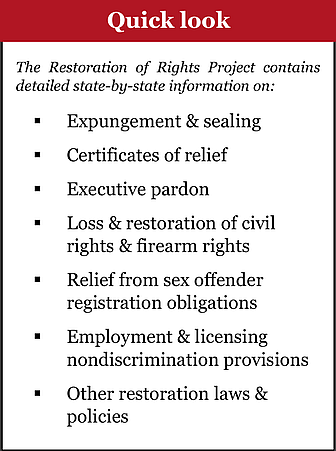
  The Collateral Consequences Resource Center and its partner organizations, the National Association of Criminal Defense Lawyers, the National Legal Aid and Defender Association, and the National HIRE Network, are pleased to announce the launch of the newly expanded and fully updated Restoration of Rights Project. The Restoration of Rights Project is an online resource that offers state-by-state analyses of the law and practice in each U.S. jurisdiction relating to restoration of rights and status following arrest or conviction.   Jurisdictional “profiles” cover areas such as loss and restoration of civil rights and firearms rights, judicial and executive mechanisms for avoiding or mitigating collateral consequences, and provisions addressing non-discrimination in employment and licensing.  Each jurisdiction’s information is separately summarized for quick reference.    In addition to the jurisdictional profiles, a set of 50-state comparison charts summarizes the law and illustrates national patterns in restoration laws and policies.   We expect to supplement these resources in weeks to come with jurisdiction-specific information about organizations that may be able to assist individuals in securing relief, and information on other third-party resources. The resources that comprise the Restoration of Rights Project were originally published in 2006 by CCRC Executive Director Margaret Love, and she has continued to keep them updated.  As a result, the profiles and comparison charts have expanded over the years to broaden their scope and to account for the many changes in this complex area of the law.  Love’s research has recently been hosted by CCRC and NACDL, and it appears as an appendix to the treatise on collateral consequences published jointly by NACDL and Thompson Reuters (West). Project resources have now been re-organized into a unified online platform that makes them easier to access, use, and understand. The short “postcard” summaries of the law in each state — which serve as a gateway to more detailed information — have also been reviewed and revised to provide a more current and accurate snapshot of applicable law in each state. The Project is intended as a resource for practitioners in all phases of the criminal justice system, for courts, for civil practitioners assisting clients whose court-imposed sentence has exposed them to additional civil penalties, for policymakers and advocates interested in reentry and reintegration of convicted persons, and for the millions of Americans with a criminal record who are seeking to put their past behind them. The Restoration of Rights Project is available now at: http://restoration.ccresourcecenter.org Read more

Is pardon making a comeback? Probably not, but law reform may be

A recent issue of Governing Magazine reports that pardoning is “making a comeback” after decades of neglect.  It would be nice if it were true. But the evidence of comeback is thin. Almost all of the jurisdictions where pardoning is thriving today are the same ones where it was thriving a decade ago.  In a dozen states, including Connecticut, Delaware, Georgia, Nebraska, South Carolina and South Dakota, pardon has never been neglected, much less abandoned by responsible officials. In these jurisdictions and a handful of others, pardon has deep roots in the justice system and is supported by accountable institutions of government. It is certainly true that Pat Quinn of Illinois and Jerry Brown of California have made generous use of the power of their office after years in which the pardon power in their states languished unused.  Terry McAuliffe of Virginia is a newcomer to the small group of governors who evidently feel that pardoning is a responsibility of office.  All three are to be commended for it.  But three swallows do not make a summer. For the most part pardoning in the United States remains a timid exercise in tokenism, and the vitality of pardon in most jurisdictions still depends on the personal predilections of the particular elected chief executive.  Most are not very interested in an activity that has few rewards and many pitfalls.   Our President is a case in point.  A number of current governors have refused to use their pardon power at all, some invoking bogus separation of powers arguments (Scott of Wisconsin), others making empty promises (Hickenlooper of Colorado). The Marshall Project recently published an article asking if pardon was still the third rail of American politics. Apparently most governors think it is, whatever changes there may have been in the public mood. Legislative alternatives to pardon It seems to me that if governors and presidents are reluctant to use the power of their office to temper what Alexander Hamilton called the “necessary severity” of the criminal code, they have an obligation to see that the legal system addresses the needs pardon serves. Ohio Governor John Kasich did that when he supported legislation to authorize courts to issue “certificates of qualification for employment” to help people with convictions overcome legal restrictions that bar them from certain jobs.   Governors in Indiana, Louisiana, Minnesota and Vermont have also recently signed legislation giving courts the power to do what they are evidently reluctant to do themselves.  That is an acceptable alternative approach to governing, both in theory and in practice. Indeed, pardon was never supposed to be a substitute for law reform, and courts or administrative agencies are likely to be fairer and more accessible than an elected official. Unfortunately, there is no indication that the Obama Administration is interested in supporting legislation that would ameliorate the adverse effects of a criminal record, though this is one of the few areas in which there is bipartisan support for reform in Congress.  The President’s failure to give criminal justice reform more than a passing mention in the State of the Union address, and only in the context of police/community relations, was discouraging. Many U.S. jurisdictions are attempting to deal with the problems created by mass incarceration, by reducing the number of people who go to prison and by improving social services to keep those who do from going back.  Mass conviction has produced a separate and less tractable set of problems, including proliferation of collateral consequences that discourage rehabilitation, and creation of a permanent class of second class citizens defined by their criminal record. The laboratories of democracy have not yet produced a single legislative solution that can command consensus.  Reform efforts in some jurisdictions involve limiting public access to criminal records through expungement or sealing, an approach that has both practical and theoretical drawbacks.  Other jurisdictions have adopted the more transparent judicial certificates recommended by the 2010 Uniform Collateral Consequences of Conviction Act and the 2014 Model Penal Code: Sentencing. Indiana’s approach combining the two may be the wave of the future. With a clear problem demanding a legislative solution, the recommendation of the National Association of Criminal Defense Lawyers looks appealing: The three branches of government, on the federal, state, and local levels, should undertake a comprehensive effort to promote restoration of rights and status after conviction.   This is a major effort that requires a multi-faceted approach.  It should include enactment of laws to circumscribe or repeal existing collateral consequences, and  a resolve to stop enacting new ones. More fundamentally, government entities, the legal profession, the media and the business community must promote a change in the national mindset to embrace concepts of redemption and forgiveness, including a public education campaign to combat erroneous and harmful stereotypes and labels applied to individuals who have at one point or another committed a crime.  As a cornerstone of this movement, the United States and the states and territories should establish a “National Restoration of Rights Day” to recognize the need to give individuals who have successfully fulfilled the terms of a criminal sentence the opportunity to move on with their lives. This will take leadership at a national level.  Given the support for collateral consequences reform in Congress and in governor’s mansions across the country, perhaps we will get it. Read more