The Supreme Court ruled on June 19, without dissent, that sex offenders cannot constitutionally be barred from social-networking sites. SCOTUSblog’s Amy Howe introduced the Court’s ‘s holding in Packingham v. North Carolina as follows: In 2002, Lester Packingham became a convicted sex offender at the age of 21, after he pleaded guilty to taking indecent liberties with a child – having sex with a 13-year-old girl. Packingham got into hot water with the law again in 2010, when he posted on Facebook to thank God for having a traffic ticket dismissed. After a police officer saw his post, Packingham was prosecuted and convicted under a North Carolina law that makes it a felony for a convicted sex offender to use social-networking websites, such as Facebook and Twitter, that allow minors to create accounts. Today Packingham has something else to be grateful for, and he can take to social media to express that appreciation, because the Supreme Court agreed with him that the North Carolina law violates the Constitution’s guarantee of freedom of speech.
Read moreTag: Justice Kennedy
Restoration of Rights Project (RRP)
- Loss & restoration of civil/firearms rights
- Pardon policy & practice
- Expungement, sealing & other record relief
- Criminal record in employment, licensing & housing
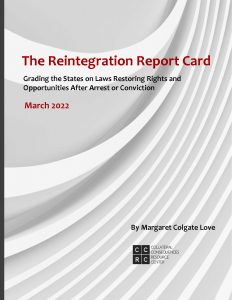
RRP: State-By-State Guides
RRP: 50-State Comparisons
Restoration of Firearm Rights After Conviction: A National Survey and Recommendations for Reform (Dec. 2025)
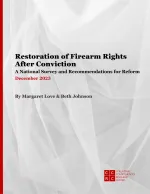
50-state comparisons
About the Restoration of Rights Project
The Restoration of Rights Project (RRP) is a project of the Collateral Consequences Resource Center in partnership with the National Association of Criminal Defense Lawyers, National Legal Aid & Defender Association, National HIRE Network, Association of Prosecuting Attorneys, and Paper Prisons Initiative. Launched in 2017, the RRP is an online resource containing detailed state-by-state analyses of the law and practice in each U.S. jurisdiction relating to restoration of rights and status following arrest or conviction. Jurisdictional “profiles” cover areas such as loss and restoration of civil rights and firearms rights, judicial and executive mechanisms for avoiding or mitigating collateral consequences, and provisions addressing non-discrimination in employment, licensing, and housing. In addition to the jurisdictional profiles, RRP materials include a set of 50-state comparison charts that make it possible to see national patterns in restoration laws and policies. Short “postcard” summaries of the law in each state serve as a gateway to the more detailed information in the profiles, and provide a snapshot of applicable law in each state.
Originally published in 2006 by CCRC Executive Director Margaret Love, the research in the RRP has been kept up to date and substantially expanded over the years, and it is summarized in an appendix to the treatise on collateral consequences published jointly by NACDL and Thompson Reuters (West). It is intended as a resource for practitioners in all phases of the criminal justice system, for courts, for civil practitioners assisting clients whose court-imposed sentence has exposed them to additional civil penalties, for policymakers and advocates interested in reentry and reintegration of convicted persons, and for the millions of Americans with a criminal record who are seeking to put their past behind them.
These resources may be republished as long as appropriate attribution is given to the RRP as its source.