The Wisconsin statute that allows courts to expunge certain conviction records of youthful offenders, Wis. Stat. § 973.015, provides that the court must make its decision about whether to expunge at the time of sentencing, conditioned upon the defendant successfully completing his or her sentence. Often, young defendants receive a probationary term for crimes that are eligible for expungement (all misdemeanors, as well as certain felonies in the lower levels of severity). Prior case law has established that, although expungement is conditional upon successful completion of probation in this situation, the court may not defer ruling on the expungement request. In State v. Hemp, the Wisconsin Supreme Court clarified that expungement occurs automatically if the statutory conditions are met, and that a defendant is not required after completing probation to apply to the sentencing court for entry of the expungement order. Importantly, the court also provided some guidance regarding the legal effect of expungement that will be of interest to job applicants who have had a previous conviction expunged.
Read moreTag: criminal practice
“Justice Is Swift as Petty Crimes Clog Courts”
In a recent national study of case processing in the nation’s misdemeanor courts, Wall Street Journal reporters Gary Fields and John Emschwiller document how “blindingly swift” justice is for the “millions of Americans charged each year with misdemeanor crimes”: In Florida, misdemeanor courts routinely disposed of cases in three minutes or less, usually with a guilty plea, according to a 2011 National Association of Criminal Defense Lawyers study. In Detroit, court statistics show, a district judge on an average day has over 100 misdemeanor cases on his or her docket–or one every four minutes. In Miami, public defenders often hardly have time to introduce themselves to their misdemeanor clients before the cases are over. . . . In a Houston courtroom one day recently, defendants–sometimes individually, sometimes in groups of up to nine . . . , pleaded guilty, received their sentences and got a “good luck” from the judge in less than 30 seconds. It appears that very little has changed in the forty years since the Supreme Court in Argersinger v. Hamlin bemoaned the assembly line that characterized the processing of misdemeanor offenses at that time. The Court noted: Wherever the visitor looks at the system, he finds great numbers […]
Read more“Street Vendors, Taxicabs, and Exclusion Zones: The Impact of Collateral Consequences of Criminal Convictions at the Local Level”
Amy Meek just sent us her colorfully titled and important new article recently published in the Ohio State Law Journal, about the collateral consequences imposed by municipal and county ordinances. As far as I know, this is the first serious effort to address consideration of conviction in connection with opportunities and benefits controlled at the local level. As the abstract below suggests, many types of entrepreneurial opportunities likely to be attractive to people with a criminal record are subject to governmental regulation below the state level. Because these local ordinances and regulations are rarely included in collections of state collateral consequences, they are invisible to defendants and unavailable to their counsel and the court at the time of plea or sentencing. Only in a few large municipalities, notably New York City, are criminal justice practitioners even aware of this locally created and administered system of restrictions and exclusions. For example, with the exception of the District of Columbia, municipal and county rules and regulations are not included in the NIJ-funded National Inventory of the Collateral Consequences of Conviction (NICCC). The potential for interaction between state and local authorities is a particularly intriguing subject that Professor Meek explores in her recommendations for legislative […]
Read moreOhio’s on-line inventory of collateral consequences – a useful tool for defense lawyers
Kelley Williams-Bolar was a single mother in Akron Ohio, a teacher’s aide who was studying to become a teacher herself. Her story made headlines in 2011, when she was accused of misusing her father’s home address to enroll her two young daughters in a public school they were not entitled to attend. After her own home was burglarized, Kelley had enrolled the girls in their grandfather’s school district, so they could spend each afternoon after school safely at their grandfather’s house. To make this possible she had signed a “grandparent affidavit” saying that the girls lived with their grandfather. The new school district ultimately rejected the affidavit, and she withdrew the girls from their new school at the end of the school year. Ohio’s “grandparent affidavit” form contains a printed warning, advising that anyone who submits a false affidavit can be charged with “Falsification, a first degree misdemeanor.” But that warning gave no hint of what would actually happen to Kelley. Eighteen months after her daughters left the new school, the district attorney charged Kelley with felony Grand Theft, claiming she had “stolen” tens of thousands of dollars’ worth of tuition for her children. Particularly given Kelley’s career aspiration to […]
Read moreReduced charge more harmful than original?
An earlier post highlighted the dilemma that some young Wisconsin defendants face because of the narrow scope of the law on sealing conviction records. The court can seal the record of certain convictions, but the record of dismissed charges remains accessible to the public in a searchable online database. Therefore, the dismissal can increase the potential for prospective employers to learn of an applicant’s legal troubles. Now the Wisconsin Court of Appeals has held that the court may not seal the record of a non-criminal violation. Kenosha County v. Frett, 2014AP6 (Wis. Ct. App. Nov. 19, 2014). The appellate court reviewed the statutory language and concluded that references to 1) the maximum term of imprisonment for sealable offenses; 2) “completion of the sentence”; and 3) “certificate of discharge” from the “detaining or probationary authority” showed that the procedure applies only to criminal convictions. For a young woman cited in 2012 in Kenosha County for underage drinking, now a college student in New York, the decision means that the record of her conviction for the amended charge of littering remains publicly accessible. If she had been convicted of drug possession or fraud she might have been able to close the book on this […]
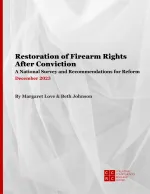
Read moreRestoration of Firearm Rights After Conviction: A National Survey and Recommendations for Reform (Dec. 2025)
Positive Credentials That Limit Risk: A Report on Certificates of Relief (June 2024)
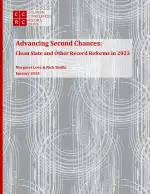
Advancing Second Chances: Clean Slate and Other Record Reforms in 2023 (Jan. 2024)
Accessing SNAP and TANF Benefits after a Drug Conviction: A Survey of State Laws (Dec. 2023)
The Many Roads from Reentry to Reintegration (March 2022)
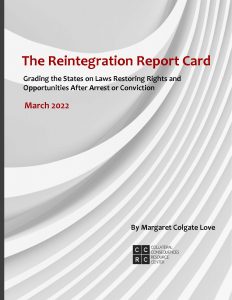
The Reintegration Report Card