Gleeson Certificate enters “uncharted waters”

The New York Law Journal published an article over the weekend about the “novel relief” provided by the federal certificate of rehabilitation issued by former Judge John Gleeson on March 7, just days before he stepped down from the bench.  A reproduction of the certificate reveals its official appearance, complete with court seal and signatures of Judge Gleeson and the Chief U.S. Probation Officer.
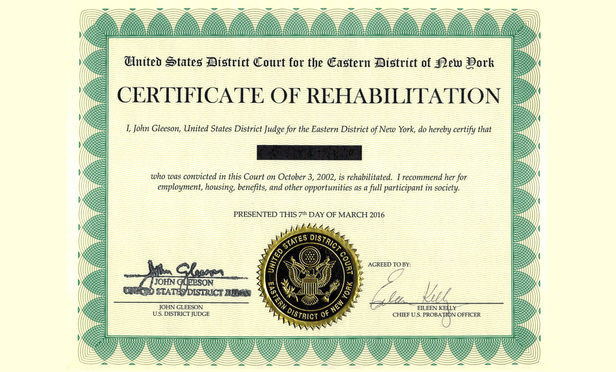
certificate-of-rehabilitation

The government has until April 7 to appeal – the very day its appeal of Judge Gleeson’s expungement order in his first Jane Doe case will be argued in the Second Circuit.  The jurisdictional issues presented by the certificate order may be similar, if only because the certificate has some effect under state law.  See N.Y. Correct. Law §§ 703(7), 752, both cited in Judge Gleeson’s opinion.  It is likely that others similarly situated will apply for similar relief.
Read more

Judge Gleeson issues a “federal certificate of rehabilitation”

In his final week on the bench, in an opinion that may in time prove among his most influential, U.S. District Judge John Gleeson issued a “certificate of rehabilitation” to a woman he had sentenced 13 years before.  See Jane Doe v. United States, No. 15-MC-1174 (E.D.N.Y., March 7, 2016) (Jane Doe II).  The opinion breaks new ground in holding that federal courts have authority to mitigate the adverse effects of a criminal record short of complete expungement.  Along the way, it confirms that a district court may use its inherent equitable powers to expunge convictions in “extreme circumstances,” an issue now on appeal to the Second Circuit in Judge Gleeson’s earlier expungement case.  (Jane Doe I has been calendared for argument on April 7.)  The opinion also finds a role for federal probation to play, including under New York State’s “robust” certificate system, which lifts mandatory state law bars to employment and other opportunities.  It does all of this in a manner that should make it hard for the government to appeal, since “this court-issued relief aligns with efforts the Justice Department, the President, and Congress are already undertaking to help people in Doe’s position shed the burden imposed by a record of conviction and move forward with their lives.”    

Joe Palazzolo at the Wall Street Journal blog noted that  

More than a dozen states and the District of Columbia issue certificates to certain ex-offenders who have shown their days of crime are behind them, usually by remaining offense-free for a long stretch. . . . . 

There is no equivalent federal certificate. So Judge Gleeson invented his own.

Read more

“Future Interrupted”: The collateral damage of juvenile adjudications

Capture

1.5 million children are arrested each year. At some point in each of these children’s lives, the record of their arrest or court involvement will impose barriers to education and employment.  At least two-thirds of post-secondary institutions conduct background checks of prospective students. More than 90% of employers conduct background checks. And, many licensed occupations and professions require FBI background checks. Yet, the reality is, these background checks are often incomplete or inaccurate and they are always stigmatizing.

The justice system has long recognized that children are different from adults, and historically the public had little or no access to the records of juvenile adjudications. That is no longer the case.  The effect of juvenile records now punish kids well into adulthood.

Juvenile Law Center’s recent policy paper, Future Interrupted, urges that children must be free to grow up unfettered by their childhood mistakes—to have their court involvement remain in the past so they can move forward with their lives. This paper explores how various background check systems disseminate juvenile record information, using real-life stories from youth to illustrate the devastating effects of record retention and dissemination.

Read more

Wisconsin court rules for non-citizen years after her plea

In an unusual case involving judicial failure to warn about the immigration consequences of a guilty plea, the Wisconsin Supreme Court has held that the likelihood of inadmissibility (as opposed to deportation) was sufficient to set aside three guilty pleas entered more than a decade before. State v. Valadez, 216 WI 4 (Jan. 28, 2016).  The decision suggests that it may be possible to challenge guilty pleas years after the fact, in any jurisdiction where a statute or court rule requires the court to warn about immigration consequences before accepting a guilty plea.

Read more

New York certificates of relief fall short in practice

New York’s venerable certificate of relief scheme, which aims to mitigate the adverse collateral effects of criminal conviction, has served as a blueprint for certificate laws recently adopted in many other states.  But are New York’s certificates actually effective at restoring rights and status? That is a question addressed in two new scholarly articles, both of which find that New York’s certificates are frequently inaccessible to their intended beneficiaries and misunderstood both by the officials tasked with issuing them and the employers and licensing boards that should be giving them effect.

Governor Cuomo recently directed reforms in the process for obtaining certificates in response to a report concluding that it has “historically been burdensome and slow.”  These articles should be useful in that effort.

Both articles use interviews and anecdotal evidence to shed light on how certificate schemes operate in practice, providing insight into how government officials (including judges and probation officers), employers and convicted individuals interact with the laws (or fail to) in the real world. The increasing popularity of such well-intentioned laws represents an encouraging shift in legislative attitudes about second chances; but, as the articles make clear, they are only as good as their real-world application, which is more limited and less effective than many suppose.

Read more