New federal screening requirements for child care workers

Child care workers in every state are subject to rigorous criminal background checks that may result in mandatory bars to employment. Until now, each state has been generally free to define its own standards regarding screening for criminal history. That is about to change.

By September of next year, states receiving funds under the federal Child Care and Development Block Grant (CCDBG) Act of 2014 (which appropriates over $ 2.5 billion each year to fund state child care and child welfare programs) must adopt minimum federally-defined screening standards for child care workers or risk loss of funding. The revised statutory standards subject current and prospective child care workers to a multi-level criminal background check and disqualify from employment anyone convicted of crimes against children, specified violent crimes, and drug crimes within the past 5 years.  States may opt to waive the disqualification for drug crimes on a case-by-case basis, but they are also free to adopt conviction-based disqualifications that are more restrictive than the law requires.

If the new CCDBG standards were not bad enough, the Department of Health and Human Services has issued proposed rules that would make them worse.  On Monday, the CCRC joined a coalition of organizations led by the National Employment Law Project in calling on HHS to rethink proposed rules that would implement the new screening requirements. A formal comment filed by the coalition details the ways in which the proposed rules fail to adequately address the disparate impact that the requirements could have on women, African Americans, and Latinos, and takes issue with requirements in the rules that are more exclusionary than the Act requires. Read more
New York Bar adopts reentry recommendations

In 2012 newly elected President of the New York State Bar Association (NYSBA), Seymour James, Jr., drew upon his 38 years of experience at the Legal Aid Society of New York City to establish a Special Committee on Reentry and appointed committee members who would spend the next three years researching and studying issues relating to reentry and reintegration.

The goal of this Special Committee was to develop a report and recommendations including a consideration of collateral consequences that can have an impact on reentry regarding education, housing employment, medical health, mental health and juveniles. The report identifies some of the best practices to ensure productive lives and minimize recidivism of formerly incarcerated adults and detained juveniles, and of adults and juveniles who can avoid convictions and delinquency findings through innovative diversion programs.

On January 29, 2016 the NYSBA House of Delegates adopted the report and recommendations of the Special Committee.

Read more

Mexico vacations out for sex offenders?

It appears that Mexico has inaugurated a policy of refusing entry to anyone registered in the United States as a sex offender.  While no formal policy has been announced, the body of anecdotal evidence supporting the existence of an informal policy is growing.  In numerous internet postings, vacationers report being turned back at the border or forced to take the next plane home, leaving their families behind.  There is no indication that people with other convictions are being similarly excluded.  The Mexican government’s new policy has been made technologically feasible by new federal data-sharing policies, including the Dru Sjodin National Sex Offender website maintained by the Justice Department’s SMART Office. Members of the public may now do a free national search of all state sex offender registries, as well as all registries maintained in Indian country.  We will continue to monitor this situation, and watch for reports about exclusionary policies from other countries.

50-state guide to expungement and sealing laws

The 50-state chart of judicial relief mechanisms from the NACDL Restoration of Rights Resource, which is also posted on this site, is a comprehensive survey of all authorities for judicial relief in the states and federal system. We wanted to bring it to our readers’ attention in light of the new federal interest in helping individuals with a criminal record overcome barriers to employment and licensing through clearing their records.

The National Clean Slate Clearinghouse, recently announced as part of President Obama’s reentry initiative, will “provide technical assistance to local legal aid programs, public defender offices, and reentry service providers to build capacity for legal services needed to help with record-cleaning, expungement, and related civil legal services.” This joint project of the Labor and Justice Departments will doubtless make it a first priority to survey the laws providing judicial and other relief in different states, to determine what sort of assistance lawyers will need to neutralize the adverse employment consequences of conviction, though the courts or otherwise.  We hope these resources will prove useful in that effort.

Read more

How a parent’s criminal record limits children

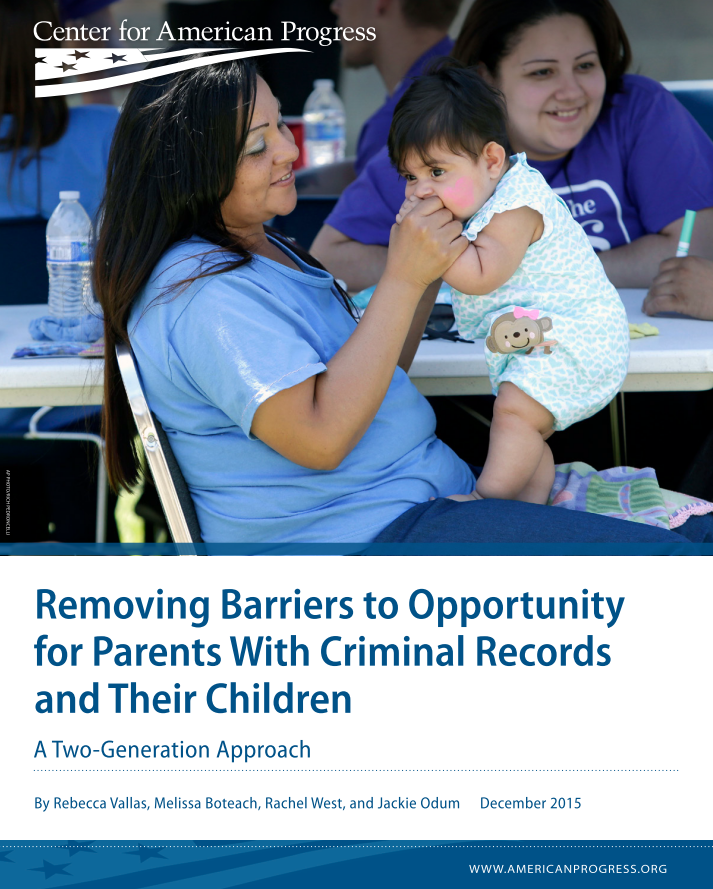
reportcover“The barriers associated with having a criminal record do not just result in lifelong punishment for the parent with the record; they also can significantly limit a child’s life chances.” This is according to a new report by the Center for American Progress that examines the multi-generational effects of collateral consequences and the cycle of poverty and lost opportunity that those consequences perpetuate.

A parent’s criminal record can affect everything from a child’s emotional and physical well-being to future economic and educational outcomes.  This is true even if the record was for a minor conviction that did not result in incarceration or, in some cases, an arrest that did not result in conviction at all.

Read more