Indiana’s new expungement law the product of “many, many compromises”

In May of 2013, Indiana Governor Mike Pence signed into law what is possibly the most comprehensive and forward-looking restoration of rights statute ever enacted in this country.  Under the new law, courts are empowered to “expunge” most criminal records, after waiting periods keyed to the seriousness of the offense.  The effect of an expungement order varies to some extent according to the nature of the crime, but its core concept is to restore rights and eliminate discrimination based on criminal record in the workplace and elsewhere.  This new law has already resulted in relief for hundreds of individuals, due in large part to the proactive approach of the state courts in facilitating pro se representation.

We r150px-On_the_Banks_of_the_Wabash,_Far_Away,_sheet_music_cover_with_Bessie_Davis,_Paul_Dresser,_1897ecently had a chance to talk to the person primarily responsible for shepherding this law through the Indiana legislature, and his experience should be instructive to reform advocates in other states.  Jud McMillin, a conservative former prosecutor who chairs the House Committee on Courts and Criminal Code, might once have been regarded as a rather unusual champion of this unique and progressive legislation.  But in an age of bipartisan support for criminal justice reform, apparently anything can happen.   Read more
How risky is pardoning? Not as risky as committing uninformed journalism

An AP story about the perils of pardoning, picked up by newspapers and media outlets across the country, manages to convey three pieces of misinformation in its very first sentence.  Riffing off a recent high profile pardon application, it begins like this:  “Mark Wahlberg’s plea for a pardon has focused fresh attention on excusing criminal acts – something governors rarely do because it’s so politically risky.”

But pardons do not “excuse” crimes, they forgive them; governors have been pardoning more and more generously in recent years; and pardoning, like any other government program involving personal participation by a high profile elected official, is generally not risky if done in a responsible manner with good staff support and without apology.

Read more

Second Amendment challenges to felon-in-possession laws

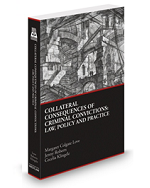
Below is another excerpt from the second edition of Love, Roberts & Klingele, Collateral Collat_ConsequencesConsequences of Criminal Conviction: Law, Policy & Practice (West/NACDL, 2d ed. 2015)(forthcoming), this one about challenges to firearms-related collateral consequences based on the constitutional right to bear arms.  Criminal defense lawyers representing clients on felon-in-possession charges, and anyone seeking restoration of firearms rights after conviction, will be interested to know that the government has appealed the district court’s decision in Binderup v. Holder cited in note 8, discussed here a few weeks ago.

Binderup is a civil rights action in which the federal court in the Eastern District of Pennsylvania held that the federal felon-in-possession statute could not constitutionally be applied to an individual convicted of a non-violent sex offense in 1998 and sentenced to probation.  This case, the first in which a federal court invalidated a federal statute on Second Amendment grounds, is likely to provide an early opportunity for the court of appeals to consider an issue that most commentators and some courts believe was left unresolved by the Supreme Court in D.C. v. Heller.

Read more

Discipline for schoolgirls differs by race and skin tone

The New York Times this morning describes data from the U.S. Department of Education’s Office for Civil Rights showing that African-American girls tend to face more serious school discipline than white girls.  “For all the attention placed on problems that black boys face in terms of school discipline and criminal justice, there is increasing focus on the way those issues affect black girls as well.”  Black girls who get in trouble at school are also more frequently referred to the criminal justice system, where they can incur a criminal record that sticks with them into adulthood.

Read more

Guess who’s driving for Uber

The background checking policies of Uber and other ride-sharing companies like Lyft and Sidecar are again in the news, after an Uber driver with an extensive criminal record allegedly raped a female passenger in New Delhi.  Other horror stories of cab rides from hell with these popular “taxi aggregators” are surfacing.  The New York Times reports that background check requirements for taxi drivers vary widely by jurisdiction, but are “generally more rigorous” than the sketchy services used by Uber and its competitors, and “usually include searches of private databases like F.B.I. records.”  (Note to self:  Must inform the “paper of record” that the FBI records system is not a “private database.”)

Uber et al. have so far successfully resisted most legislative efforts to require them to perform particular kinds of background checks using particular kinds of background checkers, using the good offices of well-connected lobbyists to avoid this annoying speed bump on their road to a public offering.  But episodes like the New Delhi rape, and lawsuits for misleading consumers about the kinds of checks they do, may bring them around to a more responsible position. Read more