Category: Scholarly articles

How to expand expungement: base it in retribution instead of rehabilitation

A thoughtful new article by Brian Murray recommends a new way of conceptualizing expungement that should make it easier for reformers to justify facilitating access to this record relief.  In “Retributive Expungement,” forthcoming in the University of Pennsylvania Law Review, Murray argues that expungement should be seen as a way to end warranted punishment rather than to recognize and incentivize rehabilitation.  The argument goes that if the legal and social disadvantages of a criminal record function as part and parcel of the criminal sentence imposed by the court, as opposed to a loosely related system of civil penalties that are activated by other laws and other actors, then the court has an obligation at some point to discharge it.  While this argument is not new, Murray places it squarely in a modern retributivist framework.

In an earlier era, the drafters of the 1962 Model Penal Code embraced this idea of tying up the loose ends of criminal punishments through court-ordered dispensation, although they chose a more transparent form of remedy in judicial vacatur or set-aside.  Before that, this function of ending punishment was performed by executive pardon.  In modern times, as ubiquitous background checking has made a criminal record a lasting Mark of Cain, most agree that the record should be made unavailable for private and most public purposes at some point, unless disclosure is ordered by the court for some purpose authorized by law.  Facilitating access to this record relief should be easier with the theoretical frame proposed by Murray.

Here is the abstract and a link:

Expungement relief was introduced in the mid-twentieth century to reward and incentivize rehabilitation for arrestees and ex-offenders and to protect their privacy. Recently, many states have broadened their expungement remedies, and those remedies remain useful given the negative effects of public criminal records on reentry. But recent scholarship has suggested an “uptake gap,” meaning many who are eligible never obtain relief. Despite broadening eligibility, petitioners face substantial obstacles to filing, pre-hearing hurdles, waiting periods, and difficult standards of review without the assistance of counsel. And even when expungement is granted, the recipients are basically left on their own to guarantee the efficacy of the remedy. Some of these attributes of expungement were originally conceived as features, designed to ensure only the most rehabilitated received relief, allowing the state to continue to pursue public safety objectives with public criminal records. But the cold reality of expungement procedure leaves many petitioners facing insurmountable obstacles that amplify the effects of the punishment originally imposed.

In exploring this reality, this Article illustrates that expungement procedure is stuck in a rehabilitative and privacy-centric paradigm. While this framework inspired the creation of expungement remedies and recent reforms, it also has justified onerous procedural obstacles and the placing of the burden of persuasion on the petitioner rather than the state. Outside of automated expungement, which is still relatively rare and restricted to only certain types of petitions, most expungement regimes in substance or through procedure invert what should be the state’s burden to justify retention of criminal records that enable extra punishment by state and private actors. An alternative theoretical basis for expungement is necessary to convince policymakers and decision-makers of the need for broader substantive and procedural reform.

This Article suggests a different paradigm: retributive based expungement. It proposes that incorporating retributive constraints that already underlie the criminal system can benefit petitioners. Plenty of arrestees do not deserve stigma and ex-offenders have done their time, meaning punitive stigma from public criminal records can amount to unwarranted punishment. A retributive-minded expungement procedure would all but guarantee expungement in the case of arrests, where the desert basis is questionable, and would place the burden of proof on the state for convictions once desert has been satisfied. As such, this approach can supplement the case for broader eligibility, automated expungement, and favorable pre-hearing procedures that limit the uptake gap. It also has legal and political viability given that many states already maintain retributivist constraints on sentencing and given that huge swaths of the public perceive desert as a crucial component of any criminal justice issue. In fact, some states are already moving in this direction and can serve as a model for the rest of the country. In short, retributivist constraints can trim procedural overgrowth to supplement substantive reforms that already recognize the disproportionate effects of a public criminal record.
Broken records: criminal history errors cost jobs and housing

Ariel Nelson of the National Consumer Law Center has authored an important new report, Broken Records Redux, which describes how errors by criminal background check companies harm consumers seeking jobs and housing.  In particular, the report shows how background screeners continue to include sealed and expunged records in criminal background check reports, omit disposition information, misclassify offenses, mismatch the subjects of records, and include other misleading information.  The report also examines problems arising from the use of automated processes to evaluate prospective employees and tenants.

This report, a sequel to a 2012 NCLC report on criminal background errors, observes that since 2012 advocates and federal agencies have litigated many actions for violations of the Fair Credit Reporting Act (FCRA), leading to settlements and judgments requiring background screeners to reform their processes and pay millions in penalties and relief to consumers.  Despite these lawsuits, “companies continue to generate inaccurate reports that have grave consequences for consumers seeking jobs and housing.”  Based on these issues, the report recommends a broad array of legislative and regulatory changes at the federal and state level.  Accompanying the report is an article: Fertile Ground for FCRA Claims, which describes FCRA violations that can result from “inaccurate, incomplete, or outdated” background checks.

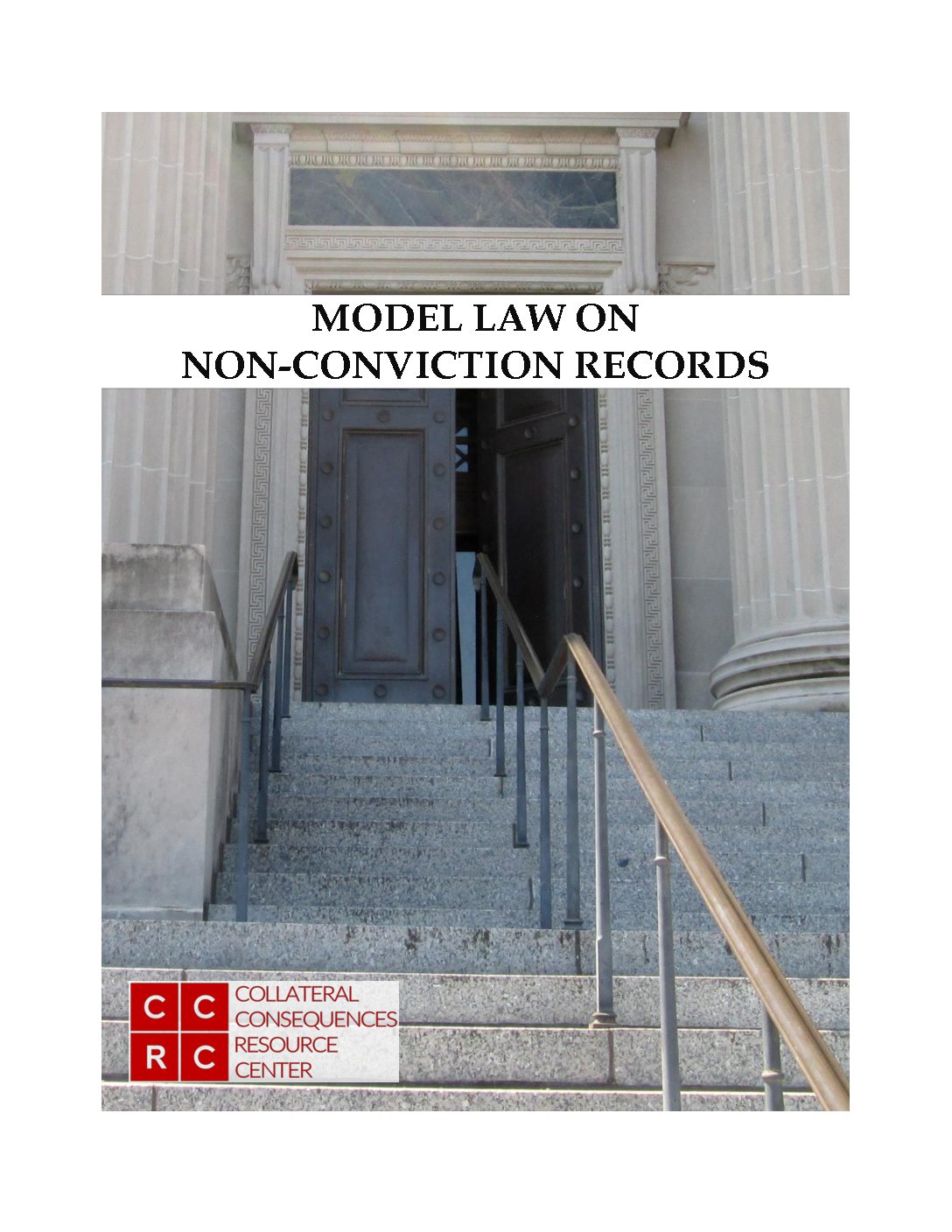
This new report also provides support for policy recommendations in our recently released Model Law on Non-Conviction Records, including restrictions on the dissemination of expunged records and records indicating no disposition by commercial providers of criminal records.

“For expungement and clean slate laws to succeed in removing barriers to employment and housing, they must take into account issues like background check reporting, data aggregation, and the use of stale data,” says Nelson, the author of the NCLC report. “I’m happy to see that CCRC’s Model Law on Non-Conviction Records provides guidance for addressing those issues.”

Model law proposes automatic expungement of non-conviction records

An advisory group drawn from across the criminal justice system has completed work on a model law that recommends automatic expungement of most arrests and charges that do not result in conviction.  Margaret Love and David Schlussel of the Collateral Consequences Resource Center served as reporters for the model law.  It is available in PDF and HTML formats.

“Many people may not realize how even cases that terminate in a person’s favor lead to lost opportunities and discrimination,” says Sharon Dietrich, Litigation Director of Community Legal Services of Philadelphia, and one of the advisors of the model law project.  “Over the years, my legal aid program has seen thousands of cases where non-convictions cost people jobs.”

In proposing broad restrictions on access to and use of non-conviction records, the project aims to contribute to conversations underway in legislatures across the country about how to improve opportunities for people with a criminal record.  Already in 2019, states have enacted more than 130 new laws addressing the collateral consequences of arrest and conviction.  The group regards its model as the first step in a broader law reform initiative that will address conviction records as well.

Law enforcement officials make over 10 million arrests each year, a substantial percentage of which do not lead to charges or conviction.  Records of these arrests have become widely available as a result of digitized records systems and a new commerce in background screening and data aggregation.  These checks often turn up an “open” arrest or charges without any final disposition, which may seem to an employer or landlord more ominous than a closed case.

Very few states have taken steps to deal with the high percentage of records in repositories and court systems with no final disposition indicated.  Paul McDonnell, Deputy Counsel for New York’s Office of Court Administration and a project advisor, noted: “Criminal records that include no final disposition make it appear to the untrained eye that an individual has an open, pending case, which can have serious results for that person. New York has recently made legislative progress in addressing this problem, though more can be done.”

Current state and federal laws restricting access to and use of non-conviction records have limited application and are hard to enforce.  Eligibility criteria tend to be either unclear or restrictive, and petition-based procedures tend to be burdensome, expensive, and intimidating.  In recent years, lawmakers and reform advocates have expressed a growing interest in curbing the widespread dissemination and use of non-convictions, leading some states to simplify and broaden eligibility for relief, reduce procedural and financial barriers to access, and in a handful of states to make relief automatic.

Rep. Mike Weissman, a Colorado State Representative and model law project advisor, noted that Colorado has recently overhauled its laws on criminal records with broad bipartisan support.  “It is heartening to see similar reforms underway in other states, both red and blue, as well.  I commend the practitioners and researchers who helped formulate the model law for illustrating avenues for further progress in reducing collateral consequences.”

The model law would take this wave of criminal record reforms to a new level.  It recommends that expungement be immediate and automatic where all charges are terminated in favor of an accused.  Uncharged arrests should also be automatically expunged after a brief waiting period, as should dismissed or acquitted charges in cases where other charges result in conviction.  Cases that indicate no final disposition should also be expunged, unless there is indication that they are in fact pending.

The model law also recommends that expunged non-conviction records should not be used against a person in a range of criminal justice decisions, including by law enforcement agencies.  It would prohibit commercial providers of criminal background checks from disseminating expunged and dated non-conviction records, and civil decision-makers from considering them.

David LaBahn, President of the national Association of Prosecuting Attorneys, indicated that organization’s support for the model law, stating that the collateral consequences of non-convictions “do not serve to make the community safer,” and that “the current structures in place to expunge a non-conviction record can be confusing and difficult for the layperson to navigate alone.”

This model law sets the stage for jurisdictions to address record relief for convictions more generally, and its structure and principles can be brought to bear on that important work.

The Collateral Consequences Resource Center organized this model law project.  An early draft of the model law was discussed at an August 2019 Roundtable conference at the University of Michigan that was supported by the Charles Koch Foundation.  The model law report was supported by Arnold Ventures.

Read the model law in PDF or HTML.

Algorithms, Race, and Reentry: A Review of Sandra G. Mayson’s Bias In, Bias Out

In true Minority Report fashion, state actors are increasingly relying on algorithms to assess the risk a person will commit a future crime.  Unlike Minority Report, these algorithms simply estimate the likelihood of rearrests; they do not offer the absolute answer to future criminal behavior that condemned the defendant, Tom Cruise, in the 2002 action film.  Still, criminal justice actors are using many types of algorithmic risk assessments to inform their decisions in pre-trial investigations, bail recommendations and decisions, and post-trial sentencing and parole proceedings.  Sandra G. Mayson’s article[1], Bias In, Bias Out, published this year in the Yale Law Journal, explains how these algorithms could reflect and project past and present racial bias in the criminal justice system and elsewhere.

At its core, an algorithm specifies individual traits that are correlated with crime commission.  If the data show that people of color are arrested more frequently, then the algorithm will predict more arrests for people of color.  In this sense, an accurate algorithm “holds a mirror to the past” by “distilling patterns in past data and projecting them into the future.”  Mayson provides an in-depth, yet easy-to-follow explanation of why race neutrality is unattainable when the base rates of arrest differ across racial groups.  These mirror-like algorithms give us the opportunity to clearly view the racial disparity in arrests and convictions.  Is there something wrong with this image, and what should we do now that we’ve seen it?

Read more

CCRC scholarship round-up – August 2019

Editor’s note:  This past year has seen a burgeoning of scholarship dealing with collateral consequences broadly defined, from lawyers, social scientists, and philosophers.  CCRC’s good friend Alessandro Corda has selected fifteen notable articles published in 2018-19, with information, links, and abstracts.  They are organized into five categories:

(1) Legal collateral consequences

(2) Collateral consequences and criminal procedure

(3) Sex offender registration laws

(4) Informal collateral consequences

(5) Criminal records, expungement, sealing, and other relief mechanisms

A complete and regularly updated collection of scholarship on issues relating to collateral consequences and criminal records can be found on our “Books & Articles” page.  From time to time we will preview and comment on new articles, and Alessandro has promised to provide another round-up by the end of the year.  We hope he will continue indefinitely in the role of CCRC’s official bibliographer.  (A PDF copy of this scholarship round-up is here.)

Read more