Category: Policy

New federal screening requirements for child care workers

Child care workers in every state are subject to rigorous criminal background checks that may result in mandatory bars to employment. Until now, each state has been generally free to define its own standards regarding screening for criminal history. That is about to change. By September of next year, states receiving funds under the federal Child Care and Development Block Grant (CCDBG) Act of 2014 (which appropriates over $ 2.5 billion each year to fund state child care and child welfare programs) must adopt minimum federally-defined screening standards for child care workers or risk loss of funding. The revised statutory standards subject current and prospective child care workers to a multi-level criminal background check and disqualify from employment anyone convicted of crimes against children, specified violent crimes, and drug crimes within the past 5 years.  States may opt to waive the disqualification for drug crimes on a case-by-case basis, but they are also free to adopt conviction-based disqualifications that are more restrictive than the law requires. If the new CCDBG standards were not bad enough, the Department of Health and Human Services has issued proposed rules that would make them worse.  On Monday, the CCRC joined a coalition of organizations led by the National Employment Law Project in calling on HHS to rethink proposed rules that would implement the new screening requirements. A formal comment filed by the coalition details the ways in which the proposed rules fail to adequately address the disparate impact that the requirements could have on women, African Americans, and Latinos, and takes issue with requirements in the rules that are more exclusionary than the Act requires. As observed in the comment: The diverse profile of the child care workforce justifies close scrutiny of the proposed Administration for Children and Families (ACF) regulations. Sixteen percent of child care workers are African American (compared to 11 percent of the total U.S. workforce) and another 22 percent are Latino (compared to 16 percent of the total U.S. workforce). These workers typically endure long hours while earning especially low wages (averaging just $21,490 annually), and qualifying for few, if any, benefits. Given these challenges, child care workers are especially likely to reside and work in low-income communities that are most affected by over-criminalization and mass incarceration. The child care workforce is also overwhelmingly represented by women (96 percent), and women now constitute the fastest growing segment of the correctional population. Arrest data from 2003 to 2012 indicates that arrests of women in the United States increased by 3 percent, while the rate declined by 13 percent for men. The rise in arrest rates has corresponded with a major increase in incarceration rates for women as well (exceeding the rate of men by 1.5 times, from 1980 to 2010),11 and the criminalization of African American girls in schools. However, women with an arrest or conviction record pose a low risk to public safety because they tend to enter the criminal justice system for non-violent crimes that are often drug-related or driven by poverty. In fact, women have markedly lower rates of recidivism than men. Given the diverse nature of the child care workforce, the comment urges HHS to incorporate into its implementing rules language from the Equal Employment Opportunity Commission’s guidance on criminal background screening in compliance with Title VII of the Civil Rights Act of 1964.  Among other things, the EEOC guidance calls for an individualized assessment of employees and applicants that takes into account whether a particular conviction is related to the position and any mitigating factors. The coalition urges that incorporation of these standards will encourage states to implement robust procedures governing waivers for drug crimes and any additional disqualifications defined by state law. The comment also questions a provision that would require background screening for anyone age 18 or older residing in a license-exempt home that provides child care services – a requirement not mandated by the Act itself. In addition to concerns about administrative over-reach and the increased costs that the expanded checks will saddle providers with, the comment explains that expanding background checks to adult household members would have a disparate impact on low-income communities and communities of color, which have higher than average arrest and conviction rates. Based on the experience of our organizations serving these communities, it is clear that they constitute a significant proportion of license-exempt child care providers and are more likely to have multiple generations living in the same house. Finally, the comment urges HHS to omit language encouraging self-reporting of criminal history (which may result in the reporting of inaccurate and irrelevant, though potentially harmful, information) and to encourage states to create effective procedures for appealing the results of inaccurate background checks. Revising the proposed rules to address these concerns would be consistent with HHS’s active participation in the Obama Administration’s Federal Interagency Reentry Council, which is charged with “remov[ing] federal barriers to successful reentry so that motivated individuals—who have served their time and paid their debts—are able to compete for jobs, attain stable housing, support their children and families, and contribute to their communities,” and with Title VII and existing HHS policies that address unreasonable barriers to employment and reentry. Since the Act does not do any favors for child care workers with criminal backgrounds, one can only hope that HHS will administer it in a way that strikes a reasonable balance between public safety and fairness to those that deserve a second chance. The full comment can be found here. Read more

50-state guide to expungement and sealing laws

The 50-state chart of judicial relief mechanisms from the NACDL Restoration of Rights Resource, which is also posted on this site, is a comprehensive survey of all authorities for judicial relief in the states and federal system. We wanted to bring it to our readers’ attention in light of the new federal interest in helping individuals with a criminal record overcome barriers to employment and licensing through clearing their records. The National Clean Slate Clearinghouse, recently announced as part of President Obama’s reentry initiative, will “provide technical assistance to local legal aid programs, public defender offices, and reentry service providers to build capacity for legal services needed to help with record-cleaning, expungement, and related civil legal services.” This joint project of the Labor and Justice Departments will doubtless make it a first priority to survey the laws providing judicial and other relief in different states, to determine what sort of assistance lawyers will need to neutralize the adverse employment consequences of conviction, though the courts or otherwise.  We hope these resources will prove useful in that effort. Note that terminology and procedure differ significantly from state to state, so that those interested in more specific information about the scope, operation and effect of a particular state’s laws should consult the state-by-state profiles accessible through the Resources tab on the home page of this site.  For example, while the term “expungement” may involve destruction of records in a few states (e.g., Pennsylvania), more frequently it means a limited restriction on public access to records.  For example, in Kansas certain employers and licensing agencies continue to have access to criminal records notwithstanding an expungement order from the court.  In Indiana “expungement” entails no limit of public access at all — although some records may be sealed after expungement.  In some states a judicial set-aside or vacatur involves a sealing of the record (e.g., Michigan, Washington) but in others it doesn’t (e.g., California).  Most jurisdictions authorize sealing or expungement of non-conviction records upon petition to the court. In the past few years a number of states have modified their provisions for sealing or expungement of records, but most of these new laws reach only minor offenses or non-conviction records, and frequently involve long eligibility waiting periods that defeat their usefulness for reentry purposes. Conspicuous exceptions are the comprehensive new judicial relief schemes enacted in Indiana and Minnesota, and Arkansas’ reorganization and expansion of its existing expungement laws. A few states, notably Kansas and Utah, have broad expungement laws dating from the 1970s. Note that there is no statute providing for expungement of federal convictions, and almost no authority to limit access to non-conviction records — a circumstance that has led several federal sentencing courts to consider expungement through their ancillary jurisdiction. The most well-known of these cases is U.S.v. Jane Doe, now on appeal in the Second Circuit, in which Judge John Gleeson ordered expungement of a fraud conviction of a woman he had sentenced 13 years before.  (Briefs in the Doe case are available here.) Read more

How a parent’s criminal record limits children

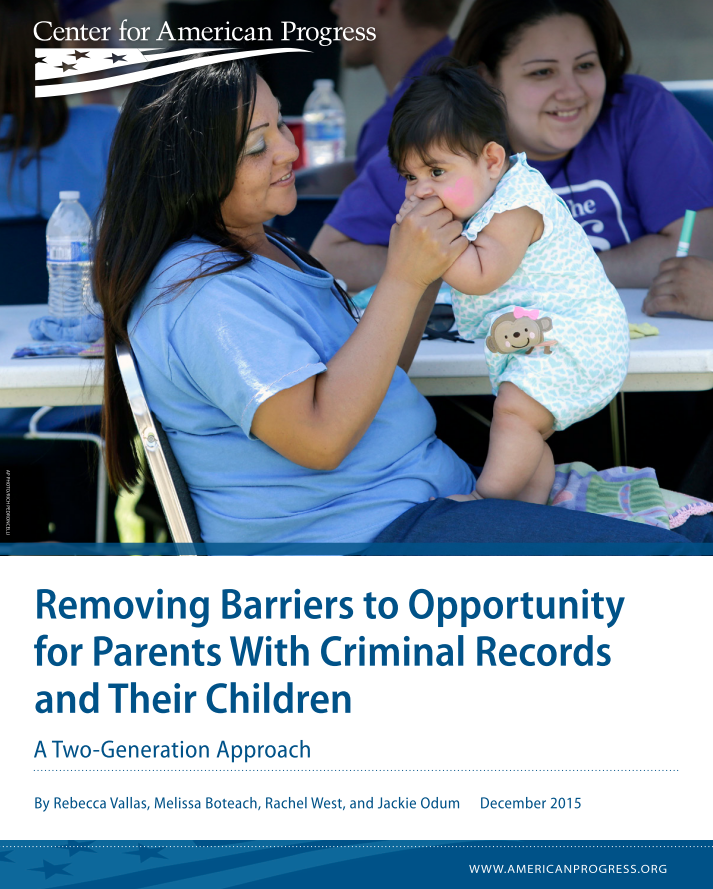
“The barriers associated with having a criminal record do not just result in lifelong punishment for the parent with the record; they also can significantly limit a child’s life chances.” This is according to a new report by the Center for American Progress that examines the multi-generational effects of collateral consequences and the cycle of poverty and lost opportunity that those consequences perpetuate. A parent’s criminal record can affect everything from a child’s emotional and physical well-being to future economic and educational outcomes.  This is true even if the record was for a minor conviction that did not result in incarceration or, in some cases, an arrest that did not result in conviction at all. The report specifically examines how a parent’s criminal record can effect “five pillars of family well being:” • Income. Parents with criminal records have lower earning potential, as they often face major obstacles to securing employment and receiving public assistance. • Savings and assets. Mounting criminal justice debts and unaffordable child support arrears severely limit families’ ability to save for the future and can trap them in a cycle of debt. • Education. Parents with criminal records face barriers to education and training opportunities that would increase their chances of finding well-paying jobs and better equip them to support their families. • Housing. Barriers to public as well as private housing for parents with criminal records can lead to housing instability and make family reunification difficult if not impossible. • Family strength and stability. Financial and emotional stressors associated with parental criminal records often pose challenges in maintaining healthy relationships and family stability. In many instances, these effects are the indirect result of collateral consequences that limit a parent’s ability to find a job or pursue education or training; however, there are a number of notable collateral consequences that can have a direct and often severe impact on a child’s well-being. For example, the federal Department of Housing and Urban Development authorizes Public Housing Authorities to exclude or evict entire families from subsidized housing on the basis of a single family member’s “criminal activity,” and, in handful of states, parents with felony drug convictions are permanently barred from receiving federally funded food stamps. The scope of the problem is large both in terms of the number of families currently affected and in terms of the future social consequences. Although the report’s claim that “nearly half of U.S. children now have at least one parent with a criminal record,” may be an overstatement (the methodology used to arrive at that figure relies on a number of questionable assumptions), it is clear that about a third of all Americans have some sort of record. That number represents millions of parents and, in turn, millions of impacted children whose chance of success in adulthood may be diminished. Sadly, we can assume that a disproportionately large number of those children are black or Latino since their parents are more likely to have a criminal record than white parents.  Unless there is significant reform, we can expect to see the racial disparities that the justice system has created among adults of this generation reverberate well into the next. To mitigate these outcomes, the report advocates for a “two generation approach” to reform that “combats intergenerational poverty by boosting education, health, and well-being; economic supports; and social capital for parents and children.” The specific reforms proposed are largely aimed at easing the burdens on parents with criminal records by removing barriers to employment, housing, and education; broadening the availability of sealing and expungement (including automatic expungement of low level offenses after a set period of time); and expanding re-entry services. The report also pushes for the adoption of policies that support family strength and stability in general terms, such as child support reform and the expansion of parent training and support programs like those funded by federal Pathways to Responsible Fatherhood Demonstration grants. You can find the full report, Removing Barriers to Opportunity for Parents With Criminal Records and Their Children: A Two-Generation Approach, at this link. Read more

Interstate restoration of rights

Can people restored to full legal status in one state expect their status to be recognized if they move to another state, just as marriage is generally given interstate recognition?  Can a person convicted in one state qualify for restoration of rights in another? What about a federal offender seeking relief under state law, or a state offender seeking relief from federal collateral consequences?  Is there a role for Congress to play in ensuring fair treatment of people with a criminal record as they move around the country?  These questions are increasingly important both as a practical and theoretical matter, as collateral consequences multiply and begin to limit Americans’ right to travel. So it is timely that Wayne Logan, a Florida State University law professor widely known for his work on sex offender registration and other collateral consequences, has published a fascinating new treatment of the issue titled ‘When Mercy Seasons Justice’: Interstate Recognition of Ex-Offender Rights.  The article, which appears in the UC Davis Law Review, examines the impact of federalism on the ability to obtain true relief from the collateral consequences of conviction in a mobile society.  It is an issue that is widely overlooked, and the article reminds us that a comprehensive discussion about the impact of collateral consequences must take into account their inter-jurisdictional effects. The true impact of collateral consequences and relief mechanisms must be measured by the interplay of laws between jurisdictions as well as by the interplay of laws within them. The article’s abstract appears below: To the great relief of many, states are now rethinking their draconian criminal justice policies of the past several decades. In addition to shrinking prison and jail populations, reforms are now underway to expand opportunities for relief from the collateral consequences of conviction, such as the loss of the right to vote, serve as a juror, or work in certain occupations, which can impede the ability of ex-offenders to successfully reintegrate into society. In coming years, as states seek to reduce their high recidivism rates, such relief efforts will likely continue to grow in number; as they do, we should expect to see parallel growth in an important horizontal federalism challenge. The challenge comes when ex-offenders, having secured collateral consequences relief in one state, relocate to another and seek to have their restored status recognized there. When this occurs a legal conflict materializes not unlike that of late witnessed with same-sex marriage. Unlike same-sex marriage recognition, however, which was the subject of major public debate and legal attention, restoration recognition — despite its potential impact on many millions more lives — has been largely ignored. This Article aims to remedy the deficit, providing the first comprehensive examination of how restoration recognition thus far has been addressed, and outlining a legislative way forward for states, or Congress, to balance the important comity, federalism, and state autonomy interests implicated. Read more

President issues order announcing reentry initiatives

On November 2, the President issued an executive order announcing a series of steps to encourage reentry and rehabilitation of individuals who have recently been released from prison.  Among other things, the order establishes a National Clean Slate Clearinghouse, and authorizes technical assistance to legal aid programs and public defender offices “to build capacity for legal services needed to help with record-cleaning, expungement, and related civil legal services.” According to an article in the New York Times, the measures are all relatively modest in scale, important to the president less for their individual effect than for the direction they keep the country moving. Collectively, they reflect a belief that former inmates should have greater leeway to apply for jobs and housing without disclosing criminal records that would hinder their chances. The order also calls on Congress to establish a ban-the-box program for federal employers and contractors.  In the interim, it asks the Office of Personnel Management to “take action where it can by modifying its rules to delay inquiries into criminal history until later in the hiring process.”  Presumably this means at a minimum that OPM should eliminate the criminal history question on its “Declaration for Federal Employment” form.  However, the order stops well short of recommending the more progressive steps proposed in a National Employment law Project report issued last January, including the revision of the federal “suitability” regulations to comply fully with the protections of Title VII of the Civil Rights Act of 1964. We will shortly take a closer look at this new federal initiative to blunt the impact of collateral consequences.  For now, we post the text of the entire order.  THE WHITE HOUSE Office of the Press Secretary FOR IMMEDIATE RELEASE November 2, 2015 FACT SHEET: President Obama Announces New Actions to Promote Rehabilitation and Reintegration for the Formerly-Incarcerated This Administration has consistently taken steps to make our criminal justice system fairer and more effective and to address the vicious cycle of poverty, criminality, and incarceration that traps too many Americans and weakens too many communities. Today, in Newark, New Jersey, President Obama will continue to promote these goals by highlighting the reentry process of formerly-incarcerated individuals and announce new actions aimed at helping Americans who’ve paid their debt to society rehabilitate and reintegrate back into their communities. Each year, more than 600,000 individuals are released from state and federal prisons. Advancing policies and programs that enable these men and women to put their lives back on track and earn their second chance promotes not only justice and fairness, but also public safety.  That is why this Administration has taken a series of concrete actions to reduce the challenges and barriers that the formerly incarcerated confront, including through the work of the Federal Interagency Reentry Council, a cabinet-level working group to support the federal government’s efforts to promote public safety and economic opportunity through purposeful cross-agency coordination and collaboration. The President has also called on Congress to pass meaningful criminal justice reform, including reforms that reduce recidivism for those who have been in prison and are reentering society.  The Sentencing Reform and Corrections Act of 2015, which recently received a strong bipartisan vote in the Senate Judiciary Committee, would be an important step forward in this effort, by providing new incentives and opportunities for those incarcerated to participate in the type of evidence-based treatment and training and other programs proven to reduce recidivism, promote successful reentry, and help eliminate barriers to economic opportunity following release.  By reducing overlong sentences for nonviolent drug offenses, the bill would also free up additional resources for investments in other public safety initiatives, including reentry services, programs for mental illness and addiction, and state and local law enforcement. Today, the President is pleased to announce the following measures to help promote rehabilitation and reintegration: Adult Reentry Education Grants.  The Department of Education will award up to $8 million (over 3 years) to 9 communities for the purpose of supporting educational attainment and reentry success for individuals who have been incarcerated.  This grant program seeks to build evidence on effective reentry education programs and demonstrate that high-quality, appropriately designed, integrated, and well-implemented educational and related services in institutional and community settings are critical  in supporting educational attainment and reentry success. Arrests Guidance for Public and other HUD-Assisted Housing. The Department of Housing and Urban Development (HUD) will release guidance today to Public Housing Authorities and owners of HUD-assisted housing regarding the use of arrests in determining who can live in HUD-assisted properties.  This Guidance will also clarify the Department’s position on “one strike” policies and will include best practices from Public Housing Authorities. Banning the Box in Federal Employment. The President has called on Congress to follow a growing number of states, cities, and private companies that have decided to “ban the box” on job applications.  We are encouraged that Congress is considering bipartisan legislation that would “ban the box” for federal hiring and hiring by federal contractors.  In the meantime, the President is directing the Office of Personnel Management (OPM) to take action where it can by modifying its rules to delay inquiries into criminal history until later in the hiring process.  While most agencies already have taken this step, this action will better ensure that applicants from all segments of society, including those with prior criminal histories, receive a fair opportunity to compete for Federal employment. TechHire: Expanding tech training and jobs for individuals with criminal records.  As a part of President Obama’s TechHire initiative, over 30 communities are taking action – working with each other and national employers – to expand access to tech jobs for more Americans with fast track training like coding boot camps and new recruitment and placement strategies.  Today we are announcing the following new commitments: Memphis, TN and New Orleans, LA are expanding TechHire programs to support people with criminal records. Newark, NJ, working with the New Jersey Institute of Technology and employers like Audible and Prudential, will offer training through the Art of Code program in software development with a focus on training and placement for formerly incarcerated people. New Haven, CT, Justice Education Center, New Haven Works, and others will launch a pilot program to train and place individuals with criminal records, and will start a program to train incarcerated people in tech programming skills. Washington, DC partners will train and place 200 formerly incarcerated people in tech jobs.  They will engage IT companies to develop and/or review modifications to hiring processes that can be made for individuals with a criminal record. Establishing a National Clean Slate Clearinghouse. In the coming weeks, the Department of Labor and Department of Justice will partner to establish a National Clean Slate Clearinghouse to provide technical assistance to local legal aid programs, public defender offices, and reentry service providers to build capacity for legal services needed to help with record-cleaning, expungement, and related civil legal services. Permanent Supportive Housing for the Reentry Population through Pay for Success. The Department of Housing and Urban Development and the Bureau of Justice Assistance at the Department of Justice have launched an $8.7 million demonstration grant to address homelessness and reduce recidivism among the justice-involved population. The Pay for Success (PFS) Permanent Supportive Housing Demonstration will test cost-effective ways to help persons cycling between the criminal justice and homeless service systems, while making new Permanent Supportive Housing available for the reentry population. PFS is an innovative form of performance contracting for the social sector through which government only pays if results are achieved. This grant will support the design and launch of PFS programs to reduce both homelessness and jail days, saving funds to criminal justice and safety net systems. Juvenile Reentry Assistance Program Awards to Support Public Housing Residents. With funding provided by the Office of Juvenile Justice and Delinquency Prevention at the Department of Justice, the Department of Housing and Urban Development will provide $1.75 million to aid eligible public housing residents who are under the age of 25 to expunge or seal their records in accordance with their applicable state laws.  In addition, the National Bar Association – the nation’s oldest and largest national association of predominantly African-American lawyers and judges – has committed to supplementing this program with 4,000 hours of pro bono legal services.  Having a criminal record can result in major barriers to securing a job and other productive opportunities in life, and this program will enable young people whose convictions are expungable to start over. Many of the announcements being made today stem from the President’s My Brother’s Keeper Task Force, which is charged with addressing persistent opportunity gaps facing boys and young men of color and ensuring all young people can reach their full potential.  In May of 2014, the Task Force provided the President with a series of evidence-based recommendations focused on the six key milestones on the path to adulthood that are especially predictive of later success, and where interventions can have the greatest impact, including Reducing Violence and Providing a Second Chance. The Task Force, made up of key agencies across the Federal Government, has made considerable progress towards implementing their recommendations, many times creating partnerships across agencies and sectors.  Today’s announcements respond to a wide range of recommendations designed to “eliminate unnecessary barriers to giving justice-involved youth a second chance.” These announcements mark a continuation of the Obama Administration’s commitment to mitigating unnecessary collateral impacts of incarceration.  In particular, the Administration has advanced numerous effective reintegration strategies through the work of the Federal Interagency Reentry Council, whose mission is to reduce recidivism and victimization; assist those returning from prison, jail or juvenile facilities to become productive citizens; and save taxpayer dollars by lowering the direct and collateral costs of incarceration. Through the Reentry Council and other federal agency initiatives, the Administration has improved rehabilitation and reintegration opportunities in meaningful ways, including recent initiatives in the following areas: Reducing barriers to employment. Last month, the Department of Justice awarded $3 million to provide technology-based career training for incarcerated adults and juveniles.  These funds will be used to establish and provide career training programs during the 6-24 month period before release from a prison, jail, or juvenile facility with connections to follow-up career services after release in the community. The Department of Justice also announced the selection of its first-ever Second Chance Fellow, Daryl Atkinson.  Recognizing that many of those directly impacted by the criminal justice system hold significant insight into reforming the justice system, this position was designed to bring in a person who is both a leader in the criminal justice field and a formerly incarcerated individual to work as a colleague to the Reentry Council and as an advisor to the Bureau of Justice Assistance Second Chance programs. In addition, the Department of Labor awarded a series of grants in June that are aimed at reducing employment barriers, including: Face Forward: The Department awarded $30.5 million in grants to provide services to youth, aged 14 to 24, who have been involved in the juvenile justice system.  Face Forward gives youth a second chance to succeed in the workforce by removing the stigma of having a juvenile record through diversion and/or expungement strategies. Linking to Employment Activities Pre-Release (LEAP): The Department awarded $10 million in pilot grants for programs that place One Stop Career Center/American Job Centers services directly in local jails.  These specialized services will prepare individuals for employment while they are incarcerated to increase their opportunities for successful reentry. Training to Work: The Department awarded $27.5 million in Training to Work grants to help strengthen communities where formerly incarcerated individuals return.  Training to Work provides workforce-related reentry opportunities for returning citizens, aged 18 and older, who are participating in state and/or local work-release programs.  The program focuses on training opportunities that lead to industry-recognized credentials and job opportunities along career pathways. Increasing access to education and enrichment. High-quality correctional education — including postsecondary correctional education — has been shown to measurably reduce re-incarceration rates.  In July, the Departments of Education and Justice announced the Second Chance Pell Pilot Program to allow incarcerated Americans to receive Pell Grants to pursue postsecondary education and trainings that can help them turn their lives around and ultimately, get jobs, and support their families.  Since this pilot was announced, over 200 postsecondary institutions across the nation have applied for consideration. In June, the Small Business Administration published a final rule for the Microloan Program that provides more flexibility to SBA non-profit intermediaries and expands the pool of microloan recipients.  The change will make small businesses that have an owner who is currently on probation or parole eligible for microloan programs, aiding individuals who face significant barriers to traditional employment to reenter the workforce. Expanding opportunities for justice-involved youth to serve their communities. In October, the Corporation for National and Community Service (CNCS) and the Office of Juvenile Justice and Delinquency Prevention at the Department of Justice announced a new round of Youth Opportunity AmeriCorps grants aimed at enrolling at-risk and formerly incarcerated youth in national service projects.  These grants, which include $1.2 million in AmeriCorps funding, will enable 211 AmeriCorps members to serve through organizations in Washington, D.C. and four states: Maine, Maryland, New York, and Texas. In addition, the Department of Labor partnered with the Department of Defense’s National Guard Youth ChalleNGe program and awarded three $4 million grants in April of this year to provide court-involved youth with work experiences, mentors, and vocational skills training that prepares them for successful entry into the workforce. Increasing access to health care and public services. In October, the Department of Justice announced $6 million in awards under the Second Chance Act to support reentry programming for adults with co-occurring substance abuse and mental disorders.  This funding is aimed at increasing the screening and assessment that takes place during incarceration as well as improving the provision of treatment options. In September, the Substance Abuse and Mental Health Services Administration (SAMHSA) at HHS announced the winners of its reintegration toolkit challenge to develop software applications aimed at transforming existing resources into user-friendly tools with the potential to promote successful reentry and reduce recidivism.  And in October, HHS issued a “Guide for Incarcerated Parents with Children in the Child Welfare System” in order to help incarcerated parents who have children in the child welfare system, including in out-of-home-care, better understand how the child welfare system works so that they can stay in touch.”  The information can be found at: http://youth.gov/youth-topics/children-of-incarcerated-parents. The Social Security Administration (SSA) finalized written statewide prerelease agreements in September with the Department of Corrections in Iowa and Kansas.  These agreements – now covering the majority of states – ensure continuity of services for returning citizens.  SSA also has prisoner SSN replacement card MOUs in place with 39 states and the Federal Bureau of Prisons.  A dedicated reentry webpage is accessible at www.socialsecurity.gov/reentry. Increasing reentry service access to incarcerated veterans. In September, the Department of Labor’s Veterans’ Employment and Training Service announced the award of $1.5 million in grants to help once incarcerated veterans considered “at risk” of becoming homeless.  In all, seven grants will serve more than 650 formerly incarcerated veterans in six states. The Department of Veterans Affairs (VA) also has developed a web-based system – the Veterans Reentry Search Service (VRSS) – that allows prison, jail, and court staff to quickly and accurately identify veterans among their populations.  The system also prompts VA field staff – automatically – so that they can efficiently connect veterans with services.  As of this summer, more than half of all state prison systems, and a growing number of local jails, are now using VRSS to identify veterans in their populations. Improving opportunities for children of incarcerated parents and their families. In October, the Federal Communications Commission (FCC) took action to make it easier for incarcerated individuals to stay in touch with their families by capping all in-state and interstate prison phone rates.  The FCC also put an end to most of the fees imposed by inmate calling service providers.  Studies have consistently shown that inmates who maintain contact with their families experience better outcomes and are less likely to return to prison after they are released.  Reduced phone rates will make calls significantly more affordable for inmates and their families, including children of incarcerated parents, who often live in poverty and were at times charged $14 per minute phone rates. In October, the Department of Justice announced new grant awards to fund mentoring services for incarcerated fathers who are returning to their families.  These awards will fund mentoring and comprehensive transitional services that emphasize development of parenting skills in incarcerated young fathers. Moreover, the Office of Juvenile Justice and Delinquency Prevention at the Department of Justice has awarded $1 million to promote and expand services to children who have a parent who is incarcerated in a Federal Bureau of Prisons (BOP) correctional facility. This program aims to provide opportunities for positive youth development, and to identify effective strategies and best practices that support children of incarcerated parents, including mentoring and comprehensive services that facilitate healthy and positive relationships.  In addition to engaging the parent while he or she is incarcerated, this solicitation also supports the delivery of transitional reentry services upon release. Private Sector Commitments to Support Reentry. The Center for Employment Opportunities (CEO), an organization that provides comprehensive employment services to people with recent criminal convictions, has committed to more than double the number of people served from 4,500 to 11,000 across existing geographies and 3-5 new states.  This winter, CEO will open in San Jose with support from Google and in the next year, the team will launch in Los Angeles. This growth has been catalyzed by federal investments, including support from the American Recovery and Reinvestment Act, the Social Innovation Fund, and a Department of Labor Pay for Success Project. In addition, Cengage Learning will roll out Smart Horizons Career Online Education in correctional facilities in up to four new states over the next 12 months, providing over 1,000 new students with the opportunity to earn a high-school diploma and/or career certificate online.  Smart Horizons Career Online Education is the world’s first accredited online school district, with a focus on reaching underserved populations.  The program has been piloted in Florida with 428 students who have received diplomas or certificates. Read more