Category: Finance & Banking

Featured Articles

Minnesota’s sweeping new expungement law takes effect

Beginning January 1st, 2015, many Minnesotans will have a meaningful shot at a second chance through criminal records expungement. For decades, many individuals have relied upon (and often languished under) a court’s inherent authority to expunge (or seal) criminal records, but recent Minnesota Supreme Court decisions effectively eviscerated that remedy. Without a legislative act expressly granting judicial authority to seal records held within executive branch agencies, the majority of petitioners were granted orders sealing only court records—leaving numerous publicly accessible criminal records untouched. The new law, passed with bipartisan support and building upon momentum gained with last year’s Ban the Box for private employers, changes that.   It provides new authority for expunging (sealing) both criminal and juvenile records held by executive branch agencies; requires data mining companies to observe expungements, protects employers and landlords hiring and renting to individuals with expunged records, addresses victimization and housing evictions, and clarifies a number of procedural issues.  The standard for granting expungement remains that under current law, requiring the court to balance private and public interests. While by no means a silver bullet, this new legislation will help a significant number of Minnesotans currently locked out of employment, housing, licensure, education, and countless other […]

Read more

A pardon celebrates the life of a public defender

One of the 12 pardons granted by President Obama on December 17 went to Albert Stork of Delta, Colorado, long-time advocate for indigent criminal defendants on the rural Western Slope.  Al Stork pled guilty in 1987 to filing a false tax return, and served six months in federal prison. While his conviction came about in an unusual way, what makes Al’s case so special is what he did with his life afterwards. Al Stork’s conviction arose out of his family circumstances. In the early 1980s, one of his two older brothers was an elected prosecutor in Colorado’s Sixteenth Judicial District; the other was a fugitive from Colorado authorities, having spent most of his life (as Al put it) “either in jail or on the lam.” Al himself, then in his early 20s, was leading what his defense lawyer described years later as “an unexceptional and unmotivated middle class life,” working construction and selling a little marijuana on the side.

Read more

“Arrests as Regulation”

Eisha Jain, a fellow at Georgetown Law Center, has posted on SSRN an important and (to us) alarming article about the extent to which mere arrests are beginning to play the same kind of screening role outside the criminal justice system as convictions. In “Arrests as Regulation,” to be published in the Stanford Law Review in the spring, Jain argues that arrests are increasingly being used systematically as a sorting and screening tool by noncriminal actors (including immigration authorities, landlords, employers, schools and child welfare agencies), not because they are the best tool but because they are easy and inexpensive to access.

Read more

Indiana’s new expungement law the product of “many, many compromises”

In May of 2013, Indiana Governor Mike Pence signed into law what is possibly the most comprehensive and forward-looking restoration of rights statute ever enacted in this country.  Under the new law, courts are empowered to “expunge” most criminal records, after waiting periods keyed to the seriousness of the offense.  The effect of an expungement order varies to some extent according to the nature of the crime, but its core concept is to restore rights and eliminate discrimination based on criminal record in the workplace and elsewhere.  This new law has already resulted in relief for hundreds of individuals, due in large part to the proactive approach of the state courts in facilitating pro se representation. We recently had a chance to talk to the person primarily responsible for shepherding this law through the Indiana legislature, and his experience should be instructive to reform advocates in other states.  Jud McMillin, a conservative former prosecutor who chairs the House Committee on Courts and Criminal Code, might once have been regarded as a rather unusual champion of this unique and progressive legislation.  But in an age of bipartisan support for criminal justice reform, apparently anything can happen.  
Read more

Second Amendment challenges to felon-in-possession laws

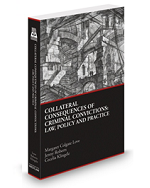
Below is another excerpt from the second edition of Love, Roberts & Klingele, Collateral Consequences of Criminal Conviction: Law, Policy & Practice (West/NACDL, 2d ed. 2015)(forthcoming), this one about challenges to firearms-related collateral consequences based on the constitutional right to bear arms.  Criminal defense lawyers representing clients on felon-in-possession charges, and anyone seeking restoration of firearms rights after conviction, will be interested to know that the government has appealed the district court’s decision in Binderup v. Holder cited in note 8, discussed here a few weeks ago. Binderup is a civil rights action in which the federal court in the Eastern District of Pennsylvania held that the federal felon-in-possession statute could not constitutionally be applied to an individual convicted of a non-violent sex offense in 1998 and sentenced to probation.  This case, the first in which a federal court invalidated a federal statute on Second Amendment grounds, is likely to provide an early opportunity for the court of appeals to consider an issue that most commentators and some courts believe was left unresolved by the Supreme Court in D.C. v. Heller.

Read more