Category: Advocacy Groups

Taking a bite out of Apple’s restrictive hiring policies


Apple, maker of the iPhone and iPad, came under fire earlier this month when the San Francisco Chronicle revealed that the company was prohibiting those convicted of a felony in the last 7 years from working on the construction of an enormous new corporate campus in Cupertino, California.  Under pressure from the iron workers union and advocates for fair hiring policies, the company quickly reversed course:

We recognize that this may have excluded some people who deserve a second chance. We have now removed that restriction and instructed our contractors on the project to evaluate all applicants equally, on a case-by-case basis, as we would for any role at Apple.

But many believe that Apple can do more to end employment discrimination against those with criminal records and can set an example for the tech industry and the country in the process.

Read more

Federal fair chance hiring proposal advances

The following note was received today from the National Employment Law Project:

We wanted to report back on the exciting progress in support of the federal fair chance hiring initiative, which builds on the momentum from the sign-on letter to the President that your organizations endorsed.

On March 25th, representatives from NELP, All of Us or None, PICO National Network and the Southern Coalition for Social Justice met with White House and Labor Department officials to present the letter signed by nearly 200 organizations and urge immediate federal action.  The news about the sign-on letter and the White House meeting was covered in an excellent exclusive that appeared in Politico (check it out) the day of the meeting.  The sign-on letter was also featured in an op-ed by a Florida small business owner (and a member of our partners at the Main Street Alliance) in The Guardian, in an NNPA syndicated story picked up by several news outlets, as well as in a National Law Review story.

In addition, thanks to the active engagement of your organizations, the social media around the initiative is also picking up steam. The Facebook image (attached) produced over 60,000 views, and it was shared by nearly 1,000 people.  During the one-hour “tweet storm” on the 25th, there were 250 unique tweets using the #FairChance or #BanTheBox hashtags (a special shout out goes to Danny Glover, whose tweet led the way with most retweets).  In just a few short months, we’re building a serious social media following thanks again to all of you.

Based on the feedback we received at the meetings on the 25th, all the support from your organizations, the press and the social media is getting the Administration’s attention – they have made clear that they are taking a serious look at the proposal to issue an Executive Order and Presidential Memo to extend fair chance hiring/ban the box to federal contractors and the federal hiring process.   Now, it’s all about  continuing to build the grassroots and public pressure to move the Administration to act.  Your continued active involvement is critical to the success of the effort.

On another positive note, we wanted to also share the news that Virginia Governor McAuliffe issued a strong executive order today extending fair chance hiring to all state positions (and urging the private sector to do the same).  McAuliffe’s action got the attention of Valerie Jarrett, President Obama’s Senior Advisor, who tweeted out her support using the #BantheBox hashtag.  Please take minute to retweet it as well.

Thanks again everyone for all your amazing support! We’ll be in touch soon with more details and next steps.

Best,
Maurice

Maurice Emsellem, Director
Access and Opportunity Program
National Employment Law Project
(510) 663-5700

New York Times weighs in on college applications and criminal records

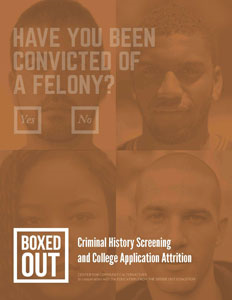
BoxedOut.untitledThe New York Times has published an editorial about the recently issued report of the Center for Community Alternatives on the deterrent effect of questions about criminal records on applications for admission to the State University of New York.  (See the piece about the report “Boxed Out: Criminal History Screening and College Attrition” by CCA Director Alan Rosenthal published in this space 10 days ago.)  The editorial notes that the 24 campuses of the CUNY system do not include “the box” asking about criminal record on their application forms and have reported no safety issues as a result.  Perhaps this will be one of those rare cases where effective public advocacy highlighted in editorial pages will actually have a concrete result.

Read more

Wisconsin attorneys volunteer to help students facing expulsion

raceclassExpulsion or suspension from school, not surprisingly, does not bode well for academic success.  Students are much less likely to graduate when they miss significant time in school or have to change schools because they have been suspended or expelled.

Incidents at school can have other serious and lasting consequences.  In Wisconsin, because 17-year-olds are considered adults when charged with criminal violations, high school students can face probation, jail, or prison, as well as all the adverse collateral consequences associated with a criminal record.  One serious consequence unique to students is that alleged misconduct in school can also result in a suspension or expulsion from school.

Read more

Federal agencies urged to adopt fair hiring policies

PresSealThe National Employment Law Project (NELP) has published a white paper urging the federal government to increase its own employment of people with a criminal record.  In “Advancing a Federal Fair Chance Hiring Agenda,” Maurice Emsellem and Michelle Natividad Rodriguez make a strong case for a federal “fair chance” hiring initiative similar to the ones put in place by state and municipal governments across the country.  Specifically, background check policies and suitability standards should be reformed by presidential order to give people with criminal records an opportunity to compete for jobs with federal agencies and federal contractors from which they are now, as a practical matter, excluded.

The NELP paper points out that the federal workforce is far more decentralized than a standard civil service structure, with fewer mandated protections regulating the hiring process.  Notwithstanding OPM guidelines, federal agencies have broad discretion to adopt their own hiring policies and practices, often with limited accountability and transparency. Indeed, the EEOC has been critical of the fact that federal agencies are not bound by the same suitability standards that apply to most other public and private employers.  Moreover, federal contractor employees (an astonishing 22 percent of the U.S. workforce) enjoy few legal protections, and applicants may be rejected (or employees dismissed) on the basis of stringent FBI background check requirements that apply, inter alia, to anyone with routine access to federal facilities.  These shortcomings could be addressed with the stroke of a presidential pen (or two strokes to be precise).

Read more