Misdemeanors and Class C felony convictions may be set aside three to five years after judgment or release, and non-violent Class B felonies may be set aside after seven years, provided in all cases that there has been no other conviction during the waiting period. Set-aside restores all rights, relieves all disabilities, and seals the record. Sealing is also available for pardoned convictions, human trafficking victims convicted of prostitution, and marijuana possession convictions. Deferred adjudication in drug cases, first misdemeanor PBJ. Set-aside of non-conviction records is available 60 days after arrest if no charges filed, or any time after an acquittal or dismissal, with prior record exclusions repealed in 2021. Juvenile records may be expunged upon reaching age 18 after a 5-year waiting period if the person has no subsequent convictions of a felony or Class A misdemeanor and no charges are pending. Juvenile records ineligible for expungement may be eligible for set-aside and sealing.
Subscribe to Blog via Email
Restoration of Rights Project (RRP)
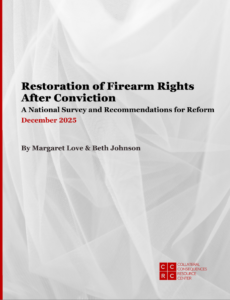
Restoration of Firearm Rights After Conviction: A National Survey and Recommendations for Reform (Dec. 2025)
50-state comparisons
About the Restoration of Rights Project
The Restoration of Rights Project (RRP) is a project of the Collateral Consequences Resource Center in partnership with the National Association of Criminal Defense Lawyers, National Legal Aid & Defender Association, National HIRE Network, Association of Prosecuting Attorneys, and Paper Prisons Initiative. Launched in 2017, the RRP is an online resource containing detailed state-by-state analyses of the law and practice in each U.S. jurisdiction relating to restoration of rights and status following arrest or conviction. Jurisdictional “profiles” cover areas such as loss and restoration of civil rights and firearms rights, judicial and executive mechanisms for avoiding or mitigating collateral consequences, and provisions addressing non-discrimination in employment, licensing, and housing. In addition to the jurisdictional profiles, RRP materials include a set of 50-state comparison charts that make it possible to see national patterns in restoration laws and policies. Short “postcard” summaries of the law in each state serve as a gateway to the more detailed information in the profiles, and provide a snapshot of applicable law in each state.
Originally published in 2006 by CCRC Executive Director Margaret Love, the research in the RRP has been kept up to date and substantially expanded over the years, and it is summarized in an appendix to the treatise on collateral consequences published jointly by NACDL and Thompson Reuters (West). It is intended as a resource for practitioners in all phases of the criminal justice system, for courts, for civil practitioners assisting clients whose court-imposed sentence has exposed them to additional civil penalties, for policymakers and advocates interested in reentry and reintegration of convicted persons, and for the millions of Americans with a criminal record who are seeking to put their past behind them.
These resources may be republished as long as appropriate attribution is given to the RRP as its source.