Tag: Wayne Logan

New collection of research on sex offense registration

Cambridge University Press has just published a new book, edited by Professors Wayne A. Logan and J.J. Prescott, containing chapters from the nation’s leading social science researchers on the many important empirical questions surrounding sex offense registration and community notification (SORN).  Since SORN’s origin in the early 1990s, basic questions have existed regarding its effects, including whether it actually achieves its intended purpose of reducing sexual offending. SORN surely numbers among the most significant social control methods of the past several decades.  Although the Supreme Court in 2003 rejected two constitutional challenges to SORN laws (Connecticut Dept. of Public Safety v. Doe and Smith v. Doe), of late courts, including the Sixth Circuit Court of Appeals (Does v. Snyder, 2016), have cast a more critical eye, invalidating new generation SORN laws that have become more onerous and expansive in their reach. An updated review of caselaw from Professor Logan on SORN and other collateral consequences triggered primarily by sex offenses will be included in the forthcoming fourth edition of Love, Roberts & Logan, Collateral Consequences of Arrest & Conviction: Law Policy & Practice (West/NACDL, 4th ed. 2021). Also, as readers might be aware, the American Law Institute, as part of […]

Read more

New edition of collateral consequences treatise now available

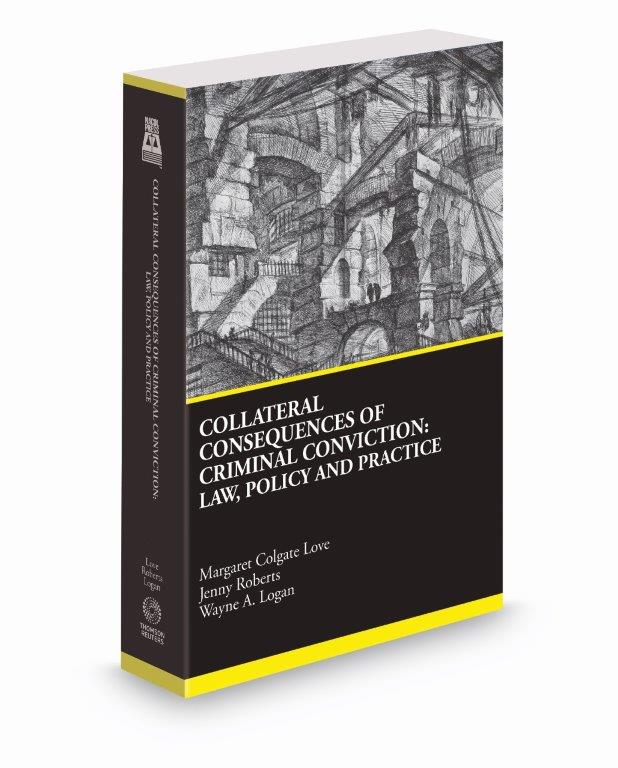
The 2018-2019 edition of the West/NACDL treatise on collateral consequences is now available for purchase, at a publisher’s promotional discount. Wayne A. Logan has joined Margaret Love and Jenny Roberts as a co-author of this comprehensive resource: Collateral Consequences of Criminal Conviction: Law, Policy & Practice. This third edition of the treatise has been entirely updated, and includes new material on regulation of criminal background checking; consideration of collateral consequences in the criminal case; laws providing for restoration of rights and status, including in employment and occupational licensing; and, recent court decisions on sex offender registration and related penalties.  Appendices include detailed state-by-state analysis of restoration laws, and other primary source materials.  The full table of contents for this 1048-page book is available here.  The publisher describes the book as follows:  Today, many millions of Americans have a criminal record of some kind, potentially triggering a vast array of highly burdensome and stigmatizing consequences that can have life-long debilitating effects. This volume provides comprehensive discussion and analysis of these after-effects of the nation’s ongoing “tough on crime” policies, ranging from loss of civil rights and employment opportunities, to registration and residency restrictions.  It serves as a single go-to resource for practicing […]

Read more

Relief from sex offender registration and notification requirements

Update (5/14/15): We have published a 50 state chart detailing relief from registration requirements on the Restoration of Rights page. The chart is based in part on Wayne Logan’s work. You can find the chart at this link.   Wayne Logan has summarized his research on relief from sex offender registration and community notification requirements for a forthcoming Wisconsin Law Review article in an excerpt from the second edition of Love, Roberts & Klingele, Collateral Consequences of Criminal Conviction: Law, Policy & Practice (West/NACDL, 2d ed. 2015)(forthcoming). This is the first of many tidbits from the book that will appear in this space from time to time: 2:42. Sex offense-related collateral consequences — Constitutional challenges to registration and community notification laws:  post-application challenges Given the extended potential duration of registration and community notification (RCN) application, ranging from ten years to life, the question naturally arises over whether relief from its requirements and burdens can be attained at some point. While the federal Adam Walsh Act allows states to provide relief to registrants with a “clean record” for ten years,[1] states typically afford only very limited opportunity to registrants to exit registries. South Carolina is most limited, offering no opportunity to petition for relief from […]

Read more