Tag: travel

Sex offender passport law survives challenge

A federal judge in San Francisco has dismissed a constitutional challenge to the recently enacted International Megan’s Law, which requires specially-marked passports for registered sex offenders whose offenses involved child victims, and authorizes notification to foreign governments when they travel.  The so-called “Scarlet Letter” law is specifically aimed at stopping child sex trafficking and sex tourism, and this purpose was evidently enough to justify it even though it has a far broader effect. In her September 23 ruling, Judge Phyllis J. Hamilton, chief judge of the Northern District of California, found that the suit was premature since the law has not yet been fully implemented, reiterating her reasoning in denying preliminary relief last spring.  But Judge Hamilton also reached out to decide the constitutional claims raised by the plaintiffs, finding each of them without merit in light of the governmental interest at stake. At the same time, Judge Hamilton stressed that the plaintiffs had challenged the law on its face, leaving open the possibility of successful challenges to its application in specific cases down the line.  In his analysis of the decision at Reason.com, Jacob Sullum suggests what such an as-applied challenge might look like: The law covers many such offenders, including streakers, public urinators, teenagers who have consensual sex with other teenagers, and even teenagers who take nude pictures of themselves. The passport and notification provisions apply decades after the offense, whether or not the offender currently poses a threat, and notification applies even to offenders who are no longer required to register. One of the plaintiffs, who “routinely travels to Europe and Asia for business purposes,” was convicted 25 years ago. Another plaintiff, who committed a crime minor enough that he was sentenced only to probation and was initially told he would not have to register as a sex offender, will nevertheless have to carry a special passport. A third plaintiff had his 1998 conviction expunged, was reinstated as a lawyer, and is no longer listed in California’s registry but is still covered by the IML’s notification provision. Applying the law to such individuals may seem irrational and cruel, but a facial challenge is not concerned with individual instances of injustice: Stigmatizing these men as a threat to children everywhere for the rest of their lives may seem irrational, but that does not mean it fails the rational basis test. “Under rational basis review,” Hamilton explains, “a law ‘may be overinclusive, underinclusive, illogical, and unscientific and yet pass constitutional muster.'” Even if the IML is poorly designed to achieve its ostensible goal, Congress says it will protect children, and that’s rational enough for government work. It remains to be seen how the law will be implemented, and whether relief or waiver provisions will be included to avoid problems of overbreadth.       Read more

Challenge to “Scarlet Letter” travel law moves forward

Last week a federal judge heard the first arguments in a lawsuit challenging certain provisions of the recently-enacted International Megan’s Law (IML),* including one mandating that the passport of any American required to register for a sex offense involving a minor be marked in “a conspicuous location” with a “unique identifier” of their sex offender status.  Other challenged provisions of the law authorize the Departments of Homeland Security and Justice to notify destination nations of forthcoming visits from those individuals. On Wednesday the court heard a motion for a preliminary injunction that would block enforcement of the challenged provisions of the law pending the suit’s final outcome. See Doe v. Kerry, Case 3:16-cv-00654 (N.D. Ca.). As the Wall Street Journal reported, The lawsuit’s plaintiffs say the law violates the U.S. Constitution by forcing people convicted of sex offenses to bear the equivalent of a “proverbial Scarlet Letter” on their passports. The First Amendment limits what the government can compel people to divulge. The complaint asks a federal judge to strike down the law as unconstitutional. The suit, filed in early February, also claims that the law violates the Fifth Amendment’s due process protections and the Constitution’s Equal Protection and Ex Post Facto Clauses. As stated in the complaint, the IML imposes significant burdens on the rights and protected liberty interests of Covered Individuals, including the right to international travel, the right to associate with family, economic liberty, and equal protection. Further, the IML stigmatizes Covered Individuals in a manner that substantially infringes on their protected liberty interests by communicating that Covered Individuals pose a current risk to public safety because they are engaged in, or at risk of engaging in, international child sex trafficking. Ostensibly, the IML is meant to curtail international child sex trafficking and sex tourism, but it will undoubtedly effect a huge number of Americans who pose little or no risk of engaging in such activity. From the Journal: The law, signed by President Barack Obama on Feb. 7, could cover a wide swath of offenders, including people convicted of misdemeanor offenses such as “sexting” with a minor, according to the lawsuit, which identifies the seven plaintiffs by the pseudonym John Doe. …. International Megan’s Law doesn’t allow for offenders who states have deemed rehabilitated, or who have had their records expunged to have the passport mark removed, according to [the plaintiffs’ attorney]. Nor does it exempt those who were minors at the time of their offense. Nicole Pittman, director of the Impact Justice Center on Youth Registration Reform, an Oakland, Calif., group pushing to eliminate the practice of placing children on sex-offender registries, said about [200,000] of the roughly 850,000 people registered as sex offenders in the U.S. were under the age of 18 when they were convicted or adjudicated in juvenile court. “This is supposed to protect kids and we’re actually hurting them,” Ms. Pittman said of International Megan’s Law. “We have kids going on the registry for sending nude pictures of themselves.” The Journal reports that many American sex offenders have been subjected to a similar “travel blacklist” for nearly a decade under an Immigration and Customs Enforcement (ICE) program called Operation Angel Watch: U.S. Immigration and Customs Enforcement agents launched Angel Watch as a pilot program in California in 2007. Under the program, ICE shares publicly available information from U.S. sex-offender registries with its foreign counterparts “to utilize as they deem appropriate,” according to a summary of the program turned over in response to a Freedom of Information Act request. [The federal Adam Walsh Child Protection and Safety Act of 2006] requires registered sex offenders to notify local law-enforcement authorities of their plans to travel abroad at least 21 days in advance. In fiscal 2014, ICE sent 2,291 notifications to authorities in more than 120 countries, up from 637 alerts in 2012, the summary shows. Mexico accounted for more than half of the Angel Watch notices in 2014, while the Philippines, the next highest, received about 15%, according to the summary. Nearly 500 of the travelers flagged by Angel Watch were denied entry into their destination country that year, the documents show. The IML essentially codifies and expands upon the existing “Angel Watch” program.  From the Journal: Homeland Security officials and lawmakers said the International Megan’s Law would bolster the program. “The countries of destination lack sufficient resources to deal with the rising number of child predators,” Rep. Ed Royce, (R., Calif.) chairman of the House Foreign Affairs Committee, said while introducing the bill in January. The passport identifier requirement is a major expansion of the pre-existing policy, and one that has no precedent under U.S. law, according to the complaint: “For the first time in the history of the United States, American citizens will be forced by the government to label and stigmatize themselves on a document foundational to citizenship.” Regardless of the ILM’s constitutionality or desirability, the fact that such a sweeping law was ushered through Congress with little debate and no real opposition is indicative of the the unique stigma reserved for those that the law brands as “sex offenders.”  That the President was willing to sign such constitutionally problematic legislation speaks volumes about his disposition to pick a fight at this stage of his presidency. A ruling on the motion for a preliminary injunction has not yet been issued. We will continue to provide updates as the litigation moves forward. The plaintiffs’ complaint is available here and links to additional commentary are listed below. International Megan’s Law: America’s Global Embarrassment (Huffington Post) An important step to reduce child sex tourism (Rep. Chris Smith (R – N.J.), sponsor; Washington Post) The yellow star, the scarlet letter, and ‘International Megan’s Law’ (Volokh Conspiracy) Do sex offenders deserve a scarlet letter on their passport? (L.A. Times)       *The law’s full title is “International Megan’s Law to Prevent Child Exploitation and Other Sexual Crimes Through Advanced Notification of Traveling Sex Offenders” Read more

Mexico vacations out for sex offenders?

It appears that Mexico has inaugurated a policy of refusing entry to anyone registered in the United States as a sex offender.  While no formal policy has been announced, the body of anecdotal evidence supporting the existence of an informal policy is growing.  In numerous internet postings, vacationers report being turned back at the border or forced to take the next plane home, leaving their families behind.  There is no indication that people with other convictions are being similarly excluded.  The Mexican government’s new policy has been made technologically feasible by new federal data-sharing policies, including the Dru Sjodin National Sex Offender website maintained by the Justice Department’s SMART Office. Members of the public may now do a free national search of all state sex offender registries, as well as all registries maintained in Indian country.  We will continue to monitor this situation, and watch for reports about exclusionary policies from other countries. Read more

International travel restrictions based on criminal record
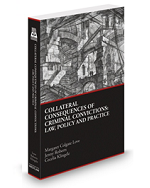
Below is another excerpt from the second edition of Love, Roberts & Klingele, Collateral Consequences of Criminal Conviction: Law, Policy & Practice (West/NACDL, 2d ed. 2015)(forthcoming), this one about restrictions on international travel based on criminal record.  The first section discusses the subject in general terms, while the second section describes restrictions on travel to Canada for individuals with a foreign conviction, and the methods of overcoming these restrictions.  (An earlier post described methods of neutralizing Canadian convictions for purposes of travel to the U.S.) 2:61. International travel restrictions — In general* A conviction can restrict a U.S. citizen’s freedom to travel outside the United States in several ways. First, domestic laws revoke passports for individuals convicted of designated offenses. When a person is convicted of a felony drug offense for conduct that involved international travel, for example, his passport will be revoked under federal law[1]. The revocation period lasts for the full duration of the sentence imposed for the drug offense[2]. Persons with a felony conviction ordinarily will not qualify for “trusted traveler” programs operated by U.S. Customs and Border Protection, such as the Global Entry program (“expedited clearance for pre-approved, low-risk travelers upon arrival in the United States”), or the NEXUS, SENTRI and FAST programs (pre-cleared personal and commercial travel across the U.S. borders with Canada and Mexico).[3]  All applicants for these programs “undergo a rigorous background check and interview before enrollment.”  Ironically, in light of the stated purpose of these programs to expedite international travel, persons who apply and are rejected based on criminal history may find themselves routinely selected for further examination when entering the United States. Foreign laws may also restrict the travel of individuals convicted in U.S. courts.   Some countries, most notably Canada, prohibit individuals convicted of certain offenses from entry.[4]  However, countries that only require travelers to present their passport for admission generally do not screen for a criminal record.  Canada is a special case, as the Canada Border Services Agency (CBSA) border agents have access to the National Crime Information Center (NCIC) database, using the traveler’s passport, which allows them to see any conviction going back to a traveler’s 18th birthday.[5] Other countries do not have immediate access to the NCIC database, which means that this issue only arises if the individual is applying for a visa to visit, work, study, or immigrate.  On visa applications, there is usually a question regarding criminal convictions and arrests, and failure to answer truthfully may have serious consequences.  U.S. citizens may also be asked to present a “certificate of good conduct” or “lack of a criminal record” for a variety of reasons for use abroad including adoption, school attendance, or employment.[6] Some countries do not automatically exclude individuals with prior convictions from entry but require certain convicted individuals to apply to the country for pre-clearance prior to travel.[7]  Individuals with criminal records who wish to travel internationally should first contact the local U.S. embassy of the nation they wish to visit for up-to-date information about the nation’s policies regarding admission.   2:62. International travel restrictions – Canada Before travelling to Canada, individuals with a criminal history should verify their entry status, since even seemingly minor offenses may render an individual inadmissible to Canada. The Canadian Immigration and Refugee Protection Act (IRPA)[8] states that a foreign national may be inadmissible on the grounds of criminality if convicted outside of Canada of an offense that, if committed in Canada, would constitute an “indictable offense” under an Act of Parliament.[9]  Thus, simply, any offense committed outside of Canada that would be considered indictable in Canada results in criminal inadmissibility. Any offense that could be treated as either summary or indictable is known as a hybrid offense. Hybrid offenses, a majority of the offenses in the Canadian criminal code, are considered to be indictable offenses for the purposes of Canadian immigration.  Summary offenses do not result in inadmissibility.[10] A significant part of the application process to overcome inadmissibility is determining the equivalence of foreign offenses with Canadian offenses.  It does not matter how lightly or severely a given crime is treated in the country where it occurred, or whether it is styled as a felony or misdemeanor.  Thus, a misdemeanor under U.S. law may render an individual inadmissible to Canada while someone with a felony conviction may not be inadmissible.[11]  In some cases it is possible to argue non-equivalence or equivalence to a minor offense to circumvent the inadmissibility regulations and allow the individual to enter without applying for permission. Once the equivalence has been established, it is important to determine the maximum authorized sentence under Canadian law, which will be relevant to determining the cost and likelihood of success when applying for relief from criminal inadmissibility.  Offenses that carry a maximum sentence of 10 years or more under Canadian law are considered serious criminality and relief is more difficult to obtain.  Non-serious criminality is a conviction for an offense with a maximum sentence of less than 10 years. The processing times and fees for applications involving non-serious criminality are less. When a foreign conviction is determined to be an indictable offense under Canadian law, whether it will render the traveler inadmissible depends on several factors: How long ago the conviction occurred; The severity/nature of the offense in Canada; How many offenses the individual has been convicted of; and Whether the individual can demonstrate they are unlikely to reoffend.[12] If travelers can prove that they have not been convicted of an offense that would render them inadmissible because they have received a deferral or conditional discharge or because the offense has been expunged or pardoned, applying for relief is not required. Criminally inadmissible visitors to Canada may petition for a “Criminal Rehabilitation” from the Canadian consulate if at least 5 years have passed since the completion of their sentence, including payment of fines and completion of probation or parole.[13] If granted, such a document overcomes barriers to entry. If fewer than 5 years have passed, an individual with a significant economic or humanitarian & compassionate reason to travel to Canada may request a Temporary Resident Permit (TRP), to temporarily overcome inadmissibility.[14]  An individual who has only one non-serious conviction (conviction for an offense carrying a maximum sentence of less than 10 years under Canadian law) may also be “deemed rehabilitated”[15] if more than 10 years have passed from the completion of all conditions of their sentence (or five years in the case of two or more summary offenses).[16] Only a lawyer certified by one of the provincial bar associations in Canada, or a certified Canadian immigration consultant, is authorized to represent an individual in a Canadian immigration application, including Criminal Rehabilitation and TRP applications.[17]   * * * * * * * * * * * * * * * *   * The authors wish to thank Marisa Feil of Montreal, Canada, for her contributions to §§ 2:61 and 2:62. [1] 22 U.S. Code § 2714 (a) http://www.law.cornell.edu/uscode/text/22/2714 [2] 22 U.S. Code 2714 (c). [3] These programs are described at http://www.cbp.gov/travel/trusted-traveler-programs. [4] IRPA S.C. 2001, c.27 s.36(2). [5] http://www.cbsa-asfc.gc.ca/agency-agence/reports-rapports/pia-efvp/atip-aiprp/infosource-eng.html.  See § 2:62. [6] See http://travel.state.gov/content/passports/english/abroad/legal-matters/criminal-record-check.html. [7] In the United Kingdom, for example, individuals with criminal records are encouraged to seek entry clearance prior to travel. Clearance will ordinarily be denied for “conviction in any country including the United Kingdom of an offense which, if committed in the United Kingdom, is punishable with imprisonment for a term of twelve months or any greater punishment or, if committed outside the United Kingdom, would be so punishable if the conduct constituting the offense had occurred in the United Kingdom.” U.K. Imm. R. 320(18). [8] IRPA S.C. 2001, c.27 s.36(2)   http://laws-lois.justice.gc.ca/eng/acts/I-2.5/. [9] Immigration and Refugee Protection Act, SC 2001, c 27, s.36 http://laws-lois.justice.gc.ca/eng/acts/I-2.5/.  Canada does not use the misdemeanor/felony classification system; offenses in Canada are either summary or indictable offenses, depending on the authorized punishment. [10] Summary offenses under the Canadian Criminal code include Trespassing at Night, Causing a disturbance, or taking a motor vehicle without consent (not Theft of an automobile).  http://www.cic.gc.ca/english/resources/manuals/enf/enf02-eng.pdf [12] http://www.cba.org/cba/cle/PDF/IMM11_Sedai_ENF14%20%282008-04-21%29.pdf. [13] IRPA S.C. 2001, c.27 s..36(3).  The application for Criminal Rehabilitation is available with instructions at http://www.cic.gc.ca/english/information/applications/rehabil.asp. [14] http://www.cic.gc.ca/english/information/inadmissibility/permits.asp. [15] Immigration and Refugee Protection Act, SC 2001, c 27 s. 18(2). [16] http://www.cic.gc.ca/english/information/inadmissibility/rehabilitation.asp. [17] http://www.cic.gc.ca/english/information/representative/rep-who.asp.  The penalty for a receiving compensation on this type of application by an unauthorized representative is a fine of up to $100,000. http://news.gc.ca/web/article-en.do?nid=824719. Read more