Tag: Stanford

“Trump’s Theater of Pardoning”

The piece reprinted below is the first part of Bernadette Meyler’s contribution to a Symposium published by the Stanford Law Review on her book Theaters of Pardoning. It is as cogent a guide to understanding President Trump’s pardoning practices, and how they differ from those of his predecessors, as anything else we have seen. If, as Prof. Meyler argues, the message sent by Trump’s pardons is “the rejection of law,” it would be ironic (though entirely welcome) if they prompted Congress to reroute into the legal system much of the business heretofore committed exclusively to presidential pardoning, notably relief from the collateral consequences of a federal conviction. Then presidents could pardon to their heart’s delight, without worrying about the inherent unfairness of their actions. “Trump’s Theater of Pardoning” by Bernadette Meyler Introduction In many ways, President Trump has returned to a performance of pardoning more familiar to early modern England than to contemporary America. Largely eschewing bureaucratic processes, Trump has taken advantage of the political theater that pardoning can provide. Like some of the real-life and fictional kings who appear in my book, Theaters of Pardoning, Trump has also called law and legal regimes into question through his pardons, and, in doing so, asserted his own impunity from law. Ignoring the common law restrictions that had accreted around pardoning, Trump has chosen to interpret his power as absolute, unfettered by norms like refraining from judging in one’s own case and forgiving but not forgetting. And this is only the story of Trump’s formal pardons. As Kenji Yoshino’s essay in this Symposium elaborates, Trump’s numerous revisions of history represent even more pervasive efforts at enacting amnesty and oblivion. Pardoning as Political Theater Within Anglo-American history, pardoning has adopted two contrasting forms: one routine and bureaucratic, happening without fanfare, and the other dramatic and subject to popular critique, acclaim, and discussion.[1] Several factors distinguish the two varieties of pardoning, including the process by which a decision to pardon is made, the prominence of the pardoner as a figure within the pardon, and the public reception of the pardon. During the past century, the bureaucratic pardon in America has come to be associated on the federal level with the Office of the Pardon Attorney, which has reviewed pardon applications since the late nineteenth century.[2] In recent decades, presidents have overwhelmingly relied on the recommendations of the Office in determining whether or not to grant pardons.[3] Not so with Donald Trump. Instead, President Trump has revitalized the theatrical version of pardoning that had seemed to atrophy under his predecessors. As Robert Weisberg observes in his essay for this Symposium, many have noted this theatricality in passing, and, in the words of the Los Angeles Times editorial board, “It’s as if he were still starring on a reality TV show that ended every week with a climactic ‘You’re pardoned!’”[4] It is instructive, however, to return to early modernity—including, as Peter Brooks’s contribution to this Symposium demonstrates, European as well as English contexts—to understand the characteristics and significance of theatrical pardoning.[5] Within that context, pardoning represented “one of the marks of sovereignty,” or a supreme power above the law, and often served to aggrandize the majesty of the King rather than simply omitting punishment for an offender.[6] Oftentimes, the pardon wasn’t deserved; the recipient had not reformed or repented, and the pardon, whether taking place on the political or theatrical stage, served not justice but the plot.[7] The timing of the pardon was also crucial; in plays, and sometimes in life, it arrived unexpectedly to shift the scene from tragedy to comedy.[8] And the theater involved was sometimes of the page rather than the stage.[9] Finally, the impact of the performance was not localized with the event but reverberated long afterwards through controversy among the audience and citizenry.[10] President Trump’s pardons revive many of these elements. While he has pardoned the fewest people of any recent president during his first three years in office, public discussion of and controversy over his pardons have outstripped those of any modern president.[11] Rather than continuing in the vein of bureaucratic pardoning produced by the work of the Office of the Pardon Attorney, Trump has instead appeared to select the vast majority of pardon recipients because of their celebrity, his personal connection with them, political ties, or the nature of the law under which they were convicted.[12] As Robert Weisberg elaborates upon the aesthetics of these pardons, Trump has extended his status “as emperor of his shows” on reality TV, where he “made subjective choices of winners and losers,” to his role as a presidential “disruptor of rules and norms of government,” through, among other devices, pardoning.[13] In all of these pardons, Trump himself has been front and center and the pardon has served to aggrandize his own power. Comparing the textual form of President Trump’s pardons with those of President Obama visually demonstrates the prominence of Trump and his own power within his clemency grants. President Obama generally pardoned multiple people at a time, prefacing the enumeration of their names with a statement of the processes that led to these pardons, and delegated the power to sign specific clemency grants to the Pardon Attorney.[14] By contrast, Trump has announced most of his pardons individually and emphasized his own actions by placing his name in enormous bold letters at the beginning of the document then specifically referring to his constitutional power.[15] In this case, the document furnishes a striking performance of Trump’s exercise of sovereignty through pardoning. In the aftermath of pardoning, Trump has also integrated pardon recipients into his own public performance, highlighting the significance of the pardon as prospective and legal rather than retrospective and pertaining to culpability. Most recently, he staged an appearance of the military officers he had pardoned of war crimes at his own fundraising event.[16] President Trump’s performance of pardoning has exalted himself over both pardon recipients and the rule of law. The theatrical foregrounding of pardoning within Trump’s regime stages pardoning as a personal and sovereign decision rather than an outcome of routine or bureaucratic processes. The result is an emphasis on Trump himself and his decisions about what is or is not properly sanctioned. The visibility of the theatrical pardon conveys a message, and that message is, as the following Part discusses, the rejection of law. Pardoning as a Rejection of Law Continued here. [1] See Bernadette Meyler, Theaters of Pardoning 3 (2019); see also Jim Phillips, The Operation of the Royal Pardon in Nova Scotia, 1749-1815, 42 U. Toronto L.J. 401, 414-21 (1992) (emphasizing the theatrical aspects of the pardon process in Nova Scotia and their political importance in contrast with earlier arguments for the exclusively legal and bureaucratic functions of pardoning). [2] For a discussion of the history of the Office of the Pardon Attorney, see Jeffrey Crouch, The Presidential Pardon Power 21-23 (2009). Rachel Barkow has associated that office with an endorsement of administrative procedures over the President’s independent power to exercise mercy, arguing that “[t]hose attacking clemency are . . . using key administrative law concepts to frame their critiques.” Rachel E. Barkow, Essay, The Ascent of the Administrative State and the Demise of Mercy, 121 Harv. L. Rev. 1332, 1350 (2008). [3] Crouch, supra note 2, at 21. [4] Editorial, Trump Is Politicizing (and Personalizing) the Pardon Process, L.A. Times (May 18, 2019, 3:10 AM), https://perma.cc/8V8T-7FS4; see also Robert Weisberg, The Drama of the Pardon, the Aesthetics of Governing and Judging, 72 Stan. L. Rev. Online 80 (2020). [5] Peter Brooks, The Ends of Pardoning, 72 Stan. L. Rev. Online 73 (2020). [6]  Meyler, supra note 1, at 82-84, 262-67. [7] See id. at 16, 36-43. [8] Id. at 20-25. In Peter Brooks’s words, the “moment of pardoning” in the final act of Pierre Corneille’s Cinna, ou la clémence, “irrupts into the play as a kind of gratuitous gesture of the sovereign.” Brooks, supra note 5, at 76. [9] See, for example, Michel Foucault’s mention of the letter of pardon, discussed in Meyler, supra note 1, at 15. When researching images for the cover of my book, I realized how few artistic renderings of pardon scenes exist from even the most popular Shakespeare plays. This may reflect the fact that the pardon itself is not as visually arresting as the events leading up to it or the pardon’s reception and aftermath. [10] Meyler, supra note 1, at 6-13. As Robert Weisberg describes this phenomenon, in his essay for this Symposium, “[t]he pardons are anticlimaxes that disrupt the usual expectations.” Weisberg, supra note 4, at 83. [11] Although President Obama commuted many sentences, primarily in drug cases, he did not grant that many outright pardons, fitting within the trend of diminishing presidential pardons. See Margaret Colgate Love, Obama’s Clemency Legacy: An Assessment, 29 Fed. Sent. R. 271, 272 (2017) (“The 142 pardons granted in the final weeks of his term, more than twice the total number granted in the previous seven-plus years, enabled Obama to avoid being labeled the stingiest full-term president in history.”). Trump has been even more sparing of his pardon power if one looks numerically at the tally. As of February 21, 2020, he has granted a total of twenty-five pardons. Pardons Granted by President Donald Trump, U.S. Dep’t of Justice, https://perma.cc/QXW8-CKBE (last updated Feb. 19, 2020). At the same time, media attention has focused extensively on his use of the pardon power, already resulting in over 100 articles and op-eds in mainstream media by my count. Jeffrey Crouch has even credited Trump with “single-handedly reinvigorat[ing] the clemency power” due to the prominence of his pardons. Jeffrey Crouch, President Donald J. Trump and the Clemency Power: Is Claiming “Unfair” Treatment for Pardon Recipients the New “Fake News”?, in Presidential Leadership and the Trump Presidency: Executive Power and Democratic Government 91, 91 (Charles M. Lamb & Jacob R. Neiheisel eds., 2020). [12] For articles suggesting these motivations, see Crouch, supra note 11, at 91-92; Kevin Liptak, Trump’s Pardons Appear Prompted by TV, Friends and Politics, CNN (May 21, 2019, 7:53 AM ET), https://perma.cc/FR3Z-GGQ5. [13] Weisberg, supra note 4, at 80. [14] See, e.g., Exec. Office of the President, Executive Grant of Clemency (Jan. 17, 2017) https://perma.cc/7PQG-FANA (“After considering the applications for executive clemency of the following named persons and a letter from the Department of Justice recommending executive clemency in each case, I hereby grant full and unconditional pardons to the following named persons for those offenses against the United States described in each such recommendation . . . .”). [15] Exec. Office of the President, Executive Grant of Clemency of Joseph M. Arpaio (Aug. 25, 2017), https://perma.cc/L9CA-6TJ6 (“Donald J. Trump, President of the United States of America, To all to whom these presents shall come, greeting: Be it known that this day, I, Donald J. Trump, President of the United States, pursuant to my powers under Article II, section 2, clause 1 of the Constitution, have granted unto . . . .”). [16] Maggie Haberman, Trump Brings 2 Officers He Cleared of War Crimes Onstage at Fund-Raiser, N.Y. Times (Dec. 8, 2019), https://perma.cc/B5PX-TSVY. Read more

“Divergent moral vision” — Collateral consequences in Europe and the U.S.

A new article in the Stanford Law Review discusses the radically different forms of punishment in the United States and Europe, which its author attributes at least in part to differing moral visions of wrongdoing and wrongdoers.  In Two Cultures of Punishment, Joshua Kleinfeld argues that while Americans tend to regard serious offenders as “morally deformed people rather than ordinary people who have committed crimes,” European cultures “affirm even the worst offenders’ claims to social membership and rights.” Kleinfeld illustrates this “divergent moral vision” by the very different approach European countries take to collateral consequences. (The other two areas discussed in the article are lengthy prison terms and capital punishment).  Whereas in this country people convicted of crime are subject to a lifetime of legal restrictions and social stigma analogous to older forms of civil death, and are effectively consigned to a kind of “internal exile,” in Europe people who have committed a crime benefit from numerous measures to encourage their reintegration. . . . . Superficially, there is not much to say: European countries simply do not impose collateral consequences at all in the vast majority of cases and never impose them on anything like the American scale. But at a deeper level, the issue is not just whether Europe imposes some analogue to civil death, but how Europe handles the terms of prisoner reentry. And when that is the question, the answer turns out to be that Europe engages in various measures that amount to the opposite of civil death—measures designed affirmatively to restore offenders to full social membership. The article illustrates this with specific examples from German, Italian and French law. Germany is a good example. The German Code of Punishment Practice has a statutory requirement of Angleichungsgrundsatz—“the principle of approximation”—which “holds that prison life must resemble as closely as possible life in the outside world.” . . . . . After release, German criminals have a network of rights meant to promote their integration with and membership in ordinary German society. Perhaps most astonishing from an American perspective is the right to have their criminal file destroyed, fingerprints and all. They also have substantial rights not to have their crimes publicized. . . . . In Germany, there are no sexual offender registries, to say the least. These practices are echoed in other European jurisdictions. The Italian criminal system aims to give prisoners some modicum of normalcy, with, for example, leaves for up to five days if a family member or spouse is near death and leaves of up to forty-five days per year for good behavior once a sufficient portion of the sentence has been served. Giving prisoners jobs is also seen as a rehabilitative tool in Italy, and prisoners must be paid at least two-thirds of the wages paid to workers outside of the prison. France, like Germany, has programs designed to encourage offenders to vote. The French penal code provides for “[r]ehabilitation . . . as of right” when an offender sentenced to ten years imprisonment or less does not commit any new offense for a sufficient period of time; the effect of this right is to “erase[] any incapacity or forfeiture resulting from a sentence.” Twenty-eight European countries allow either all or all but a handful of prisoners to vote. And in terms of prison conditions, where many of America’s prisons are essentially cages rife with gang violence and prison rape—a place to house those whom we hate or do not care about—European jurisdictions generally insist that their prisons be humane, and some actively aim to make prison personally enriching in a way designed to bring out the best in the prisoners. The article contrasts the “norms of full forgiveness on the European side and what might be called ‘residual criminality’ on the American.” The released criminal in America is a permanent suspect; that is what it means to have a “record.” The conceptual difference between forgiveness and residual criminality reflects two ways of looking at the imprisoned and then released offender. The criminal pictured in European practices is not a them, but one of us. Such people landed in prison, the thought goes, not because they have a deformed nature but because they did a poor job of managing ordinary life, and the solution is to have them live ordinary life under extra supervision. The criminal is not mismade but just poorly socialized. The criminal pictured in American practices is a person whose crime exposes the truth about his character: he is a criminal, and efforts to change that fact are so likely to fail that they are not worth bothering about in the first place. I see this conceptual distinction most vividly in my own law practice, where my clients are frequently decades away from a single minor criminal offense but continue to pay a heavy price in social ostracism and second class legal status.  A dated criminal record continues to dog them, barring them from certain professions, from obtaining loans and insurance, from entering into contracts, and even from coaching college sports.  Seen through the lens of reentry, collateral consequences may be justified based on some real or imagined public safety risk.  But there can be no such comforting excuse where the excluded person was sentenced decades ago and may never have spent a day in prison, and who in the intervening years, against all odds, has been a law-abiding and productive citizen. It is time America reconsidered the dysfunctional and unforgiving moral vision that turns a criminal record into a permanent Mark of Cain.  In some states legislators and governors are taking steps to help people overcome the malign effect of a criminal record, but in many others (including the federal system) there is no evident recognition of the issue beyond a superficial concern with avoiding further crime.  I remain ever hopeful that President Obama, who has commendably drawn the public’s attention to the moral issue of too-long prison sentences, will in his final months also speak to the moral issue of how we treat people who have fully paid their debt to society. Read more

Expanding college opportunities for prisoners in California

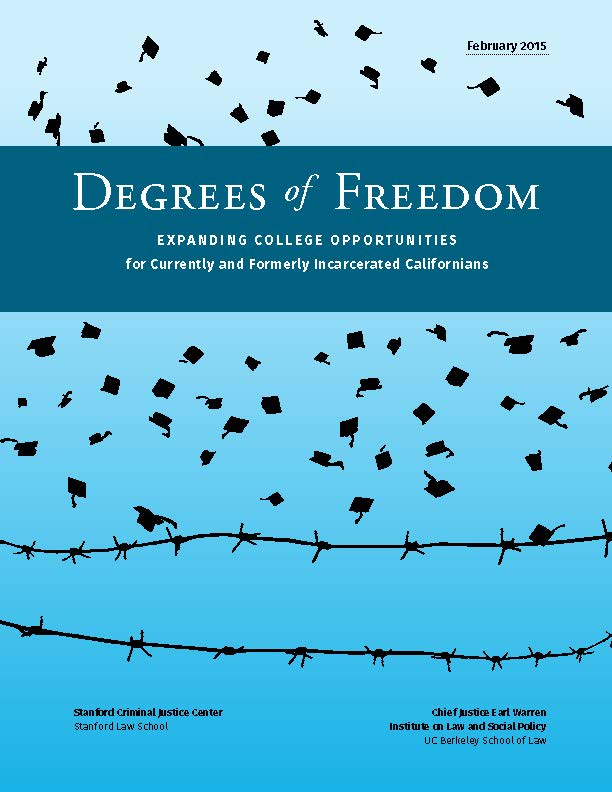
Last week was an exciting one for proponents of the expansion of college opportunities for people who are currently incarcerated or who have criminal records.  Two reports were released that propose strategies to break the cycle of recidivism, promote public safety, and de-escalate mass incarceration by opening up post-secondary educational opportunities.  It is fitting that both reports come at a time when America is reflecting on the events of “Bloody Sunday” in Selma, Alabama, fifty years ago, and envisioning where the momentum of Black Lives Matter will take us.  It is the intersection of an historic civil rights struggle, the human rights movement that confronts “mass criminalization” and the racial divide in the U.S. today. The Stanford Criminal Justice Center and the Warren Institute at the UC Berkeley School of Law issued a report from the Renewing Communities Initiative, Degrees of Freedom: Expanding College Opportunities for Currently and Formerly Incarcerated Californians.  It was released just days after the Center for Community Alternatives (CCA) in cooperation with the Education from the Inside Out Coalition (EIO Coalition), issued its report, Boxed Out: Criminal History Screening and College Application Attrition, the subject of an earlier post on March 4, 2015.   Each report reviews the college system within its respective state, California and New York, yet both reports make findings and offer recommendations that have national implications.  In Degrees of Freedom, Part I provides a background on the higher education and criminal justice systems in California.  Part II explains why California needs this initiative and Part III presents the landscape of existing college programs dedicated to criminal justice-involved populations in the community and in jails and prisons.  Part IV lays out concrete recommendations on steps California should take to realize the vision of expanding high-quality college opportunities for currently and formerly incarcerated individuals.    The two reports complement one another.  Each provides a different focus on the same problem – a need to expand access to education for people with criminal records to increase the chances of reintegration.  In Degrees of Freedom the focus is on currently and formerly incarcerated.  In Boxed Out the focus is more broadly on the barriers faced by all people with criminal records in higher education. Both reports agree on the need to expand college opportunities.  A college education strengthens economies, changes lives and renews communities.  According to Degrees of Success, failure to provide access to college for people with criminal records “is an expensive and unsustainable oversight that does a disservice to thousands of potential students, their families and all our communities.” A different focus is presented by each report with regard to recommendations that identify the changes that need to be made.  In Degrees of Freedom the focus is on developing collaborations between education and criminal justice administrators to open up initiatives, and create buy-in.  Indeed that is important.  But what about those colleges that have created hurdles to admission for people with criminal records?  Calling for their collaboration is not enough.  They have refused to eliminate criminal history screening in their admissions practices.  While the public higher education system in California does not screen for criminal convictions, more than half of all college in the U.S. engage in this insidious practice.  As identified in Boxed Out, all SUNY campuses engage in criminal history screening in admission, which results in 2 out of every 3 applicants who check “Yes” in the felony question box being excluded by “felony application attrition.” There are colleges that have shouldered the responsibility of opening the doors to higher education for people with criminal records.  They have recognized the human right to higher education and that education is a key to transforming lives.  They do not ask about an applicant’s criminal history on their applications for admission. The City University of New York (CUNY) and California’s public higher education systems are good examples. We applaud and support their efforts.  They embrace a mission that accepts all students who seek an education. But what is to be done about those college administrators that turn a deaf ear to the call for change?  We have made terrible mistakes over the past four decades with our criminal justice policy, creating “mass incarceration” and “mass criminalization.”  It becomes that much more difficult to recover from the devastation that these policies have wrought, when institutions of higher education employ policies that compound the problem and widen the divide in America racially, ethnically and economically. When Boxed Out was released several reporters questioned SUNY administrators.  A SUNY spokeswoman stated that they did not dispute any of the report’s findings.  Another SUNY police official acknowledged to NPR that they don’t have – and aren’t aware of – any data showing people with criminal history records are more likely to commit a crime on campus than someone without a record.  Despite these answers, these same administrators justified the use of criminal history screening in admissions because “it’s risk management.”  An outspoken college administrator from Texas is more brazen in her justification for a criminal history screening:  “By requiring criminal background checks of all admitted students, colleges and universities will send a message about the type of students they want and the types of behaviors they expect on campus.” Some call it risk management.  Some call it sending a message.  As we suggested when we put together a presentation entitled “Unchaining Civil Rights,” you can call it what you want to, it’s still Jim Crow. It will take more than collaboration to open up access to colleges and eliminate the criminal history box on college applications.  It will take organizing, litigation, and legislation.  Just like the old Jim Crow, it will not yield without a demand. When we look back at the segregation of  our public schools during Jim Crow, it  is an outrage.  We look back comfortably  with the distance of time and deplore it as  a moral evil.  It is a stain on the American  story.  Some might say, ‘but I didn’t have  anything to do with it.’  In the same way, future observers of our time will look back  and say it is a shame that we allowed the  use of the criminal history box on college  applications to happen.  In light of racial  disparities in our criminal justice system, it is just another way to promote segregation.  We all bear responsibility for that. —  Khalil Gibran Muhammad, Director,  The Schomberg Center                                                  for Research in Black Culture Read more