Tag: Gleeson

Federal expungement case argued in court of appeals

On April 7 a panel of the Court of Appeals for the Second Circuit heard argument in United States v. Jane Doe (Jane Doe I).  At issue in that case is whether U.S. District Judge John Gleeson acted within his authority when he expunged the conviction of a woman he had sentenced some 14 years earlier, based on his finding that her conviction had proved an insurmountable bar to the jobs in home health care for which she was qualified.  Judge Gleeson directed that the government seal the records of Ms.Doe’s conviction, stating that he had sentenced her “to five years of probation supervision, not to a lifetime of unemployment.”  The government appealed, arguing that a federal court has no authority to expunge or seal a conviction record, particularly the record of a valid conviction. Briefs in the case can be viewed here. The panel did not appear persuaded by the government’s argument that the Supreme Court’s 1994 decision in Kokkonen v. Guardian Life, 511 U.S. 375 (1994)(refusing ancillary jurisdiction to enforce state law civil claims), meant that federal courts have no jurisdiction to expunge the record of a federal criminal case.  The import of the government’s argument would be to overrule the Circuit’s leading expungement case from the 1970s, United States v. Schnitzer, 567 F.2d 536 (2d Cir. 1977), which held that federal courts have ancillary jurisdiction to grant expungement on equitable grounds in extraordinary circumstances.  No judge on the panel expressed any support for overruling Schnitzer, and the government seemed reluctant to ask for it.  At the same time, Schnitzer involved expungement of an arrest that the government did not pursue, not a valid conviction.   That distinction seemed to have some appeal for one judge on the panel, who suggested that the holding in Schnitzer might not apply where conviction as opposed to arrest is at issue. The government proposed that a court’s direction to executive agencies to expunge records in their possession might raise separation of powers issues, an argument the panel sidestepped by asking counsel to focus on the court’s authority over its own records.  It also argued that the federal court had intruded into an area already covered by state law, which provides federal offenders some relief from collateral consequences.  However, counsel for Ms. Doe pointed out that she had sought and been denied state relief. On the jurisdictional issue that is central to the case, counsel for Ms. Doe argued that expungement or sealing of records in a criminal case falls within Kokonnen’s exception for matters that are “factually interdependent.”  Having properly exercised jurisdiction over Ms. Doe’s expungement request, the district court could “balance the equities” to conclude that expungement (or, more accurately, sealing) relief was appropriate in the “extreme” circumstances of the case.  While the panel appeared to have some doubts about whether a civil suit for expungement based on post-conviction events is necessarily “factually interdependent” with the criminal case, a holding against Ms. Doe on this issue would appear to require overruling Schnitzer, since it is hard to distinguish an arrest from a conviction on this issue. While it is hard to predict the result in the case, based on the argument it appears that no member of the panel is inclined to overrule Schnitzer, and only one of the three judges suggested that the jurisdictional outcome might be different in Doe because Schnitzer involved a mere arrest.  If the court finds jurisdiction to expunge a conviction, it is unlikely that the decision on the merits will be disturbed. There was no mention of the second Jane Doe case in which Judge Gleeson declined to order expungement and instead issued a “federal certificate of rehabilitation.” Coincidentally, April 7 was the final day for the government to appeal Judge Gleeson’s certificate order, and it came and went with no appeal filed. The New York Law Journal posted a lengthy and thoughtful commentary on the argument that can be accessed here by subscribers.  See Andrew Keshner, Gleeson Expungement in Doe is put to the test at the Circuit, April 8, 2016.       Read more

“A Federal Judge’s New Model for Forgiveness”

New York Times By JESSE WEGMAN March 16, 2016 Should a judge care what happens, years down the road, to the defendants convicted in his courtroom? In 2003, John Gleeson, a federal district judge in Brooklyn, presided over the trial of a woman charged for her role in faking a car accident for the insurance payments. After a jury found her guilty, Judge Gleeson sentenced the woman to 15 months in prison. Many judges might leave it at that, but in an extraordinary 31-page opinion released on March 7, Judge Gleeson stepped back into the case. Finding that this one conviction continued to scare off employers and make it impossible for the woman, identified in court records only as Jane Doe, to get hired as a nurse, Judge Gleeson gave her what amounted to a voucher of good character — he called it a “federal certificate of rehabilitation.” No such certificate exists under federal law, so the judge designed one himself and attached it to his opinion. While he believed the original punishment he gave Jane Doe was fair, Judge Gleeson wrote, “I had no intention to sentence her to the unending hardship she has endured in the job market.” Jane Doe had asked the judge to expunge her conviction from the record. “I just feel intimidated when I see that question,” she told the judge, referring to the standard inquiry into a job applicant’s criminal history. “If you put ‘yes’ on there, that’s it. You are not getting that job.” But Judge Gleeson declined her request, saying expungement was reserved for “unusual or extreme” cases. Instead, he opted for forgiveness over forgetting, as he put it. While the certificate has no legal effect, when Jane Doe shows it to a prospective employer or landlord, it should, the judge wrote, send “a powerful signal that the same system that found a person deserving of punishment has now found that individual fit to fully rejoin the community.” Jane Doe earned the certificate, Judge Gleeson wrote, in part because she has never been convicted of another crime. It also mattered to him that at the time of the crime, she was raising two children alone on less than $15,000 a year. She received no money from the scheme, and after her conviction she was evicted from her apartment and had her nursing license suspended. “If we want formerly incarcerated people to become upstanding citizens, we should not litter their paths to re-entry with stumbling blocks,” he wrote. The struggle to find stable, secure employment is one of the most common and damaging effects of a criminal record. To address this problem, more than 100 cities and counties have enacted so-called ban-the-box laws, which prohibit employers from asking about an applicant’s criminal record until later in the hiring process. Last November, President Obama ordered federal agencies to follow suit. Judge Gleeson said the federal system needs to catch up with the states. He pointed to several states, including New York, that offer strong relief, like certificates that remove automatic penalties attached to a conviction, like the loss of the right to vote. But states have no power to restore some very important privileges, like the ability to serve in the military or on a jury, or full access to government benefits. Over more than two decades on the bench, Judge Gleeson has often challenged Congress, the White House and other judges to think more sensibly about harsh criminal laws. His latest effort, unfortunately, was his last: Two days after giving Jane Doe her certificate, Judge Gleeson retired from the bench. Read more

Gleeson Certificate enters “uncharted waters”

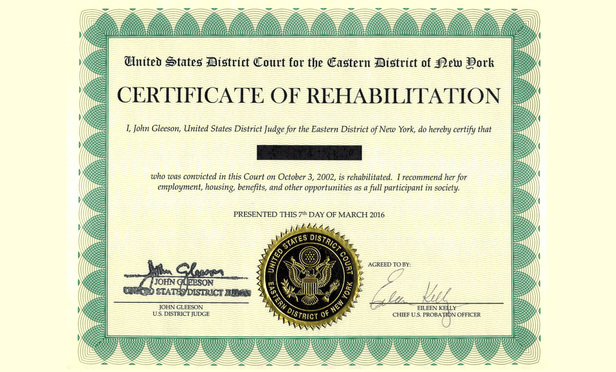
The New York Law Journal published an article over the weekend about the “novel relief” provided by the federal certificate of rehabilitation issued by former Judge John Gleeson on March 7, just days before he stepped down from the bench.  A reproduction of the certificate reveals its official appearance, complete with court seal and signatures of Judge Gleeson and the Chief U.S. Probation Officer. The government has until April 7 to appeal – the very day its appeal of Judge Gleeson’s expungement order in his first Jane Doe case will be argued in the Second Circuit.  The jurisdictional issues presented by the certificate order may be similar, if only because the certificate has some effect under state law.  See N.Y. Correct. Law §§ 703(7), 752, both cited in Judge Gleeson’s opinion.  It is likely that others similarly situated will apply for similar relief. The text of the NYLJ article follows: Expungement is Denied, But Court Offers Novel Relief Andrew Keshner, New York Law Journal 2016 While a federal judge declined to expunge a woman’s fraud conviction, he devised his own certificate meant to prove her rehabilitation to employers, landlords and others. Eastern District Judge John Gleeson said he could not provide Jane Doe with her sought-after remedy of expunging her 2002 conviction, but gave her a “lesser form of relief” through his issuance of a certificate of rehabilitation where he said he recommended Doe “for employment, housing, benefits and other opportunities as a full participant in society.” Though certificates of rehabilitation exist in New York and several other states and are generally meant to relieve certain licensing, employment and benefit barriers that attach to convictions, there is no statutory counterpart in the federal system. In Doe v. United States of America, 15-mc-1174, Gleeson said the certificate, also signed by the Eastern District’s chief probation officer, memorialized his conclusions for Doe’s future employers. “I hope they will give my careful consideration of Doe’s current suitability for employment significant weight, and conclude that it far outweighs the effect of her aberrant criminal conduct all those years ago,” Gleeson wrote in his March 7 decision, just days before he stepped down from the bench to join Debevoise & Plimpton. And if Doe’s attorneys chose to seek a presidential pardon, “I believe the certificate will help her make a strong case.” “The federal system has much to gain from adopting a certification system similar to those states,” Gleeson wrote. The 32-page ruling is not Gleeson’s first analysis of the jurisprudence surrounding expungement. Though the petitioner in the current matter was able to find intermittent nursing work and start her own cleaning business, Gleeson last year granted expungement to another woman whose job prospects were crippled following her conviction for a minor role in a fraud scheme. Gleeson said at the time that he “sentenced her to five years of probation supervision, not to a lifetime of unemployment” (NYLJ, June 3, 2015). Prosecutors in the Eastern District U.S. Attorney’s Office are appealing the decision. The U.S. Court of Appeals for the Second Circuit is scheduled to hear arguments on April 7. Other judges have wrestled with expungement requests. For example, Gleeson’s Eastern District colleague, Judge Raymond Dearie, said he regretted he could not erase the conviction of a woman who “turned her life around” and urged prosecutors, judges and Congress to re-think expungement laws (NYLJ, Oct. 15, 2015). In the current case before Gleeson, Doe was passenger in a staged car accident scheme. In 2002, a jury found her guilty of conspiring to commit and committing health care and mail fraud. Doe’s adjusted income was less than $15,000 in the two years before the offense, according to her pre-sentence report. She was also raising two children by herself with $80 a week in child support from the father. Gleeson ultimately imposed an 11-month sentence and almost $7,500 in restitution. When Doe was released from prison in 2004, she went through periods of employment and unemployment in the nursing field. Due to the conviction, her state nursing license was suspended in 2006 for two years, with the second year stayed, as well as two years of probation. When the suspension ended, Doe went back to work. Gleeson noted that Doe applied unsuccessfully to a number of nursing agencies, some of which mentioned the conviction, but others did not. In 2014, Doe started her own house-cleaning business and managed to make some money while she applied to other nursing agencies. Doe first moved to expunge the conviction in 2008 and Gleeson denied the bid. In 2013, he denied her effort to vacate the conviction. Doe filed the instant bid last year, invoking Gleeson’s prior expungement decision, which he had released approximately a month earlier. “The government might have responded by engaging in an effort to help Doe seek employment,” said Gleeson, noting how other U.S. Attorney’s offices across the country were taking steps like hosting employment fairs and holding community re-entry forums. But the prosecution instead opted to oppose, Gleeson said. He invited attorney Margaret Colgate Love, co-author of “Collateral Consequences of a Criminal Conviction: Law, Policy and Practice” to submit an amicus brief addressing issues including whether he was authorized to enter a certificate of rehabilitation. In the filing, Love, represented by Jones Day, said while there was no federal law permitting the issuance of a federal certificate of rehabilitation, there were “two mechanisms, each perhaps underappreciated but with deep historical roots, by which the court may recognize an individual’s rehabilitation.” One was a so-called writ of audita querela, enabling the reopening of a judgment in “extraordinary circumstances” through the All Writs Act of 1789. The other was the recommendation of a clemency grant to the president. In his ruling, Gleeson said there was “no reason to issue such a writ here because Doe has not requested that I vacate her judgment entirely, but rather that I delete the record of it.” He also waved off the prosecution’s argument that he lacked the jurisdiction to hear the motion. He noted the Second Circuit’s expungement standard said it should be used only for “the unusual or extreme case” —a standard that “unfortunately” was not met here. He said there were reasons apart from the conviction that Doe lost jobs or had been declined offers “including patient complaints and the usual ebb and flow of clientele.” Though acknowledging she “struggled considerably,” Gleeson said he was not clear how expungement would significantly help her. Her conviction would st Read more

Judge Gleeson issues a “federal certificate of rehabilitation”

In his final week on the bench, in an opinion that may in time prove among his most influential, U.S. District Judge John Gleeson issued a “certificate of rehabilitation” to a woman he had sentenced 13 years before.  See Jane Doe v. United States, No. 15-MC-1174 (E.D.N.Y., March 7, 2016) (Jane Doe II).  The opinion breaks new ground in holding that federal courts have authority to mitigate the adverse effects of a criminal record short of complete expungement.  Along the way, it confirms that a district court may use its inherent equitable powers to expunge convictions in “extreme circumstances,” an issue now on appeal to the Second Circuit in Judge Gleeson’s earlier expungement case.  (Jane Doe I has been calendared for argument on April 7.)  The opinion also finds a role for federal probation to play, including under New York State’s “robust” certificate system, which lifts mandatory state law bars to employment and other opportunities.  It does all of this in a manner that should make it hard for the government to appeal, since “this court-issued relief aligns with efforts the Justice Department, the President, and Congress are already undertaking to help people in Doe’s position shed the burden imposed by a record of conviction and move forward with their lives.”     Joe Palazzolo at the Wall Street Journal blog noted that   More than a dozen states and the District of Columbia issue certificates to certain ex-offenders who have shown their days of crime are behind them, usually by remaining offense-free for a long stretch. . . . .  There is no equivalent federal certificate. So Judge Gleeson invented his own. Judge Gleeson summarized his opinion as follows: I conclude that while Doe has struggled considerably as a result of her conviction, her situation does not amount to the “extreme circumstances” that merit expungement.  That said, I had no intention to sentence her to the unending hardship she has endured in the job market. I have reviewed her case in painstaking detail, and I can certify that Doe has been rehabilitated. Her conviction makes her no different than any other nursing applicant. In the 12 years since she reentered society after serving her prison sentence, she has not been convicted of any other wrongdoing. She has worked diligently to obtain stable employment, albeit with only intermittent success. Accordingly, I am issuing Doe a federal certificate of rehabilitation.   Judge Gleeson sees a constitutional dimension to the collateral consequences of conviction, and a corresponding obligation of sentencing courts to relieve them: There is no longer a need to deprive Doe of her liberty interests in the way collateral consequences imposed by the law have been doing. As her sentencing judge, I owe it not only to Doe, but to her family and community, to do my part to lift any remaining hardship on her. His opinion compares the “forgetting” model, exemplified by expungement, with the “forgiveness” model, which “acknowledges the conviction but uses a certificate of rehabilitation or a pardon to symbolize society’s forgiveness of the underlying offense conduct.”  It points out that “it is not clear to me that expungement would significantly help Doe, as her conviction will still appear on her nursing license and in private criminal record databases.” The forgiveness model, which preserves the public record of a conviction, is gaining favor in the reentry community for both functional and philosophical reasons. . . . Where expungement relief is unavailable or otherwise unhelpful, I believe a certificate of rehabilitation can significantly alleviate the collateral effects of a criminal record by emitting a powerful signal that the same system that found a person deserving of punishment has now found that individual fit to fully rejoin the community. Judge Gleeson reviews the certificate schemes enacted by many states, including the one adopted in Illinois through the efforts of then-State Senator Obama, and concludes that “t]he federal system has much to gain from adopting a certification system similar to those in certain states.”  If authorized by law, a federal certificate would not only evidence rehabilitation, it could also lift mandatory collateral sanctions. The opinion describes the key role a sentencing court can play in encouraging prospective employers and others to give a person with a criminal record a second chance: Most prospective employers do not have the time or resources to gain a comprehensive understanding of who Doe is, and then to figure out what weight, if any, her conviction should play in the hiring process. So I have done that for them. I have reviewed each page of Doe’s trial transcript, presentence report, probation reports, deposition transcript, and other documents she and the government provided to me for a holistic view of her character and competency today. I find that there is no relationship between Doe’s conviction and her fitness to be a nurse. See N.Y. Correct. Law § 752 (prohibiting the denial of employment unless there is a “direct relationship” to the offense of conviction or “the employment would involve an unreasonable risk to property or to the safety or welfare of specific individuals or the general public”); N.Y. Exec. Law § 296(15) (making unlawful the denial of employment due to a finding of moral character based on a criminal conviction). Any legitimate impact that her fraudulent actions more than 15 years ago may have had on her suitability for employment no longer exists. Jane Doe is rehabilitated. Appended to the opinion is an actual certificate, presumably designed in Judge Gleeson’s chambers, which embodies the court’s recommendation “that she be welcomed to participate in society in the ways the rest of us do.”  Moreover, “[i]f her attorney decides to make an application for a pardon from the President, I believe the certificate will help her make a strong case.”  If other federal courts accept Judge Gleeson’s invitation to engage in post-sentence record-mitigation efforts, it could be as significant for collateral consequences in federal cases as Booker was for federal sentencing.  Read more

50-state guide to expungement and sealing laws

The 50-state chart of judicial relief mechanisms from the NACDL Restoration of Rights Resource, which is also posted on this site, is a comprehensive survey of all authorities for judicial relief in the states and federal system. We wanted to bring it to our readers’ attention in light of the new federal interest in helping individuals with a criminal record overcome barriers to employment and licensing through clearing their records. The National Clean Slate Clearinghouse, recently announced as part of President Obama’s reentry initiative, will “provide technical assistance to local legal aid programs, public defender offices, and reentry service providers to build capacity for legal services needed to help with record-cleaning, expungement, and related civil legal services.” This joint project of the Labor and Justice Departments will doubtless make it a first priority to survey the laws providing judicial and other relief in different states, to determine what sort of assistance lawyers will need to neutralize the adverse employment consequences of conviction, though the courts or otherwise.  We hope these resources will prove useful in that effort. Note that terminology and procedure differ significantly from state to state, so that those interested in more specific information about the scope, operation and effect of a particular state’s laws should consult the state-by-state profiles accessible through the Resources tab on the home page of this site.  For example, while the term “expungement” may involve destruction of records in a few states (e.g., Pennsylvania), more frequently it means a limited restriction on public access to records.  For example, in Kansas certain employers and licensing agencies continue to have access to criminal records notwithstanding an expungement order from the court.  In Indiana “expungement” entails no limit of public access at all — although some records may be sealed after expungement.  In some states a judicial set-aside or vacatur involves a sealing of the record (e.g., Michigan, Washington) but in others it doesn’t (e.g., California).  Most jurisdictions authorize sealing or expungement of non-conviction records upon petition to the court. In the past few years a number of states have modified their provisions for sealing or expungement of records, but most of these new laws reach only minor offenses or non-conviction records, and frequently involve long eligibility waiting periods that defeat their usefulness for reentry purposes. Conspicuous exceptions are the comprehensive new judicial relief schemes enacted in Indiana and Minnesota, and Arkansas’ reorganization and expansion of its existing expungement laws. A few states, notably Kansas and Utah, have broad expungement laws dating from the 1970s. Note that there is no statute providing for expungement of federal convictions, and almost no authority to limit access to non-conviction records — a circumstance that has led several federal sentencing courts to consider expungement through their ancillary jurisdiction. The most well-known of these cases is U.S.v. Jane Doe, now on appeal in the Second Circuit, in which Judge John Gleeson ordered expungement of a fraud conviction of a woman he had sentenced 13 years before.  (Briefs in the Doe case are available here.) Read more