*Update (3/31/20): the Eleventh Circuit has denied Florida’s petition for rehearing en banc. A decision yesterday from the U.S. Court of Appeals for the Eleventh Circuit is a major victory for voting rights and criminal justice reform advocates. It has the potential to dramatically expand access to the ballot for people with felony convictions in Florida. The decision concerns Florida’s 2018 ballot initiative Amendment 4, which restored the vote to state residents who have completed the terms of their sentence, which includes fines, fees, and restitution imposed by the court. The appeals court’s decision held that Florida may not deny the vote to individuals who can demonstrate that they are genuinely unable to pay outstanding court debt. The decision also called into question the very requirement that financial penalties must be satisfied in order to regain the vote under Amendment 4, and potentially similar requirements in several other states.
Read moreTag: Eleventh Circuit
Restoration of Rights Project (RRP)
- Loss & restoration of civil/firearms rights
- Pardon policy & practice
- Expungement, sealing & other record relief
- Criminal record in employment, licensing & housing
RRP: State-By-State Guides
RRP: 50-State Comparisons
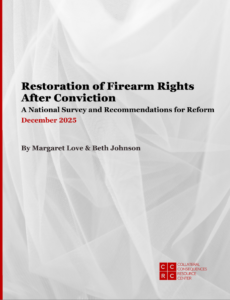
Restoration of Firearm Rights After Conviction: A National Survey and Recommendations for Reform (Dec. 2025)

50-state comparisons
About the Restoration of Rights Project
The Restoration of Rights Project (RRP) is a project of the Collateral Consequences Resource Center in partnership with the National Association of Criminal Defense Lawyers, National Legal Aid & Defender Association, National HIRE Network, Association of Prosecuting Attorneys, and Paper Prisons Initiative. Launched in 2017, the RRP is an online resource containing detailed state-by-state analyses of the law and practice in each U.S. jurisdiction relating to restoration of rights and status following arrest or conviction. Jurisdictional “profiles” cover areas such as loss and restoration of civil rights and firearms rights, judicial and executive mechanisms for avoiding or mitigating collateral consequences, and provisions addressing non-discrimination in employment, licensing, and housing. In addition to the jurisdictional profiles, RRP materials include a set of 50-state comparison charts that make it possible to see national patterns in restoration laws and policies. Short “postcard” summaries of the law in each state serve as a gateway to the more detailed information in the profiles, and provide a snapshot of applicable law in each state.
Originally published in 2006 by CCRC Executive Director Margaret Love, the research in the RRP has been kept up to date and substantially expanded over the years, and it is summarized in an appendix to the treatise on collateral consequences published jointly by NACDL and Thompson Reuters (West). It is intended as a resource for practitioners in all phases of the criminal justice system, for courts, for civil practitioners assisting clients whose court-imposed sentence has exposed them to additional civil penalties, for policymakers and advocates interested in reentry and reintegration of convicted persons, and for the millions of Americans with a criminal record who are seeking to put their past behind them.
These resources may be republished as long as appropriate attribution is given to the RRP as its source.