Tag: Doe

“Invisible Stripes: The Problem of Youth Criminal Records”

This is the title of a paper by Professor Judith McMullen of Marquette University Law School.  Professor McMullen points out that “the efforts of today’s young people to ‘go straight’ are hampered by nearly unlimited online access to records of even the briefest of encounters with law enforcement, even if those encounters did not result in conviction.”  She argues that “we need to restrict access to and use of information about contacts that offenders under the age of 21 have had with the criminal justice system.”

CCRC’s forthcoming study of how jurisdictions manage non-conviction records underscores the points made in this article.  It may come as a surprise to many that few jurisdictions automatically limit public access to and use of non-conviction records, and in fact many facilitate both through mass on-line posting of records – including arrests that never result in charges.  Even states that authorize courts to seal or expunge non-conviction records frequently impose daunting barriers to this relief, including financial barriers.  A decision of the Iowa Supreme Court last month, upholding a law conditioning expungement of dismissed charges on an indigent defendant’s payment of court-appointed attorney fees, vividly illustrates this access to justice problem that squarely frustrates efforts at reintegration.  There are a number of studies underway of the adverse effect of court debt on reentry, but none that we know of linking court debt to the operation of “clean slate” laws.

Read more
Federal expungement order reversed on appeal

In an eagerly awaited decision, a panel of the Second Circuit Court of Appeals has ruled that federal courts have no authority to expunge the records of a valid conviction.  As Joe Palazzolo at the Wall Street Journal noted, this effectively “put an end to an experiment by a Brooklyn judge that drew attention to the challenges people with criminal records face trying to find and keep jobs.”  In reversing Judge John Gleeson’s May 2015 expungement order in the case of a woman he had sentenced more than a decade before, the court distinguished its precedent upholding a court’s power to expunge arrest records following dismissal of charges.  The panel pointed out that

a motion to expunge records of a valid conviction on equitable grounds will ordinarily be premised on events that are unrelated to the sentencing and that transpire long after the conviction itself.  For example, in this case the facts underlying the District Court’s sentencing were clearly independent of the facts developed in Doe’s motion filed years later.  Conversely, the District Court granted Doe’s motion based on facts and events (her repeated efforts to obtain employment) that transpired years after her sentencing and term of probation.

Read more

“A Federal Judge’s New Model for Forgiveness”

New York Times
By

Read more

Gleeson Certificate enters “uncharted waters”

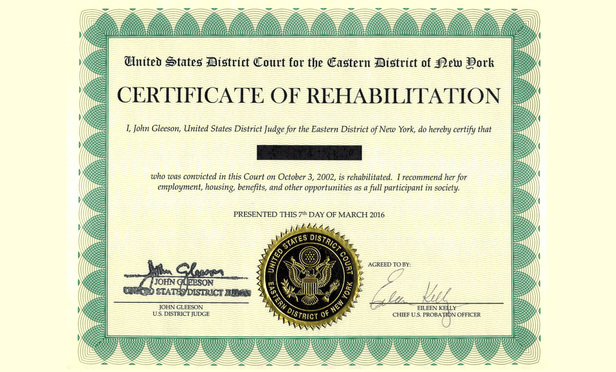
The New York Law Journal published an article over the weekend about the “novel relief” provided by the federal certificate of rehabilitation issued by former Judge John Gleeson on March 7, just days before he stepped down from the bench.  A reproduction of the certificate reveals its official appearance, complete with court seal and signatures of Judge Gleeson and the Chief U.S. Probation Officer.

certificate-of-rehabilitation

The government has until April 7 to appeal – the very day its appeal of Judge Gleeson’s expungement order in his first Jane Doe case will be argued in the Second Circuit.  The jurisdictional issues presented by the certificate order may be similar, if only because the certificate has some effect under state law.  See N.Y. Correct. Law §§ 703(7), 752, both cited in Judge Gleeson’s opinion.  It is likely that others similarly situated will apply for similar relief.

Read more

Judge Gleeson issues a “federal certificate of rehabilitation”

In his final week on the bench, in an opinion that may in time prove among his most influential, U.S. District Judge John Gleeson issued a “certificate of rehabilitation” to a woman he had sentenced 13 years before.  See Jane Doe v. United States, No. 15-MC-1174 (E.D.N.Y., March 7, 2016) (Jane Doe II).  The opinion breaks new ground in holding that federal courts have authority to mitigate the adverse effects of a criminal record short of complete expungement.  Along the way, it confirms that a district court may use its inherent equitable powers to expunge convictions in “extreme circumstances,” an issue now on appeal to the Second Circuit in Judge Gleeson’s earlier expungement case.  (Jane Doe I has been calendared for argument on April 7.)  The opinion also finds a role for federal probation to play, including under New York State’s “robust” certificate system, which lifts mandatory state law bars to employment and other opportunities.  It does all of this in a manner that should make it hard for the government to appeal, since “this court-issued relief aligns with efforts the Justice Department, the President, and Congress are already undertaking to help people in Doe’s position shed the burden imposed by a record of conviction and move forward with their lives.”    

Joe Palazzolo at the Wall Street Journal blog noted that  

More than a dozen states and the District of Columbia issue certificates to certain ex-offenders who have shown their days of crime are behind them, usually by remaining offense-free for a long stretch. . . . . 

There is no equivalent federal certificate. So Judge Gleeson invented his own.

Read more