Tag: collateral consequences

Model law proposes automatic expungement of non-conviction records

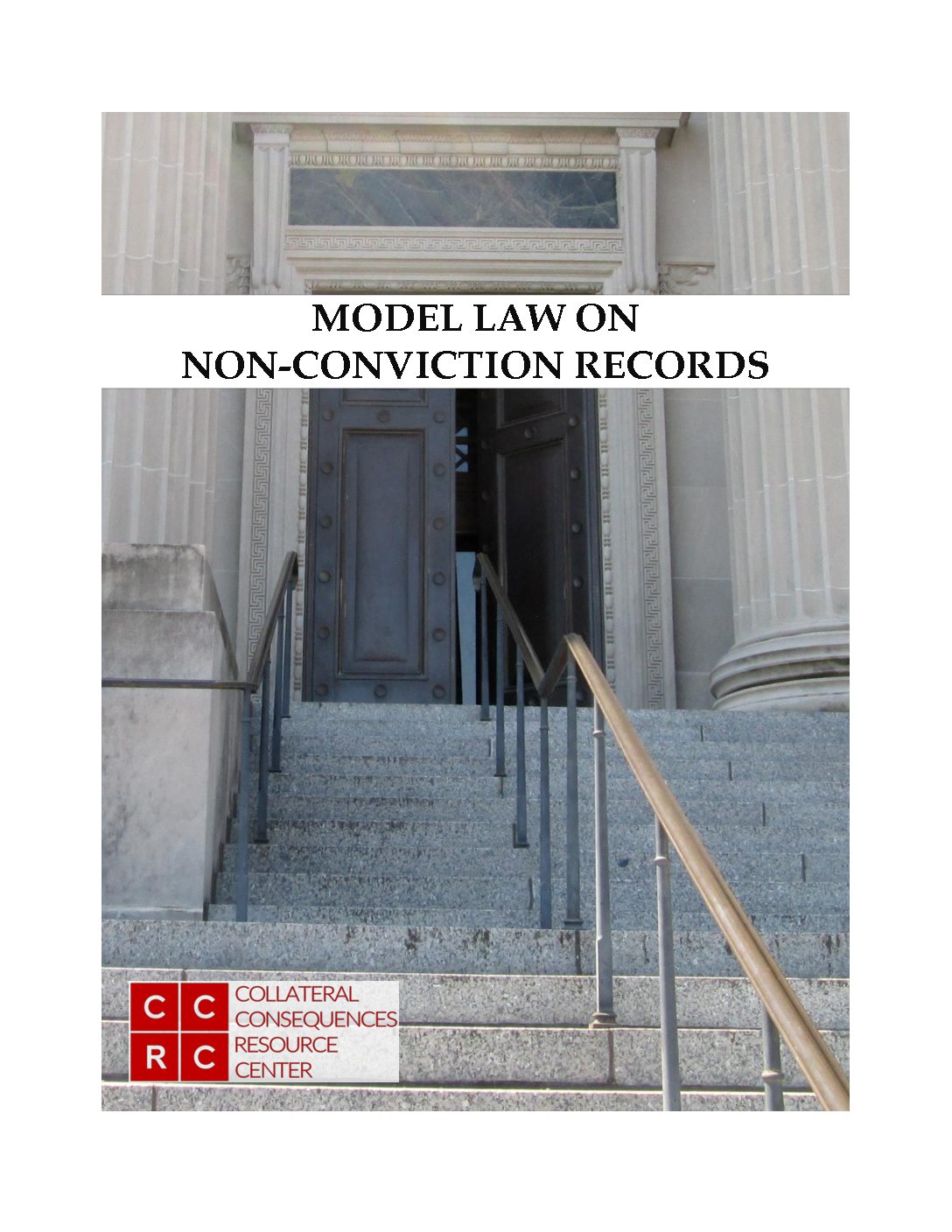
An advisory group drawn from across the criminal justice system has completed work on a model law that recommends automatic expungement of most arrests and charges that do not result in conviction.  Margaret Love and David Schlussel of the Collateral Consequences Resource Center served as reporters for the model law.  It is available in PDF and HTML formats. “Many people may not realize how even cases that terminate in a person’s favor lead to lost opportunities and discrimination,” says Sharon Dietrich, Litigation Director of Community Legal Services of Philadelphia, and one of the advisors of the model law project.  “Over the years, my legal aid program has seen thousands of cases where non-convictions cost people jobs.” In proposing broad restrictions on access to and use of non-conviction records, the project aims to contribute to conversations underway in legislatures across the country about how to improve opportunities for people with a criminal record.  Already in 2019, states have enacted more than 130 new laws addressing the collateral consequences of arrest and conviction.  The group regards its model as the first step in a broader law reform initiative that will address conviction records as well. Law enforcement officials make over 10 million arrests each year, a substantial percentage of which do not lead to charges or conviction.  Records of these arrests have become widely available as a result of digitized records systems and a new commerce in background screening and data aggregation.  These checks often turn up an “open” arrest or charges without any final disposition, which may seem to an employer or landlord more ominous than a closed case. Very few states have taken steps to deal with the high percentage of records in repositories and court systems with no final disposition indicated.  Paul McDonnell, Deputy Counsel for New York’s Office of Court Administration and a project advisor, noted: “Criminal records that include no final disposition make it appear to the untrained eye that an individual has an open, pending case, which can have serious results for that person. New York has recently made legislative progress in addressing this problem, though more can be done.” Current state and federal laws restricting access to and use of non-conviction records have limited application and are hard to enforce.  Eligibility criteria tend to be either unclear or restrictive, and petition-based procedures tend to be burdensome, expensive, and intimidating.  In recent years, lawmakers and reform advocates have expressed a growing interest in curbing the widespread dissemination and use of non-convictions, leading some states to simplify and broaden eligibility for relief, reduce procedural and financial barriers to access, and in a handful of states to make relief automatic. Rep. Mike Weissman, a Colorado State Representative and model law project advisor, noted that Colorado has recently overhauled its laws on criminal records with broad bipartisan support.  “It is heartening to see similar reforms underway in other states, both red and blue, as well.  I commend the practitioners and researchers who helped formulate the model law for illustrating avenues for further progress in reducing collateral consequences.” The model law would take this wave of criminal record reforms to a new level.  It recommends that expungement be immediate and automatic where all charges are terminated in favor of an accused.  Uncharged arrests should also be automatically expunged after a brief waiting period, as should dismissed or acquitted charges in cases where other charges result in conviction.  Cases that indicate no final disposition should also be expunged, unless there is indication that they are in fact pending. The model law also recommends that expunged non-conviction records should not be used against a person in a range of criminal justice decisions, including by law enforcement agencies.  It would prohibit commercial providers of criminal background checks from disseminating expunged and dated non-conviction records, and civil decision-makers from considering them. David LaBahn, President of the national Association of Prosecuting Attorneys, indicated that organization’s support for the model law, stating that the collateral consequences of non-convictions “do not serve to make the community safer,” and that “the current structures in place to expunge a non-conviction record can be confusing and difficult for the layperson to navigate alone.” This model law sets the stage for jurisdictions to address record relief for convictions more generally, and its structure and principles can be brought to bear on that important work. The Collateral Consequences Resource Center organized this model law project.  An early draft of the model law was discussed at an August 2019 Roundtable conference at the University of Michigan that was supported by the Charles Koch Foundation.  The model law report was supported by Arnold Ventures. Read the model law in PDF or HTML. Read more

Legislative update: third quarter 2019 sees more new licensing and expungement laws

In July we reported on the extraordinary number of new laws enacted in the first half of 2019 aimed at restoring rights and status after arrest and conviction.  A total of 97 separate pieces of legislation, some covering multiple topics, were enacted by 38 states and many broke new ground in their jurisdictions.  Moreover, clear trends begun in 2018 accelerated in the first half of 2019, as state lawmakers continued to focus most of their attention on facilitating access to record-clearing.  In addition, a significant number of new laws limited the authority of occupational licensing boards to disqualify a person based on criminal record.  Another area of progress was restoring voting rights. Those trends continued over the summer, with 17 new laws, including significant laws enacted to regulate occupational licensing and expand record relief, including but not limited to marijuana convictions.  Several states showed a keen interest in exploring the possibility of automating record relief, although only one state actually enacted an automatic relief system by the end of the quarter (New York, for marijuana convictions).  (California enacted a “clean slate” law shortly after the beginning of the fourth quarter.)  At the end of the third quarter, Arkansas, Colorado and Florida were studying the feasibility of automating relief, North Carolina was considering automatic expunction of non-conviction records, and the Governor of New Jersey was attempting to persuade his legislature to adopt an automated system for convictions as well as non-convictions.) By the end of the third quarter of 2019, 42 states had enacted an unprecedented total of 114 laws restoring rights and status, and more new laws on the horizon. All of the laws described briefly below are more fully analyzed in the context of the state’s overall restoration scheme, in the detailed profiles of the Restoration of Rights Project. Occupational licensing Florida and North Carolina enacted impressive occupational licensing schemes.  Florida’s new licensing provisions added by H7125 appear targeted to trades learned in the state prison system, and also provide that: “A conviction, or any other adjudication, for a crime more than 5 years before the date the application is received by the applicable board may not be grounds for denial of a [specified] license.”  Boards are permitted to consider violent and sexual offenses but only if they “relate to the practice of the profession.”  Starting on October 1, 2019, and updated quarterly thereafter, the boards must compile a list identifying each crime used as a basis for a license denial. North Carolina’s new law prohibits disqualification from licensure unless a crime is “directly related” to the license involved, requires written reasons in the event of denial, and provides for a preliminary determination as to whether an individual will be favorably considered that is binding on the board when the applicant later applies.  The new law also requires licensing boards to report annually to the legislature on their consideration of applications from people with a criminal record. In New Hampshire, HB 637 created two categories of criminal history information to be maintained by the state police records repository, one “confidential” and the other “public.”  “Confidential criminal history information” (defined to include non-conviction records and records of convictions that have been annulled) will no longer be disseminated for employment and licensing purposes.    Sealing and expungement Florida substantially reorganized its laws relating to sealing and expungement of non-conviction records in H7125, and the Department of Law Enforcement was directed to create an automatic process for sealing eligible non-conviction records.  See Fla. Stat. § 943.0595. Four states (DE, HI, NH and NY) passed laws authorizing expungement or sealing of marijuana possession convictions.  Of these new laws, New York’s law setting up an automated relief system is by far the most significant, because it seals the record without requiring eligible individuals to apply to the court for relief.  Individuals whose records are sealed may, further, apply later to have the record destroyed.  As an important recent study by JJ Prescott and Sonja Starr established, where laws make relief depend upon a burdensome petition process, few eligible individuals will take advantage of them.  (As the third quarter ended, a far broader “clean slate” bill was poised for enactment in California, and was signed on October 7.) Relatedly, in August, New Jersey’s governor Phil Murphy refused to sign a bill substantially expanding expungement in that state, which included but was not limited to marijuana convictions, on grounds that its cumbersome petition process did not go far enough in addressing the problem of dated convictions.  The governor cited with approval the “clean slate” law enacted by New Jersey’s neighboring state Pennsylvania, and proposed a series of measures aimed at developing a similar automated system in his state.  As of this writing, the governor has been unable to persuade the legislature to adopt it, but we may expect to see another pass at the problem before year’s end. Two more states (HI and NC) expanded their provisions offering record relief to victims of human trafficking convicted of any non-violent offense linked to their victim status. Civil rights Finally, New Hampshire revised its law disqualifying people with a conviction from holding public office, making the restriction applicable only during actual incarceration, so that it is now coincident with the period of felony disenfranchisement (this limit on disenfranchisement to only during actual incarceration has been in place in the Granite State since 1965). Perhaps more significant, HB 486 requires the commissioner of the department of corrections to ensure that probation/parole officers receive instruction on the current state of the law regarding the civil rights of individuals convicted of a felony, and to direct that individuals serving a suspended sentence or on parole receive “written notice that he or she may vote during the period of the suspension or parole.” Similar provisions were enacted earlier in the year in Colorado and Washington.  In our experience, many people who have been convicted of a felony believe that they cannot vote long after their rights have been restored – and some (like those in New Hampshire not sentenced to prison) never lost the right to vote in the first place.     Read more

“Old Writ Could Give Ex-Offenders a New Start”

Joe Palazzolo has posted at the Wall Street Journal Blog an article describing an amicus brief filed yesterday in United States v. Jane Doe (Jane Doe II), one of two federal expungement cases before Judge John Gleeson that we’ve been following.  Argument in Jane Doe II is now scheduled for October 26.  (The government has appealed Judge Gleeson’s May 21 expungement order in Jane Doe I to the Second Circuit Court of Appeals.)  The brief begins like this: This Court invited the views of Amica on the Court’s authority to issue “a certificate of rehabilitation in lieu of expungement” and the appropriateness of issuing such a certificate in this case. While there is no federal statute that authorizes a court to issue relief styled as a “certificate of rehabilitation,” Amica wishes to bring to the Court’s attention two mechanisms, each perhaps underappreciated but with deep historical roots, by which the Court may recognize an individual’s rehabilitation and otherwise address issues such as those raised by petitioner’s case. The first is by exercising its statutory authority to issue a writ of audita querela, which is available in extraordinary circumstances under the All Writs Act, 28 U.S.C. §1651, to grant a measure of relief from the collateral consequences of conviction. The second is by recommending to the President that he grant clemency. The blog post describing the brief is reprinted in full after the jump. October 9, 2015 Old Writ Could Give Ex-Offenders a New Start by Joe Palazzolo A federal case in Brooklyn may offer a solution for some ex-offenders struggling to find work because of their criminal convictions. Most states permit certain types criminal records to be expunged, sealed or otherwise concealed from public view. Some allow ex-offenders to seek certificates of rehabilitation that exempt them from felony-related sanctions such as those barring people with criminal records from obtaining professional licenses. But in the federal system, which has nothing akin to expungement or a certificate program, convictions can mark people for life, compromising their prospects for jobs and housing, among other things. Many believe such consequences are an appropriate deterrent. A growing number of policymakers, judges and law enforcement officials, however, question the wisdom of limiting job opportunities for ex-offenders, who are less likely to return to prison when they find stable employment, research shows. Margaret C. Love, a former Justice Department pardon attorney, and a group of lawyers from Jones Day LLP have dusted off an 18th century law that they believe has a modern application for ex-offenders who have served their time but face obstacles related to their convictions. Part of the 1789 All Writs Act, the writ of audita querela allows courts to relieve the consequences of an otherwise valid judgment. It was used by debtors against creditors in the nation’s early days, but federal and state courts have more recently recognized the writ’s usefulness in other cases, including when a criminal conviction “gives rise to a subsequent injustice,” the lawyers wrote in a brief filed Friday in federal district court in Brooklyn. Ex-offenders could make a strong case for audita querela relief when a law or regulation strips them of a right to which they otherwise would be entitled, the brief said. For instance, a conviction-based restriction that results in job loss could violate due process rights by depriving an ex-offender of a fundamental property interest. Losing the ability to possess a gun as a result of a conviction could violate the Second Amendment. “In such a case, a person convicted of an applicable crime would have a legal or, technically, constitutional objection to the continued enforcement of the judgment, thereby meeting the requirements for audita querela relief,” the brief said. Ex-offenders could also seek relief under the writ “where the totality of the circumstances make continued enforcement of the judgment, in whole or in part, unjust,” the lawyers wrote. Courts could grant their requests by vacating convictions or issuing orders lifting sanctions against ex-offenders. The brief was filed at the invitation of U.S. District Judge John Gleeson in a case involving a woman convicted of health-care fraud who is seeking to have her record expunged. Judge Gleeson expunged the conviction of another defendant in the scheme earlier this year, in what legal experts said was the first instance of a federal judge erasing a criminal record on the grounds that it interfered with employment. The Justice Department is appealing his order in that case. The woman in the latest case, identified as 56-year-old Jane Doe in court documents, drove a car in a staged collision and claimed to have received medical services, as part of a scheme to collect insurance money. She was sentenced in 2003 to 15 months in prison, and her nurse’s license was suspended for two years. Her criminal record has prevented her from maintaining employment, she said in her June petition. The Justice Department disputed that federal judges can erase convictions for “equitable reasons,” such as difficulty finding work, and even if they could, her case wouldn’t merit it, prosecutors said in court documents. No federal appeals court has held that judges have the power to expunge valid convictions absent “extreme circumstances,” the department said. Read more